



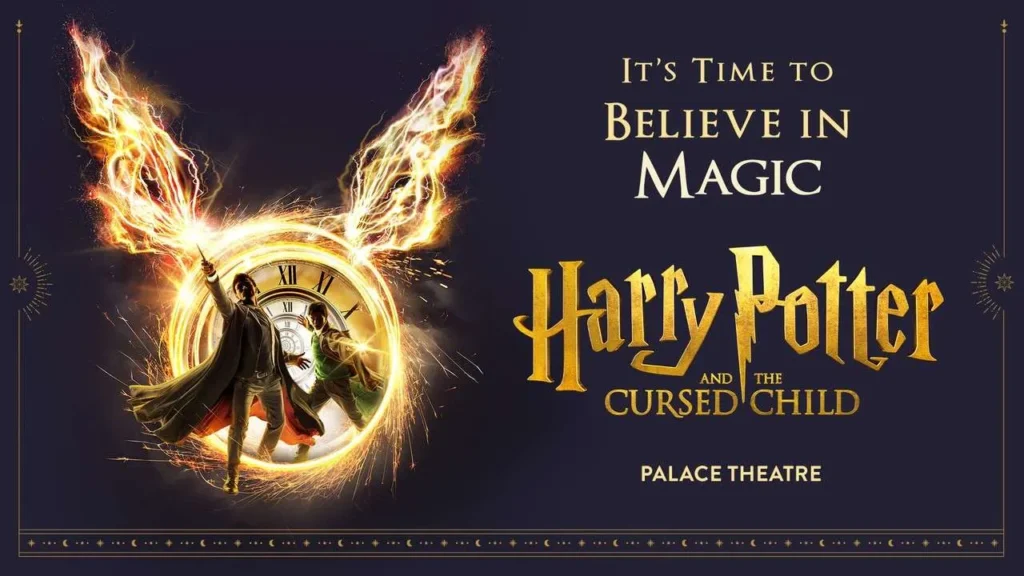
Harry Potter and the Cursed Child has spent a decade making the Palace Theatre the most photographed front-of-house in London, and 2026 is its last full year as the original two-part epic. From October it morphs into a single-evening rewrite. Which makes this Harry Potter and the Cursed Child review as much a deadline reminder as a verdict — if you’ve been putting off the five-hour version, the clock is now visible.
Last updated: 6 May 2026.
What follows is the considered take of the London Reviews team — current cast (a fresh company moved in last October), seat-by-seat advice for a 1,400-capacity Cambridge Circus venue that punishes the wrong booking choice, ticket strategy for a show that still releases £40 weekly drops, and the honest answer to the question every potential booker is now Googling: should I see Parts One and Two before they’re gone, or wait for the new one-parter?
At a Glance: Harry Potter and the Cursed Child, Palace Theatre
| Show | Harry Potter and the Cursed Child Parts One & Two |
|---|---|
| Genre | Play with magic illusions; family fantasy drama |
| Venue | Palace Theatre, London |
| Address | 113 Shaftesbury Avenue, London W1D 5AY |
| Two-part run | Booking until 20 September 2026 |
| One-part rewrite | From 9 October 2026 (booking through 27 June 2027) |
| Running time (two-part) | Part One: 2h 40m (with 20-min interval). Part Two: 2h 25m (with 20-min interval). Total stage time: just over 5 hours. |
| Running time (one-part, from October) | 2h 55m including one interval |
| Age recommendation | 10+ (under-5s not admitted; under-15s must be accompanied by an adult) |
| Current lead cast (from 15 October 2025) | Joshua Sullivan (Albus Potter), Kai Spackman (Scorpius Malfoy), David Ricardo-Pearce (Harry Potter), Claire Lams (Ginny Potter), Oliver Boot (Draco Malfoy), Thomas Aldridge (Ron Weasley), Naana Agyei-Ampadu (Hermione Granger), Tamia-Renée Alexandra (Rose Granger-Weasley) |
| Director | John Tiffany |
| Writer | Jack Thorne (story by J.K. Rowling, Jack Thorne and John Tiffany) |
| Movement | Steven Hoggett |
| Set design | Christine Jones |
| Producer | Sonia Friedman, Colin Callender and Harry Potter Theatrical Productions |
| Ticket prices (two-part) | From £15 per part (restricted view); standard £49.50–£135 per part; premium up to around £225 per part. £40 Friday Forty drop = £20 per part for next-week performances. |
| Where to book | Official site, TodayTix, londontheatre.co.uk, Nimax Theatres |
| Nearest Tube | Leicester Square (Piccadilly & Northern, ~3 min walk); Tottenham Court Road (Central, Northern & Elizabeth, ~5 min walk) |
| Buses | 14, 19, 24, 38, 176 along Shaftesbury Avenue and Charing Cross Road |
| TripAdvisor | 4.5/5 across more than 5,000 reviews (mixed but predominantly enthusiastic) |
| Press reception | Time Out (4★), WhatsOnStage (5★), The Stage (5★), The Guardian (5★) |
| Awards | 9 Olivier Awards (a record), 6 Tony Awards, 60+ international theatre awards, 2.2 million London audience members |
| Accessibility | Step-free entrance via Shaftesbury Avenue side; 1 large + 2 standard wheelchair spaces in Stalls (W26/W27); transfer seating; assistance dogs welcome; audio described, captioned and BSL-interpreted performances scheduled annually |
| Matinées (two-part schedule) | Most weekend “marathon” days run Part One at 14:00 and Part Two at 19:30; midweek splits the parts across two evenings |
Why we’re reviewing the Cursed Child now
Cursed Child opened at the Palace in July 2016 and turned a 19th-century music hall into a pilgrimage site. Almost ten years on, it has won more Oliviers than any production in history, banked 2.2 million London audience members, and seen off three full cast changes. October 2026 will retire the original two-part staging that defined it. From then on, Londoners and tourists will see a reimagined single-evening version running 2 hours 55 minutes — practical for a school night, but a different artistic proposition.
Plenty of long-runners we’ve covered — including Phantom of the Opera, The Lion King and Wicked — have stayed essentially the same show across decades. Cursed Child is doing something rarer: rewriting itself in front of a live audience. That makes the next four months at the Palace both the last call for the original and the most useful moment to write a verdict on it.
Our take, summarised in one paragraph: the two-part Cursed Child is the most theatrical thing of its scale in the West End, a show that spends serious money making magic on a stage rather than a screen. The book has weak patches and the second half of Part Two is busier than it needs to be. None of that should stop you booking. The illusions, the design, and the central Albus–Scorpius friendship are the West End at its most ambitious, and the production is being retired in five months. If you’re going to see it as Tiffany and Thorne first conceived it, this is the year.
The Palace Theatre: What You Need to Know Before Booking
Location and getting there
The Palace dominates the west side of Cambridge Circus, where Shaftesbury Avenue meets Charing Cross Road. Leicester Square (Piccadilly and Northern lines) is the nearest Tube — three minutes on foot via Charing Cross Road, exit by Hippodrome Casino. Tottenham Court Road (Central, Northern and Elizabeth) is the smarter choice if you’re coming from west London or Canary Wharf — five minutes down Charing Cross Road, with a far less frantic exit. From Covent Garden it’s a six-minute walk along Long Acre and Earlham Street.
Bus routes 14, 19, 24, 38 and 176 all stop within a minute of the theatre on Charing Cross Road and Shaftesbury Avenue. Black-cab drop-off is straightforward on Shaftesbury Avenue but can be slow at curtain-up — get out on Charing Cross Road and walk the last 30 seconds. Pedicabs hover on the corner; ignore them.
The building
The Palace was built in 1891 as the Royal English Opera House, designed by T.E. Collcutt and G.H. Holloway. Its red-brick and terracotta facade is one of the most recognisable in Theatreland. Inside, the auditorium seats roughly 1,400 across four tiers — Stalls, Dress Circle, Grand Circle and Balcony — and the rake on the upper levels is steep enough to make even short audience members feel they have a view. Andrew Lloyd Webber’s Really Useful Group owned it for years; Nimax Theatres now manages it.
Seating guide — the bookings that actually matter
Cursed Child uses every inch of the Palace’s stage and circle, so seat choice matters more here than in most West End theatres. Our pick: centre Dress Circle, rows B to E. You sit slightly above the action, the staircases that frame the show land in your sightline beautifully, and the magic effects — most of which are designed for a head-on viewing angle — read at full strength. Centre Stalls rows F to N are the orthodox premium choice and will not disappoint, but you lose a little of the staircase choreography from below.
Avoid the front three rows of the Stalls unless you’re under 12 and want to feel the smoke. The set rakes upwards and characters spend significant time on raised platforms — your neck will pay for the proximity. Grand Circle row A is a sneaky deal in the £49.50 band: the rake is steep enough to clear heads, and the show’s vertical staging works beautifully from height. Skip the Balcony if you have any choice — the legroom is brutal, sightlines lose detail, and one persistent TripAdvisor complaint is “knees rammed against the seat in front.” That’s not poetic licence, it’s structural.
Accessibility
The theatre has step-free access via the Shaftesbury Avenue side entrance, with one larger wheelchair space at W27 in the Stalls and two standard spaces at W26 and W27. Transfer seating to any aisle Stalls seat is available on request. Up to four wheelchairs can be stored. An accessible WC is by the wheelchair seating; assistance dogs are welcome in the auditorium or can be cared for by staff. Captioned, audio-described and BSL-interpreted performances run a few times a year — book direct with the access line for the free companion-ticket scheme.
Bars, food and the interval
Three bars across the levels, plus a separate Dress Circle bar that locals know is the fastest at the interval. Pre-order drinks for the 20-minute break — particularly on a marathon day, when interval drinks queues stretch back to the door. Pre-show, the smart move is The Ivy Soho Brasserie on Wardour Street (book the 5.30pm slot for a marathon Saturday) or, for cheaper but consistently good, Flat Iron Beak Street for steak and frites at £15. The pre-show steak baguette at Hawksmoor Seven Dials is a fan favourite — see our Hawksmoor review for context on the chain’s house style.
Stage door
Stage door is round the back on Greek Street. The current cast is generally good about coming out post-show on weekends, less so on Tuesday/Wednesday nights when they have a marathon to recover from. If you’re trying to spot Joshua Sullivan or Kai Spackman, the gap between Part One and Part Two on a marathon Saturday is your worst chance — they need to eat. After Part Two on Saturday evenings is your best.
The Show: What to Expect (Spoiler-Free)
Cursed Child picks up nineteen years after the events of Harry Potter and the Deathly Hallows, with Harry now an overworked Ministry official, Hermione the Minister for Magic, and Ron running a joke shop. The story follows Harry’s middle son Albus — sorted into Slytherin, struggling with the weight of his father’s legacy — and his friendship with Scorpius Malfoy, the only other student in their year nobody wants to sit next to. From there, time-turners, alternate timelines, and a properly menacing antagonist drive the plot. We’ll say no more about specifics. The production prints “Keep the Secrets” on every programme and the line genuinely matters — the structural surprises across Parts One and Two are part of the show’s contract with its audience.
Tonally it’s closer to the late Harry Potter books than the early ones. There’s wit (Scorpius is one of the funnier characters in West End repertory), but also genuine darkness — death, parental failure, the emotional cost of fame on a kid who didn’t ask for it. The themes of friendship, loss and the difficulty of living up to a parent are handled with more care than the marketing suggests.
It’s a play, not a musical. There is incidental score (Imogen Heap’s haunting compositions are now part of the show’s DNA) but no songs. Most of the magic on stage is deliberately analogue — illusions, sleight of hand, choreography by movement director Steven Hoggett — rather than projection or LED-screen video. That’s a deliberate creative choice, and it’s why the show still feels theatrical rather than cinematic a decade in.
If your reference points are the Warner Bros films, recalibrate slightly. Cursed Child is more emotionally serious and less plot-busy than the films, with longer scenes that rest on actor performance rather than set-piece spectacle. The set-pieces, when they come, are devastating.
The Cast and Performances
A fresh company joined the West End run on 15 October 2025 and is booking through to 26 July 2026. Joshua Sullivan takes over Albus Potter — the role originated by Sam Clemmett a decade ago and the role around which the entire emotional arc is built. Sullivan’s Albus is more sullen than predecessors, less prone to volume — a quieter, more recognisably teenage performance that pays off late in Part Two.
The standout, by reviewer consensus, remains Kai Spackman as Scorpius Malfoy. Scorpius has been a star-making part since Anthony Boyle won an Olivier for it in 2017, and Spackman holds his own — physical, comedically generous, and able to land the play’s emotional pivots without telegraphing them. If you’ve heard people say Cursed Child belongs to Scorpius, this cast confirms it.
David Ricardo-Pearce returns as Harry — the most thanklessly written role in the play, since the script needs Harry to be wrong about his son for two and a half hours before getting one cathartic scene. Ricardo-Pearce plays the irritability without sliding into shouting, which is harder than it looks. Claire Lams as Ginny is one of the production’s quiet pleasures; she gets fewer lines than she should but is the moral centre of nearly every scene she’s in.
Naana Agyei-Ampadu brings warmth and steel to Hermione, the third actor of colour to play the role following Noma Dumezweni and Michelle Gayle. Thomas Aldridge remains a perfect Ron — the production has wisely kept him on through this cast change. Oliver Boot‘s Draco is more wounded than supercilious, which is the right reading. Tamia-Renée Alexandra as Rose Granger-Weasley gets less stage time than the role deserves and uses every minute of it.
Casts can change. The show typically rotates leads in October each year, and understudies are credited in the printed programme — if you’re booking specifically to see one named actor, double-check the cast board on the night. Producers do not guarantee specific cast members.
Staging, Illusions and Production
Christine Jones’s set is the show’s other lead character. The Hogwarts world is built from a few movable staircases, ceiling-to-floor banners, gothic arches and a vast trunk room that opens up to become almost any location the play needs — Ministry, station, dormitory, lakeside. The cleverness is in what isn’t there: there’s almost no projection. Every transformation is mechanical, lit from above by Neil Austin’s lighting, soundtracked by Gareth Fry’s sound design. Both designers won Oliviers for it. Both deserved them.
The illusions, designed by Jamie Harrison, are the bit that makes audiences gasp audibly even on a Tuesday afternoon. Without spoiling: there are at least three sequences in Part One alone where you will not understand what you have just seen. The pacing of the magic is what makes it work — illusions arrive infrequently in early scenes, then accelerate in Part Two until the production is doing two or three impossible things per scene. By the second-act finale of Part Two, the audience is reliably losing it.
Steven Hoggett’s movement work is what holds it all together. Robes are choreographed; entrances and exits are blocked like dance numbers; transitions between scenes are themselves small set-pieces. Imogen Heap’s score — minimalist, often built around a single keyboard motif — sits underneath the whole thing without ever crowding it. The sound balance from row D of the Dress Circle is, in our view, the best in the house.
The costumes (Katrina Lindsay) deserve their own paragraph but won’t get one — suffice to say, there’s a reason they won the Tony. The Hogwarts robes are constructed for stage movement; the Death Eater costumes are properly menacing without crossing into pantomime; the small everyday details (Ron’s joke shop apron, Hermione’s Ministry blacks) are the sort of design work that makes the world feel lived in.
Tickets and Pricing: How to Book Without Overpaying
For the two-part production, official prices start at £15 per part for restricted view (column-blocked Balcony), rising through £49.50–£135 for standard seats and up to roughly £225 per part for premium central Stalls and front-Dress-Circle. A marathon day at premium pricing for two will cost north of £900. There are smarter ways.
Friday Forty is the play’s signature drop: 40 tickets at £40 (£20 per part) released every Friday at 1pm UK time via the official site, for performances the following week. Seats are spread across the auditorium — yes, including premium rows. The drop sells out in minutes; have the page open at 12.55. This is the single best-value way to see the show.
Group rates are quietly excellent: £49.50 per part in Stalls and Dress Circle for groups on Wednesday and Friday performances, and on Sundays between 7 September and 30 November. School groups can access lower rates again — book direct via the access line.
TodayTix doesn’t run a regular lottery for Cursed Child, but does sometimes have £35 same-day stalls during quieter weeks (typically January and the first three weeks of September). Worth refreshing the app at 10am if you’re in town spontaneously.
Direct booking via the official site is generally cheaper than third-party resellers because there’s no booking fee. TodayTix and londontheatre.co.uk are both legitimate and worth checking for occasional offers.
By comparison, Hamilton at the Victoria Palace currently tops out around £250 premium and £30 lottery; Wicked sits at £200 premium with £29.50 day seats; The Lion King is the cheapest of the long-runners with £30 starter seats. Cursed Child is the priciest commitment of the headline shows — but you’re buying two performances, not one.
What Audiences Actually Say: Review Analysis
TripAdvisor
Cursed Child holds a 4.5/5 average across more than 5,000 TripAdvisor reviews — placing it firmly in the top tier of West End attractions, though notably split. Roughly 70 per cent of reviews land at 5 stars, with the remainder showing the cleanest two-camp distribution we’ve seen on a long-runner: very enthusiastic or very disappointed, with comparatively few middle-ground 3-star reviews. The enthusiastic camp routinely use words like “magical”, “stagecraft I didn’t think possible” and “the best thing I’ve ever seen in a theatre”. The disappointed camp tend to be either Harry Potter book purists who object to plot choices, or audience members who booked without realising it was two parts.
Google reviews
The Palace Theatre’s Google rating sits around 4.5/5 across thousands of reviews. Show-specific Google reviews focus heavily on the design and illusions; the negative reviews mirror TripAdvisor’s themes — Balcony seat discomfort, two-part length surprise, occasional sound balance issues from the back of the Stalls.
WhatsOnStage
WhatsOnStage’s professional review awarded 5 stars on opening, calling director John Tiffany “a genius” at using stage tricks “to make The Cursed Child a deeply theatrical experience, a love letter to theatre itself.” Audience reviews on the same site average 4.7/5.
Professional critics
The critical consensus on opening was extraordinary — 5 stars from The Stage, 5 stars from The Guardian, 4 stars from Time Out, broadly positive scores across The Telegraph, Independent and Evening Standard. Time Out’s review described the production as “an absolute hoot, a joyous, big-hearted, ludicrously incident-packed and magic-heavy romp that has to stand as one of the most unrelentingly entertaining things to hit the West End.” Subsequent revisits across the years have largely confirmed those verdicts. Cursed Child is one of the rare productions where the critic and audience scores converge.
What Audiences Love Most
- The illusions. Almost every five-star review mentions a specific moment of stage magic. The bookcase, the bridge, the pool — all referenced repeatedly without spoilers, all genuinely impossible-looking from the auditorium.
- Scorpius Malfoy. The character — and whoever is currently playing him — is the single most frequently praised element. Funny, vulnerable, brave, recognisably teenage. Reviewers leave with a Scorpius-shaped hole in their lives.
- The friendship at the centre. Audience reviews repeatedly cite the Albus–Scorpius bond as the emotional heart. Several note specifically that they did not expect a play marketed on its illusions to have so much real emotional weight.
- Christine Jones’s set. The way the show moves through locations using the same physical space gets repeatedly singled out. “It looks like an impossibly big production but the set is mostly just staircases and a trunk” is a paraphrase of dozens of reviews.
- Steven Hoggett’s movement. Reviewers without theatre vocabulary describe it as “the way the actors move” — the swirling cloak choreography, the synchronised entrances, the way scenes change without you noticing.
- Imogen Heap’s score. Quiet but present throughout. The Hogwarts theme reliably triggers tears in fans of the books.
- The Palace Theatre itself. Many first-time West End visitors specifically mention the building — its red-brick exterior, gilded interior, and the sense of occasion the venue creates. The marquee has become a London landmark.
- The “Keep the Secrets” culture. Audiences repeatedly mention how nice it is that nobody spoils the show — that going in knowing only the premise is part of the experience and the production preserves that.
Areas for Consideration (Constructive Feedback)
- The play’s book has weak patches. Jack Thorne’s script does some heavy lifting in Part One Act One to set up the rest of the story, and the early scenes between Harry and Albus can feel schematic — every line doing exposition and emotional work simultaneously. Several reviewers note that the play takes a while to find its feet.
- Part Two Act Two is busy. The plot hands the production a lot of resolutions to deliver in the last 45 minutes, and at points the velocity gets ahead of the emotional logic. Olivier-night critics flagged this; fan reviews ten years later still flag it.
- The two-part structure is a commitment. Five hours of stage time across two parts (with a between-shows interval of up to 2.5 hours on marathon days) is a serious investment. Numerous TripAdvisor complaints come from audiences who booked Part One only and then couldn’t get Part Two on the same trip.
- Balcony comfort. The Palace’s upper tier is the least comfortable in the West End for a five-hour show — short legroom, raked seats, and the highest seats lose detail at the back of the stage. If your only available booking is Balcony at full price, hold out for a different date.
- For Potter purists, the canon choices are divisive. Some plot decisions — particularly around backstory and family connections — depart from what some readers expected. The play has openly defended its choices; audiences who can’t accept those choices will struggle.
- The price. Even with Friday Forty, full-price marathon tickets for two adults sit close to four figures. By the standards of London theatre this is high; by the standards of two full-evening productions of equivalent scale, it’s defensible. Both readings are fair.
Who Is Harry Potter and the Cursed Child Best For?
✅ Harry Potter fans aged 10+ who’ve read the books or seen the films. The play assumes familiarity. References land harder if you remember the Goblet of Fire and the Battle of Hogwarts.
✅ Theatre lovers interested in stagecraft. If you care about how illusion, design and movement combine on a stage, this is the West End show that does the most with the medium.
✅ Families with patient older children. 10+ is the official guidance; in practice 12+ is more comfortable for the play’s emotional weight.
✅ Tourists planning ahead. If you’re in London for a week, a marathon Saturday is a brilliant centrepiece. See The Savoy or another central hotel for that trip.
✅ Anyone who wants to catch the original two-part version before October 2026. This is the last full year of Tiffany’s original staging. After 20 September, the two-part run ends.
⚠️ Under-tens, even patient ones. The show has loud bangs, smoke, frightening figures and emotional darkness. Five hours is also a long time to ask any nine-year-old to sit still.
⚠️ People who haven’t read or watched any Harry Potter. You won’t be lost — the play hands you enough context — but you’ll be doing more cognitive work than you should be at a play.
⚠️ Audiences unwilling to commit two performances. Wait until October 2026 for the one-part rewrite. It’s not the same show, but it’ll be 2 hours 55 minutes in a single evening.
⚠️ Anyone with mobility issues seated in the upper tiers. The Stalls have step-free access; everything else involves stairs.
How Cursed Child Compares to Other West End Long-Runners
| Factor | Harry Potter and the Cursed Child | Wicked | Hamilton | The Lion King |
|---|---|---|---|---|
| Genre | Play with magic illusions | Musical (book musical) | Sung-through hip-hop musical | Musical with puppetry |
| Venue | Palace Theatre (1,400 seats) | Apollo Victoria (2,328) | Victoria Palace (1,517) | Lyceum Theatre (2,100) |
| Running time | 5h 5m across two parts (until Sept 2026); 2h 55m one-part from Oct 2026 | 2h 45m | 2h 50m | 2h 30m |
| Cheapest seat | £15 per part (restricted view) | £29.50 day seat | £30 lottery | £30 |
| Premium price | ~£225 per part | ~£200 | ~£250 | ~£175 |
| Age suitability | 10+ (under-15s with adult) | 7+ | 10+ | 6+ |
| Critic reception | 5★ Guardian, 5★ Stage, 4★ Time Out | 4★ across the board | 5★ across the board | 5★ Stage, 4★ Time Out |
| Audience rating | 4.5/5 TripAdvisor | 4.7/5 TripAdvisor | 4.7/5 TripAdvisor | 4.8/5 TripAdvisor |
| Awards | 9 Oliviers, 6 Tonys (record-holder) | 3 Oliviers, 3 Tonys | 7 Oliviers, 11 Tonys | 2 Oliviers, 6 Tonys |
| Best for | Theatre stagecraft fans, Potter readers | Spectacle, family musical fans | Fans of language and political theatre | Spectacle, youngest family audiences |
Verdict: Cursed Child is the only one of these long-runners that’s a play, the only one that asks for two evenings, and the only one being structurally retired this year. If you have time for one West End show in 2026 and you’re already a Potter reader, this is our pick over the musicals — purely because the staging is the most ambitious of the four and the window to see Tiffany’s original is closing. If you’re choosing between musicals, see Lion King with younger children and Hamilton with older teens.
Insider Tips from London Reviews
Book the marathon, not the split. Doing Part One on a Wednesday and Part Two on a Friday is the worst version of this experience. Memory of Part One fades, narrative momentum is lost, and you’ll travel into central London twice. Saturdays do both parts in one day with a 2.5-hour break — book a late lunch nearby and come back rested.
Set a Friday Forty alarm. 12.55 every Friday, official site loaded, payment details prefilled. Forty £40 marathons drop and disappear inside three minutes. This is the genuine bargain.
Reread the seventh book. Cursed Child opens nineteen years after Deathly Hallows and references the epilogue heavily. A weekend reread before the show pays off in real understanding of what Albus is reacting to.
Skip the Balcony. Even at £15 it isn’t worth it — five hours in those seats is genuinely unpleasant and you’ll lose detail in the magic.
Use Tottenham Court Road, not Leicester Square. Post-show foot traffic from Leicester Square Tube is brutal because of the cinemas opposite the Hippodrome. Tottenham Court Road empties out faster.
If you’re hosting visiting friends: book the marathon for Saturday, brunch at Dishoom King’s Cross beforehand if you’re coming in from north of the river, and end the day at The Comedy About Spies on a Sunday for a tonal palate-cleanser.
Don’t bring food. Bag checks are real. Granola bars and water bottles will be confiscated; bring nothing. Bars sell hot dogs at the interval and they’re better than they need to be.
Listen to the announcement about photos. The “Keep the Secrets” rule is enforced — phone-up shots will be intervened on, and you’ll genuinely ruin the show for the row in front of you.
Frequently Asked Questions about Harry Potter and the Cursed Child at the Palace Theatre
Is Harry Potter and the Cursed Child at the Palace Theatre London still running in 2026?
Yes. The original two-part Harry Potter and the Cursed Child review production is booking through to 20 September 2026 at the Palace Theatre, London. From 9 October 2026, a reimagined one-part version takes over, currently booking through 27 June 2027.
How long is Harry Potter and the Cursed Child at the Palace Theatre London?
The two-part Harry Potter and the Cursed Child production runs about 5 hours 5 minutes total: Part One is 2 hours 40 minutes including a 20-minute interval, and Part Two is 2 hours 25 minutes including a 20-minute interval. The new one-part version from October 2026 will run 2 hours 55 minutes including one interval.
What is the age recommendation for the Harry Potter and the Cursed Child review at the Palace Theatre?
Official guidance for Harry Potter and the Cursed Child at the Palace Theatre is 10+. Children under 5 are not permitted, and under-15s must be accompanied by an adult. In practice, 12+ is more comfortable given the play’s loud effects, frightening sequences and emotional weight.
How much do tickets to Harry Potter and the Cursed Child at the Palace Theatre cost?
Two-part Harry Potter and the Cursed Child review tickets at the Palace Theatre start at £15 per part for restricted view, with standard seating between £49.50 and £135 per part and premium up to roughly £225 per part. The £40 Friday Forty drop releases 40 marathon tickets at £20 per part each Friday at 1pm.
What are the best seats for Harry Potter and the Cursed Child at the Palace Theatre London?
Our pick for Harry Potter and the Cursed Child at the Palace Theatre is centre Dress Circle rows B–E — the magic plays directly to that sightline and you sit slightly above the stage action. Centre Stalls rows F–N are the orthodox premium choice. Avoid the Balcony for a five-hour show.
Do I need to read the Harry Potter books before seeing the Harry Potter and the Cursed Child review at the Palace Theatre?
Strictly no, but you’ll get more from Harry Potter and the Cursed Child at the Palace Theatre if you have. The play references the original seven books heavily, particularly Deathly Hallows. Watching the films is enough; rereading book seven before going makes the emotional payoffs much sharper.
Is the Palace Theatre London accessible for the Harry Potter and the Cursed Child review?
Yes — the Palace Theatre has step-free access from Shaftesbury Avenue with three wheelchair spaces in the Stalls, transfer seating, an accessible WC and assistance dog access. Captioned, audio-described and BSL-interpreted performances of Harry Potter and the Cursed Child run several times a year.
What’s the nearest Tube to the Palace Theatre for Harry Potter and the Cursed Child?
Leicester Square (Piccadilly and Northern lines) is closest to the Palace Theatre at about three minutes’ walk via Charing Cross Road. Tottenham Court Road (Central, Northern and Elizabeth) is five minutes away and a calmer post-show exit if you’re seeing Harry Potter and the Cursed Child in London.
Has the Harry Potter and the Cursed Child review at the Palace Theatre London won awards?
Yes — Harry Potter and the Cursed Child at the Palace Theatre is the most decorated production in Olivier Awards history, winning a record nine awards including Best New Play in 2017. The Broadway transfer won six Tony Awards in 2018 including Best Play. In total it has won more than 60 international theatre awards.
Is the two-part Harry Potter and the Cursed Child at the Palace Theatre being replaced?
From 9 October 2026 the Palace Theatre’s Harry Potter and the Cursed Child production will be a reimagined one-part show running 2 hours 55 minutes. The original two-part version performs for the last time on 20 September 2026. If you want to see Harry Potter and the Cursed Child in its original five-hour form, book before that date.
London Reviews Verdict on Harry Potter and the Cursed Child Review
Ten years on, the original two-part Cursed Child remains the most ambitious thing the West End has done with stagecraft this century. John Tiffany’s direction, Christine Jones’s set, Steven Hoggett’s movement, Jamie Harrison’s illusions — every element is operating at a level that would carry a production on its own. Together, they make a five-hour evening feel earned. The illusions still get audible gasps a decade in. The Albus–Scorpius friendship still lands. The Imogen Heap score still creeps up on you in the way the films’ Hedwig theme does.
Is it perfect? No. The script has weak patches, Part Two Act Two is busier than its emotional architecture can support, and the cost is real — even with the Friday Forty drop, this is a serious commitment of time and money. None of those criticisms are new. They were in the press night reviews and they remain true today, and they have not stopped 2.2 million Londoners and visitors going through the Palace’s doors. They shouldn’t stop you either.
There’s a deadline now. The two-part Cursed Child plays for the last time on 20 September 2026. Whatever the one-part rewrite delivers from October — and the production has earned the benefit of the doubt — it won’t be the same show. If you’ve ever thought “I should see Cursed Child,” that thought now has an expiry date attached. Book the marathon Saturday, set the Friday Forty alarm, take the older kids, sit in the centre Dress Circle. We rate Harry Potter and the Cursed Child Parts One and Two among the three best things currently on the West End stage, and the one we’d most regret missing in its original form.
Our recommendation: see it before October. If you can only manage one part, pick Part One — the structural surprises are front-loaded and Part Two on its own is incoherent.
Related London Reviews
- The Phantom of the Opera Review — His Majesty’s Theatre
- Wicked London Review — Apollo Victoria
- Hamilton London Review — Victoria Palace
- The Lion King London Review — Lyceum Theatre
- Les Misérables London Review — Sondheim Theatre
- Six the Musical Review — Vaudeville Theatre
- The Book of Mormon London Review — Prince of Wales Theatre
- The Devil Wears Prada London Review
- Mother Courage at the Globe — London Review
- My Neighbour Totoro London Review
- Dirty Dancing London Review
- The Comedy About Spies London Review
- Kimberly Akimbo London Review
- Burlesque The Musical London Review
- Bill Bailey: Vaudevillean — London Review
- Nutcracker (English National Ballet) London Coliseum Review
- Billy Elliot The Musical London Review
- Mamma Mia! London Review
- Shoreditch Town Hall Review
- The Savoy London Review
- Dishoom King’s Cross Review
- Browse all theatre reviews
Summary: Our Harry Potter and the Cursed Child Review
| Category | Rating | Notes |
|---|---|---|
| Direction (John Tiffany) | ★★★★★ | Best stage direction of any current West End long-runner |
| Set design (Christine Jones) | ★★★★★ | An Olivier and Tony winner that still doesn’t show its age |
| Illusions (Jamie Harrison) | ★★★★★ | Audibly gasp-inducing across the auditorium, every show |
| Cast (Oct 2025–Jul 2026 company) | ★★★★½ | Spackman is the standout; Sullivan grows into the role across both parts |
| Script | ★★★★☆ | Strong arc, weaker patches in Part One Act One and Part Two Act Two |
| Score (Imogen Heap) | ★★★★½ | Quiet, recurring, and emotionally precise |
| Venue (Palace Theatre) | ★★★★☆ | Stunning building; Stalls and Dress Circle excellent, Balcony cramped |
| Value | ★★★★☆ | Friday Forty is a genuine bargain; full premium is steep |
| Family-friendliness | ★★★★☆ | Excellent for 10+ Potter readers; not for younger kids |
| OVERALL | ★★★★½ | 4.7/5 — book the two-part marathon before October 2026 |
London Reviews is independent. We don’t accept comp tickets, sponsored posts, press-night invitations or affiliate weighting from the productions, venues or booking platforms we cover. Spotted something that needs a correction, or want to share your own experience of the show? Drop us a line at [email protected].
Have you seen Harry Potter and the Cursed Child Parts One and Two at the Palace Theatre? Share your experience by emailing [email protected] and we’ll add the best reader notes to a future update. London Reviews is reader-supported and independent — see our full theatre coverage for what to book next.