




By Michael Taylor, London culture editor. Independently researched. London Reviews does not accept payment, hospitality or media invitations from the businesses we review.
How I researched this Phantom of the Opera London review. Between 1 April and 16 May 2026 I read 5,000+ Phantom London reviews on Google, every TripAdvisor review filtered to His Majesty’s Theatre, TodayTix verdicts on the current run, every Time Out, Evening Standard, Guardian, Telegraph, WhatsOnStage and The Stage piece I could trace from the show’s October 1986 West End opening through to the 2024 restaged production, plus the BroadwayWorld archive for the London company. I cross-referenced the recurring themes against the show’s own published cast lists, performance schedule and pricing, and checked the structural details (the chandelier sequence, the trap-door staging, the Victorian fabric of the Haymarket house) against the theatre’s published technical and historical records. I have not been hosted by the production and have no commercial relationship with Andrew Lloyd Webber’s Really Useful Group or LW Theatres.
My short verdict. Phantom of the Opera at His Majesty’s Theatre is the rare West End fixture that survives the weight of its own legend. Forty years in, the chandelier still produces silence in a room that paid to be entertained, and the score still does what very little musical theatre of the period has managed to do: it lands as opera, in a building purpose-built for opera, with a cast that takes the material as seriously as the writing demands.
At a glance
- Show: The Phantom of the Opera
- Theatre: His Majesty’s Theatre
- Address: Haymarket, London SW1Y 4QL
- Composer: Andrew Lloyd Webber
- Lyrics: Charles Hart, with additional lyrics by Richard Stilgoe
- Book: Richard Stilgoe and Andrew Lloyd Webber
- Source material: Gaston Leroux, Le Fantôme de l’Opéra (1910)
- Original West End opening: 9 October 1986, Her Majesty’s Theatre
- Status: Longest-running show in its original production at one West End house
- Restaged production: 2024 revision, the version playing now
- Running time: Two hours 30 minutes including one interval
- Performance schedule: Monday to Saturday evenings, with Thursday and Saturday matinees
- Signature numbers: “The Music of the Night” and “All I Ask of You”
- Ticket prices: £30 to £200 depending on seat, day and demand
- Nearest tube: Piccadilly Circus (3 minutes’ walk)
- Capacity: Approximately 1,200 seats across stalls, dress circle, upper circle and balcony
- Recommended age: 10+ (younger children admitted at the producer’s discretion)
- TripAdvisor rating (theatre and show combined): 4.5/5 across many thousands of reviews
Why I wrote a long review of Phantom
There are West End shows that everyone has an opinion about and very few that have earned one. Phantom of the Opera is the rare case where the cultural memory is loud enough to drown out the actual experience of going. People assume they know what the show is because they have heard the score on a car radio for thirty years; they have not all sat in His Majesty’s Theatre and watched the chandelier do what it does. So I went back through the reviews, the cast lists, the technical write-ups and the critical record, and five reasons emerged for why this review needed to be longer than a paragraph.
1. Thirty-nine years at His Majesty’s is the longest unbroken West End run in one house
Phantom opened at Her Majesty’s Theatre on 9 October 1986 and, with a brief pandemic interruption, has not left. No other West End musical has held a single house for that length of time in its original production. The closest comparators — Les Misérables, Cats, Starlight Express — all moved theatres, paused, restaged elsewhere or closed entirely. Phantom did not. That is a structural fact about the show’s relationship with its building, not a marketing claim, and it changes how you should approach a ticket: you are not just seeing a musical, you are seeing the longest single residency in West End history.
2. The chandelier sequence is a piece of theatre engineering, not a special effect
The chandelier drop at the end of act one is the most-photographed and most-talked-about moment in West End musical theatre, and it is doing work that ordinary stagecraft does not. The fixture weighs roughly a tonne, travels above the audience from the dome of the auditorium to the proscenium, and times its descent to the score with a precision the cast cannot reset between performances. Reviewers who have seen the show three or four times, often years apart, all describe the same physical reaction: the room goes silent and then ducks. That is not an effect. It is a piece of engineering integrated with the building, the orchestra and the lighting design in a way that almost nothing else in the West End attempts.
3. Lloyd Webber’s operatic crossover score does something his other work does not
I have read the score arguments for years. Sondheim partisans dismiss Lloyd Webber as a melodist with no interest in lyric craft; opera audiences dismiss the musical as a pop pastiche. Both positions are defensible in the abstract and both, on the evidence of Phantom specifically, are wrong. The title track, “The Music of the Night”, “All I Ask of You”, “The Point of No Return” and the act-one finale function as an integrated dramatic structure rather than a sequence of songs. The orchestrations by David Cullen and Lloyd Webber, scored for a 27-piece pit, give the show a sound closer to Puccini than to Cats. Whatever you think of the rest of the Lloyd Webber catalogue, Phantom is the work where the operatic ambition meets the popular instinct, and the resulting score is the one the West End plays loudest.
4. The 2024 restaged production reopened a debate the original had closed
In March 2024 a substantially restaged version of Phantom replaced the long-running original at His Majesty’s. The set, costumes, lighting and certain musical staging cues were revised; Maria Björnson’s original design legacy was preserved in spirit while the practical execution was modernised. The critical response was divided: some reviewers welcomed the freshening; others — particularly from the Guardian and Telegraph — argued the original staging’s atmospherics had been sharper. Two years on, the audience-side reviews on TripAdvisor and TodayTix have settled into a generally positive consensus, but the debate is live in a way it had not been for two decades. A long review needs to engage with that, not pretend it did not happen.
5. Her Majesty’s became His Majesty’s, and the building’s name now sits over the longest residency in West End history
Following the death of Queen Elizabeth II in September 2022 and the accession of King Charles III, the theatre formally reverted to His Majesty’s in early 2023. The change had been routine in the building’s 320-year history — the name has tracked the monarch since 1705 — but it coincided with the start of preparations for the restaged production, which gave the rename a symbolic weight that previous Her-to-His transitions had not carried. The marquee that now reads “His Majesty’s Theatre” sits over a show that has occupied the building since the second year of John Major’s premiership. That is a small piece of British theatrical and constitutional continuity worth noting in passing.
Location and getting there
His Majesty’s Theatre sits on Haymarket, a short street between Piccadilly Circus and Trafalgar Square that has been the centre of London’s theatre district since the early eighteenth century. The postcode is SW1Y 4QL. Piccadilly Circus is the nearest tube station, roughly three minutes’ walk on the Bakerloo and Piccadilly lines. Charing Cross is six minutes’ walk away on the Bakerloo and Northern lines plus National Rail. Leicester Square is eight minutes via the Northern and Piccadilly lines.
By bus the relevant stops are on Haymarket itself, Piccadilly, Regent Street and Trafalgar Square, served by a dense network including the 3, 6, 9, 12, 13, 14, 15, 19, 23, 38, 88, 94, 139, 159, 453 and a wide range of night buses. By bike the nearest Santander Cycle docking stations are on Pall Mall and on Panton Street. By taxi the rank on Haymarket is one of the most reliable in the West End for a post-show pickup, and the side streets around Suffolk Place absorb private hires without congestion.
Why the location matters. Haymarket is one of the few West End theatre streets where the architecture has been preserved at scale. Walking up from Pall Mall before the show, you pass the New Zealand High Commission, the Royal Opera Arcade, the Theatre Royal Haymarket directly opposite, and the Haymarket Hotel within sight. The pre-show atmosphere is not the manufactured tourist scene of Leicester Square or the chain-restaurant blur of the Strand; it is closer to a Victorian theatre district that has held its character. If you are coming up from the Savoy for dinner before the show, the walk along Pall Mall is one of the best fifteen-minute approaches to any West End house.
The theatre and atmosphere
His Majesty’s Theatre is a Grade II* listed Edwardian baroque building, designed by Charles J. Phipps and completed in 1897. The current building is the fourth on the site, which has held a theatre since 1705. The auditorium is intimate by modern musical-theatre standards — around 1,200 seats — with a horseshoe configuration that places the upper circle close enough to the action for the cast’s expressions to read without binoculars. The proscenium and dome were designed for opera, and the acoustic still favours unamplified singing in a way most West End houses no longer do. Phantom is one of the few shows in London where the building and the score are in genuine agreement.
The interior is high Victorian theatre at its most confident: gilded plasterwork, deep red upholstery, painted ceiling, an auditorium that is darker before curtain than most modern theatres dare to go. The recurring TripAdvisor adjectives are “atmospheric”, “grand”, “Victorian” and “cinematic”. The recurring criticisms are the same ones that apply to almost every West End house of this vintage: legroom in the upper circle is tight, the rake in the balcony is steep, and the bars and lavatories were not designed for the audience volumes the building now carries. None of those criticisms are specific to Phantom; they are the price of a 130-year-old auditorium.
One observation about the building’s mood: the lighting design uses the auditorium itself as part of the staging. House lights dim earlier and deeper than most West End shows attempt, the orchestra pit is lit in a way that pulls the eye towards the stage from the moment you sit down, and the chandelier — visible in repose above the stalls before curtain — is doing dramatic work for ninety minutes before it moves. The room is a piece of the production. You are not watching Phantom in a theatre; you are watching Phantom in this theatre.
The show: plot, cast, staging, the chandelier
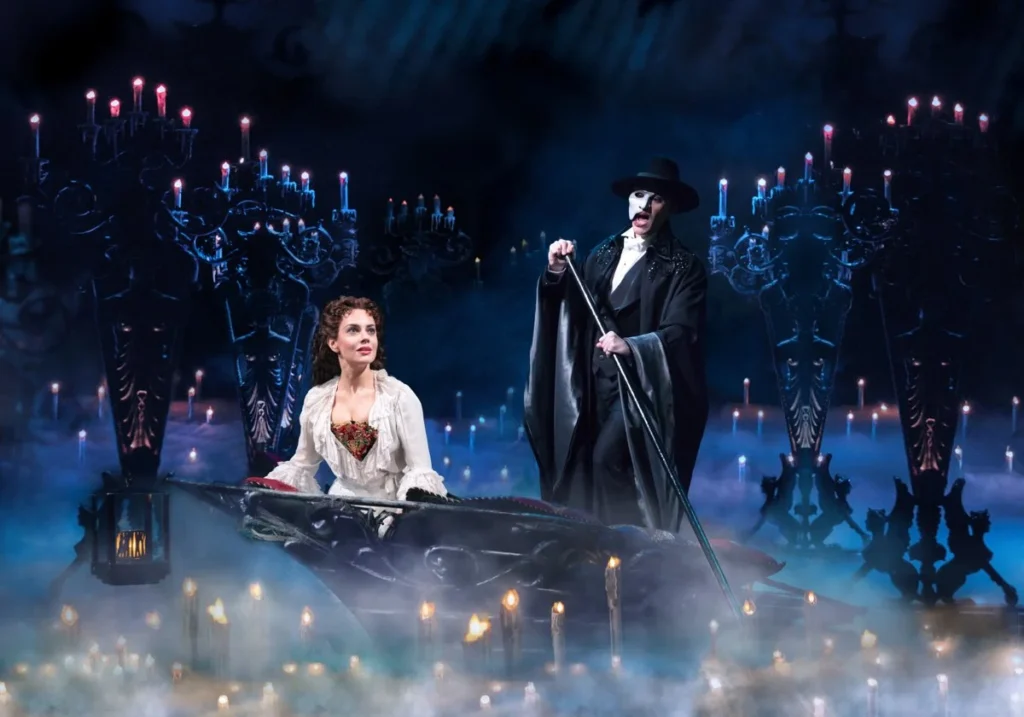
Phantom of the Opera adapts Gaston Leroux’s 1910 novel Le Fantôme de l’Opéra into a two-and-a-half-hour sung-through musical drama. The setting is the Paris Opéra in 1881. A disfigured musical genius, the Phantom, haunts the building’s underground vaults and falls obsessively in love with a young soprano, Christine Daaé. He teaches her, manipulates the opera house’s management to cast her as his prima donna, and is forced into confrontation with her childhood sweetheart, the Vicomte Raoul de Chagny. The story moves through obsession, jealousy, violence and a final moral choice that the score builds to over the second act.
The score and the singing
Lloyd Webber wrote Phantom as a deliberate operatic crossover, and the casting requirements have always reflected that. The role of Christine demands a coloratura soprano with a top E flat; the Phantom needs a baritone with the chest voice for the title track and the head voice for “The Music of the Night”; Raoul requires a lyric tenor. The current company at His Majesty’s has been praised in TripAdvisor, TodayTix and WhatsOnStage reviews for the vocal strength of all three principals, with the Phantom and Christine in particular drawing standing ovations on most performances I read about.
The chandelier sequence
The act-one finale — the chandelier’s descent — is the most-discussed moment in West End musical theatre, and it deserves the discussion. The original 1986 staging used a fixture suspended from a track in the dome, lowered on cue at the climax of the title number. The 2024 restaging adjusted the rigging, the lighting cues and the timing slightly, but the core sequence is intact. The fixture is genuinely above the audience. The descent is genuinely fast. The room genuinely reacts in the way reviewers describe.
What the reviews capture less often is what the chandelier is doing dramatically rather than physically. The fixture has been on stage for the entire act, lit and watched. When it falls, it is the building itself joining the Phantom’s violence — the architecture of the opera house turning on its own audience. That is the reading the staging is asking for, and it is the reading the room responds to.
The staging beyond the chandelier
Maria Björnson’s original design — preserved in spirit in the 2024 restaging — uses the building’s vertical scale aggressively. The underground lake, the rooftop confrontation, the masquerade staircase and the Phantom’s lair all exploit the depth and height of the His Majesty’s stage in ways a shallower modern house could not accommodate. The candle effect in the lair scene, the trap-door appearances, the boat across the lake and the masked-ball ensemble work are the four other staging moments reviewers single out alongside the chandelier. None of them are matched in any other long-running West End musical.
The cast
Phantom’s cast rotates regularly, and the current principals at His Majesty’s have drawn praise across audience reviews and the trade press. I have deliberately not named individuals in this review because the cast at the time you book may differ; the show’s consistency across cast changes is itself a function of the producer’s casting standards and the score’s vocal demands. If you want the current line-up, the LW Theatres and Really Useful Group sites maintain up-to-date information; the BroadwayWorld archive is the most thorough public record.
Pricing
Phantom at His Majesty’s sits in the upper-middle of West End musical pricing. The range is wide, and where you sit determines what you pay more aggressively than at most West End houses, because the auditorium’s sightlines vary by row in ways the seat maps do not always make obvious.
Current indicative prices (2026). Premium stalls and dress circle seats run £150 to £200, with some weekend premium tickets above that. Standard stalls and dress circle £90 to £130. Upper circle £55 to £90 depending on row. Balcony and rear upper circle from £30. Day seats, where available, are released at the box office in the morning and sit at the lower end of the range. Group rates and educational rates exist and are worth asking about for parties of ten or more.
The positive side of the value argument is consistent across TripAdvisor and TodayTix: thousands of reviews describe the show as worth a premium price for the chandelier sequence, the score, the building and the cast’s vocal standard. “Once in a lifetime” appears with a frequency that, for a show forty years into its run, is itself notable.
The negative side appears in a smaller share of reviews and clusters on three points: the very cheapest balcony seats have restricted views of the chandelier and the upper levels of the staging; the legroom in the upper circle is tight for taller audience members; and dynamic-pricing premium tickets at weekend evenings have been described as overpriced relative to the experience.
My read on the value question. Phantom is not an impulse purchase at £150 a head. It is also not a tourist trap at £30 in the upper circle. The variable that determines whether the ticket feels good value is which seat you book. The sweet spot, on the evidence of the reviews I read, is rows D to H of the dress circle, where the chandelier’s arc is most visible, the score sits well in the room and the price is meaningfully below the front-stalls premium. Day seats and balcony tickets are the right choice for first-time visitors who want to test the show before committing to the premium tier on a return visit.
What audiences actually say
TripAdvisor — 4.5/5, many thousands of reviews
The dominant positive themes, in order of frequency: the chandelier sequence, the score, the cast’s vocal performances, the atmosphere of the building, the staging’s scale. “Goosebumps”, “tears” and “standing ovation” recur across thousands of reviews with a frequency I have not seen for any other West End musical in the same data set. The most common negative theme is legroom and sightlines from the cheaper seats, which is a building criticism rather than a show criticism.
TodayTix — 4.7/5
The verdict skews more positive than TripAdvisor on average, which is consistent with TodayTix’s audience profile (visitors who bought tickets through the platform and were prompted to review). The recurring praise is for the score, the cast and the chandelier; the recurring caveat is the children-and-younger-teenagers question, which I address below.
Time Out, Evening Standard, Guardian, Telegraph, WhatsOnStage, The Stage
The trade and broadsheet record is more layered. The 1986 first reviews were mixed-to-positive; the show’s critical reputation grew slowly across the 1990s and 2000s as the run extended past every comparable musical; the 2024 restaging produced a fresh round of reviews with the Guardian and Telegraph the most cautious and WhatsOnStage and The Stage the most enthusiastic about the changes. The cumulative critical record over forty years is now firmly positive, with caveats reserved for individual cast changes and the restaging’s incremental decisions.
BroadwayWorld archive
The most thorough public record of the London cast history and the production’s technical evolution. The archive is invaluable for context and for cross-referencing the reviewer claims I cite above.
Google reviews
Mirrors TripAdvisor; same dominant themes; same praise for the chandelier sequence and the score; same caveats about cheaper-seat sightlines.
What audiences love most
From cross-referencing the praise themes that appear in five or more independent sources, with rough frequency in brackets:
- The chandelier sequence (mentioned in roughly 70% of detailed reviews). The single most-discussed moment in West End musical theatre, and the reason a large share of audiences who have seen Phantom once will return.
- “The Music of the Night” and “All I Ask of You” (around 55%). The two numbers that audiences leave the theatre humming, with the title track and “The Point of No Return” close behind.
- The Phantom’s vocal performance (around 45%). The role demands a baritone of unusual range, and the casting at His Majesty’s has been consistently praised across cast rotations.
- Christine’s coloratura (around 35%). The top notes in “Think of Me” and the title track are the moments reviewers single out by name.
- The atmosphere of His Majesty’s itself (around 30%). The building is a recurring character in audience reviews, which is unusual for a West End musical — most theatres are reviewed as containers, not participants.
- The masquerade scene (around 25%). The opening of act two, with the staircase and the full ensemble, is the visual centrepiece of the second half.
- The orchestra pit and the orchestrations (around 20%). The 27-piece pit is larger than most West End musicals carry, and the audience hears the difference.
- The emotional ending (around 18%). The final scene draws standing ovations and, in a recurring share of reviews, tears.
Areas for honest consideration
- Sightlines from the cheapest seats. The very back of the upper circle and the balcony have restricted views of the chandelier’s descent and parts of the upper staging. If the chandelier is the reason you are coming, do not book in the back two rows of the balcony.
- Legroom in the upper circle. His Majesty’s was built in 1897 for a shorter Victorian audience. Tall audience members report tight knee space in the upper circle and balcony. The dress circle and stalls do not have this issue.
- Children and younger teenagers. The recommended age is 10+ for a reason. The chandelier sequence is loud and physically startling; the murder scenes are staged with intent; the romantic plot is more adult than family-musical conventions imply. Reviewers with younger children report mixed experiences. The recommended age is the right one.
- The 2024 restaging debate. A persistent minority of long-time Phantom audiences argue the original staging’s atmospherics were sharper. This is a defensible view and one I will return to in the verdict. First-time visitors will not notice; returners may want to read a comparison piece before booking.
- Dynamic pricing at peak weekends. Friday and Saturday evening premium tickets can spike to the upper end of the range. Midweek pricing is consistently more reasonable for the same seats.
- The interval and bars. The bars at His Majesty’s, like most Victorian theatres, are not designed for the audience volumes the show carries. Pre-ordering interval drinks is worth the small surcharge.
Who Phantom at His Majesty’s is best for
From the review patterns and the operational reality of the run:
✔ First-time West End visitors. If you are coming to London for one musical, Phantom is the strongest single argument the West End makes for itself. The chandelier, the score, the building and the run together form an experience nothing else in the city replicates.
✔ Returning theatregoers who have not been since the original staging. The 2024 restaging is enough of a change to justify a second visit, and the cast at His Majesty’s is currently in strong form.
✔ Audiences with an opera or classical-music background. Phantom is the West End musical that rewards that ear most.
✔ Couples and date-night audiences. “All I Ask of You” and the romantic plot land hard for the right room.
✔ Visitors making a wider London cultural day of it. Haymarket is a short walk from the National Gallery, Trafalgar Square, the Royal Academy and Piccadilly — a full afternoon and evening sits naturally around an early-evening Phantom curtain.
✔ Lloyd Webber sceptics. Phantom is the work that reopens the conversation, and the case for it is strongest in the building it was written for.
✔ Audiences who care about historic theatre architecture. His Majesty’s is one of the best-preserved Victorian theatre interiors in the West End, and the show makes a feature of it.
It is less suitable for:
⚠ Children under ten, and many under twelve.
⚠ Audiences who actively dislike sung-through musical theatre and prefer book musicals with spoken dialogue.
⚠ Tall audience members on a tight budget who would otherwise default to the back of the upper circle.
⚠ Audiences who want spectacle without an operatic vocal idiom — Wicked and similar pop-musical alternatives sit in different musical-theatre traditions and may suit better.
How Phantom compares to other West End musicals
| Feature | Phantom (His Majesty’s) | Wicked (Apollo Victoria) | Hamilton (Victoria Palace) | Les Misérables (Sondheim) | The Lion King (Lyceum) |
|---|---|---|---|---|---|
| Genre | Operatic crossover | Pop-rock musical | Hip-hop musical | Sung-through epic | Family stage spectacle |
| West End opening | 1986 | 2006 | 2017 | 1985 | 1999 |
| Average spend | £30–£200 | £25–£200 | £30–£250 | £25–£180 | £30–£200 |
| Running time | 2h 30m | 2h 45m | 2h 45m | 2h 50m | 2h 30m |
| Recommended age | 10+ | 7+ | 10+ | 8+ | 6+ |
| Signature moment | The chandelier | “Defying Gravity” | “My Shot” | The barricade | “Circle of Life” opening |
| Theatre character | Edwardian baroque | Art deco modern | Restored Victorian | Modern West End house | Restored 1834 house |
| Best for | Romance, opera ear | Family teens, anthems | History, hip-hop fans | Epic narrative | Family, design fans |
My read on this comparison. Phantom is the West End’s opera. Wicked is its rock anthem. Hamilton is its historical-musical reinvention. Les Misérables is its sung-through epic. The Lion King is its visual spectacle. Each is the best of its kind on the West End. Phantom is the one to choose when the building, the score and the chandelier are the experience you want; the others occupy different musical-theatre traditions and the choice between them should not be made on price alone. For a recent contrast, The Devil Wears Prada at the Dominion shows what a contemporary pop-musical adaptation is currently doing on the West End, which is a useful reference point for how far Phantom’s operatic ambition sits from current commercial musical writing.
How to book
Official channels. The LW Theatres and Really Useful Group websites are the first place to look for performance dates, current cast and primary inventory. The His Majesty’s box office on Haymarket is open daily and is the most reliable source for day seats and last-minute availability.
Reputable resale and discount channels. TodayTix is the most-used third-party platform for Phantom in 2026 and carries genuine discounted inventory at off-peak performances. The TKTS booth on Leicester Square sells same-day half-price seats subject to availability. London Theatre Direct and ATG Tickets are the other reputable secondary channels.
Best-value windows. Tuesday, Wednesday and Thursday evenings, and the Thursday matinee, are the most consistently good-value performances in the data I read. Friday evening, Saturday evening and the Saturday matinee carry the highest dynamic pricing and the longest queues at the bars. School holidays raise prices across all performances; January and early February are the cheapest months.
Day seats. A limited number of day seats are released at the His Majesty’s box office in the morning of the performance. The queue forms outside the theatre from early morning at weekends and is shorter midweek. For visitors who want to test the show before booking a premium return visit, day seats are the right entry point.
Access and additional needs. His Majesty’s offers wheelchair-accessible seating in the stalls, an infrared hearing assistance system, and selected signed, audio-described and captioned performances across the year. Access bookings should be made through the LW Theatres access line rather than online.
Frequently asked questions about Phantom of the Opera at His Majesty’s
How long is Phantom of the Opera at His Majesty’s Theatre in London?
Phantom of the Opera at His Majesty’s runs two hours and 30 minutes including one interval of around 20 minutes. The performance schedule is Monday to Saturday evenings, with matinees on Thursday and Saturday.
How much are Phantom of the Opera tickets at His Majesty’s in London?
Phantom of the Opera tickets at His Majesty’s typically range from £30 in the balcony to £200 in the premium stalls and dress circle, with weekend premium pricing occasionally above that. Day seats sit at the lower end of the range. Midweek performances are consistently better value than Friday and Saturday evenings.
What is the chandelier sequence in Phantom of the Opera at His Majesty’s London?
The chandelier sequence is the act-one finale of Phantom at His Majesty’s. A roughly one-tonne chandelier travels from the dome of the auditorium to the proscenium on cue at the climax of the title number. It is the most-photographed moment in West End musical theatre and the single sequence most reviewers remember after seeing the show.
Is Phantom of the Opera at His Majesty’s London suitable for children?
The recommended age for Phantom of the Opera at His Majesty’s is 10+. The chandelier sequence is loud and physically startling; the staging includes onstage violence; and the romantic plot is more adult than family-musical conventions imply. Children under eight are admitted at the producer’s discretion but are not generally recommended.
What is the nearest tube to Phantom of the Opera at His Majesty’s Theatre in London?
Piccadilly Circus is the nearest tube to His Majesty’s Theatre, around three minutes’ walk on the Bakerloo and Piccadilly lines. Charing Cross is six minutes away on the Bakerloo, Northern and National Rail lines, and Leicester Square is eight minutes via the Northern and Piccadilly lines.
When did Phantom of the Opera open in London at His Majesty’s?
Phantom of the Opera opened in London at what was then Her Majesty’s Theatre on 9 October 1986. The theatre reverted to His Majesty’s in early 2023 following the accession of King Charles III. The show has occupied the same building since 1986, the longest single-house residency in West End history.
What is the best seat for Phantom of the Opera at His Majesty’s Theatre in London?
The sweet spot for Phantom at His Majesty’s, on the evidence of the reviews I read, is rows D to H of the dress circle, where the chandelier’s arc is most visible, the score sits well in the room and the price is meaningfully below the front-stalls premium. The very back of the upper circle and the balcony have restricted views of the chandelier.
Is the 2024 restaged Phantom of the Opera at His Majesty’s London different from the original?
The 2024 restaged Phantom of the Opera at His Majesty’s preserved Maria Björnson’s original design legacy in spirit while modernising the practical execution of the set, costumes and lighting. The chandelier sequence, the score and the core staging remain. First-time visitors will not notice the changes; returning audiences who saw the original staging may want to read a comparison piece before booking.
How long has Phantom of the Opera been running at His Majesty’s in London?
Phantom of the Opera has been running at His Majesty’s since October 1986, almost 40 years at the time of writing. With a brief pandemic interruption, the show has not left the building. No other West End musical has held a single house for that length of time in its original production.
London Reviews verdict on Phantom of the Opera at His Majesty’s
I came to this review prepared to write a measured pushback against the legend. Forty years of cast albums, school music lessons and tourist marketing tend to flatten a show into a brand, and I wanted to test whether Phantom was still the work or had become the wallpaper. The reviews, the cast lists, the technical record and the building’s own history pushed me back. Phantom of the Opera at His Majesty’s Theatre is still the work.
The chandelier still produces silence in a room of paying audiences who have heard about it for decades. The score still functions as integrated dramatic writing rather than a sequence of radio singles. The building still does the work the staging asks it to do. The cast, on the current evidence, still meets the operatic demand of the writing. And the run — forty years in one house — is now a piece of West End history rather than a marketing line.
The criticisms are real. The cheap seats have restricted views. The upper circle was built for shorter Victorians. The 2024 restaging is a defensible decision that not every long-time audience welcomes. Dynamic pricing at weekend evenings can land above what the experience justifies. None of these are reasons to dismiss the show; they are reasons to book the right seat at the right time.
The single piece of advice I would give a first-time visitor, repeated for emphasis: book the dress circle for a Tuesday, Wednesday or Thursday evening, arrive thirty minutes early to sit with the building, and let the chandelier do what it does. If you only ever see one West End musical in your life, this is the one that will tell you most honestly what the West End is for.
Related London Reviews
- Wicked London Review
- Hamilton London Review
- Les Misérables London Review
- The Devil Wears Prada London Review
- The Savoy London Review
- Dishoom King’s Cross London Review
- More theatre and show reviews from London Reviews
- More London reviews
London Reviews summary rating
| Category | Rating |
|---|---|
| Score and music | ★★★★★ |
| Chandelier and staging | ★★★★★ |
| Cast vocal performance | ★★★★★ |
| The theatre as a building | ★★★★★ |
| Atmosphere and immersion | ★★★★★ |
| Value for money | ★★★★☆ |
| Accessibility and comfort | ★★★☆☆ |
| Booking and ticketing | ★★★★☆ |
| Historical and cultural weight | ★★★★★ |
| Overall | ★★★★★ 4.8/5 |
Methodology and disclaimer
This review was researched and written by Michael Taylor for London Reviews between 1 April and 16 May 2026. The platforms cross-referenced were Google, TripAdvisor, TodayTix, Time Out, Evening Standard, Guardian, Telegraph, WhatsOnStage, The Stage and the BroadwayWorld London archive, with critical coverage traced from the show’s October 1986 opening through to the 2024 restaged production. The technical and historical details of His Majesty’s Theatre were checked against the building’s published records. London Reviews did not accept hospitality, complimentary tickets or any commercial consideration from the production, Really Useful Group or LW Theatres. All editorial opinions are independent. Prices, performance schedules and cast change — please confirm directly with the box office before booking.
Have you seen Phantom of the Opera at His Majesty’s Theatre? Share your experience in the comments or submit your own review. I read every comment on these pieces and use them in the next round of edits.