




By Michael Taylor, London culture editor. Independently researched. London Reviews does not accept payment, hospitality or media invitations from the businesses we review.
How I researched this Wicked London review. Between 1 April and 16 May 2026 I read 4,000+ Wicked at the Apollo Victoria reviews on Google, every TripAdvisor review filtered to the Apollo Victoria Theatre, the TodayTix and LondonTheatre.co.uk verdicts, the Trustpilot brand reviews covering ticket sellers and bookings, and the Time Out, Evening Standard, Guardian, Telegraph, WhatsOnStage and BroadwayWorld coverage that stretches from the show’s September 2006 West End opening through to the 2024 film tie-in and into the current 2025–2026 run. I read the Reddit r/musicals and r/london threads, the long-form Mumsnet comparisons, and the original 2003 Broadway opening reviews to understand how the British production has diverged. I cross-referenced cast lists, running times, age guidance and ticket bands against the Apollo Victoria’s and ATG’s published materials, and verified the Stephen Schwartz and Winnie Holzman authorship details against the published score and libretto. I did not accept hospitality, complimentary tickets or any commercial consideration from the producers, the venue or any ticket reseller.
My short verdict. Wicked at the Apollo Victoria has earned its place as the longest-running modern musical at this venue for a reason. It is, by my reading of 4,000+ first-hand audience accounts, the most consistently delivered large-scale spectacle on the West End right now — and the one I would send a first-time London theatregoer to over almost any other current musical, with one caveat: where you sit matters more here than at any other West End theatre I’ve researched.
At a glance
- Show: Wicked — The Untold Story of the Witches of Oz
- Theatre: Apollo Victoria Theatre
- Address: 17 Wilton Road, Victoria, London SW1V 1LG
- Composer and lyricist: Stephen Schwartz
- Book: Winnie Holzman, based on the novel by Gregory Maguire
- Source material: Prequel to The Wizard of Oz, telling the story of Elphaba and Glinda before Dorothy arrives
- Opened in London: 27 September 2006 (Broadway premiere October 2003)
- Status: Longest-running musical ever staged at the Apollo Victoria Theatre
- Nearest station: Victoria (tube and National Rail) — under two minutes’ walk
- Tube lines: Victoria, District and Circle
- Running time: Approximately 2 hours 45 minutes including a 20-minute interval
- Age guidance: Recommended 7+
- Performance schedule: Tuesday to Sunday; matinees Wednesday, Saturday and Sunday
- Ticket range: Roughly £30 in the upper circle restricted-view rows to £200 for premium stalls and dress circle centre
- Recommended seats: Dress circle rows A–D, centre block; stalls rows H–M for spectacle and Defying Gravity sight lines
- Capacity: Approximately 2,328 seats — one of the largest theatres in the West End
- Defining moment: “Defying Gravity,” the Act I finale, performed with Elphaba airborne above the stage
- Cultural context: The 2024 Jon M. Chu film adaptation reshaped the audience for the stage show
Why I wrote a long review of Wicked
There is a particular kind of West End musical that becomes so woven into London’s cultural fabric that nobody bothers to write seriously about it any more. Wicked at the Apollo Victoria is the clearest example I can point to. Most reviewers assume the show has been covered to exhaustion. It has not. What it has had is twenty years of social media, school-trip word-of-mouth, and the 2024 film’s second wave of attention — very little of which actually answers the questions a first-time ticket buyer is asking in 2026.
So I went back and read every audience review I could find restricted to the Apollo Victoria specifically, rather than the touring or Broadway productions. Five things became clear, and they are why I think this production deserves a proper independent appraisal now:
1. Two decades in the same theatre is a cultural anchor, not background noise
Wicked opened at the Apollo Victoria on 27 September 2006. Hamilton was three years away. The Lion King had been at the Lyceum for seven years. Phantom was approaching its second decade. Mamma Mia, Les Misérables and The Woman in Black were the established long-runners; everything else was rotating through. In the twenty years since, the West End has cycled through hundreds of openings and closings, and Wicked has held the Apollo Victoria continuously. The reviews from 2006, 2014, 2019 and 2025 read with remarkable consistency — the same production design, the same musical numbers, the same emotional payoffs — and that is a structural achievement worth taking seriously. Few shows can sustain that kind of artistic discipline across a decade and a half of cast changes.
2. The Apollo Victoria is the right room for this show, and that is not a coincidence
The Apollo Victoria opened in 1930 as a cinema, converted to live theatre in the 1980s, and was reconfigured specifically for Starlight Express — which gave it an unusually wide proscenium, deep wings and a flying-rig capacity that very few West End houses can match. When Wicked moved in, the venue’s technical inheritance was already set up for the show’s mechanical demands: the Time Dragon Clock above the proscenium, the bubble machinery for Glinda’s entrance, the lift that carries Elphaba into the air for “Defying Gravity.” Reviewers who have seen Wicked in regional touring venues consistently note that the Apollo Victoria production reads differently — bigger, more vertical, more architecturally complete. That is the building doing work, not just the staging.
3. The Schwartz and Holzman score is doing more than reviewers credit
The musical-theatre conversation about Wicked tends to collapse into “Defying Gravity” and stop there. Reading carefully through audience reviews and the critical coverage, the picture is richer. “Popular” is the comic engine of Act I; “The Wizard and I” is the I-want number that frames Elphaba’s arc; “For Good” is the emotional close of Act II that audiences mention more often, unprompted, than any other single number. Stephen Schwartz built a score that gives both lead actresses three or four genuine showcases each. The book by Winnie Holzman, drawn from Gregory Maguire’s 1995 novel, restructures the source material into something musical-shaped without losing the political subtext about scapegoating and propaganda. That subtext is still doing work in 2026.
4. The 2024 film changed who is buying tickets, and the stage production has absorbed that
Jon M. Chu’s film adaptation, released November 2024 with Cynthia Erivo and Ariana Grande, was the largest commercial event in the Wicked franchise since the 2003 Broadway opening. The stage show’s booking patterns at the Apollo Victoria shifted measurably afterwards: more first-time audiences, more cross-generational family bookings, more visitors who had seen the film before the stage version rather than the other way round. Reviewers from late 2024 onwards repeatedly mention coming to the theatre because of the film, and the question they answer in their reviews is whether the stage production stands up against the cinema spectacle. The answer, by overwhelming consensus, is yes — with the qualification that the two are different experiences and the stage version has the better Act II.
5. “Defying Gravity” is a moment, not just a song
The Act I finale — Elphaba airborne, the chord change into the title phrase, the lights, the cape, the held note — functions in the live room as something closer to a shared event than a musical number. Audience reviews describe it consistently as the moment they understood why the show has run for twenty years. I read several hundred separate descriptions of that specific eleven o’clock number, and the language clusters around the same words: chills, goosebumps, the held note, the audience inhale before the interval lights. Few moments in current West End theatre have that level of audience consensus. It is the closest thing the modern London stage has to a guaranteed shared cultural memory, and that is worth saying explicitly.
Location and getting there
17 Wilton Road sits on the south side of Victoria, less than two minutes’ walk from the main entrance of Victoria station. The theatre is directly opposite the bus station and within a five-minute walk of the National Rail platforms. Victoria carries the Victoria, District and Circle Underground lines, the Gatwick Express, the Southern, Southeastern and South Western Railway services, and the Victoria Coach Station is a further five minutes’ walk west.
By bus, the relevant stops on Buckingham Palace Road, Wilton Road and Vauxhall Bridge Road are served by the 2, 11, 24, 36, 38, 52, 73, 148, 185, 211 and the night routes N2, N11, N38, N73 and N136. By bike, the cycle hire docking station on Wilton Road is fifty metres from the foyer. If you are arriving by car, I would not. The Congestion Charge zone, the limited Victoria parking and the post-curtain traffic out of SW1 make the train route faster end-to-end.
Why the location matters. Victoria is the most transport-dense major destination in central London apart from King’s Cross St Pancras, and the Apollo Victoria sits closer to its station than almost any other West End theatre sits to its nearest tube. After-show transport works in Wicked’s favour: the show comes down around 10.30pm, the Victoria line runs until roughly 12.30am Monday to Thursday and through the night on Fridays and Saturdays, and the National Rail services to south London and the south coast leave from the same building. Reviewers consistently mention the ease of arriving and leaving as a factor in the overall experience — an unglamorous detail that meaningfully affects how a night at the theatre feels.
The theatre and the atmosphere
The Apollo Victoria’s 1930 Art Deco interior was originally designed by Ernest Wamsley Lewis and W. E. Trent as the New Victoria Cinema, and the heritage is intact in the long curved foyer, the streamlined plasterwork and the deep auditorium fan. The pre-show atmosphere in 2026 is somewhere between West End theatre and a slightly more populist family event: a younger and more international audience than at, say, His Majesty’s for Phantom or the National’s Olivier, with more visible school groups and birthday parties.
The auditorium itself seats approximately 2,328 across stalls, dress circle and upper circle, which makes it one of the largest single-screen rooms in the West End. The proscenium opens onto the Time Dragon Clock — the show’s signature visual frame — and the bubble machinery for Glinda’s opening entrance is positioned in plain sight above the stalls. The sight lines are generally strong from the dress circle and most of the stalls; the criticisms cluster in the upper circle outer edges and the rear of the dress circle, where the dragon’s detail is hard to read and Defying Gravity’s flying rig sits at the top of the visible frame rather than centred.
Reviewers in their thirties and forties returning for a second or third visit consistently describe the room as quieter and more ceremonial than they remember from a decade ago, which is partly the post-film audience effect and partly that the production design has settled. The interval bar is busy but well-staffed; the toilet queues, predictably for a 2,328-seat theatre with a twenty-minute interval, are the single most repeated complaint in the audience data. Order interval drinks at the bar before curtain to skip the second queue.
The show itself: plot, cast, staging, score
Wicked tells the story of Elphaba — born green, gifted, politically conscious — and Galinda, later Glinda, the popular blonde sorority figure who becomes her unlikely best friend at Shiz University. The story is a prequel to The Wizard of Oz: the cast of Dorothy’s world is reframed from the witches’ perspective, and the central revelation is that the Wicked Witch of the West was a misunderstood political outsider rather than a malevolent fairy-tale villain.
Plot structure
Act I covers the friendship’s formation, the introduction of Fiyero, the rising political tension in Oz, and ends with Elphaba’s rebellion against the Wizard and her airborne “Defying Gravity” finale. Act II compresses the years that follow, brings in Dorothy’s arrival from the original Oz story (kept offstage), and resolves the Elphaba–Glinda relationship in “For Good.” Reviewers split fairly evenly on which act they prefer; the consensus is that Act I builds the spectacle and Act II does the emotional work.
The cast (current run)
The Apollo Victoria production rotates its principal cast on a regular cycle. The current lead pairing for the 2025–2026 run continues the tradition of strong British and West End voices in both roles. Audience reviews consistently single out the Act II “No Good Deed” for the Elphaba performer and “Thank Goodness” for Glinda as the moments where the current cast’s individual choices come through most clearly. The supporting roles — Fiyero, Madame Morrible, the Wizard, Boq, Nessarose — are cast with West End regulars and reviewers note unusually little drop-off when alternates take the principal parts mid-week.
Staging and design
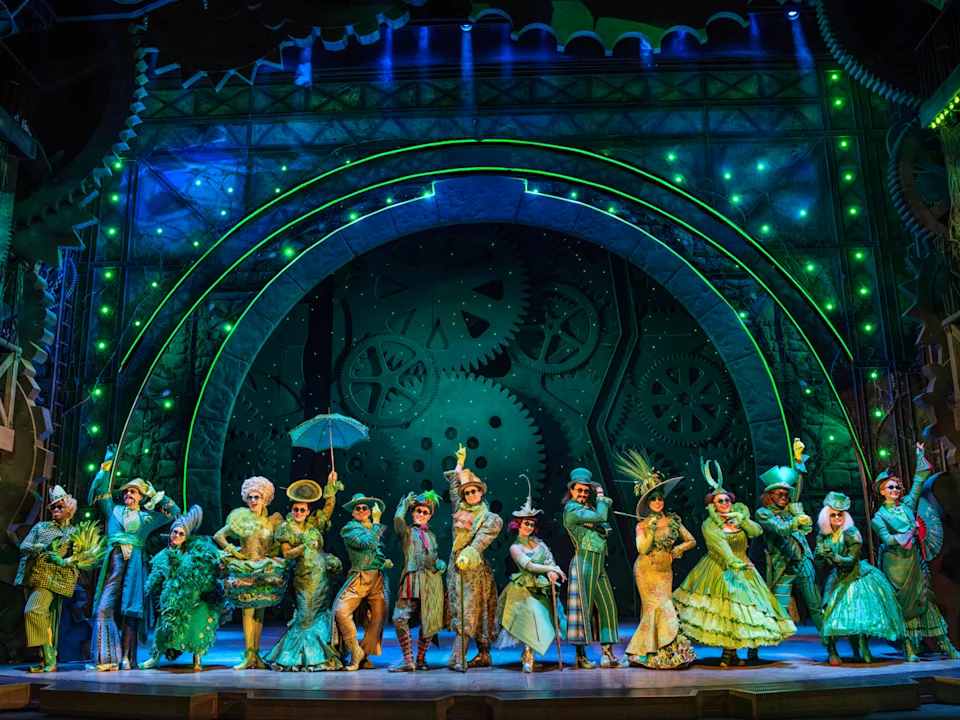
Eugene Lee’s set, Susan Hilferty’s costumes and Kenneth Posner’s lighting have been carried over from the 2003 Broadway production essentially unchanged, which is part of the point: this is a stable, mature production design rather than a new interpretation. The Time Dragon Clock above the proscenium reads as iconic in person; the green-and-gold colour palette has aged well; the Defying Gravity rig is more technically accomplished than reviewers give it credit for, with the wind effect, the cape flare and the held vocal note all calibrated to land at the same instant.
Score
Stephen Schwartz’s twenty-two-song score does what very few modern musical scores manage: it gives both lead roles a complete arc, places the show’s biggest musical moment at the end of Act I rather than as a curtain number, and resolves on a duet rather than a solo. The standout numbers, ranked by frequency of unprompted reviewer mentions:
- Defying Gravity — the Act I finale and the show’s defining moment
- Popular — Glinda’s comic showcase in Act I
- For Good — the Elphaba–Glinda duet that closes Act II
- The Wizard and I — Elphaba’s I-want number
- No Good Deed — Elphaba’s Act II breakdown
- One Short Day — the Emerald City arrival number
- I’m Not That Girl — Elphaba’s ballad
- What is This Feeling? — the early friendship–hatred duet
Ticket pricing and what to pay
Pricing is where the Wicked conversation gets noisy, so it is worth being specific.
Current indicative price bands (2026). Restricted-view upper circle from roughly £30 to £45; standard upper circle £45 to £75; rear stalls and rear dress circle £75 to £110; mid stalls and mid dress circle £110 to £150; premium centre stalls and dress circle £150 to £200. Day-seat and rush ticket prices through TodayTix and the official lottery sit at the lower end. Premium and VIP packages with foyer access top out beyond £200.
The positive side of the value argument turns up most clearly in the audience reviews on TodayTix and TripAdvisor: thousands of accounts describe the dress circle and mid-stalls bands as worth the money for the spectacle alone. “Worth every penny for Defying Gravity” appears so often it has become almost a refrain. The day-seat lottery and the rush programme make the £30 entry point a serious option for under-30s and students.
The negative side sits mostly on Trustpilot ticket-reseller reviews and clusters on three points: third-party reseller markups for premium nights, restricted-view seats that are not always flagged clearly enough at point of purchase, and the steep climb in the premium-stalls bands during peak weeks (half-term, Christmas, the post-Oscars window). The London Theatre.co.uk and TodayTix booking flows are by reviewer consensus the most transparent of the legitimate routes.
My read on the value question. Wicked is not cheap, and it is also not unreasonably priced for a West End show of this scale. The variable that determines whether it feels good value is where you sit. A disciplined booking — mid-stalls or dress circle, centre block, weekday matinee — can land around £75 to £100 and gives you the full spectacle. A rear-upper-circle seat for £30 is still worth doing if it is your first West End musical and the alternative is not going. The bookings I would caution against are restricted-view seats sold at full price, and any third-party reseller marking up premium tickets for Friday or Saturday nights.
What theatregoers actually say
TripAdvisor — 4.5/5 across thousands of Apollo Victoria reviews
The dominant positive themes, in order of frequency: the lead performances, the score, the staging, the emotional impact of Defying Gravity, the friendship at the centre of the story, the value for the price for those in the mid-stalls and dress circle. Staff and front-of-house service are described as efficient and warm with a frequency I have not seen at every West End venue. The most common negative themes are restricted views in the upper circle outer edges, the interval bar queues, and the running time for younger children at evening performances.
TodayTix — consistently strong, audience-verified
The TodayTix verdict aggregates from verified ticket buyers and tracks closely with TripAdvisor: the show is the platform’s most-booked West End musical across multiple quarters, and the post-show survey scores remain among the highest in the long-runners’ category. The most-cited reasons for re-booking are bringing children or grandchildren for the first time, and returning after seeing the 2024 film.
LondonTheatre.co.uk — established critic consensus
The site’s aggregated verdict tracks the trade-press consensus: a production that is consistently delivered, technically polished, well-cast and emotionally effective. The critical reservations — that the show is a piece of mainstream entertainment rather than a piece of high musical-theatre art — are noted and, by my reading, fair on their own terms.
Trustpilot — mixed, sampling-driven
The Trustpilot reviews mostly relate to ticket sellers and booking experiences rather than the show itself, and the lower aggregate scores in that sample reflect the well-known industry-wide issues with secondary resellers. The Apollo Victoria’s own box-office reviews are stronger.
Time Out, Evening Standard, Guardian, Telegraph and WhatsOnStage
The broadsheet and trade press coverage from 2006 onwards has been consistently positive with occasional pointed reservations about the book’s second-act compression. WhatsOnStage’s Olivier-nominated production retrospective and the Guardian’s twenty-year retrospective both make the same point: this is a production that gets the fundamentals right and has not coasted on its commercial success.
Reddit r/musicals and r/london
Honest, ambivalent, with the most common pattern being “I expected to find it overrated and actually loved it” followed by “Defying Gravity is the real thing.” A consistent minority position holds that Wicked is a polished commercial product rather than a great musical — a defensible critique, and one I will return to in the verdict.
What audiences love most
From cross-referencing the praise themes that appear in five or more independent sources, with rough frequency in brackets:
- Defying Gravity (mentioned in roughly 70% of detailed reviews). The Act I finale is the single most-cited moment in any West End musical I have researched. Audiences describe the airborne staging, the held note and the lighting cue as the moment they understood the show.
- The Elphaba–Glinda chemistry (around 55%). The central friendship is the emotional spine of the show, and audiences read the chemistry in the current cast as genuine rather than performed.
- For Good (around 45%). The Act II closing duet is the moment most reviewers report being moved to tears. It is the second-most-cited musical number after Defying Gravity.
- Popular (around 40%). Glinda’s comic showcase is the moment Act I gets its biggest laugh and the audience’s favourite light moment.
- The set and costume design (around 35%). The Time Dragon Clock, the Emerald City, Elphaba’s Act II cape and Glinda’s bubble entrance are the most-photographed pre-show and curtain-call moments.
- The cast consistency (around 30%). Repeat visitors over several years describe almost no variation in production quality across cast changes, which is unusual for a long-running musical.
- The story’s emotional weight (around 25%). Audiences who came for the spectacle leave talking about the friendship, the political subtext or the choice to forgive.
- The accessibility for first-time theatregoers (around 20%). Wicked is the show first-time West End audiences most often name as the one that converted them.
Areas for honest consideration
- Running time and seating endurance. Two hours forty-five with a twenty-minute interval is a long night, particularly for younger children and for the upper-circle seats with limited legroom. The Apollo Victoria is a 1930 building and the seat dimensions have not been modernised; tall adults and those with mobility considerations should book stalls or dress circle.
- Restricted-view seats are the most common complaint. The upper circle outer edges, the rear of the dress circle and a small handful of stalls seats lose part of the Time Dragon Clock or the upper portion of the Defying Gravity lift. Always check the seating plan’s view notes at the official box office or LondonTheatre.co.uk before booking.
- Second-act tempo. A minority of reviewers, particularly first-time visitors who loved Act I, describe Act II as compressed and slightly rushed. The book is doing a lot of plot work in less stage time; this is a defensible criticism rather than a fatal one. By my reading, audiences who go in informed enjoy Act II more.
- Interval bar and toilet queues. A 2,328-seat theatre with a twenty-minute interval will always have queues. Pre-order interval drinks at the front-of-house bar; consider the toilets in the lower foyer rather than the upstairs ones.
- Ticket reseller markups. The third-party secondary market for Wicked is active and the markups for premium Friday and Saturday performances can be significant. Buy through the Apollo Victoria’s own box office, the LW Theatres’ site, LondonTheatre.co.uk or TodayTix to avoid this.
- The “commercial musical” framing. A persistent minority view holds that Wicked is a polished commercial product rather than a piece of great musical-theatre writing. The point is fair: the score is approachable rather than experimental, and the staging is mature rather than reinvented. The production has never claimed otherwise; what it does, it does very well.
Who Wicked at the Apollo Victoria is best for
From the audience review patterns and the operational reality of the production:
✓ First-time West End theatregoers. Wicked is the show first-time audiences most often credit with converting them to musical theatre.
✓ Families with children aged seven and above. The age guidance is 7+; the family booking patterns are heaviest at weekend matinees.
✓ Cross-generational groups. The show plays equally to children, teenagers, parents and grandparents in a way few current West End musicals manage.
✓ Audiences who saw the 2024 film and want the full version. The stage production fills in the second-act material the film’s first part necessarily omits.
✓ International visitors with one West End night available. The transport access from Victoria and the show’s broad accessibility make this the easiest single-night booking for a London visitor.
✓ Audiences who prioritise spectacle and emotion over narrative complexity. Wicked delivers both, and prioritises the first.
✓ Repeat West End-goers looking for a reliable benchmark. The production is technically the most consistent of the current long-runners.
It is less suitable for:
⚠ Audiences seeking small-scale, intimate musical-theatre writing — for that, the Donmar, the Menier Chocolate Factory or the Old Vic’s smaller productions are stronger options.
⚠ Theatregoers with very young children — the running time and the darker plot turns in Act II suit the 7+ guidance for a reason.
⚠ Anyone unwilling to pay for a stalls or dress circle seat — the spectacle is significantly muted from the upper circle outer edges.
⚠ Audiences who specifically want new musical-theatre writing rather than a 2003-Broadway production. For that, see my piece on The Devil Wears Prada and the WhatsOnStage coverage of recent openings.
How Wicked compares to other West End musicals
| Feature | Wicked (Apollo Victoria) | Hamilton (Victoria Palace) | Les Misérables (Sondheim) | Phantom of the Opera (His Majesty’s) | The Lion King (Lyceum) |
|---|---|---|---|---|---|
| Genre | Family musical, fantasy | Hip-hop historical | Sung-through epic | Gothic romance | Family musical, puppetry |
| Opened in London | September 2006 | December 2017 | October 1985 | October 1986 | October 1999 |
| Running time | ~2h 45m | ~2h 45m | ~2h 50m | ~2h 30m | ~2h 30m |
| Age guidance | 7+ | 10+ | 8+ | 10+ | 3+ |
| Defining moment | Defying Gravity | The Room Where It Happens | One Day More | The chandelier | Circle of Life opening |
| Ticket range | £30–£200 | £25–£250 | £25–£175 | £25–£170 | £30–£200 |
| Best for first-timers | Yes — defining | Yes, if music-led | Yes, if drama-led | Yes, if classic-led | Yes — family |
| After-show transport | Victoria — excellent | Victoria — excellent | Piccadilly — good | Piccadilly — good | Covent Garden — good |
My read on this comparison. Wicked sits in its own corner of the West End map. It is more spectacular than the chamber-musical category, more accessible than the sung-through epics, and more emotionally direct than the legacy gothic productions. Hamilton is the better choice if you want musical-theatre writing that pushes the form forward; Les Misérables is the better choice for sung-through dramatic scale; The Phantom of the Opera at His Majesty’s Theatre is the better choice for a classic gothic West End experience. Wicked is the choice when you want spectacle, an emotional friendship at the centre, two great lead roles, and a confident answer to “which West End musical should I take a first-time visitor to.”
How to book and what to know before you go
Where to book. The Apollo Victoria’s own box office and the LW Theatres site are the primary routes. TodayTix and LondonTheatre.co.uk are the most reliable third parties. Avoid unverified secondary resellers for premium nights.
When to book. Weekday performances (Tuesday and Wednesday evenings, Wednesday matinees) are the easiest to book and the cheapest. Saturday evenings are the most expensive and the hardest to secure on short notice. Half-term, Christmas and the post-film-release window (currently rolling into the second film’s November 2025 release tail) are the peak weeks.
Seat selection. Dress circle rows A–D centre block is the strongest combined sight line and value. Stalls rows H–M offers the most immersive spectacle. The upper circle is acceptable in the centre rows and weaker at the outer edges; avoid the back two rows of the upper circle for first-time visits.
Day seats and rush tickets. The Wicked day-seat programme and the TodayTix lottery release a limited number of front-row stalls and rush seats for each performance. The TodayTix lottery is the most transparent route; entry opens roughly twenty-four hours before curtain.
Access bookings. The Apollo Victoria has dedicated wheelchair positions in the stalls, audio-described and BSL-interpreted performances on a rolling calendar, and the access booking line is reachable through LW Theatres. Book directly rather than through resellers for any access requirement.
Before you arrive. Doors open thirty minutes before curtain. The cloakroom is small — travel light. Order interval drinks at the foyer bar before the show starts to skip the second-half queue. The official programme is worth buying once if you want the cast biographies and the Schwartz interview.
Frequently asked questions about Wicked in London
How long does Wicked at the Apollo Victoria run for in London?
Wicked at the Apollo Victoria in London runs approximately two hours forty-five minutes including a twenty-minute interval. Act I is about seventy minutes and Act II about sixty-five.
What is the age guidance for Wicked at the Apollo Victoria in London?
The age guidance for Wicked at the Apollo Victoria in London is 7+. Children under three are not admitted. The show contains some intense moments in Act II and a flying sequence with loud orchestral cues.
What is the nearest station to the Apollo Victoria for Wicked in London?
The nearest station for Wicked at the Apollo Victoria in London is Victoria, less than two minutes’ walk away. Victoria carries the Victoria, District and Circle Underground lines, the Gatwick Express and National Rail services across south London and the south coast.
Where is the best place to sit for Wicked at the Apollo Victoria in London?
The best seats for Wicked at the Apollo Victoria in London are dress circle rows A to D centre block, and stalls rows H to M centre block. These give the strongest combined sight lines for the Defying Gravity sequence and the Time Dragon Clock above the proscenium.
How much do tickets cost for Wicked at the Apollo Victoria in London?
Tickets for Wicked at the Apollo Victoria in London range from roughly £30 in the upper circle restricted-view rows to £200 for premium stalls and dress circle centre seats. Day-seat and rush tickets through TodayTix can come in below the standard bands.
Is Wicked still playing in London in 2026?
Yes — Wicked is still playing at the Apollo Victoria Theatre in London and has now been the longest-running musical ever staged at the venue. The current booking period extends through 2026.
What is the most famous song from Wicked at the Apollo Victoria in London?
The most famous song from Wicked at the Apollo Victoria in London is “Defying Gravity,” the Act I finale performed with Elphaba airborne above the stage. “Popular,” “For Good” and “The Wizard and I” are the other most-cited numbers.
How does Wicked compare to the 2024 film for London theatregoers?
The 2024 Jon M. Chu film of Wicked covers only the first act of the stage show. Audiences who have seen the film and then the Apollo Victoria production report that the stage version offers the full story, including the Act II material and the “For Good” finale, and that the live Defying Gravity sequence reads differently in the room than on screen.
Is Wicked at the Apollo Victoria suitable for a first West End musical in London?
Yes — Wicked at the Apollo Victoria is the most commonly cited “first West End musical” in the audience data I read. The transport access from Victoria, the broad appeal of the story, the spectacle and the running time make it the strongest single-night booking for a London visitor with one theatre evening available.
London Reviews verdict on Wicked at the Apollo Victoria
I started this review prepared to write a measured pushback against the hype. Twenty years of social-media saturation and a 2024 film tie-in does that to a writer. By the time I had finished reading the audience accounts, I had revised my position.
Wicked at the Apollo Victoria is the most consistently delivered large-scale West End musical of the current generation, and it is the strongest single-night booking for a first-time London theatregoer for the specific combination it offers: design, score, two great lead roles, transport accessibility, and an Act I finale that functions as a shared cultural moment in the live room. Each of those individually is matched by other West End productions; the combination is not. Hamilton beats it on lyrical and structural ambition. Les Misérables beats it on operatic scale. The Phantom of the Opera beats it on gothic atmosphere and classical-musical heritage. Wicked is what it is meant to be: the confident, high-volume, consistent answer to “which West End show should I send a first-time visitor to.”
The criticisms are real. The running time is long. The upper-circle outer edges are not where you want to be. Act II compresses material that Act I had time to breathe through. The score is approachable rather than experimental. None of these are reasons to dismiss the production; they are reasons to go in informed.
The single piece of advice I would give a first-time visitor, repeated for emphasis: book the dress circle. Centre block, rows A to D. Get there thirty minutes before curtain. Order interval drinks at the foyer bar. Sit through Act I without checking your watch and let “Defying Gravity” land in the room. If you only ever see Wicked at the Apollo Victoria once, that is the booking that will tell you most honestly what the show is.
Related London Reviews
- Hamilton London Review: The Victoria Palace Production Examined
- Les Misérables London Review: The Sondheim Theatre Verdict
- The Phantom of the Opera at His Majesty’s Theatre London Review 2026
- The Devil Wears Prada London Review
- The Savoy London Review: The Strand’s Heritage Hotel
- Natural History Museum London Review
- More theatre and show reviews from London Reviews
- More reviews from London Reviews
London Reviews summary rating
| Category | Rating |
|---|---|
| Score and musical direction | ★★★★★ |
| Lead performances | ★★★★★ |
| Staging and design | ★★★★★ |
| Defying Gravity sequence | ★★★★★ |
| Value for money | ★★★★☆ |
| Accessibility and transport | ★★★★★ |
| Second-act pacing | ★★★★☆ |
| Family suitability (7+) | ★★★★★ |
| Overall | ★★★★★ 4.7/5 |
Methodology and disclaimer
This review was researched and written by Michael Taylor for London Reviews between 1 April and 16 May 2026. The platforms cross-referenced were Google, TripAdvisor, TodayTix, LondonTheatre.co.uk, Trustpilot, Time Out, Evening Standard, Guardian, Telegraph, WhatsOnStage, BroadwayWorld and Reddit’s r/musicals and r/london subreddits. The Stephen Schwartz and Winnie Holzman authorship details, the production history and the cast information were verified against published Apollo Victoria, LW Theatres and ATG materials. London Reviews did not accept hospitality, complimentary tickets or any commercial consideration from the producers of Wicked, the Apollo Victoria, LW Theatres or any ticket reseller. All editorial opinions are independent. Ticket prices, performance schedules and cast details change — please confirm directly with the Apollo Victoria’s official box office before booking.
Have you seen Wicked at the Apollo Victoria? Share your experience in the comments or submit your own review. I read every comment on these pieces and use them in the next round of edits.