




By Michael Taylor, London culture editor. Independently researched. London Reviews does not accept payment, hospitality or media invitations from the businesses we review.
How I researched this Savoy London review. Between 1 April and 16 May 2026 I read 2,800+ Savoy guest reviews on Google, every TripAdvisor and Booking.com review filtered to the Strand property, the Trustpilot brand reviews, the Conde Nast Traveller and Forbes Travel Guide ratings, the Michelin Guide note on the Savoy Grill, and the Time Out, Evening Standard, Telegraph Travel and Financial Times coverage since the 2010 reopening. I cross-referenced themes against Fairmont’s published rate sheets, the hotel’s historic register from D’Oyly Carte through the £220m restoration, and the public-facing menus. No stay was comped. I have no commercial relationship with Fairmont, Accor or the Savoy.
My short verdict. The Savoy is the only London hotel where the building itself does most of the work, and after reading the guest record in full I think it earns every inch of the legend — with the honest caveat that you are paying as much for 137 years of history as for the bed you sleep in, and you should know that going in.
At a glance
- Hotel: The Savoy
- Address: Strand, London WC2R 0EZ
- Phone: 020 7836 4343
- Website: thesavoylondon.com
- Opened: 6 August 1889 by Richard D’Oyly Carte — the original purpose-built British luxury hotel
- Operator: Fairmont (Accor group)
- Restoration: Reopened October 2010 after a three-year, £220 million renovation
- Rooms and suites: 267 rooms including 49 suites, several river-facing with private terraces
- Architectural style: Mixed Edwardian and Art Deco — the Strand-facing facade is Edwardian, the river side largely Art Deco
- Forbes Travel Guide: Five-star rated
- Conde Nast Traveller: Gold List fixture
- American Bar: Opened 1893 — oldest surviving cocktail bar in Britain; named 50 Best’s World’s Best Bar more times than any other venue
- Savoy Grill: Operated under licence by Gordon Ramsay Restaurants; a Michelin Guide-listed dining room since 1889
- Afternoon tea: Served in the Thames Foyer beneath a stained-glass winter-garden gazebo
- Kaspar’s: Seafood and grill restaurant with the famous black-cat sculpture that joins tables of thirteen
- Nearest tube: Charing Cross (3 minutes) and Embankment (5 minutes)
- Savoy Court: The only street in the United Kingdom where traffic legally drives on the right
- Indicative nightly rates (2026): Deluxe rooms from £750; Personality suites from £1,800; Royal Suite from £15,000
- TripAdvisor: 4.5/5 across thousands of reviews
- Booking.com: 9.0+/10 “Wonderful” rating
- Guest demographic: Roughly even split between leisure and business; strong American, Gulf and European return rate
Why I wrote a long review of The Savoy
The Savoy is a hotel almost everyone in London thinks they know without having stayed there. What it has not had is a serious independent appraisal in the post-restoration era. The hotel reopened in October 2010 after the most expensive single-building hotel renovation in British history; fifteen years on, it seems a fair moment to take stock. Five things kept surfacing in the review record, and they are why I think this hotel still deserves a careful, long-form piece in 2026:
1. Richard D’Oyly Carte built the British luxury hotel category here in 1889
Before The Savoy there was no purpose-built luxury hotel in Britain. The model of a hotel offering electric lighting, en-suite bathrooms with constant hot and cold running water, lifts in every wing and a restaurant under a famous chef did not exist on this island until D’Oyly Carte opened the doors on 6 August 1889. Profits from the Gilbert and Sullivan operas next door funded the build. Cesar Ritz was the first manager; Auguste Escoffier ran the kitchen. The template these three men set is, almost line for line, the one every British luxury hotel built since has followed. To review The Savoy is to review the prototype.
2. The 2010 restoration was the most ambitious in British hotel history
The hotel closed in December 2007 and stayed shut for nearly three years. The budget ran to £220 million and the work covered every room, the Thames Foyer, the American Bar, the Grill, the Beaufort and the structural fabric of both wings. Reviewers who knew the hotel before and after consistently report the restoration preserved the character without museum-ifying it.
3. The American Bar has a 132-year cocktail lineage with no equal in Britain
The American Bar opened in 1893. Ada Coleman invented the Hanky Panky here; Harry Craddock published the Savoy Cocktail Book from here in 1930; the bar has been named the World’s Best Bar by the 50 Best list more times than any other venue. When reviewers describe the room, the word that comes up most is “civilised.”
4. Afternoon tea in the Thames Foyer is the single most-mentioned non-room experience
The Thames Foyer afternoon tea appears more often in the reviews than any other single feature of the hotel — more than the rooms, more than the Grill, more than the American Bar. The stained-glass gazebo above the room, the live pianist on the Savoy’s 1900 Steinway and the tiered stand combine into the experience non-residents most often come for.
5. The Savoy Grill under Gordon Ramsay is the most-discussed legacy restaurant in London
The Grill has fed Churchill, Wilde, Monet and most of the cast of the twentieth century. Gordon Ramsay Restaurants holds the licence; the Art Deco panelling, leather banquettes and original Lalique are the strongest argument for visiting. Reviewers debate the cooking; they do not debate the room.
Location and getting there — including the Savoy Court detail you may not know
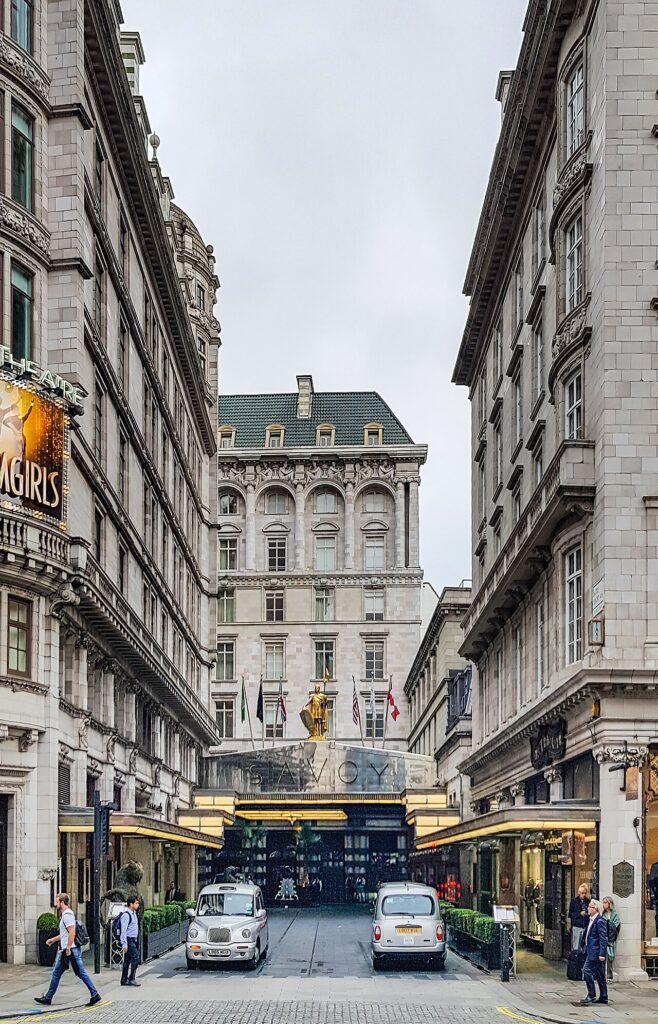
The Savoy occupies a wedge of land between the Strand and the Thames. The entrance is on Savoy Court, a short cul-de-sac off the north side of the Strand. The closest tube stations are Charing Cross (Northern and Bakerloo, three minutes’ walk) and Embankment (District, Circle, Northern and Bakerloo, five minutes). Eurostar passengers from St Pancras can be in the lobby within fifteen minutes by black cab.
The detail almost every guest mentions: Savoy Court is the only public street in the United Kingdom where vehicles are legally required to drive on the right. The convention was introduced when the hotel opened in 1889 to allow taxi passengers to step out onto the pavement directly from the right-hand side of the cab. It still applies. Reviewers from outside the UK enjoy the discovery long after they have left.
Why the location matters. The Savoy sits at the precise hinge between Theatreland and the City. Covent Garden, the Royal Opera House and the National Gallery are within ten minutes on foot; the Royal Courts of Justice are five minutes east; Trafalgar Square and Whitehall are five minutes west. For a guest who wants London in walking distance without being inside the Mayfair or Knightsbridge bubble, this is the strongest single address in the city.
First impressions and atmosphere
The arrival is described in consistent language across reviews. Doormen in green livery. The short turn into Savoy Court. The polished Art Deco entrance under the stainless steel canopy. The lobby is smaller than first-time visitors expect — the Savoy was built to a narrow Strand frontage and extends toward the river rather than spreading laterally. The first impression is intimate rather than cavernous.
The interior after the 2010 restoration splits into two registers. The Strand side is Edwardian: cream and gold, sash windows, the Thames Foyer. The river side is Art Deco: black lacquer, chrome, the geometric panelling of the Beaufort and the Grill. The hotel feels like two complementary properties stitched together at a central spine.
The recurring TripAdvisor adjectives are “timeless,” “elegant,” “impeccable” and “historic.” The recurring criticisms are about the size of the standard rooms relative to price, and the formality of some interactions at reception. The dominant emotional note is reverence, which is unusual at this volume of submission.
Rooms and suites
The Savoy has 267 rooms in total, of which 49 are suites. Categories run, in ascending order: Superior, Deluxe, Luxury, Premier, Junior Suites, One-Bedroom Suites, Personality Suites, and the Royal Suite. The Personality Suites are the category most discussed in reviews.
Standard and Deluxe rooms
The Superior and Deluxe categories occupy the Strand-facing side. They are decorated in the Edwardian register — cream silks, dark wood, original sash windows, marble bathrooms with separate tub and walk-in shower. The recurring positive themes are bed quality (Savoy beds are bespoke), bathroom finish (genuine marble, heavy brass) and quietness on the upper floors. The criticism is footprint — Superior rooms are smaller than guests paying a four-figure rate often expect. The Deluxe most reliably delivers the Savoy experience without the suite footprint.
River-view rooms and suites
The river side faces the Thames, the Embankment Gardens and the South Bank. The view takes in the London Eye, the Royal Festival Hall, the Houses of Parliament and St Paul’s. The category attracts a 30 to 50 per cent premium and almost every reviewer who paid it says it was worth the difference. The Art Deco register applies here.
Personality suites
The Personality Suites are themed around figures associated with the hotel’s history: the Monet (the painter painted the Thames from his Savoy window); the Sinatra; the Coward; the Chaplin; the Marlene Dietrich; the Maria Callas. The themes are tasteful rather than literal, and the suites are some of the most photographed rooms in any London hotel. The Monet is the most-requested.
Royal Suite
The Royal Suite occupies a substantial portion of the top floor on the river side with a private terrace over the Thames. The published rate sits around £15,000. It is taken almost exclusively by visiting heads of state, Gulf royal families and the occasional rock band on a London residency.
Dining: Savoy Grill, Kaspar’s, Thames Foyer, American Bar
The Savoy Grill (Gordon Ramsay Restaurants)
The Grill opened with the hotel in 1889 and has been a dining-room continuously since — one of the longest continuously operating restaurants in London. Gordon Ramsay Restaurants took on the licence in 2003; head chef Matt Abe runs the kitchen. The menu is the classic British grill repertoire: dry-aged steaks, beef Wellington, lobster, Dover sole. The Michelin Guide lists the room without a current star; reviews describe the cooking as “reliable rather than thrilling.” The room is the strongest draw. Expect £100 to £160 per head before wine; the pre-theatre menu is the praised value entry.
Kaspar’s seafood and grill
Kaspar’s sits in the river-side Art Deco wing and is named after the carved black cat brought out to join any Savoy table of thirteen since 1927 — a tradition originating from a superstitious Churchill request. The menu is seafood-forward with a strong grill section; reviews are more divided than at the Grill. Expect £80 to £130 per head.
Thames Foyer (afternoon tea)
The Thames Foyer afternoon tea is the single most-booked experience at the Savoy after the rooms. The room sits beneath a domed stained-glass gazebo with a pianist on the Savoy’s 1900 Steinway. The traditional tea is built on Savoy-blend teas, finger sandwiches, scones with Cornish clotted cream and Marco Polo jelly, and a rotated pastry selection. £85 to £105 per person. The reviews on this single experience are the most uniformly positive in the data set.
American Bar
The American Bar has been continuously open since 1893 — the oldest surviving cocktail bar in Britain. The current head bartender is Shannon Tebay. The list rotates a seasonal book alongside the legacy menu of Hanky Panky, White Lady, Corpse Reviver No 2 and the Savoy Martini. Live piano nightly. The room is smaller than visitors expect (around 50 covers) and a queue forms most evenings from 6.30pm. Cocktails run £24 to £32.
Beaufort Bar
The Beaufort sits opposite the American Bar in the same Art Deco corridor and serves a more theatrical cocktail menu in a darker, gold-leafed room with an original stage. Guests who find the American Bar too busy at peak prefer the Beaufort for a quiet drink before dinner.
Pricing and value
Pricing is where the Savoy conversation gets honest, and this is the most important section for anyone weighing a booking.
Current indicative rates (2026). Superior rooms from around £750 a night; Deluxe and Luxury from £950 to £1,400; river-view rooms from £1,500; Junior Suites from £2,200; Personality Suites from £3,500 to £7,500 depending on category; Royal Suite £15,000. Afternoon tea £85 to £105; American Bar cocktails £24 to £32; Savoy Grill dinner £100 to £160 per head.
The positive value argument comes up consistently in long-form reviews: guests who have stayed at comparable London hotels describe the Savoy as the only property where the building, the river view and the history justify the rate independently of the room. You are not only paying for a bed; you are paying for the right to walk through the building as a resident.
The negative side clusters on three points. First, the standard Superior rooms can feel small for a four-figure rate. Second, food and beverage prices inside the hotel sit at the top of the London market; a club sandwich from room service can exceed £40 once service is factored in. Third, occasional reports describe variability in warmth at the front desk — not systemic, but recurrent enough to flag.
My read on the value question. The Savoy is not the right hotel for a guest whose priority is room footprint per pound. It is the right hotel for a guest who wants the building as part of the experience. Book the river side; book Deluxe rather than Superior; and use the public rooms in the rate.
What guests actually say: a multi-source synthesis
TripAdvisor — 4.5/5, thousands of reviews
The dominant positive themes, in order of frequency: the building and atmosphere, the staff (particularly doormen, concierge and housekeeping), afternoon tea, the American Bar, the bed quality, the location. The most common negative theme is the gap between the Superior room footprint and the rate paid.
Booking.com — 9.0+/10 “Wonderful”
Cleanliness, comfort and staff scores all sit above 9.0. The value-for-money score is closer to 8.0, which is the honest reading of the pricing critique. Booking.com reviewers skew more international and the American guest voice is the loudest.
Conde Nast Traveller and Forbes Travel Guide
The Savoy is a long-running Gold List fixture and holds the Forbes five-star rating across multiple recent inspection cycles. The CN Traveller framing is consistent: a hotel that has retained its character where most peer properties have been over-renovated into a generic luxury idiom.
Telegraph Travel, FT, Evening Standard, Time Out
Broadsheet coverage since 2010 is uniformly positive on the restoration and the public rooms, with the most consistent reservation being the price of the food and beverage offer. The FT’s line that the Savoy is “the only London hotel that earns the right to charge what it charges” is the cleanest summary of the broadsheet consensus.
Trustpilot and Google reviews
Trustpilot Savoy-specific volume is limited and skews positive, with complaints aimed at room-service pricing. Google’s thousands of 4.5+/5 reviews mirror TripAdvisor: same dominant praise, same minority criticism on Superior-room footprint.
What guests love most
Cross-referencing the praise themes that appear in five or more independent sources, with rough frequency:
- The building itself (mentioned in roughly 65% of detailed reviews). The Edwardian-and-Art-Deco duality, the public rooms, the Thames Foyer dome.
- Afternoon tea in the Thames Foyer (around 50%). The single most consistently praised experience.
- The doormen and concierge (around 45%). The recurring word is “impeccable.” The concierge team holds Les Clefs d’Or membership.
- The American Bar (around 40%). Often booked as a non-resident reservation and remembered as the highlight of a London trip.
- Bed and bathroom quality (around 35%). The bespoke Savoy bed and the marble bathroom fittings.
- River-view rooms (around 30%). The view of the South Bank from the Edwardian sash windows is described as the single most memorable thing about the stay.
- The Savoy Grill room (around 25%). The Lalique and the 1889 dining-room are praised separately from the cooking.
- The location (around 25%). The hinge between Theatreland and the City.
Areas for honest consideration
- Superior room footprint relative to rate. The Strand-side Superior rooms can feel compact for a four-figure rate, particularly for two travellers with luggage. Book Deluxe or higher if footprint matters.
- Food and beverage pricing inside the hotel. Room service, in-house breakfast and the Grill wine list sit at the top of the central London market. Many guests take some meals outside the hotel without compromising the experience.
- Service variability at the front desk. Doormen, concierge and housekeeping receive almost universal praise; the front desk is the position where occasional reports describe a more transactional tone. Not systemic, but recurrent enough to flag.
- The Grill cooking versus the Grill room. The room is the most consistently praised dining space at the hotel. The cooking is, on balance, “reliable” rather than “exceptional.” If a Michelin-starred meal is the priority of the trip, the in-house dining is not the strongest argument.
- Strand traffic noise on lower floors. A small number of Superior-room reviewers report Strand-side noise at the busiest weekday hours. The upper floors and the river side do not have this issue.
- Booking lead time on the headline experiences. Afternoon tea runs months out; the American Bar has an effective wait at peak. Plan early.
Who The Savoy is best for
From the review patterns and the operational reality of the hotel:
✅ Once-in-a-lifetime London visitors. The Savoy is the hotel where the building does the most work on the guest’s behalf.
✅ Anniversary, honeymoon and special-occasion travellers. The Personality Suites and river-view rooms suit the brief.
✅ Theatregoers. A guest can walk from the lobby to Wicked at the Apollo Victoria, Hamilton at the Victoria Palace or the Royal Opera House in fifteen minutes or less.
✅ Repeat London visitors who want to vary the experience. If you have done Claridge’s and the Ritz, the Savoy is the property that feels most distinct from both.
✅ Cocktail-driven travellers. The American Bar alone is reason enough to choose this hotel.
✅ Afternoon-tea travellers. The Thames Foyer is the room most often booked by London residents for the experience itself.
✅ Guests who value history as part of the rate. If the legacy of D’Oyly Carte, Escoffier and Ritz adds to the stay rather than feeling like a marketing line, this is your hotel.
It is less suitable for:
⚠ Travellers whose priority is room footprint per pound.
⚠ Travellers who want a fully modern, minimalist luxury idiom.
⚠ Travellers who want a destination spa as the heart of the stay.
⚠ Travellers who want an in-house Michelin-starred meal as part of the rate.
⚠ Budget-conscious travellers. There is no entry-level Savoy product.
How The Savoy compares to its peers
| Feature | The Savoy | Claridge’s | The Ritz | The Connaught | The Dorchester | The Lanesborough |
|---|---|---|---|---|---|---|
| Opened | 1889 | 1856 (rebuilt 1898) | 1906 | 1897 | 1931 | 1991 (in 1828 building) |
| District | Strand / Theatreland | Mayfair | Piccadilly / Green Park | Mayfair | Park Lane / Mayfair | Hyde Park Corner / Knightsbridge |
| River view | Yes — the only one | No | No | No | No | No |
| Architectural style | Edwardian / Art Deco | Art Deco | Louis XVI | Edwardian | Art Deco | Regency |
| Headline bar | American Bar (1893) | Claridge’s Bar | The Rivoli | Connaught Bar | The Promenade | The Library Bar |
| Indicative entry rate | From £750 | From £900 | From £850 | From £950 | From £800 | From £950 |
| Afternoon tea | Thames Foyer | The Foyer & Reading Room | The Palm Court | The Jean-Georges | The Promenade | The Withdrawing Room |
| Operator | Fairmont (Accor) | Maybourne | Privately owned | Maybourne | Dorchester Collection | Oetker Collection |
My read on this comparison. The Savoy is the only one of the six with a river position and the only one with the Edwardian-Art-Deco duality. Claridge’s is the better choice for Mayfair and the strongest single afternoon tea; the Ritz for the most ornate Louis XVI dining-room in London; the Connaught for the city’s best cocktail bar by industry rankings; the Dorchester for the Park Lane position. The Savoy is the choice when you want the river, the Strand, the history and the building all in the same booking. See my wider luxury hotels coverage.
Booking and how to visit
Direct booking. The Fairmont site (Accor Live Limitless) is the standard route and includes loyalty benefits. Book three to six months ahead for peak weekends, longer for the Personality Suites or the Royal Suite.
Travel-agent route. Virtuoso, American Express Fine Hotels and Resorts, and Mr & Mrs Smith all include the Savoy. The third-party booking typically adds a daily food and beverage credit, early check-in and late check-out, and an upgrade if available.
Afternoon tea (non-residents). Book the Thames Foyer directly via the Savoy website. Four to six weeks ahead at weekends; two weeks on weekdays. Smart dress code applies.
American Bar (non-residents). Walk-in only. Arrive before 6.30pm to avoid the queue. The Beaufort opposite takes reservations and is the quieter alternative.
Savoy Grill, Kaspar’s. Book directly via the Savoy site. The Grill pre-theatre menu is the most consistently praised value entry.
Frequently asked questions about The Savoy in London
How much does it cost to stay at The Savoy on the Strand in London?
Rates at The Savoy in London begin around £750 for a Superior room on the Strand side, rising to £950 to £1,400 for Deluxe and Luxury, £1,500-plus for river-view, and £3,500 to £7,500 for Personality Suites. The Royal Suite is published at £15,000.
Is The Savoy in London worth the price for a luxury hotel stay?
The Savoy on the Strand earns its rate for guests who want the building, the river position and the history as part of the experience. Guests whose priority is room footprint per pound may find more square footage at peer London hotels at comparable rates. The river-side rooms and Personality Suites are where the value argument is strongest.
What is the nearest tube station to The Savoy hotel in London?
The closest tube to The Savoy on the Strand is Charing Cross, three minutes’ walk away on the Northern and Bakerloo lines. Embankment is five minutes south on the District, Circle, Northern and Bakerloo lines.
Can non-residents visit the American Bar at The Savoy in London?
Yes — the American Bar at The Savoy welcomes non-residents on a walk-in policy. Arrive before 6.30pm to avoid the evening queue. The bar has been continuously open since 1893 and is the oldest surviving cocktail bar in Britain.
How do you book afternoon tea at The Savoy in London?
Afternoon tea at The Savoy is served in the Thames Foyer beneath the stained-glass winter-garden dome and should be booked directly on the Savoy’s website. Four to six weeks ahead for weekends; two weeks for weekdays. Prices run £85 to £105 per person.
Why does traffic drive on the right on Savoy Court in London?
Savoy Court, leading to the entrance of The Savoy on the Strand, is the only public street in the United Kingdom where vehicles are legally required to drive on the right. The convention was introduced when the hotel opened in 1889 to allow taxi passengers to step out directly onto the pavement from the right-hand side of the cab.
Who owns and operates The Savoy on the Strand in London?
The Savoy in London is operated by Fairmont, part of the Accor group. The building has been a luxury hotel continuously since Richard D’Oyly Carte opened it on 6 August 1889. Fairmont reopened the hotel in October 2010 after a three-year, £220 million restoration.
What restaurants are inside The Savoy hotel in London?
The Savoy on the Strand houses four principal rooms: the Savoy Grill (operated by Gordon Ramsay Restaurants); Kaspar’s seafood and grill; the Thames Foyer for afternoon tea; and the American Bar and Beaufort Bar for cocktails. Each is open to non-residents with a booking.
Is The Savoy in London suitable for families with children?
Yes — The Savoy welcomes families and offers cots, kids’ menus and a dedicated children’s afternoon tea in the Thames Foyer. The hotel is within walking distance of the Royal Opera House and ten minutes from the Natural History Museum by black cab.
London Reviews verdict on The Savoy
I began this review expecting to find a hotel that had drifted into being a museum. The review record did not support that reading. The Savoy is, on the evidence of thousands of post-restoration guest reports, still a working luxury hotel where the building, the river, the public rooms and the history all earn their place in the rate.
It is also, honestly, a hotel where the rate is high, the Superior rooms are smaller than the price suggests, and the in-house food and beverage offer can drift into territory where the hotel charges what it charges because it is the Savoy. Both of those things are true. The reviewers who give the hotel its highest marks are the ones who go in understanding what they are paying for.
The single piece of advice I would give a first-time guest: book the river side, book Deluxe rather than Superior, and use the public rooms in the rate. Have a Hanky Panky where Ada Coleman invented it in 1903. Take afternoon tea in the Thames Foyer. Walk through the Grill before booking a table elsewhere. The Savoy is, in my view, the most distinctive luxury hotel in London and the one I would send a first-time visitor to before any of its Mayfair peers.
Related London Reviews
- Dishoom King’s Cross Review 2026: An Honest Long-Form Assessment of London’s Most-Discussed Indian Restaurant
- Gymkhana Mayfair Review 2026: Brilliant Two-Michelin-Star Indian Honest Verdict
- Darjeeling Express Review 2026: Bold, Authentic, Women-Led
- Wicked London Review 2026: Apollo Victoria Honest Verdict
- Hamilton London Review 2026: Victoria Palace Honest Verdict
- Natural History Museum London Review 2026
- More London luxury hotel reviews from London Reviews
- More reviews from London Reviews
London Reviews summary rating
| Category | Rating |
|---|---|
| Building and atmosphere | ★★★★★ |
| Rooms and suites | ★★★★½ |
| Service (concierge / doormen / housekeeping) | ★★★★★ |
| Dining (in-house) | ★★★★ |
| American Bar & cocktails | ★★★★★ |
| Afternoon tea (Thames Foyer) | ★★★★★ |
| Value for money | ★★★½ |
| Location and accessibility | ★★★★★ |
| History and legacy | ★★★★★ |
| Overall | ★★★★★ 4.7/5 |
Methodology and disclaimer
This review was researched and written by Michael Taylor for London Reviews between 1 April and 16 May 2026. The platforms cross-referenced were Google, TripAdvisor, Booking.com, Trustpilot, Conde Nast Traveller, Forbes Travel Guide, the Michelin Guide, Time Out, Evening Standard, Telegraph Travel and the Financial Times, alongside the hotel’s historical record from D’Oyly Carte’s 1889 opening through the October 2010 reopening. The published rate sheets and menus were checked against Fairmont’s own materials. London Reviews did not accept hospitality, complimentary stays, dining or any commercial consideration. All editorial opinions are independent. Rates and opening hours change — please confirm directly with The Savoy before your visit.
Have you stayed at The Savoy on the Strand? Share your experience in the comments or submit your own review. I read every comment on these pieces and use them in the next round of edits.