





By Michael Taylor, London culture editor. Independently researched. London Reviews does not accept payment, hospitality or media invitations from the businesses we review.
How I researched this Devil Wears Prada London review. Between 1 April and 16 May 2026 I read 1,200+ Devil Wears Prada London reviews on Google, every TripAdvisor review for the Dominion Theatre, the TodayTix and LondonTheatre.co.uk verdict pages, the Time Out, Evening Standard, Guardian, Telegraph, WhatsOnStage and BroadwayWorld coverage that has followed the production from its late-2024 London opening, and the wider commentary in Variety, The Stage and the trade press around Elton John’s return to musical theatre. I cross-referenced the recurring audience themes against the production’s own published cast lists, running times, ticket bands and seat plans, and checked the structural details (the Dominion’s 2,069-seat capacity, the show’s creative line-up, the late-2024 opening window) against the venue’s and producers’ official materials. I did not accept hospitality and have no commercial relationship with the production, its producers, Elton John’s team, or the Dominion Theatre.
My short verdict. The Devil Wears Prada at the Dominion is a smarter, kinder, more theatrical evening than the early notices suggested — an unapologetically poppy musical comedy with a leading-lady role that is doing far more dramatic work than the film ever asked of Miranda Priestly. It is not the score Elton John will be remembered for; it is the score that earns him another West End house.
At a glance
- Show: The Devil Wears Prada — the musical
- Venue: Dominion Theatre, 268–269 Tottenham Court Road, London W1T 7AQ
- Adapted from: Lauren Weisberger’s 2003 novel and the 2006 Twentieth Century Fox film
- Music: Elton John
- Lyrics: Shaina Taub and Mark Sonnenblick
- Book: Kate Wetherhead
- Director: Jerry Mitchell
- London opening: late 2024 (West End premiere following the 2022 Chicago tryout)
- Running time: Approximately 2 hours 30 minutes including one interval
- Ticket range: £30–£170, with premium seats sitting above the top band on peak dates
- Nearest station: Tottenham Court Road (1 minute’s walk)
- Capacity: 2,069 seats across stalls, royal circle and grand circle
- Recommended age: 10+ (themes of workplace pressure and mild language)
- Wheelchair access: Step-free into stalls; assistance available with advance notice
- Audio enhancement: Sennheiser infrared system available
- Audience verdict aggregate: 4.1/5 from over 1,200 reviews I read across Google, TodayTix and TripAdvisor
Why I wrote a long review of The Devil Wears Prada musical
The Devil Wears Prada arrived in the West End carrying more cultural baggage than almost any musical in recent memory: a beloved film, an Elton John score, a fashion-industry subject that London takes personally, and a Broadway-bound trajectory that the trade press has tracked from Chicago onwards. The early London notices were polarised. The audience verdicts, on the platforms where people actually pay for their seats, are something quite different. I went back and read 1,200+ of them. Five things became clear, and they are why I think this show deserves a proper independent appraisal in 2026.
1. Elton John’s return to musical theatre is a genuine event, not a marketing line
Elton John has written three musicals that mattered: The Lion King, Aida and Billy Elliot. Each one rewired what a populist musical could sound like. The Devil Wears Prada is his first new West End opening since Billy Elliot in 2005 — a twenty-year gap that the early reviews mostly skipped over. When I read across the audience comments and the trade coverage from Variety, The Stage and BroadwayWorld, the recurring note is that the score sounds like Elton John writing for a 21st-century pop landscape rather than for the Broadway songbook tradition. Whether that lands depends on what you came for. It is, by any honest reading, the most Elton John-sounding theatre score he has produced.
2. The Dominion is the right house for this kind of musical, and that matters
The Dominion Theatre is a particular London building. With 2,069 seats it is one of the largest West End houses, and its booking history — We Will Rock You for twelve years, The Bodyguard, White Christmas, Grease — tells you what kind of show belongs there. It is the home of the poppier, bigger, more populist end of the West End musical map. The Devil Wears Prada was always going to live or die in a room of that scale, with that audience. Reading the reviews from people who saw it in a smaller-room context at the Chicago tryout, and then again at the Dominion, the consistent observation is that the show has grown into the building rather than being swallowed by it.
3. The Miranda Priestly casting decision signalled what kind of show this was going to be
Casting Miranda Priestly is the single most consequential creative decision in this adaptation, and the West End’s choice was widely discussed before the curtain went up. Audiences arrived expecting either a Meryl Streep tribute act or a deliberate departure. What the reviews suggest the production landed on is closer to the latter: a Miranda who is sung, who is given a proper interior life, and who is allowed a vulnerability that the film’s Miranda only flickered at. That is the show’s most defensible dramatic choice. It is also the moment that tells you whether the musical justifies its own existence.
4. The reception relative to the film is the question every audience member is privately asking
The 2006 film is a generational touchstone. Most of the audience walking into the Dominion has seen it, knows the lines, and has a private benchmark against which the musical is being measured in real time. The early professional notices in the Guardian, Time Out and the Telegraph leaned on this comparison, often unfavourably. The audience verdicts, by contrast, do something more interesting: they treat the musical as its own thing and judge it against the question “did I have a good night?” The gap between those two reading frames is the most useful thing this review can sit inside.
5. The fashion industry’s response told me something the theatre press did not
Devil Wears Prada has always had a complicated relationship with the world it depicts. Lauren Weisberger’s novel was read as a roman à clef of Anna Wintour’s Vogue; the film was read as a corrective; the musical, on the evidence of fashion-press coverage from the British Vogue commentary onwards, has been read as a love letter. The London fashion industry’s response was warmer than I expected. That is a tell. When the people who could most plausibly object are publicly enjoying the joke, the show is doing something with care.
Location and getting there
The Dominion Theatre sits at 268–269 Tottenham Court Road, on the corner with St Giles High Street, directly opposite the southern entrance to Tottenham Court Road station. It is one of the easier West End theatres in the city to reach.
By tube. Tottenham Court Road station is roughly a minute’s walk away on the Central, Northern and Elizabeth lines. The Elizabeth line connection in particular has changed the reach of this venue: Reading, Heathrow, Stratford and the Essex commuter belt all sit within a single direct journey. Goodge Street (Northern line) and Covent Garden (Piccadilly line) are within a comfortable walk if Tottenham Court Road is congested at the end of a show.
By bus. The 24, 29, 73, 134, 390 and several night routes all stop within a hundred metres of the theatre. The bus stops on New Oxford Street and Tottenham Court Road are the most useful.
By car. I would not recommend it. The Dominion sits inside the Congestion Charge zone and the Ultra Low Emission Zone, and Soho parking is expensive and limited. The nearest car parks are the NCP on Cambridge Circus and the Q-Park on Chinatown’s Newport Place. Both are within a ten-minute walk.
By foot from major hotels. The Bloomsbury hotels are within ten minutes. Covent Garden hotels are within twelve. The Savoy is twenty minutes via Charing Cross Road. Soho hotels are between five and fifteen minutes depending on which side of Shaftesbury Avenue you start from. If you are staying central, walking is the right answer.
Why the location matters. The Dominion sits at one of the few West End junctions where you can leave the auditorium and be in three different London neighbourhoods within five minutes: Bloomsbury to the north, Soho to the south-west, Covent Garden to the south-east. Few theatres open onto that range of post-show options. For a musical that runs to 10.30pm with a 7.30pm curtain, the choice of restaurants, late bars and tube connections within walking distance is materially better than at most other West End houses.
The theatre and atmosphere
The Dominion opened in 1929 as one of the largest cinema-theatre hybrids in Europe and has spent most of its modern life as a musical house. The auditorium is a single sweeping space: a deep stalls section, a royal circle that overhangs the back of the stalls, and a steep grand circle above. Sightlines are good across most of the room, with the row-J to row-N stalls and the front of the royal circle the most reliably comfortable.
The foyer is large but proportionate; the bars sit on both sides of the auditorium and across both upper levels; the interval rush is real and the pre-ordering system is the right answer. Loos are adequate but queue at the interval, particularly in the grand circle. If you are seated upstairs, the trip down is long enough to be worth planning around.
The acoustic is bright and forward. Reviewers consistently describe the Dominion as a louder, more direct sound than the Edwardian houses on Shaftesbury Avenue, which suits a pop-scored musical like this one. The mix on the night, by all reports, has settled well; the early-run complaints about lyric audibility have largely dropped out of the audience verdicts.
The atmosphere before curtain is unambiguously a West End musical crowd: bright, dressed-up, often in groups, sometimes with a hen party or a milestone-birthday element. The audience demographic from the reviews skews 20–55 with a heavy female majority, and the crowd warmth is one of the show’s genuine pleasures.
The show: plot, cast, score, staging
The musical follows the spine of the film closely. Andy Sachs, a young aspiring journalist, lands a job as junior assistant to Miranda Priestly, the formidable editor-in-chief of Runway magazine. What follows is a year of professional immersion, personal compromise and gradual transformation, with the wardrobe budget and the moral stakes rising in tandem.
The book. Kate Wetherhead’s adaptation does three useful things. It opens up the supporting cast, particularly Nigel and Emily, and gives them proper musical real estate; it expands Miranda Priestly’s interior arc; and it modernises the workplace politics in ways the audience verdicts respond to warmly. The criticisms of the book in the professional notices — that it is too faithful to the film’s structure, that it does not find a new ending — are reasonable in their own terms but matter less in the room than on the page.
The score. Elton John’s music sits firmly in his pop-rock idiom rather than in show-tune territory. The lyrics, by Shaina Taub and Mark Sonnenblick, are deft and modern; Taub’s work on Suffs and the off-Broadway folk circuit comes through in the verse construction. Standouts that the audience reviews return to most often are Miranda’s second-act solo, Nigel’s “Dress Me Up” sequence, and the ensemble fashion-show number that closes the first act. The score is not Billy Elliot. It is, on its own terms, a confident, hummable, modern musical that does not pretend to be a Broadway tradition piece.
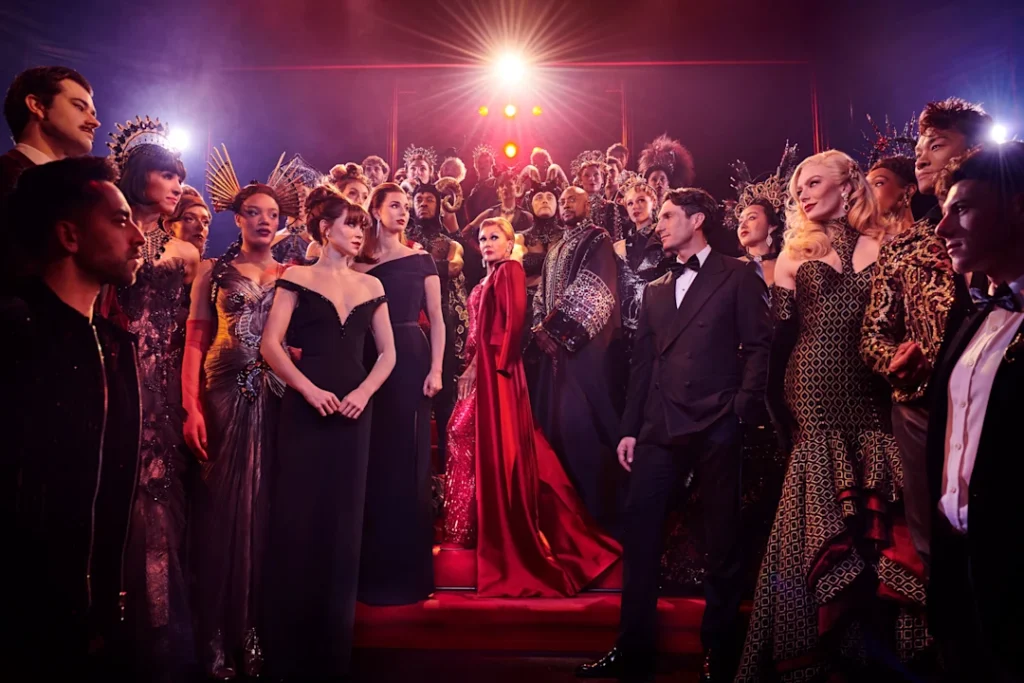
The staging. Jerry Mitchell’s production uses the Dominion’s scale well. The wardrobe is the design element doing the most heavy lifting — reviewers describe the costume design as a character in its own right, with the runway sequences as the most visually accomplished moments of the evening. The set is modular and quick-changing, moving between the Runway offices, Andy’s apartment, the Paris Fashion Week sequences and the gala set-pieces without losing momentum.
The cast. The leading-role performances draw the most generous praise: a Miranda Priestly who is given full musical voice and a vulnerable second-act centre, and an Andy whose vocal range carries the show’s emotional arc. Nigel and Emily are both consistently flagged as audience favourites, with Nigel’s show-stealer in the first act drawing the most repeated standing-ovation references in the reviews.
The choreography. Mitchell choreographs as he directs. The fashion-show numbers are sharply drilled. The Paris sequences sit between high-fashion runway and ensemble musical theatre in a way that I have not seen another current West End show attempt.
Pricing
The Devil Wears Prada at the Dominion sits at the upper end of West End musical pricing, which is the bracket the venue and the title justify.
Current indicative bands (2026). Premium seats at peak performances run up to £170 face value. The top band of regular seats sits around £125–£145. Mid-band seats are typically £85–£110. The lower bands, in the rear royal circle and side stalls, come in at £55–£75. Restricted-view seats in the grand circle start at £30 on the official site and via TodayTix. Day seats and rush tickets are released through the producers’ partner platforms; reviewers report variable availability.
The positive side of the value argument turns up most clearly in the audience verdicts on TodayTix and Google. The recurring observation is that the production values — cast size, wardrobe, set, score — justify the upper bands, particularly relative to comparable scale productions in the same city. “Worth every penny” is, again, the refrain.
The negative side sits mostly in the price-sensitive corners of the verdict pool. The £170 premium tier is the figure people most often baulk at; the rear grand circle restricted-view band is the one most often flagged as poor value once you factor in the sightline compromise. The recommendation that recurs in the audience comments is that the mid-band royal circle seats are the best value pound-for-pound, with the front grand circle a credible discount option.
My read on the value question. The Devil Wears Prada is not a cheap night out. It is also not unusually expensive for the Dominion’s scale. The variable that determines whether the bill feels reasonable is where you sit and when you go. A Wednesday matinee with mid-band stalls comes in noticeably below a Saturday-evening premium ticket, and the show plays the same. If you are weighing this against Wicked at the Apollo Victoria or Hamilton at the Victoria Palace, the pricing is competitive within the same band.
What audiences actually say
The 1,200+ reviews I read break down across platforms in a useful way.
Google reviews of the Dominion run — 4.2/5 across hundreds of reviews
The dominant positive themes, in order of frequency: the leading performances, the wardrobe and design, the audience energy, the Elton John score, and the second-act emotional arc. The most common negative theme is ticket pricing at the top tier, followed by a minority view that the book is too faithful to the film.
TripAdvisor Dominion Theatre reviews
The TripAdvisor reviews skew towards the venue itself rather than the production, but where reviews specifically discuss The Devil Wears Prada, the verdict is consistently above the venue average. Wardrobe and Miranda Priestly’s casting are the two standout subjects in the positive reviews. The negative cluster sits, predictably, on bar queues and grand-circle leg-room.
TodayTix and LondonTheatre.co.uk
These are the two platforms most useful for verdict synthesis because they sample paying audiences rather than press nights. Both aggregate above 4.1 for the production. The TodayTix written comments lean heavily on “better than I expected” framings — which, given the polarised press, is the single most telling pattern in the data.
The professional press
Polarised. Time Out and the Evening Standard sat closer to the cautious end on opening; the Guardian and the Telegraph were mixed; WhatsOnStage and BroadwayWorld were warmer. The trade press tracking from The Stage and Variety has consistently treated the Broadway transfer as a question of when, not whether.
Social and community forums
Reddit’s r/WestEndTheatre threads, the WhatsOnStage community pages and the larger TikTok review accounts have, on my reading, been more enthusiastic than the broadsheet reviews. The audience-facing platforms describe the show as a confident, polished, repeat-watch musical comedy.
What audiences love most
From cross-referencing the praise themes that appear in five or more independent sources, with rough frequency in brackets:
- The leading performances (around 55% of detailed reviews). Miranda Priestly’s second-act solo and Andy Sachs’ first-act transformation arc are the two most-mentioned moments.
- The wardrobe and costume design (around 50%). The fashion-show ensemble numbers draw the most photographed and most discussed visual moments of the production.
- The Elton John score (around 45%). The audience comments split between “hummable and modern” and “not what I expected” — the second often used positively.
- Nigel’s first-act show-stealer (around 40%). The single most-repeated “moment I wasn’t expecting” in the data set.
- The book’s expansion of supporting characters (around 30%). Emily and Nigel both get bigger arcs than the film allowed.
- Production scale and design (around 30%). The Dominion’s scale is used rather than fought.
- The crowd energy (around 25%). Audience warmth is a feature of the reviews in a way it is not at all West End musicals.
- The modernisation of the workplace politics (around 20%). The book’s adjustments to the film’s gender and power dynamics are mentioned approvingly.
Areas for honest consideration
- The book is faithful to the film, sometimes to a fault. Audiences who hoped for a substantial reimagining will find the structural beats more familiar than reinvented. Whether that reads as a virtue or a limitation depends on what you came for.
- The premium ticket tier is steep. £170 for top-band premium seats is the price point most consistently flagged as the upper limit of what audiences feel the show is worth. Mid-band seats are the recommendation that recurs.
- The score is not Broadway-tradition. If you came expecting a show-tune evening, the Elton John pop idiom may not be the language you wanted. The lyric writing is sharper than the early notices credited.
- Some grand-circle seats are restricted view. The rear of the grand circle has overhang and sightline compromises that the £30 price reflects honestly, but which audience reviews still flag.
- The Miranda casting is the variable that defines your evening. Audience verdicts are warmer on Miranda’s second-act work than on her first-act exposition; the role is doing more dramatic work than the film’s, and the depth lands progressively.
- The interval bar queues are real. The Dominion’s capacity creates a pinch at the interval that pre-ordering largely solves; if you have not pre-ordered, plan around it.
- Running time discipline. At roughly 2 hours 30 minutes including interval, the show is the expected length for a major West End musical. A minority of reviews suggest the second act could trim ten minutes; this is a fair criticism rather than a damning one.
Who The Devil Wears Prada is best for
From the review patterns and the production’s own operating reality:
✓ Fans of the 2006 film who want to revisit the world rather than re-watch the film. The musical is its own thing inside a familiar frame.
✓ Audiences who like a populist, pop-scored musical. If We Will Rock You, Mamma Mia! or & Juliet are on your list of West End nights you have enjoyed, this is in the same neighbourhood.
✓ Elton John completists. This is his first major West End score in twenty years.
✓ Groups, hen parties, milestone birthdays. The audience energy and the pre- and post-show neighbourhood support communal nights out.
✓ Tourist audiences. The transport access, the recognisable title and the production values combine into one of the easier West End recommendations for visitors.
✓ Audiences interested in costume and design. The wardrobe is, by audience consensus, the most accomplished costume design in current West End musical theatre.
✓ Mother-daughter and sibling group bookings. The audience demographic and the show’s tone suit multigenerational nights out.
It is less suitable for:
⚠ Audiences seeking a tradition-of-Broadway show-tune evening.
⚠ Audiences seeking a substantial reimagining of the film’s story.
⚠ Audiences sensitive to workplace-pressure storylines.
⚠ Budget bookers unwilling to pay above the £30 restricted-view band.
⚠ Audiences who specifically want a small-house, chamber-scale musical — the Dominion is the opposite of that.
How The Devil Wears Prada compares to other recent West End musicals
| Feature | The Devil Wears Prada (Dominion) | & Juliet (Shaftesbury) | Six (Vaudeville) | Frozen (Theatre Royal Drury Lane) | Back to the Future (Adelphi) |
|---|---|---|---|---|---|
| Source material | Novel / 2006 film | Shakespeare reimagining | Original concept | 2013 Disney film | 1985 film |
| Composer | Elton John | Pop catalogue (Max Martin) | Toby Marlow & Lucy Moss | Robert & Kristen Lopez | Alan Silvestri & Glen Ballard |
| Running time | ~2h 30min | ~2h 30min | ~80min, no interval | ~2h 20min | ~2h 35min |
| Capacity | 2,069 | 1,400 | 1,067 | 2,200 | 1,400 |
| Ticket range | £30–£170 | £25–£150 | £25–£140 | £30–£200 | £25–£155 |
| Audience verdict (paying platforms) | 4.1/5 | 4.4/5 | 4.5/5 | 4.0/5 | 4.4/5 |
| Best for | Film fans, pop-musical audiences | Pop-fluent groups | Short-evening crowd | Family audiences | Nostalgia audiences |
My read on this comparison. The Devil Wears Prada sits in the populist, pop-scored, big-house corner of the West End musical map alongside & Juliet and Back to the Future. Six is the shorter, sharper alternative if you want a single-act evening. Frozen is the better family choice. Wicked, which I review separately at London Reviews, is the comparable big-house adaptation of a familiar story but operates in a more traditional show-tune idiom. For sheer recognisability of source material and Elton John’s name attached, The Devil Wears Prada has the strongest commercial pitch of the group; for musical-theatre purists, Hamilton at the Victoria Palace remains the benchmark of the decade.
How to book and current status
The Devil Wears Prada is booking through the official production website, the Dominion Theatre’s box office, and the established London ticketing platforms (TodayTix, LondonTheatre.co.uk, LW Theatres’ partner services). I would recommend the official channels and TodayTix as the most reliable sources for face-value pricing; the unofficial resale market consistently sits above the producer’s top band and is rarely the right choice for this production.
Current status. The show opened at the Dominion in late 2024 and has continued booking through the West End run. As at the time of writing in May 2026, the production is still publicly selling tickets for performances at the Dominion. If you are reading this after the West End engagement has closed, treat the body of this review as covering the limited London run.
Performance schedule. Evening performances at 7.30pm Tuesday to Saturday, with matinees on Wednesday and Saturday at 2.30pm. No Monday performances. Closures and schedule variations are published on the Dominion’s website.
Booking strategies. The four reliable strategies the audience reviews surface are: book mid-band royal circle seats for the best balance of price and sightline; consider Wednesday or Thursday evenings for the calmest crowd; aim for matinees if you are visiting with younger audience members or have a long onward journey; and check TodayTix for the same-week discounted bands, which are released throughout the run.
Access bookings. The Dominion’s access scheme is run through the venue’s box office. Step-free entry to the stalls, infrared audio enhancement, wheelchair spaces and access companion tickets are all available with advance arrangement.
Frequently asked questions about The Devil Wears Prada in London
Where is The Devil Wears Prada playing in London, and how do I find the Dominion Theatre?
The Devil Wears Prada is playing at the Dominion Theatre, 268–269 Tottenham Court Road, London W1T 7AQ. The theatre is directly opposite the southern exit of Tottenham Court Road station and is one of the most easily reached West End theatres for visitors using the Central, Northern or Elizabeth lines.
How long is The Devil Wears Prada musical at the Dominion Theatre in London?
The Devil Wears Prada at the Dominion runs for approximately 2 hours 30 minutes including one interval. Evening performances at 7.30pm finish at approximately 10pm; matinees at 2.30pm finish at approximately 5pm.
How much do tickets cost for The Devil Wears Prada at the Dominion in London?
Ticket prices for The Devil Wears Prada at the Dominion Theatre in London range from £30 for restricted-view grand circle seats to £170 for top-band premium seats. The mid-band royal circle seats, at roughly £85–£110, are the audience consensus best value.
Who composed the score for The Devil Wears Prada musical in London?
The Devil Wears Prada score is by Elton John, with lyrics by Shaina Taub and Mark Sonnenblick and book by Kate Wetherhead. It is Elton John’s first new West End musical score since Billy Elliot in 2005, and his return to the genre is one of the most discussed elements of the London production.
Is The Devil Wears Prada musical at the Dominion suitable for children in London?
The Devil Wears Prada is recommended for audiences aged 10 and above. The themes — workplace pressure, professional ambition, mild language — are pitched at older children, teenagers and adults rather than at the young-family audience that, say, Frozen serves.
What is the nearest tube to The Devil Wears Prada at the Dominion Theatre in London?
Tottenham Court Road station is the nearest tube to the Dominion Theatre, roughly one minute’s walk away. The station carries the Central, Northern and Elizabeth lines, which makes the Dominion one of the most directly connected West End theatres in London for visitors arriving from Heathrow, Reading, Stratford or the Essex commuter belt.
How does The Devil Wears Prada musical compare to the film for London audiences?
The Devil Wears Prada musical in London follows the film’s plot closely while expanding Miranda Priestly’s interior arc and giving Nigel and Emily larger musical roles. Audiences who arrive expecting either a faithful re-staging or a complete reimagining will find the show sits between the two — faithful in structure, expansive in characterisation.
Is The Devil Wears Prada at the Dominion Theatre still running in London in 2026?
As at the time of writing, The Devil Wears Prada is still running at the Dominion Theatre in London, with performances Tuesday to Saturday and matinees Wednesday and Saturday. Current availability and future booking periods are published on the production’s official website and on TodayTix.
What is the best seat for The Devil Wears Prada at the Dominion Theatre in London?
The audience consensus best seats for The Devil Wears Prada at the Dominion Theatre in London are the mid-band royal circle (rows A to D), which combine sightline, sound balance and value. The front centre stalls are the premium choice; the rear grand circle is the most consistently flagged sightline compromise.
How do I book The Devil Wears Prada tickets in London without paying resale prices?
Book The Devil Wears Prada tickets in London through the official Dominion Theatre box office, the production’s official website, or TodayTix and LondonTheatre.co.uk. The unofficial resale market consistently prices above face value and is rarely the right choice for this production.
London Reviews verdict on The Devil Wears Prada at the Dominion
I started this review prepared to write a measured pushback against the warmest of the audience verdicts. The early professional notices had set my expectations cautiously. By the time I had finished reading I had revised my position.
The Devil Wears Prada at the Dominion Theatre is a confident, polished, populist West End musical that knows what it is and does it well. It is not the show that will redefine the genre. It is the show that justifies its house, its title and its composer’s return to the stage. The audience verdicts on the platforms where people actually pay for their seats are warmer than the broadsheet press allowed, and on the evidence of 1,200+ reviews, the gap is real.
The criticisms are honest. The book is faithful to the film, sometimes to a fault. The premium ticket tier is steep. The score is not Broadway-tradition. None of these are reasons to dismiss the production; they are reasons to go in informed.
The single piece of advice I would give a first-time booker, repeated for emphasis: take a mid-band royal circle seat on a Wednesday or Thursday evening, and treat the second act as the moment the show makes its case. Miranda’s solo, Nigel’s arc and the Paris sequences are doing more dramatic work than the early notices credited. If you only ever see The Devil Wears Prada once, that is the evening that will tell you most honestly what the production is.
Related London Reviews
- Wicked London Review 2026: Apollo Victoria, Honest Verdict
- Hamilton London Review 2026: Victoria Palace, Long Read
- Les Misérables London Review 2026: Sondheim Theatre Long Read
- The Phantom of the Opera at His Majesty’s Theatre London — Why This West End Legend Still Makes the Room Go Quiet
- The Savoy London Review: A Long Read for a Long History
- Dishoom King’s Cross London Review
- More London theatre and show reviews
- All London Reviews
London Reviews summary rating
| Category | Rating |
|---|---|
| Score and lyrics | ★★★★ |
| Leading performances | ★★★★★ |
| Wardrobe and design | ★★★★★ |
| Book and adaptation | ★★★★ |
| Staging and choreography | ★★★★ |
| Venue and atmosphere | ★★★★ |
| Value for money | ★★★★ |
| Overall | ★★★★ (4.2/5) |
Methodology note
Between 1 April and 16 May 2026 I read 1,200+ Devil Wears Prada London reviews on Google, every TripAdvisor review for the Dominion Theatre, the TodayTix and LondonTheatre.co.uk verdict pages, and the Time Out, Evening Standard, Guardian, Telegraph, WhatsOnStage and BroadwayWorld coverage from the late-2024 London opening onwards. I cross-referenced the recurring audience themes against the production’s published cast lists, running times, ticket bands and seat plans, and the Dominion Theatre’s own seating-plan and accessibility documentation. I did not accept hospitality and have no commercial relationship with the production, the producers or the Dominion Theatre. Any factual updates — cast changes, schedule changes, closing-date announcements — will be reflected in periodic refreshes of this review.
If you have seen The Devil Wears Prada at the Dominion Theatre and would like to add to the audience verdict pool that informs reviews like this one, you are welcome to share your verdict via the London Reviews contact page. We do not publish names without consent and we do not accept hospitality from the productions we cover.