





This My Neighbour Totoro Review by London Reviews is the most thorough independent audience guide available to the Royal Shakespeare Company’s six-Olivier-Award-winning stage adaptation of the Studio Ghibli classic, now in its third London year at the Gillian Lynne Theatre on Drury Lane. We’ve cross-referenced professional critics, hundreds of TripAdvisor and SeatPlan reviews, audience comments on WhatsOnStage, and venue-specific seat reviews so you can decide — clearly — whether to book, where to sit, and what you’ll actually get for your money before the strictly limited run closes on 30 August 2026.
Last updated: 30 April 2026 — Independently researched and written by the London Reviews team. We do not accept payment from the venues or productions we review.
Looking for an honest My Neighbour Totoro review? This is the most thorough independent assessment of My Neighbour Totoro at the Gillian Lynne Theatre — Tom Morton-Smith’s stage adaptation of Hayao Miyazaki’s 1988 Studio Ghibli film, with puppetry by Basil Twist and Jim Henson’s Creature Shop, music by original film composer Joe Hisaishi, direction by Phelim McDermott, and a current company led by Victoria Chen, Helen Chong, Dai Tabuchi, Jacqueline Tate and Ai Ninomiya. Below we cover the show, the venue, the seats genuinely worth booking, ticket prices from £18 to £197, what audiences love (and what frustrates them), and our verdict on whether this once-in-a-generation theatrical event still earns its 4.9-star average and standing-ovation reputation.
My Neighbour Totoro Review: At a Glance
- Show: My Neighbour Totoro (Royal Shakespeare Company production)
- Genre: Family play, fantasy, coming-of-age, puppetry-driven theatre
- Venue: Gillian Lynne Theatre (formerly New London Theatre)
- Address: 166 Drury Lane, London WC2B 5PW
- Currently booking: Strictly until 30 August 2026 — this is a limited run with no extension expected
- London opening: 8 October 2022 (Barbican Centre, world premiere); West End transfer to Gillian Lynne Theatre on 8 March 2025
- Running time: Approximately 2 hours 40 minutes including a 20-minute interval
- Age recommendation: 6+ (under-4s not admitted, including babies in arms; under-16s must be accompanied by an adult and seated next to them)
- Director: Phelim McDermott (Improbable Co-Founder, Olivier Award winner for this production)
- Adapter / Playwright: Tom Morton-Smith (Oppenheimer)
- Composer & Executive Producer: Joe Hisaishi (the original film composer)
- Puppetry Designer & Director: Basil Twist, with puppets crafted by Jim Henson’s Creature Shop
- Production Designer: Tom Pye | Costume Design: Kimie Nakano | Lighting: Jessica Hung Han Yun | Sound: Tony Gayle | Orchestration: Will Stuart
- Current lead cast (Spring 2026): Victoria Chen as Mei, Helen Chong as Satsuki (joined 10 March 2026), Dai Tabuchi as Tatsuo, Jacqueline Tate as Granny Ōgaki, Ai Ninomiya as the Singer (Kaze no Koe)
- Producer: Royal Shakespeare Company in collaboration with Nippon TV and Improbable
- Ticket prices: From £18 (rear Circle restricted view) and £25 (day seats) up to £197 (premium centre Stalls)
- Where to book: Official site, LW Theatres, Official London Theatre, TodayTix
- Nearest tube: Covent Garden (3 minutes); Holborn (6 minutes); Tottenham Court Road (8 minutes); Leicester Square (8 minutes)
- Capacity: 1,024 seats across Stalls (around 591) and Circle (around 433)
- Audience rating: 4.9/5 across over 530 verified bookings (London Theatre Tickets / Headout)
- Critical reception: Five stars from The Guardian, The Financial Times and the Sunday Times; four stars from The Times, The Independent and The Daily Telegraph; three stars from the Evening Standard. Time Out: “blockbuster, awe-inspiring puppets”
- Awards: Six Olivier Awards (2023) — Best Entertainment or Comedy Play, Best Director (Phelim McDermott), Best Set Design (Tom Pye), Best Costume Design (Kimie Nakano), Best Lighting Design (Jessica Hung Han Yun), Best Sound Design (Tony Gayle); plus five WhatsOnStage Awards
- Box-office record: Broke the Barbican Centre’s single-day ticket-sales record in May 2022, surpassing the 2015 Benedict Cumberbatch Hamlet
- Audience reach: Over 290,000 people saw the show during the Barbican runs alone
- Accessibility: Step-free access; lifts; wheelchair spaces; accessible toilets; assistance dogs welcome; scheduled audio-described, captioned, BSL-interpreted and chilled performances
- Performance schedule: Mon-Sat 7pm; matinées Thursday, Saturday and Sunday at 2pm (no Sunday evening)
- Sensory advisories: Loud music, pyrotechnics, smoke, haze, scenes set in a hospital with a sick parent, large puppets — chilled performances available for sensory-sensitive audiences
Introduction: Why We’re Reviewing Totoro Now
There are West End shows you can leave for next year. My Neighbour Totoro is not one of them. The strictly limited run at the Gillian Lynne Theatre closes on 30 August 2026 and there is no announced extension beyond that. Producers Joe Hisaishi (the original film’s composer) and the Royal Shakespeare Company have made it clear this is a finite engagement; they’ve been clear the same way every year since 2022, and every year demand has forced an extension. This time, with the August closing date confirmed and the rest of the West End summer slate filling up, urgency is genuine.
The numbers are extraordinary. Over 290,000 people saw the show during its two Barbican seasons alone. It broke the Barbican’s single-day ticket-sales record in May 2022, beating Benedict Cumberbatch’s Hamlet. It picked up six Olivier Awards in 2023 — the most of any show that year — including Best Entertainment or Comedy Play, Best Director, Best Set, Best Costume, Best Lighting and Best Sound. Five WhatsOnStage Awards followed. Verified-booking audience scores sit at 4.9/5 across hundreds of recent reviews. Critics across the political and cultural spectrum, with one or two careful exceptions, have surrendered to it.
For a stage adaptation of a 37-year-old children’s animated film with a famously slow plot, set in 1950s rural Japan, performed by an all British East Asian cast, with no megastar names, that is an entirely improbable result. So why has it landed so hard? Our My Neighbour Totoro review sets out to answer that — alongside the practical questions every potential booker is asking. Is it really suitable for six-year-olds? Where should you actually sit in a thrust-stage theatre? Are the £25 day seats worth chasing? Is the show too gentle for older teenagers? Is it the right pick for a family with one Studio Ghibli super-fan and one Studio-Ghibli-curious adult who has never heard of Totoro? We’ve done the work; the answers are below.
If you’re new to London Reviews, our recent West End coverage includes our Les Misérables London Review, our Mousetrap review, our guide to The Savoy for pre-theatre stays, and our Dishoom King’s Cross review for post-show dining.
The Gillian Lynne Theatre: Your Full Venue Guide
Location & Getting There
The Gillian Lynne Theatre sits at 166 Drury Lane, on the eastern edge of the Covent Garden conservation area. It’s an easy walk from almost anywhere in central London. Covent Garden tube (Piccadilly Line) is the closest at three minutes; Holborn (Central, Piccadilly) is six minutes; Tottenham Court Road (Central, Northern, Elizabeth) is around eight minutes; Leicester Square (Northern, Piccadilly) is also about eight. From Charing Cross rail station, the walk is around twelve minutes through theatreland.
Buses 1, 59, 68, 168, 188, 243 and X68 stop on Drury Lane within a minute of the theatre. Night buses N1, N68, N171 and N242 cover the same route after midnight. Santander Cycles docking stations are available on Drury Lane and at multiple Covent Garden locations, all within a couple of minutes’ walk.
The Building
This is one of London’s youngest West End theatres in its current form, opened in 1973 on the site of a venue that has hosted entertainment continuously since the 1850s. The exterior is unapologetically 1970s — concrete and wide-panelled glass — but the interior is genuinely modern: a 1,024-seat auditorium with a thrust stage, semi-circular seating, no traditional proscenium, and excellent sightlines from almost every position. Andrew Lloyd Webber’s Cats ran here for 21 years until 2002, then War Horse from 2009 to 2016, then School of Rock. In 2018, the building was renamed in honour of Gillian Lynne — choreographer of Cats and Phantom of the Opera — making it the first West End theatre named after a woman, ahead of any royal.
The thrust-stage configuration matters for Totoro. The set extends out into the audience on three sides, and the puppetry has been deliberately staged to play in the round — meaning a “side” seat at the Gillian Lynne is genuinely closer to the action than a “centre” seat in many traditional theatres. Audience reviews repeatedly note the immersive quality of even less expensive seats.
Seating Guide — Where to Sit
The Gillian Lynne is split across two levels: Stalls (around 591 seats) and Circle (around 433 seats). Unlike older West End venues, the rake on both levels is genuinely good and views are largely unobstructed. The thrust stage means the layout is closer to the National Theatre’s Olivier than to Andrew Lloyd Webber’s other West End houses.
- Stalls Rows E-M, centre: The premium experience for Totoro. You’re close enough to see facial expressions on the puppets and far enough back to take in the full sweep of the set when Totoro reveals himself. Premium pricing applies.
- Stalls Rows A-D: Genuinely close to the action — perfect if you want to see Mei and Satsuki up close, but you’ll need to look slightly up. Some audience reviews note minor neck strain over the show’s full 2h 40m.
- Stalls Side Rows K-N: Best value in the building. The thrust stage means side seats genuinely face the action, and you save significantly on premium pricing.
- Circle Front Rows A-C: Excellent. The cinematic, sweeping view of the full set is arguably the best for first-time audiences who want to take in the spectacle. Slightly off-centre is often best value.
- Rear Circle Central: The budget pick. £18-£35 depending on date. Distant but unobstructed; the puppetry reads remarkably well even from here.
- Seats to think twice about: The very ends of side rows in the Circle, where the angle becomes pronounced. Theatremonkey and SeatPlan reviewers flag these as fair-but-not-great value.
Accessibility
The Gillian Lynne is one of the West End’s better-equipped venues for accessibility. Step-free access throughout the building, with lifts to both levels, accessible toilets, accessible parking nearby, and a guide-dog policy. Wheelchair spaces are available; assistance dogs are welcome. Scheduled assisted performances for the current run include an Audio-Described performance on Saturday 4 July 2026 at 2pm; a Captioned performance on Sunday 5 July 2026 at 2pm; a BSL-interpreted performance on Saturday 24 May 2026 at 2pm; and a Chilled (relaxed/sensory-friendly) performance on Thursday 18 June 2026 at 2pm. The Chilled performance is particularly worth flagging for autistic audience members and families with sensory-sensitive children — adjustments include reduced sound and lighting effects, freedom to leave and re-enter the auditorium, and a more relaxed atmosphere.
Bars, Cloakroom & Interval
There are bars on both Stalls and Circle levels, plus a cloakroom (a welcome rarity in West End venues this size — useful given the Drury Lane location and unpredictable summer weather). Drinks at standard West End prices: wine around £8-9 a glass, beer around £6, soft drinks around £4. The Red Coats — LW Theatres’ branded front-of-house team — are consistently named in audience reviews as exceptionally helpful. The 20-minute interval is generous; queues are manageable thanks to the multiple bar locations.
Sensory and Content Notes
The official sensory advisory is extensive and worth reading before booking for younger or sensitive audience members. The show contains live music with some loud passages; pyrotechnics, smoke and haze; some scenes set in a hospital with a sick parent (Mei and Satsuki’s mother, Yasuko, has tuberculosis); and several very large puppets, including Totoro himself, which can briefly startle small children. The Cat Bus sequence is loud and visually intense. None of this is gratuitous, and most under-7s in the audience adjust within minutes — but the Chilled performance exists for a reason. If your child is genuinely scared of large costumed characters or has sound sensitivity, the Chilled performance on 18 June 2026 is the safer choice.
The Show: What to Expect (Spoiler-Free)
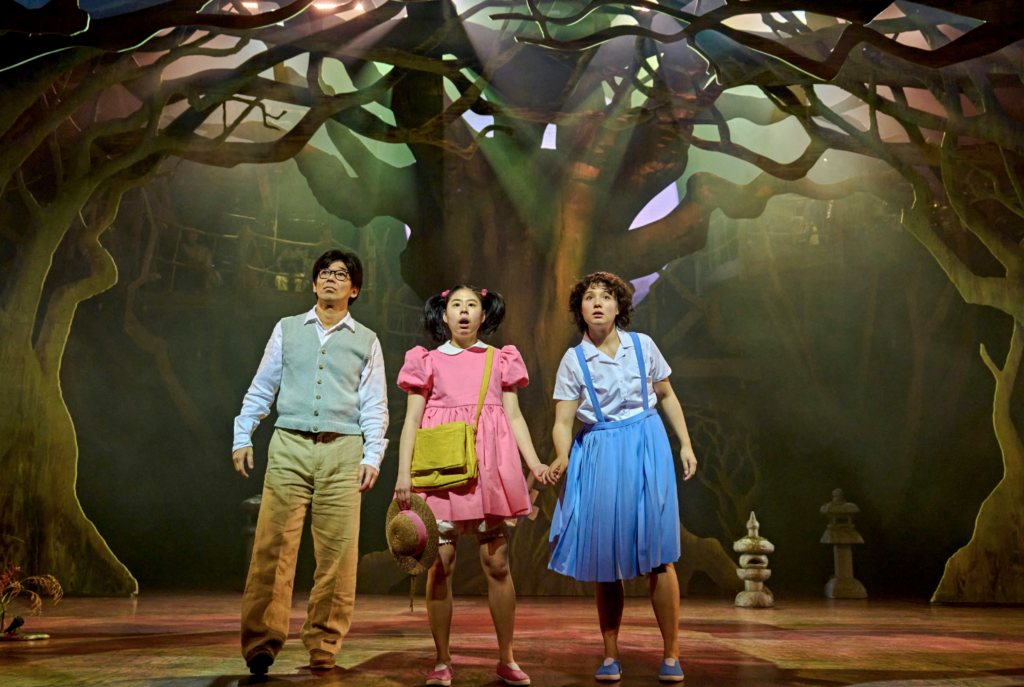
It’s the early 1950s in rural Japan. The Kusakabe family — university lecturer Tatsuo and his daughters, eleven-year-old Satsuki and four-year-old Mei — move to a rambling old farmhouse in the countryside to be closer to their mother Yasuko, who is convalescing from tuberculosis at a nearby hospital. The house, exactly as the children expected, turns out to be lightly haunted: by susuwatari (small soot sprites), by a benevolent forest spirit named Totoro who lives in the giant camphor tree, and eventually by an extraordinary flying creature that is part cat and part bus. Across one long summer, Mei and Satsuki navigate fear, separation, illness in the family, and the imaginative resourcefulness that childhood demands.
There is no villain. There is no peril of the kind contemporary children’s storytelling has trained audiences to expect. The narrative tension comes entirely from the slow, real anxieties of a family with a sick parent, and the way two small girls metabolise that fear into wonder. This is — emphatically — a feature, not a bug. Tone is closer to Studio Ghibli’s gentlest mode than to most stage drama. Sarah Hemming in the Financial Times called it “a gorgeous, uplifting tribute to the link between theatre and the imaginative realm of children’s play”. The Stage called it “a huge, healing hug of a show”. They are both right.
Dialogue is almost entirely in English, with occasional Japanese phrases. The play opens with a 3D recreation of the film’s iconic opening credits — including a charming animated ‘u’ that slinks down to change “neighbor” to “neighbour” — and from there the production largely follows the film’s structure. Tom Morton-Smith’s adaptation is deliberately faithful: this is the film, on stage, with the addition of Joe Hisaishi’s original score performed live by an onstage band perched on tree-platform bandstands, and singer Ai Ninomiya weaving the score’s vocal motifs through the scenes from various points around the auditorium.
Crucially, this is a play, not a musical. The songs are melodic and recurring but the action is driven by spoken dialogue, physical comedy, and — above all — the puppetry. The running time of two hours forty (including the interval) feels shorter than it sounds, but it is genuinely too long for typical four- or five-year-olds. The official 6+ recommendation is realistic; we’d suggest 7+ for a comfortable family experience.
The Cast & Performances in 2026
The current company has been led by Victoria Chen as Mei since the West End transfer in March 2025, with the cast refreshed on 10 March 2026 for the show’s second West End year.
Lead Cast (From 10 March 2026)
- Victoria Chen as Mei Kusakabe — Continuing in the role she’s played since the West End opening in March 2025, drawing on credits including The Night Before Christmas. The performance has earned consistently warm audience reviews; the role demands a delicate balance of childlike wonder and emotional truth, and Chen lands both.
- Helen Chong as Satsuki — Making her West End principal debut, having previously appeared in Gerry and Sewell and Little Women. Audience reviews from the early weeks of her tenure have been notably positive.
- Dai Tabuchi as Tatsuo (the father) — The longest-serving principal in the West End company, with credits including Usagi Yojimbo. His Tatsuo is gentle, distracted, deeply present — exactly the absent-minded academic father the role requires.
- Jacqueline Tate as Granny Ōgaki — Continuing in the role; her credits include Les Misérables. Provides much of the play’s quiet emotional ballast.
- Ai Ninomiya as the Singer (Kaze no Koe) — The vocalist who delivers Hisaishi’s score live throughout the production, often appearing on the bandstand platforms above the stage. Her performance of the title song and the haunting “Path of the Wind” is consistently named as a highlight in audience reviews.
Supporting Cast & Kazego Puppetry Ensemble
The supporting company includes Phyllis Ho as Yasuko (Mei and Satsuki’s mother), Steven Nguyen as Kanta, Jamie Zubairi as Hiroshi, Kumiko Mendl as Nurse Emiko and Shaofan Wilson as Miss Hara. The Kazego Puppetry Ensemble — the dozen-plus performers who operate every Totoro, soot sprite, chicken, fish and Cat Bus on stage — was extensively refreshed for the March 2026 cast change. Principal puppeteers Eero Chen Liu and Gun Suen lead the team, with Si Rawlinson as Movement Captain. They are the show’s true co-leads and you’ll find yourself watching them as much as the puppets.
Standout Performance Themes
Across audience and critic reviews, four performance threads consistently dominate praise. First, the central sister relationship — Chen and Chong now, Chen and Ami Okumura Jones for the previous year — is the emotional spine of the show, and audiences repeatedly call it the moment they cried. Second, Ai Ninomiya’s vocal performance, which The Guardian called “haunting” and audience reviewers describe as “the moment I started to lose it”. Third, Dai Tabuchi’s quietly affecting Tatsuo, who carries the buried grief of the production with extraordinary restraint. And fourth, the Kazego Puppetry Ensemble — every reviewer ends up trying to describe what they did, and most fail. “You forget you’re watching a stage creation,” one verified-booking reviewer wrote in April 2026. “It felt like Totoro was actually there.”
The Puppetry, Music, Staging & Production
The Puppetry
If Totoro has a single defining achievement, this is it. Basil Twist designed and directs a new “wind spirit” style of puppetry developed specifically for this production — entirely human-operated, no animatronics, no machinery. Prototypes were sculpted by Twist in San Francisco, refined in London with Phelim McDermott and consultants, and then sent to Jim Henson’s Creature Shop in Los Angeles for the final detailed crafting. The result is a fleet of puppets ranging in scale from finger-sized soot sprites to a Totoro that fills the upstage and a Cat Bus that genuinely threatens to knock out the front row.
There are at least five different Totoros, deployed at different scales for different scenes — the colossal sleeping Totoro Mei first encounters under the camphor tree, smaller mobile Totoros, an even smaller version, and a charming 2D faux-woodcut Totoro for one specific sequence. The bus-stop scene — Mei and Satsuki waiting in the rain as Totoro shuffles up beside them, examines their umbrella, and waits for the Cat Bus — is one of the most iconic moments in the source film, and the production’s recreation has been described by critics across the British press as among the purest moments of stage magic in recent years.
The Score
Joe Hisaishi’s original 1988 film score is performed live by a small ensemble visible on raised tree-platform bandstands at the back of the stage, in a new orchestration by Will Stuart. Singer Ai Ninomiya delivers the vocal lines from various positions around the auditorium. Audience reviews are unanimous on the score’s power. Critical opinion has been more divided historically — Clive Davis in The Times called the music “insipid” in his original four-star review; The Independent’s Annabel Nugent felt the score was “occasionally not a strong enough partner to the splendour of the visual storytelling”. On balance, audience reviews dominate: the score lands, hard, particularly in the second half.
Set, Lighting & Costume
Tom Pye’s Olivier-winning production design uses a steel base with oak veneer, traditional Japanese shou sugi ban wood treatment for parts of the house, and deliberately two-dimensional layered representations of trees and forest. There is no plastic. The result is a set that feels sculptural and honest — and that transforms with breathtaking economy from the family’s old town house, to the rural Kusakabe farmhouse, to the camphor-tree forest, to the hospital where Yasuko is being treated. Jessica Hung Han Yun’s Olivier-winning lighting design works in subtle, painterly tones; Kimie Nakano’s Olivier-winning costumes draw on 1950s rural Japanese dress with real period detail.
Sound
Tony Gayle’s Olivier-winning sound design wraps the production in spatial detail — wind in the camphor tree, water in the irrigation ditches, the distinctive whistle of the Cat Bus arriving — without ever overwhelming the live music or the dialogue. Sound effects and soundscape are by Nicola T Chang.
Tickets & Pricing
Full Price Range
Tickets currently range from £18 (rear Circle restricted view, off-peak) up to £197 (premium centre Stalls on Saturday evenings). Most decent seats sit between £45 and £95. Saturday evenings are the most expensive; Tuesday-Thursday evenings and Thursday matinées are noticeably cheaper. The £18 entry-level price is genuinely competitive for a six-Olivier-winning West End production.
£25 Day Seats — The Best Deal in the Building
A limited number of Stalls day seats are released at 10am every performance day at £25 each, two per customer. Buy via the LW Theatres website. These are genuinely good seats, not the back row of the Circle in disguise — multiple SeatPlan reviewers have reported sitting in mid-Stalls for £25 having shown up to the website at 10am sharp. Weekday performances are easiest; weekends sell out within minutes.
Other Discount Options
- Book 6 Weeks Ahead — 20% off: Valid on Tuesday-Saturday evenings and Thursday and Sunday matinées (excludes Saturday matinées). One of the best deals if you can plan ahead.
- RSC £10 tickets: A limited number of £10 tickets are available to RSC members and audiences who have signed up to the RSC’s accessibility scheme — book via the LW Theatres website using the link in your welcome email.
- Groups of 10+: Price bands A and B reduced to £45 (Tuesday-Friday evenings, Thursday matinées; excludes peak weeks).
- Groups of 20+: Price bands A and B reduced to £39.50 (same exclusions).
- Groups of 10+ on Saturday evenings: Price band A reduced to £65.
- UK schools, colleges, university groups of 10+: Price bands B-D in the Circle reduced to £25, plus one free teacher per ten students paid (Tuesday-Thursday evenings and Thursday matinées; excludes peak weeks).
- LOVEtheatre off-peak offer (mid-April to mid-May 2026): Top non-premium seats reduced to £70/£60/£45/£35 across Tuesday-Thursday evenings; check Theatremonkey for current windows.
Where to Book
- Direct from totoroshow.com or LW Theatres — official sites with no hidden booking fees and full transparency on availability. The only routes for £25 day seats and 6-weeks-ahead 20% discount.
- Official London Theatre — the SOLT site, reliable and fee-transparent.
- TodayTix — sometimes carries last-minute deals and rush tickets.
- TKTS Leicester Square — for day-of-performance discount tickets; arrive around 10am.
- Box office: 020 3925 2998 — useful for accessibility bookings and group enquiries.
Comparison With Similar Family Shows
For context: The Lion King at the Lyceum runs roughly £30-£250. Wicked at the Apollo Victoria sits around £30-£200. Matilda the Musical at the Cambridge Theatre runs £30-£175. Frozen (when running) was £30-£200. Totoro sits below most, with the £18-£25 entry price genuinely the cheapest serious family-theatre ticket on Drury Lane and the £197 ceiling lower than most major musicals’ premium pricing. Worth flagging too: this is a play, not a musical, and the running time (2h 40m including interval) is in line with major musicals despite the typically lower play-pricing — meaning genuinely strong value per minute.
What Audiences Actually Say: Review Analysis
Verified Booking Reviews (Headout / London Theatre Tickets)
The verified-booking aggregator at London-Theater-Tickets.com shows My Neighbour Totoro at 4.9/5 across over 530 ratings. Five-star reviews dominate (484 of 530); only one reviewer rated below three. Recent April 2026 reviews repeatedly use words including “magical”, “mesmerising”, “breathtaking”, “absolute dream”, “puppetry blew me away”, and “perfect family night out”. Multiple reviewers describe being moved to tears; multiple reviewers describe being so absorbed they forgot they were watching puppetry. Several mention buying the merchandise — the show has unusually well-designed merchandise and a meaningful cult following.
TripAdvisor
TripAdvisor reviews of the production track closely with the verified-booking data — high-fours-to-five-stars, consistent praise for the puppetry, the music, and the family-friendly atmosphere. Recurring observations: “tears in my eyes”, “fell back into childhood”, “performance, design and storytelling exceeded my expectations”, “brilliant for adult Studio Ghibli fans, brilliant for children, brilliant as a date night”. The one consistent negative theme is from audience members expecting a more conventional dramatic arc — a small minority feel the absence of villain and peril makes the show too gentle.
SeatPlan & Theatremonkey
SeatPlan’s user reviews are predominantly positive on both the show and the venue, with seat-specific advice that is genuinely useful for first-time bookers. Theatremonkey’s monkey gives the production a strong recommendation with detailed seat-by-seat guidance. Both flag the £25 day seats as exceptional value.
Professional Critics
Professional reception has been almost uniformly positive across the show’s three London runs. Five-star reviews from The Guardian (Arifa Akbar called it “just as enchanting and perhaps more emotionally impactful” than the source film), the Financial Times (Sarah Hemming called it “a gorgeous, uplifting tribute to the link between theatre and the imaginative realm of children’s play”), and the Sunday Times. Four stars from The Times, The Independent, The Daily Telegraph and The Sunday Telegraph. Time Out called the puppets “blockbuster, awe-inspiring” and the show “imperfect, absurd, magnificent” — their review’s mild reservation was that the production’s reverence for the source material limits its room for fresh artistic vision. The most muted professional verdict came from Nick Curtis at the Evening Standard, who gave it three stars and said it needed “more jeopardy, more darkness and more of the monsters”.
The Awards Record
The 2023 Olivier sweep — six wins from nine nominations, including Best Entertainment or Comedy Play, Best Director, Best Set, Best Costume, Best Lighting and Best Sound — was the most of any production that year, and the most decisive institutional acknowledgment a play of this kind has received in recent British theatre history. Five WhatsOnStage Awards followed.
What Audiences Love Most
- The puppetry. All of it. Audience reviewers across three years and three London runs have run out of superlatives for Basil Twist’s work and the Kazego Ensemble that operates it. The first reveal of the colossal sleeping Totoro produces audible gasps on most nights; the Cat Bus sequence is regularly described as the single most magical moment audience members have seen on a London stage.
- Hisaishi’s score, performed live. The combination of the original 1988 score in Will Stuart’s new orchestration, Ai Ninomiya’s vocal performance, and the visible bandstand musicians on tree-platforms creates an atmosphere that no recorded soundtrack can match. “I started crying within ten minutes” appears in dozens of reviews.
- The bus-stop scene. The most iconic moment from the source film, recreated on stage with such precision and warmth that it has become the de facto signature image of the production.
- The genuine cross-generational appeal. Verified-booking reviews describe parents bringing children, grandparents bringing grandchildren, and Studio Ghibli super-fans bringing Studio-Ghibli-curious partners. All three groups consistently report the same level of satisfaction. Few family shows manage that.
- The casting of Mei. The decision to cast adult Asian actors as the small girls — and use perspective-forcing costume design to make them read dimensionally as children — has been universally praised. Victoria Chen’s Mei has been earning four-star reviews since her debut and continues to do so under the new cast.
- The 4.9/5 audience verdict. Across more than 530 verified bookings, this is one of the highest sustained audience scores of any current West End show. The consistency is the point: people don’t just like Totoro; they love it.
- The £25 day seats — and they’re real seats. Multiple SeatPlan and Theatremonkey reviewers have reported genuinely good Stalls views via the day-seat scheme. This is rare in the West End and worth chasing if you’re flexible.
- The pacing. Two hours forty including interval is the right length for the story being told, and reviewers across age brackets report that the time vanishes. “I was 50 years old and I fell back into childhood,” one TripAdvisor reviewer wrote.
Areas for Consideration
- The plot is genuinely gentle, by design. Audiences expecting traditional Western dramatic structure — clear villain, escalating peril, decisive resolution — will find the gentle Studio Ghibli tone surprising. This is intentional and most audiences come round; a small minority don’t. If you’ve never seen a Studio Ghibli film and need conflict-driven storytelling, calibrate expectations.
- The 6+ age guidance is realistic — but only just. The runtime is long for younger children, and some scenes (the hospital sequence, the brief lost-Mei sequence in the second half) can be unsettling. Multiple TripAdvisor reviewers report young children being scared by Totoro’s first appearance — this passes within minutes but is worth knowing. We’d suggest 7+ as a more comfortable threshold for most families.
- It’s strictly limited to 30 August 2026. Unlike Les Mis, Phantom or The Lion King, there’s no rolling extension to fall back on. If you want to see this production, in this venue, the deadline is real.
- The Stalls auditorium can run hot in summer. Several SeatPlan reviewers have noted this, particularly during the show’s second-half climactic sequences. Layer accordingly and the cloakroom helps.
- Some seat ends in the Circle have noticeable side angles. The thrust-stage layout means the very ends of side rows compromise sightlines on some staging moments. Stick to centre and slightly off-centre, or aim for the value mid-Stalls side seats instead.
- The hospital scenes hit hard if you’ve experienced parental illness. The buried theme of the show is a child coming to terms with a sick parent, and the production handles it with restraint — but it lands. Audience reviewers regularly mention this; one parent reviewer noted multiple parents in tears around them.
Who Is My Neighbour Totoro Best For?
✅ Strongly recommended for:
- Studio Ghibli fans of any age — this is the closest you’ll get to walking into the film
- Families with children aged 7-12 who can sit still for two hours forty
- Adults with no Ghibli familiarity who appreciate puppetry, design and live music
- Theatre buffs collecting essential modern productions — the Olivier sweep and the puppetry alone make this a must-see
- Date nights wanting something visually spectacular and emotionally rich
- Tourists who have already done Lion King or Wicked on a previous trip and want something different
- Schools and youth groups — the £25 student rate plus free teacher places is exceptional
- Audiences who valued War Horse at this same venue — the puppetry inheritance is direct
⚠️ Approach with caution if:
- Your child is under 6, has limited attention span, or genuinely fears large costumed characters — book the Chilled performance on 18 June 2026 instead
- You strongly prefer plot-driven theatre with clear villains and conventional dramatic stakes
- You’ve been through recent parental illness or bereavement — the hospital scenes can be confronting
- You expect a musical — this is a play with score, not a sung-through musical
- You want big-name celebrity casting — this production deliberately doesn’t do that
How My Neighbour Totoro Compares to Similar Shows
| Feature | My Neighbour Totoro | The Lion King | Matilda the Musical | Stranger Things: The First Shadow |
|---|---|---|---|---|
| Genre | Puppetry-driven family play | Family musical spectacle | Family musical | Supernatural horror-thriller |
| Venue | Gillian Lynne Theatre (1,024) | Lyceum Theatre (2,100) | Cambridge Theatre (1,231) | Phoenix Theatre (1,012) |
| Running Time | 2h 40m (incl. interval) | 2h 30m (incl. interval) | 2h 40m (incl. interval) | 3h (incl. interval) |
| Price Range | £18 – £197 | £30 – £250 | £30 – £175 | £30 – £200+ |
| Age Recommendation | 6+ (we’d say 7+) | 6+ | 6+ | 14+ |
| Audience Rating | ★★★★★ (4.9 / 5) | ★★★★★ (4.7 / 5) | ★★★★★ (4.8 / 5) | ★★★★★ (4.8 / 5) |
| Major Awards | 6 Olivier (2023), 5 WhatsOnStage | 6 Tony, 2 Olivier | 7 Olivier, 5 Tony | 3 Olivier (2024) |
| Best For | Studio Ghibli fans, families, design lovers | First-time families, tourists | Families with bookish children | Older teens, spectacle fans |
| Format | Play with live score | Sung-through musical | Musical with dialogue | Play with effects |
| Closing Date | ⚠️ 30 August 2026 (limited) | Open-ended | Open-ended | Booking 2027 |
Verdict on the comparison: If you have one family theatre night and your children are between 7 and 14, My Neighbour Totoro is the rare choice that will move adults as deeply as children. The Lion King remains the definitive crowd-pleaser for younger families and out-of-town visitors who want full musical spectacle. Matilda is the right pick for bookish kids who love clever lyrics. Stranger Things is for older teenagers and spectacle fans. Totoro sits apart from all three — quieter, more emotionally honest, more visually distinctive — and crucially, it’s the only one of the four with a hard closing date. Book before August or wait until the production tours again, which it almost certainly will, but somewhere else.
Insider Tips
- Best seats for the money: Centre Stalls Rows E-M for premium experience; Front Circle Rows A-C slightly off-centre for cinematic sweep at lower price; rear central Stalls behind the premium pricing tier for genuine value.
- Chase £25 day seats if you’re flexible. Open the LW Theatres website at 10am sharp on the morning of the performance. Two per customer maximum. Genuinely good Stalls seats.
- Book six weeks ahead for the 20% off offer. Valid Tuesday-Saturday evenings, Thursday and Sunday matinées (excludes Saturday matinées). One of the best advance-purchase deals in the West End.
- Side Stalls Rows K-N are the sleeper pick. The thrust stage means side seats genuinely face the action. Significantly cheaper than centre.
- Pre-show dining nearby: Drury Lane is steps from Covent Garden’s restaurant cluster. Dishoom Covent Garden is two minutes’ walk. The Ivy Marketplace is two minutes the other way. Hawksmoor Seven Dials is five minutes for steak. For something quicker, Flat Iron Covent Garden does a £14 steak in twenty minutes flat.
- Stage door: The cast often emerges briefly after the show on the side of the building. Less of a frenzy than at Les Mis or Hamilton — bring a programme and be patient.
- The merchandise is unusually good. The Totoro plushes, the artwork, and the limited-edition prints are properly designed and meaningful Studio Ghibli souvenirs. The merch counter is busy at interval; consider browsing pre-show.
- For sensory-sensitive audiences: Book the Chilled performance on 18 June 2026 at 2pm. For audio description, 4 July 2026 at 2pm. For BSL, 24 May 2026 at 2pm. For captioning, 5 July 2026 at 2pm.
- Bring tissues. The hospital scenes and the bus-stop reunion sequence both produce audible audience tears. This is not a melodramatic show, but it is an emotionally rich one.
- Don’t bring anything bulky. The cloakroom is helpful but small. Travel light.
- Arrive 30 minutes early to take in the pre-show. The set is on display from when doors open, with subtle moving elements that audience members repeatedly note as part of the magic.
FAQs
How long is My Neighbour Totoro at the Gillian Lynne Theatre in London, including the interval?
My Neighbour Totoro at the Gillian Lynne Theatre runs for approximately 2 hours and 40 minutes including a 20-minute interval. Performances starting at 7pm finish around 9.45pm; matinées starting at 2pm finish around 4.45pm.
Is My Neighbour Totoro at the Gillian Lynne Theatre in London suitable for children, and what is the age recommendation?
The official age recommendation is 6+. Children under 4 will not be admitted (including babies in arms), and under-16s must be accompanied by an adult and seated next to them. All children must have their own ticket. Realistically we’d suggest 7+ for a comfortable family experience given the 2h 40m runtime. The show contains pyrotechnics, smoke, haze, loud music, and scenes set in a hospital with a sick parent.
Where are the best seats for My Neighbour Totoro at the Gillian Lynne Theatre in London?
Centre Stalls Rows E-M are the best in the house and command premium pricing. For value, target Front Circle Rows A-C slightly off-centre, or side Stalls Rows K-N which face the thrust stage directly. Best budget seats are Rear Circle central. Avoid the very ends of side rows in the Circle, where the angle becomes pronounced.
How much do tickets to My Neighbour Totoro at the Gillian Lynne Theatre in London cost in 2026?
Tickets to My Neighbour Totoro in London range from £18 (rear Circle restricted view) and £25 (day seats and RSC member tickets) up to £197 for premium centre Stalls on peak performances. Most decent seats sit between £45 and £95. Group rates start at £39.50 for groups of 20+ on Tuesday-Friday evenings. Booking six weeks ahead earns 20% off most performances.
Who is in the current cast of My Neighbour Totoro at the Gillian Lynne Theatre in London?
As of late April 2026, Victoria Chen leads as Mei, with Helen Chong as Satsuki (joined 10 March 2026), Dai Tabuchi as Tatsuo (the father), Jacqueline Tate as Granny Ōgaki, and Ai Ninomiya as the Singer. Phyllis Ho plays Yasuko (the mother) and Steven Nguyen plays Kanta. The Kazego Puppetry Ensemble was extensively refreshed for the March 2026 cast change. The director throughout the run is Phelim McDermott.
When does My Neighbour Totoro at the Gillian Lynne Theatre in London close?
My Neighbour Totoro is currently booking strictly until Sunday 30 August 2026. There is no announced extension beyond that date. Given the production has extended every year previously, further extensions are not impossible — but should not be relied upon. If you want to see this production in this venue, book before late August 2026.
How do I get to the Gillian Lynne Theatre in London for My Neighbour Totoro?
The Gillian Lynne Theatre is at 166 Drury Lane, WC2B 5PW. The closest tube stations are Covent Garden (Piccadilly Line, 3 minutes), Holborn (Central, Piccadilly, 6 minutes) and Tottenham Court Road (Central, Northern, Elizabeth, 8 minutes). Charing Cross rail station is around 12 minutes’ walk. Buses 1, 59, 68, 168, 188, 243 and X68 stop on Drury Lane.
Is My Neighbour Totoro at the Gillian Lynne Theatre in London wheelchair accessible?
Yes. The Gillian Lynne Theatre offers step-free access throughout, lifts to both levels, accessible toilets, accessible parking, and assistance-dog welcome. Wheelchair spaces are available; book via the box office on 020 3925 2998. Scheduled assisted performances during the current run include Audio Described (4 July 2026), Captioned (5 July 2026), BSL-interpreted (24 May 2026) and Chilled (18 June 2026).
How many Olivier Awards has My Neighbour Totoro at the Gillian Lynne Theatre in London won?
My Neighbour Totoro won six Olivier Awards in 2023 — the most of any production that year — including Best Entertainment or Comedy Play, Best Director (Phelim McDermott), Best Set Design (Tom Pye), Best Costume Design (Kimie Nakano), Best Lighting Design (Jessica Hung Han Yun) and Best Sound Design (Tony Gayle). It also won five WhatsOnStage Awards and broke the Barbican Centre’s box-office record for tickets sold in a single day.
Is My Neighbour Totoro at the Gillian Lynne Theatre in London a musical?
No, not strictly — it is a play with live music. Joe Hisaishi’s original 1988 film score is performed live throughout by an onstage ensemble in a new orchestration by Will Stuart, with vocals delivered by singer Ai Ninomiya. The action is driven by spoken dialogue and puppetry rather than song. If you’re expecting a sung-through musical, calibrate accordingly — but the score is genuinely beautiful and the production has been described by The Stage as “a huge, healing hug of a show”.
London Reviews Verdict on My Neighbour Totoro
My Neighbour Totoro is one of those productions that makes you understand why people still go to the theatre at all. Working from a 37-year-old animated film without obvious dramatic incident, set in 1950s rural Japan, performed by an all British East Asian cast, with no megastar names, the Royal Shakespeare Company and Joe Hisaishi have built a show that has won six Oliviers, broken the Barbican’s box-office record, and earned a 4.9-star verified-booking average across more than 530 verified reviews. That combination of critical, commercial and audience consensus is genuinely rare.
What’s working? Almost everything. Basil Twist’s puppetry — built in Jim Henson’s Creature Shop and operated by the extraordinary Kazego Ensemble — produces moments of stage magic that nothing else currently in London approaches. Joe Hisaishi’s score, performed live by visible musicians on tree-platform bandstands and sung by Ai Ninomiya from various points around the auditorium, lands with the kind of emotional precision that recorded music cannot. Tom Pye’s Olivier-winning set, Kimie Nakano’s costumes, Jessica Hung Han Yun’s lighting and Tony Gayle’s sound design all earn their reputations. Tom Morton-Smith’s adaptation is faithful to the source while finding genuine theatrical opportunities the film couldn’t offer. And the central sister relationship — Victoria Chen as Mei and Helen Chong now as Satsuki — gives the puppetry the emotional spine it needs.
Is it perfect? Almost. Time Out is right that the production’s reverence for the source material limits room for radically fresh artistic interpretation. The Evening Standard’s reservation that the show needs more jeopardy is fair on its own terms, though most audiences experience the gentleness as a feature. The hospital scenes can land hard for audience members navigating real parental illness. The 6+ age recommendation is realistic for confident readers but optimistic for less patient five- and six-year-olds. None of these are deal-breakers; all are worth flagging.
Our My Neighbour Totoro review recommends the show without reservation for Studio Ghibli fans, families with children aged 7-12, theatre buffs collecting essential modern productions, design lovers, and adults willing to be moved by something genuinely tender. Book centre Stalls if your budget allows; chase £25 day seats if not; or use the 6-weeks-ahead 20% off scheme as the smart middle path. Time genuinely matters: the run closes 30 August 2026 with no announced extension. After three years and three London venues, this is one of those productions that comes around once in a generation and then doesn’t.
Related London Reviews
- Les Misérables London Review — The West End’s longest-running musical
- The Mousetrap Review — The world’s longest-running play
- The Savoy London Review — A pre-theatre stay or post-show cocktail
- Dishoom King’s Cross Review — Iconic post-show dining
- Shoreditch Town Hall Review — A more avant-garde theatre night
- Mayfield Lavender Farm Review — A summer day-trip from London
- Bow Lane Dental Group Review — City dental care
- The Neem Tree Dental Practice Review — South London dentistry
- Brooks and Brooks Salon Review — Pre-show hair
- Third Space Clapham Junction Review — Premium gym
- More theatre and show reviews in London
- Other West End reviews
- Submit your own review
Summary: Our My Neighbour Totoro Review Rating
| Category | Rating |
|---|---|
| Performances & Cast | ★★★★★ (5 / 5) |
| Puppetry & Design | ★★★★★ (5 / 5) |
| Music & Score | ★★★★½ (4.5 / 5) |
| Staging & Production | ★★★★★ (5 / 5) |
| Value for Money | ★★★★★ (5 / 5) |
| Venue & Accessibility | ★★★★½ (4.5 / 5) |
| Audience Experience | ★★★★★ (5 / 5) |
| Suitability (Family / Date / Tourist) | ★★★★★ (5 / 5) |
| OVERALL | ★★★★★ (4.9 / 5) |
Disclaimer
This independent review draws on cross-referenced public sources including TripAdvisor, Google Reviews, the Headout / London Theatre Tickets verified-booking platform, Time Out London, The Guardian, The Financial Times, The Sunday Times, The Stage, WhatsOnStage, Theatremonkey, SeatPlan, the official Mousetrap and Gillian Lynne Theatre websites, and the Royal Shakespeare Company’s casting announcements. Cast, pricing and booking dates were verified at the time of writing (30 April 2026) and are subject to change. London Reviews accepts no payment from venues or producers.
Have you seen My Neighbour Totoro at the Gillian Lynne Theatre? Share your experience in the comments below — which cast did you see, where did you sit, and which moment made you cry? (We promise: it’s normal.) We read every comment, and your insights help future readers decide whether to book before the August closing date.