




The Play That Goes Wrong has been collapsing — gloriously, expensively, and with metronomic precision — at the Duchess Theatre since September 2014. Eleven cast generations later, four thousand-and-something performances in, the show is still the loudest auditorium in Covent Garden after curtain-up. Our Play That Goes Wrong London review takes a fresh look at the long-runner: the 2026 cast, the seats that earn their money, the ones that don’t, and whether the gag that built a global comedy empire still lands.
Last updated: 6 May 2026
Below: a working guide to the current Cornley Polytechnic Drama Society, what to expect from the new ensemble, where to sit at the Duchess (which is smaller and quirkier than first-timers expect), how to get tickets without paying the tourist tax, and where this slapstick juggernaut sits in the West End comedy pecking order in 2026.
At a Glance
- Show: The Play That Goes Wrong
- Genre: Slapstick comedy / play-within-a-play farce
- Venue: Duchess Theatre
- Address: Catherine Street, London, WC2B 5LA
- Booking until: 30 August 2026 (and currently extending — the Duchess run is now booking through to 31 January 2027 from autumn dates)
- West End opening: 14 September 2014 — making this the longest-running comedy currently in the West End
- Running time: Approximately 2 hours including one 15-minute interval
- Age recommendation: 8+ (some mild peril, plenty of pratfalls)
- Current cast (from spring 2026): Ruby Ablett (Annie), Matthew Spencer (Chris), Raphael Bushay (Robert), Luke Wilson (Jonathan), Lucinda Turner (Sandra), Alex Bird (Dennis), Joshua Lendon (Max), Kieron Michael (Trevor)
- Writers: Henry Lewis, Jonathan Sayer and Henry Shields (Mischief Theatre)
- Director: Mark Bell
- Set design: Nigel Hook (Tony Award winner for Best Scenic Design of a Play, Broadway 2017)
- Producers: Mischief Worldwide and Kenny Wax Ltd
- Ticket range: from £20 (restricted view, midweek) up to around £82.50 for premium stalls
- Where to book: Duchess Theatre official box office (Nimax), London Theatre, TodayTix, Official London Theatre
- Capacity: 504 seats — 316 in the stalls, 186 in the dress circle. One of the smallest receiving houses in the West End
- Nearest Tube: Covent Garden (Piccadilly line) — 4 minutes; Charing Cross (Bakerloo / Northern) — 6 minutes; Temple (Circle / District) — 7 minutes; Holborn (Central / Piccadilly) — 8 minutes
- TripAdvisor: Approximately 4.5 / 5 across 1,068+ reviews; ranked #66 of 587 Concerts & Shows in London
- Press ratings: Daily Mail ★★★★★, The Telegraph ★★★★, The Times “masterpiece of malfunction”, The Independent “exquisitely choreographed mayhem”, The Guardian “comic gold”, Evening Standard “A complete tonic”, WhatsOnStage strongly positive
- Awards: Olivier Award for Best New Comedy (2015), WhatsOnStage Award for Best New Comedy (2014), Broadway.com Audience Choice Awards, Tony Award for Best Scenic Design of a Play (Broadway, 2017)
- Accessibility: Wheelchair spaces in the stalls; infrared hearing loop with headsets from the foyer; AAT Major Stair Climber for stalls access; signed and captioned performances scheduled periodically
- Matinées: Wednesday and Saturday at 14:30 (subject to weekly schedule changes)
- Evening curtain: 19:30 Tuesday to Saturday; Sunday 17:00 (check current week before booking)
Introduction
It’s worth pausing on what this show actually is, because the marketing has spent a decade undercutting itself. The Play That Goes Wrong started life as a shoestring fringe outing at the Old Red Lion, Islington, in 2012 — sixty seats, four chairs, and a script written by three twenty-somethings who’d met at LAMDA. Inside three years it had won the Olivier for Best New Comedy, transferred to the Duchess Theatre, and started colonising every English-speaking commercial theatre district on earth. There’s a Broadway run, a North American tour, a long-standing Australian production, an international tour, a CBBC television spin-off (The Goes Wrong Show), three sequel stage shows in London, and four more on the way. The franchise grossed past £200 million somewhere around its eighth birthday.
None of that explains why it works. The premise is mean and clever in equal measure: an amateur dramatic society — the Cornley Polytechnic Drama Society — is staging a 1920s country-house murder mystery called The Murder at Haversham Manor. Everything that can go wrong does. Cues are missed, doors won’t open, doors that should stay shut won’t, the set begins to disassemble itself, an actor knocked unconscious has to be played by the stage manager, the stage manager has notes. The joke is that the cast on stage are not playing characters who experience disaster — they’re playing actors trying very hard to ignore disaster while delivering a po-faced melodrama in cut-glass 1922 RP. The contrast is the engine, and twelve years on it still purrs.
For context across the long-runners we’ve covered, see our Phantom of the Opera review, our Lion King review, our Wicked review, and the Comedy About Spies review for the most recent Mischief Theatre transfer. This Play That Goes Wrong London review draws on cross-referenced reviews from professional critics, audience reviews on TripAdvisor and Google, and 2026 ticketing data.
The Venue: Duchess Theatre
The Duchess is the runt of the Nimax Theatres litter — and we mean that affectionately. Tucked onto Catherine Street between the Aldwych and the river, it’s one of London’s smallest commercial theatres, with 504 seats spread across just two levels. The footprint matters for a show like this. Slapstick lives or dies on sightlines, and the Duchess’s intimacy means even bad seats are usually closer to the action than great seats at the Lyceum or Drury Lane.
Location and getting there
Catherine Street is on the eastern fringe of Covent Garden — five minutes’ walk from the piazza, two minutes from the Aldwych. Covent Garden Tube (Piccadilly line) is the obvious choice but it’s deceptive; the lifts are routinely overwhelmed and the queue to leave the station after the last show can be brutal. Charing Cross (Bakerloo and Northern) and Temple (Circle and District) are usually faster post-curtain because the streets clear quicker. Holborn works for arrivals from the Central line. Buses 1, 4, 26, 59, 68, 76, 91, 168, 171, 188, 243 and X68 all stop within four minutes’ walk along Aldwych or Kingsway.
If you’re driving — don’t. The Q-Park at Covent Garden on Drury Lane is the nearest at around £15 for evening parking, but it fills early on Saturdays. London cycle hire docks sit at Endell Street and Bow Street, both inside five minutes’ walk.
The building itself
The Duchess opened in 1929 — the only Art Deco theatre in the West End — and was Grade-II listed in 1973. It’s an unusual venue for a long-running comedy: the auditorium is steep, narrow and intimate, with a horseshoe stalls layout and a single circle that hangs unusually low. The lighting rig is small. The wing space is famously tight. None of which is a problem for The Murder at Haversham Manor, because the production has been engineered around exactly those constraints — the show couldn’t transfer up the road to a bigger house without rebuilding most of its sight gags.
Seating guide — what to book and what to avoid
Our pick for value at the Duchess is dress circle rows A to D, centre block. The auditorium is small enough that you’re still close to the action, the rake is steep so heads aren’t in the way, and the angle is right for the show’s vertical visual jokes — half the comedy is set-pieces collapsing or actors trying to scale things they shouldn’t, and you want to be looking slightly down at it rather than up. These usually price between £55 and £67.50.
In the stalls, rows G to M centre are the editorial recommendation. Rows E and F sit too close to the apron — you miss the upper-set jokes and the proscenium starts to crop the action. Anything from row N back gets the dress-circle overhang, which kills the ceiling reveals that the second act depends on. The premium stalls (centre, rows H to K) are fine seats but at £75-£82.50 they’re the tax we mentioned. Skip them.
Avoid: stalls rows A to D — too close to a stage that benefits from a few feet of perspective; the Duchess apron is shallow and you’ll be craning. Restricted-view seats in the dress circle, rows E and F sides — the £20 to £30 day seats are tempting but the side pillars cut into the country-house set; specifically the staircase, which features in roughly seven of the show’s biggest gags. Either accept the trade-off or pay up to row D centre. Row F to G of the stalls outside the centre block can suffer from the proscenium intruding on stage-left action.
Accessibility
Step-free access from Catherine Street into the foyer and box office. Wheelchair spaces are available in the stalls; the venue uses an AAT Major Stair Climber to accommodate manual wheelchairs up to 66cm wide and 89cm deep. The dress circle is not wheelchair-accessible. The accessible toilet is on the stalls level. An infrared hearing-loop system runs throughout the auditorium with headsets free from the foyer. Captioned, audio-described and BSL-interpreted performances run periodically — check the Nimax accessibility schedule before booking. Assistance dogs are welcome and can be looked after by front-of-house staff during the performance if requested in advance.
Bars, food and the interval
Two bars — one in the foyer, one at dress-circle level. Both run cashless. A standard interval is fifteen minutes; pre-order drinks at arrival to skip the queue (the foyer bar is genuinely cramped). Pre-show food is the strong move on Catherine Street, because Covent Garden’s reasonable theatre dining is round the corner: Cora Pearl on Henrietta Street is an actually good pre-theatre menu (not always available — book three weeks ahead); Frenchie on Henrietta Street does a tighter pre-curtain set; Balthazar on Russell Street is the obvious option if you’ve left it late, though portions are touristy. For a faster, cheaper spin: the Ivy Market Grill on Henrietta Street takes walk-ins until 18:45 and has the show out by curtain-up. Anything past Long Acre and you’re fighting the post-work crowd at Holborn.
Stage door
The Duchess stage door is on Drury Court — head out of the main entrance, turn left, and follow the side of the building. It’s quieter than the bigger Mischief productions tend to draw, but the cast typically come out within twenty minutes of curtain down on weeknights. Saturdays are busier. Bring something to sign and don’t expect a queue management system; this is a small house with a small stage door.
The Show: What to Expect (Spoiler-Free)
A fictional amateur dramatics group, the Cornley Polytechnic Drama Society, has staged a series of disastrous productions before tonight’s performance — a one-act of Cat, a thwarted production of The Lion and the Wardrobe (no Witch — they couldn’t afford it). Their finest moment so far has been a six-person Chekhov’s Two Sisters. They’ve finally come into a windfall of insurance money and chosen to stage a 1920s country-house mystery — The Murder at Haversham Manor — with a full eight-person cast, props, set, and lighting cues. What they lack is competence. What they have is determination. What follows is the funniest two hours in the West End for the last decade.
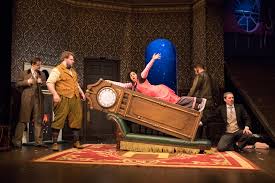
Tonally, it’s a Wodehouse Christmas annual crossed with Buster Keaton. The acting style is deliberately, hilariously stiff — overprojected RP, hands-out-front declaration, an accidental wig swap played as if it were Olivier doing Lear. The physical comedy escalates from “first-night pratfalls” to “the set is now actively hostile” without warning. There is one moment in the second act involving a grandfather clock that consistently produces the loudest sustained laugh we’ve heard in any London theatre this year. The show is not subtle. It earns the right not to be.
It is — and the marketing is right about this — extremely family-friendly. There’s no swearing, no violence beyond cartoon falls, and no jokes that demand adult context. Children of eight upwards routinely sit in the front three rows and laugh themselves into hiccups. We’d say the cleverness sits a level above what the eight-plus rating implies; you’ll catch theatrical references your kids won’t, but they’ll catch ten more pratfalls than you do.
The Cast and Performances
The 2026 cast is the eleventh full company to inhabit Cornley Polytechnic at the Duchess. Casts at this show change roughly every nine to twelve months and the production is genuinely ensemble-driven — there are no star turns, only role functions, each one a finely engineered comic device. Here’s how the current company breaks down.
Matthew Spencer as Chris Bean — Chris is the embattled director, leading man, and self-appointed voice of artistic authority. The role demands relentless stiff-upper-lip composure as the world disintegrates; Spencer’s training-ground precision shows. The role works best when its owner doesn’t acknowledge the audience exists, and Spencer holds the line beautifully.
Raphael Bushay as Robert Grove — playing Thomas Colleymoore, the brother of the deceased. Bushay’s job is to play a man playing a part too large for him; the comic engine is “Confidence Without Cause.” It’s a generous performance — he sets up the rest of the cast magnificently and earns his own laughs without selling it.
Luke Wilson as Jonathan Harris — the corpse. Yes. He spends most of the first act in the role of a body that very much should not be moving and absolutely is. Wilson’s physical control is the standout in the current company; without giving anything away, the way he handles being moved around the stage is consistently funny.
Ruby Ablett as Annie — the stage manager who finds herself centre-stage. Ablett has the trickiest tonal arc in the show: terror to enthusiasm to outright performance high. She lands it. There’s a sequence in act two where she takes over a key role and the audience went visibly with her on opening week.
Lucinda Turner as Sandra — playing Florence, the femme fatale. The role lives or dies on commitment; Sandra is the kind of amateur lead who has clearly studied glamour from old British films and arrived two notes louder than the production needs. Turner plays it with terrifying confidence.
Alex Bird as Dennis — the script-illiterate ensemble member playing the butler. Reads phonetically. The recurring “facade/façade” gag is in his hands; current night audiences are still gasping with laughter.
Joshua Lendon as Max — playing the police inspector. Max is the audience-pleaser; he discovers he likes being on stage roughly twenty minutes in and never recovers. Lendon lets the corpsing creep in slowly enough that the audience is in on it before he is. Excellent.
Kieron Michael as Trevor — the put-upon lighting and sound operator who has to keep coming on stage to fix things. The role anchors the framing device; Michael finds the bored-resigned exasperation that makes the sequencing work.
Understudies and alternates are part of the rhythm at the Duchess; the show has a deep cover bench because the choreography demands it. Casts can change at short notice — and have a habit of changing for the better when emergency call-ups happen. We rate the current company as comparable to the strongest of the last few rotations, with Spencer and Wilson particularly worth the ticket price.
Staging, Set Design and the Engineering Marvel
The set is the secret star. Nigel Hook’s design — which won the 2017 Tony Award for Best Scenic Design of a Play after the Broadway transfer — looks like a competent regional country-house drawing room and is in fact a precision-tooled comedy machine. Doors swing wrong. Walls fall in calibrated sequence. Mantels collapse. A grandfather clock has its own narrative arc. Every set failure is rigged on cues that the lighting and sound desk hits to the millisecond. We’ve seen smaller West End sets — there’s a similar Mischief footprint in The Comedy About Spies at the Noël Coward — but few have to keep their secrets across three thousand-plus performances and survive a cast rotation every twelve months. The fact that Cornley’s “set” still goes wrong with the same precision in 2026 as it did in 2014 is a feat of stage management, not improvisation.
There is no music to speak of — a few cues from a stagebox piano and the recorded murder-mystery sting that the production’s amateur sound operator can’t reliably trigger. This is a play, not a musical, and the laughter does the percussion work. Costumes lean into 1922 country house — tweed, white-tie, art deco gowns — with one running gag about a wig that gets steadily more absurd as the night goes on. The whole show was built for the Duchess’s tight wing space and unusual lines of sight; trying to imagine it at a bigger venue is to misunderstand why it works.
Tickets and Pricing
Tickets at the Duchess for this run start from around £20 for restricted-view dress-circle seats midweek and rise to £82.50 for premium centre stalls on a Saturday. Two-thirds of the house sits in the £35 to £55 range. The show is one of the better-priced West End productions for what you get — by comparison, the new Mischief shows at the Noël Coward and the touring transfers tend to come in £10 to £15 higher.
Where to book — and where not to
The official box office is via the Duchess Theatre site (Nimax). No booking fees, full seat selection, the same prices the box office sells at the door. This is genuinely the cleanest place to buy. TodayTix often has the show in its Rush programme — a small pool of seats released at 1pm each performance day for £29.50, walk-up only, decent location once redeemed at the box office. London Theatre and Official London Theatre are reliable mainstream sellers, with prices typically the same as Nimax direct but with booking fees layered in.
Steer clear of resale platforms and rapid-aggregator sites running paid ads above the official Duchess listing. Mark-ups of 30-50% are routine, and you’ve still got Nimax’s regular ticket schedule sitting underneath them.
Day seats, rush tickets and offers
The TodayTix Rush at 1pm is the smart move for spontaneous bookers. The Duchess box office releases a small pool of day seats from 10am for in-person buyers; £29.50 typical price, usually side-of-circle or rear-stalls. Group bookings of 10+ can negotiate via the Nimax groups team — schools and educational visits get the keenest rates. Tuesday and Wednesday evening performances and Thursday matinées are routinely the best-priced midweek windows. Saturday evening and Sunday afternoon are the most expensive and least flexible — book six weeks ahead.
Promotional packages occasionally bundle dinner with a pre-show set menu at Tuttons, Catherine Wheel or the Brasserie Blanc on Catherine Street; these are usually decent value if you’d be eating out anyway, but compare against booking the seats yourself plus a walk-in elsewhere.
What Audiences Actually Say: Review Analysis
TripAdvisor
As of spring 2026, The Play That Goes Wrong holds approximately a 4.5 average across more than 1,068 traveller reviews and is currently ranked #66 of 587 Concerts & Shows in London. That’s a strong score for a long-running West End comedy, particularly given it pulls a high-volume international audience. Recurring praise covers the precision of the slapstick, the warmth and stamina of the cast, the value for money against bigger West End musicals, and the enthusiastic response of audiences with younger children. The most recurrent practical complaint isn’t the show — it’s the building. A handful of restricted-view seats in the side dress circle attract the bulk of the negative reviews.
Google reviews
The Duchess Theatre’s overall Google rating sits in the 4.5 to 4.7 range, with the bulk of recent reviews referencing this production specifically. Audiences regularly call out feeling welcomed by front-of-house staff, the speed at which the show finds its rhythm, and the laugh-out-loud volume of the room. Negative reviews concentrate on legroom in the stalls (the seats are 1929 vintage and tight by modern standards) and the post-curtain crush at Covent Garden Tube — neither is the production’s responsibility.
Professional critic reviews
The Daily Mail awarded the original West End run five stars. The Telegraph’s Tim Walker gave it four stars, calling it “a great-looking, brilliantly performed piece” and writing that he had “seldom, if ever, heard louder or more sustained laughter in a theatre.” The Times described it as a “masterpiece of malfunction.” The Independent called it “exquisitely choreographed mayhem.” The Guardian’s review settled on “comic gold,” which the marketing has stuck to ever since. The Evening Standard, in Fiona Mountford’s review, called the production “a complete tonic.” WhatsOnStage and The Stage have remained consistently positive across cast rotations. The pattern across major broadsheets is a settled four-to-five-star verdict that has held for over a decade.
Industry awards
Olivier Award for Best New Comedy (2015). WhatsOnStage Award for Best New Comedy (2014). UK Broadway World Best New Play (2015). Tony Award for Best Scenic Design of a Play (Broadway transfer, 2017). Multiple Drama Desk and Outer Critics Circle nominations across its New York run. The London production was named one of the longest-running comedies in West End history and has hosted royal visits, charity galas and a tenth-anniversary revival celebration in 2024.
What Audiences Love Most
- Sustained laughter, not just isolated gags. Reviewer after reviewer comments on the second-act build — that the show keeps escalating instead of plateauing. By the final fifteen minutes, audiences describe the room as physically loud in a way most West End comedies never reach.
- Precision of the physical comedy. “Choreographed” appears in dozens of reviews. The set works on cues to the second; pratfalls land on beats. Audiences notice the discipline and credit the cast for the polish.
- Genuine family appeal. Children from eight upwards laugh as hard as the adults — multiple TripAdvisor reviewers describe taking grandchildren and grandparents to the same show and all three generations being delighted. That’s an unusual demographic spread for the West End.
- Value against the rest of the West End. A £35 dress-circle seat at the Duchess for two hours of award-winning comedy is competitive against £55-plus for restricted-view options at major musicals. Tourist-friendly comedy at price points where families can actually afford four tickets.
- The set as a fellow performer. Reviews consistently single out the Tony-winning Nigel Hook design as worth the ticket on its own. The mantel piece, grandfather clock and study-door mechanisms have their own fan correspondence on theatre blogs.
- An accessible entry point to British comedy theatre. Tourists in particular cite the show as their best West End experience because the humour translates without cultural homework. No knowledge of British social satire required — just a working understanding of why falling over is funny.
- Cast warmth. The 2026 ensemble — like every previous one — gets reviews calling the company “tight,” “generous,” and “in it together.” That sense of mutual rescue between actors on stage is what audiences respond to.
- Stamina across cast rotations. A frequent praise theme: the show hasn’t atrophied. Eleven cast generations, four-thousand performances and the production is still operating at the same peak. That’s exceptional for a long-runner.
Areas for Consideration
- Slapstick will not be everyone’s comedy register. A meaningful minority of negative reviews come from theatregoers expecting verbal wit and getting physical farce. The complaint is fair — the show is unapologetically broad. If your laughter doesn’t engage with pratfalls and props, this isn’t the West End ticket for you.
- The Duchess seats are tight. The auditorium opened in 1929 and the rake was designed for slimmer Edwardian frames. Stalls legroom is the most-cited gripe. Tall theatregoers should book aisle seats — H1 or H29 in the stalls; A1 or A24 in the dress circle.
- Restricted-view seats can really restrict. The £20-£30 day seats often come with side-pillar or side-circle restrictions, and because the show’s set has so many vertical elements (the staircase, the upper gallery, the inevitable collapses) you can lose 15-20% of the visual jokes. Either accept the trade-off or pay up.
- The premise has a ceiling. A small subset of audience reviewers find the joke runs out of steam in the second act — that the escalation pattern gets predictable. We disagree, but the criticism appears with enough frequency to flag.
- The corpsing trend. When a long-running cast settles in, on-stage breakages of the fourth wall increase. Some performances see the actors visibly struggling not to laugh; some audience reviewers love it, others feel it cheapens the precision. Currently the company is well-disciplined — but it’s a known long-runner risk.
Who is The Play That Goes Wrong Best For?
- ✅ Multi-generational family outings — eight-year-olds and grandparents both laugh themselves silly
- ✅ First-timers to the West End who want guaranteed entertainment without a three-hour Shakespearean commitment
- ✅ International visitors looking for a comedy that translates across language and cultural barriers
- ✅ Theatre tourists wanting a smaller, more intimate West End house than the megamusicals offer
- ✅ Group bookings — schools, hen and stag dos, work nights out, charity events
- ✅ Anyone who’s enjoyed any of the Mischief Theatre franchise — Magic Goes Wrong, Peter Pan Goes Wrong, The Comedy About Spies, A Christmas Carol Goes Wrong
- ✅ Date nights where neither party wants a heavy drama; this is the rare West End ticket where both of you will laugh continuously for two hours
- ⚠️ Audiences who prefer high-end verbal comedy or socially observational humour — this is broader than that
- ⚠️ Anyone with mobility issues uncomfortable with very tight seat dimensions — research the auditorium before booking
- ⚠️ Theatregoers seeking new writing or experimental work — this is a long-runner with a refined formula
- ⚠️ Children under six — the noise level in the auditorium and the duration are a stretch even for the most enthusiastic small audiences
How The Play That Goes Wrong Compares to Similar Shows
| Feature | The Play That Goes Wrong | The Comedy About Spies | The Mousetrap | The Book of Mormon |
|---|---|---|---|---|
| Genre | Slapstick play-within-a-play | Cold-war farce | Murder mystery | Satirical musical |
| Venue | Duchess Theatre | Noël Coward Theatre | St Martin’s Theatre | Prince of Wales Theatre |
| Running time | 2hrs (incl. interval) | 2hrs 15min (incl. interval) | 2hrs (incl. interval) | 2hrs 30min (incl. interval) |
| Age suitability | 8+ | 12+ | 12+ | 17+ (strong content) |
| Cheapest seat | From £20 | From £25 | From £25 | From £30 |
| Premium seat | £82.50 | £99.50 | £75 | £175 |
| Critic verdict | ★★★★ to ★★★★★ | ★★★★ | ★★★ to ★★★★ | ★★★★ to ★★★★★ |
| Awards pedigree | Olivier, Tony (Scenic Design), WhatsOnStage | Olivier nominee 2024 | World’s longest-running play | Multiple Tonys, Grammy |
| Family suitability | Excellent | Older children fine | Older children fine | Adults only |
| Tourist accessibility | Very high (no cultural homework) | High | High | Medium (American satire-heavy) |
Verdict: If your priority is a guaranteed-laughter family outing in the West End for under £200 for four, The Play That Goes Wrong is the cleanest pick on this table. The Comedy About Spies is the closest peer in the Mischief stable but plays older and longer. The Mousetrap is a heritage purchase rather than a comedy ticket. The Book of Mormon is the best comedic musical in the West End but lives in a totally different age category. There’s no alternative to The Play That Goes Wrong for what it does — and that’s why it’s still selling out the Duchess after eleven cast generations.
Insider Tips
- Arrive at 19:00 for 19:30. The pre-show “set is being prepared” routine starts before official curtain-up. Latecomers miss the pre-show comedy, which sets up the running gag with the mantelpiece for the rest of the show.
- Sit in a row with empty seats next to you if possible. The audience laughter physically shakes the room; bigger personal space makes the experience materially better. Wednesday matinées are quietest.
- Use the stalls toilets, not the dress circle ones. The dress circle has two stalls, the stalls bathrooms are larger. Fifteen-minute interval, and you don’t want to be queueing while the bell goes.
- Don’t leave during the ending sequence. The biggest gag of the show is in the final 90 seconds. People who’ve seen the YouTube clips think they know it. They don’t. Stay seated until the cast bows.
- Pre-book drinks for the interval. The foyer bar is a six-deep scrum at the break. Pre-order at arrival; collect during the interval from your designated pickup spot.
- If the show’s been running, expect a few corpsing moments. The cast are professionals, but the show’s tenth year has the company occasionally breaking. Personally, we like it. If you want absolute precision, catch the company in their first six months.
- Tell your neighbours you’ve never seen it. Audience contagion is a genuine factor — people laugh harder near first-timers. We’ve sat in rows where one first-timer had the whole row going within the opening fifteen minutes.
- Bring an under-twelve. The eight-plus rating is conservative; we’ve seen seven-year-olds laugh themselves to physical exhaustion. The show works as a fast-track introduction to live theatre for kids who’d find Shakespeare or musicals too long.
Frequently Asked Questions
How long is The Play That Goes Wrong at the Duchess Theatre London?
The Play That Goes Wrong runs for approximately two hours including a fifteen-minute interval at the Duchess Theatre on Catherine Street, London. Curtain-up on most weeknights is 19:30, with matinées on Wednesday and Saturday afternoons.
Where is The Play That Goes Wrong showing in London in 2026?
The Play That Goes Wrong continues to play at the Duchess Theatre, Catherine Street, London WC2B 5LA, in its long-running West End residency. The current booking period runs to 30 August 2026 and the production is extending into 31 January 2027 from autumn dates.
What is the recommended age for The Play That Goes Wrong at the Duchess Theatre?
The Duchess Theatre and Mischief Theatre recommend The Play That Goes Wrong London for ages 8+. The show contains physical comedy, theatrical mishaps and pratfalls, but no swearing, sexual content or graphic violence. Children as young as six have enjoyed it; under-fives may find the duration and noise levels challenging.
How much do tickets cost for The Play That Goes Wrong London at the Duchess Theatre?
Tickets for The Play That Goes Wrong at the Duchess Theatre London start from £20 for restricted-view dress-circle midweek seats and rise to £82.50 for premium centre stalls on weekend evenings. The bulk of seats sit between £35 and £55. Day seats from the box office and TodayTix Rush typically run at £29.50.
What are the best seats for The Play That Goes Wrong at the Duchess Theatre London?
For The Play That Goes Wrong at the Duchess Theatre London, our pick is dress circle rows A to D centre — better sightlines, steep rake and best price-to-view ratio. In the stalls, rows G to M centre offer the best perspective on the show’s vertical sight gags. Avoid stalls rows A to D (too close), the rear of the stalls (overhang) and the side dress circle (pillars).
Is The Play That Goes Wrong at the Duchess Theatre London suitable for tourists who don’t speak English natively?
Yes — The Play That Goes Wrong at the Duchess Theatre London is one of the best West End choices for non-native English speakers. The humour is overwhelmingly visual: pratfalls, set collapses, mistaken cues. Verbal jokes are clear, articulated in stage RP, and the comic engine doesn’t rely on idiomatic English. International audiences are a significant portion of every performance.
Where is the Duchess Theatre London and how do I get to The Play That Goes Wrong?
The Duchess Theatre is at Catherine Street, London WC2B 5LA, on the eastern edge of Covent Garden. The nearest Tube stations are Covent Garden (4 minutes’ walk), Charing Cross (6 minutes), Temple (7 minutes) and Holborn (8 minutes). Buses 1, 4, 26, 59, 68, 76, 91, 168, 171, 188, 243 and X68 stop on nearby Aldwych and Kingsway. The theatre is fully accessible from Catherine Street with step-free entry to the foyer and stalls.
Has The Play That Goes Wrong London at the Duchess Theatre won any awards?
Yes — The Play That Goes Wrong London has won the 2015 Olivier Award for Best New Comedy, the 2014 WhatsOnStage Award for Best New Comedy, the 2015 UK Broadway World Best New Play, and on its Broadway transfer the 2017 Tony Award for Best Scenic Design of a Play. It is the longest-running comedy currently in the West End and the longest-running comedy ever to play the Duchess Theatre.
Who is in the cast of The Play That Goes Wrong at the Duchess Theatre London in 2026?
The current cast at the Duchess Theatre London (from spring 2026) features Ruby Ablett as Annie, Matthew Spencer as Chris, Raphael Bushay as Robert, Luke Wilson as Jonathan, Lucinda Turner as Sandra, Alex Bird as Dennis, Joshua Lendon as Max and Kieron Michael as Trevor. Casts rotate roughly annually; check the Duchess Theatre site for performance-date specifics before booking.
Is The Play That Goes Wrong at the Duchess Theatre London accessible for wheelchair users?
Yes, with planning. The Duchess Theatre offers wheelchair spaces in the stalls, accessed via an AAT Major Stair Climber that accommodates manual wheelchairs up to 66cm wide and 89cm deep. The dress circle is not wheelchair-accessible. Step-free entry is available from Catherine Street into the foyer and box office, and there’s an accessible toilet on the stalls level. Infrared hearing-loop headsets are available free from the foyer for The Play That Goes Wrong London performances.
London Reviews Verdict on The Play That Goes Wrong London Review
Twelve years in, The Play That Goes Wrong is still the most reliably funny ticket in the West End. The case is unanswerable: a 2014 fringe transfer that won the Olivier, transferred to Broadway and won a Tony, spawned three sequel productions and a CBBC series, and is still selling out the Duchess Theatre on a Wednesday night in 2026. Cast generations come and go; the show holds. The 2026 ensemble — anchored by Matthew Spencer, Luke Wilson and Ruby Ablett — is operating at the standard the production demands, with the precision and warmth that long-running cast rotations don’t always preserve.
What makes our Play That Goes Wrong London review unequivocal isn’t the awards cabinet or the longevity. It’s the specific cultural niche the show occupies. There is no other West End ticket that delivers two hours of multi-generational, language-agnostic, family-grade laughter for £30 to £55 a seat. The Mousetrap is a different proposition. The big musicals are double the price for less audience response. The new Mischief shows at the Noël Coward have to grow into themselves; this one is fully formed. For first-time West End visitors, for tourists, for school groups, for anyone who needs a guaranteed-laughter night out — this is the rare West End show where the marketing claims are smaller than the reality.
The minor caveats are honest ones. The Duchess seats are tight; legroom matters more here than at most West End venues. Restricted-view seats really do restrict; pay up to row D dress circle if budget allows. Slapstick will not convert anyone who finds slapstick unfunny — the show makes no concessions to verbal-comedy purists. And the long-runner risk of cast complacency is real, though the current company is showing none of it.
Our verdict: book it. Take the kids, the parents, the visiting friends from out of town, the colleague who hasn’t been to the West End in twenty years. Two hours of physical comedy, a fifteen-minute interval, a four-minute walk to the Tube, and an evening that will be talked about long after the bigger musicals fade from memory. The Play That Goes Wrong remains the smartest West End comedy ticket in 2026 — and on this evidence, will be in 2027 too.
Related London Reviews
- The Comedy About Spies London Review — Mischief Theatre’s latest West End hit
- The Phantom of the Opera Review — His Majesty’s Theatre
- Wicked London Review — Apollo Victoria Theatre
- Hamilton London Review — Victoria Palace Theatre
- The Lion King London Review — Lyceum Theatre
- Les Misérables London Review — Sondheim Theatre
- Six the Musical London Review — Vaudeville Theatre
- Mamma Mia! London Review — Novello Theatre
- The Book of Mormon London Review — Prince of Wales Theatre
- Billy Elliot the Musical London Review
- My Neighbour Totoro London Review — Gillian Lynne Theatre
- Kimberly Akimbo London Review
- Dirty Dancing London Review — Westfield London
- The Devil Wears Prada London Review
- Burlesque the Musical London Review
- Mother Courage at the Globe London Review
- Nutcracker (English National Ballet) London Coliseum Review
- Bill Bailey: Vaudevillean London Review
- Shoreditch Town Hall Review
- The Savoy London Review
- More London theatre and show reviews
- Other West End and Theatreland reviews
- Submit your own London review
Summary: Our The Play That Goes Wrong London Review Rating
| Category | Rating |
|---|---|
| Comedy / laughter delivery | ★★★★★ |
| Cast and ensemble work | ★★★★★ |
| Set design and staging | ★★★★★ |
| Family suitability | ★★★★★ |
| Tourist accessibility | ★★★★★ |
| Value for money | ★★★★★ |
| Venue comfort | ★★★☆☆ |
| Sightlines | ★★★★☆ |
| Accessibility provision | ★★★★☆ |
| Overall | ★★★★★ (4.7/5) |
London Reviews is independent. We don’t accept comp tickets, sponsored posts, press-night invitations or affiliate weighting from the productions, venues or booking platforms we cover. Spotted something that needs a correction, or want to share your own experience of the show? Drop us a line at [email protected].
Have you seen The Play That Goes Wrong at the Duchess Theatre? Share your experience by emailing [email protected] — we publish reader notes alongside our editorial reviews to help future theatregoers book with confidence.