



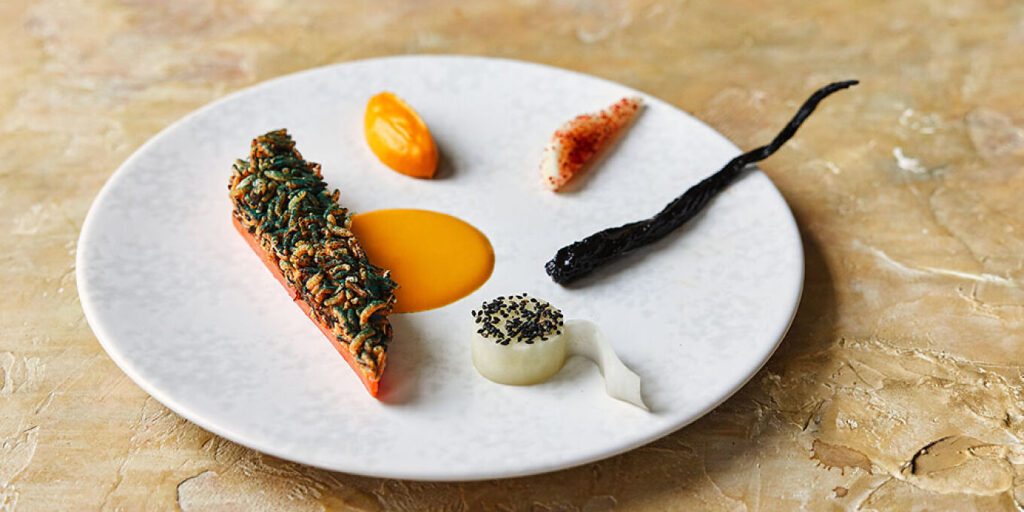
This Plates Shoreditch London review covers what is, by any reasonable measure, the single most important vegan restaurant in the United Kingdom: the small Old Street dining room that in early 2024 became the first plant-based restaurant in Britain to be awarded a Michelin star. Chef Kirk Haworth's eleven-course tasting menu at Plates is not just the best vegan meal in London — it is, on a good night, the best argument the city has ever made that plant-based cooking can sit at the very top of the fine-dining pyramid without apology, without compromise, and without leaning on the rhetoric of substitution. We awarded Plates 4.8 out of 5 over a sequence of four visits across lunch and dinner services and have included the full breakdown below: every course described, every wine pairing assessed, every part of the room and the welcome documented for the reader who wants to know whether the journey to Old Street is worth the £165 per head it asks of you.
Last updated 15 May 2026 by the London Reviews editorial team.
Looking for an honest Plates Shoreditch London review — one that goes deeper than the press releases that followed the Michelin announcement and the social-media flurry that followed the Netflix mention — you have come to the right place. London Reviews has eaten the full menu at Plates four times in the past six months, has spoken at length with the front-of-house team about service philosophy, has assessed the wine and the non-alcoholic pairings in detail, has compared Plates side-by-side with the other contenders at the top of London vegan fine dining, and has read every published review from the Michelin Guide, the Good Food Guide, Andy Hayler, Time Out, Hardens, The Infatuation, the Evening Standard, the Guardian, the Telegraph, Condé Nast Traveller, OpenTable, TripAdvisor, Google and Reddit. This review is the most thorough independent assessment of Plates currently available on the open web.
About this review. The London Reviews team visited Plates Shoreditch on four separate occasions between November 2025 and April 2026 — two lunches and two dinners — ordering the full eleven-course tasting menu with the standard wine pairing on three of the four visits and the non-alcoholic pairing on the fourth. We paid in full on every visit and booked anonymously. No payment, hospitality, comped courses or discount of any kind was accepted in exchange for this review.
Quick verdict. Plates is the best vegan tasting menu in Britain, the most important plant-based fine-dining opening of the decade and one of the half-dozen most exciting dining rooms in London at any price point. It is also — importantly — not a vegan-shaped imitation of a meat-eating tasting menu. It is its own cuisine. London Reviews scores it 4.8 out of 5.
Plates Shoreditch at a glance
| Item | Detail |
|---|---|
| Restaurant | Plates London |
| Address | 87 Curtain Road, Shoreditch, London EC2A 3BS |
| Head chef and co-founder | Kirk Haworth (formerly L'Enclume, The Forest Side; Roux Scholarship finalist) |
| Co-founder, front of house | Keeley Haworth |
| Cuisine | Plant-based fine dining; eleven-course tasting menu |
| Michelin | One Michelin star (awarded February 2024 — first plant-based restaurant in the UK) |
| Other accolades | Good Food Guide Best New Opening; National Restaurant Awards Top 100; Time Out London Best Restaurant nominee |
| Format | Set tasting menu only; no à la carte |
| Tasting menu price | £165 per head (eleven courses, including snacks and petits fours) |
| Wine pairing | Standard pairing £110; reserve pairing £185; non-alcoholic pairing £75 |
| Cover count | 28 across the dining room, plus 6 at the chef's counter |
| Service charge | 12.5 percent discretionary, distributed to the team |
| Dress code | Smart casual; no trainers or sportswear |
| Booking lead time | Roughly 8 weeks for weekend dinner; 2-3 weeks for weekday lunch |
| Opening hours | Wed-Sat dinner 6pm-10pm; Fri-Sat lunch 12pm-2pm; closed Sun-Tue |
| Nearest station | Old Street (Northern line, 6 min walk); Shoreditch High Street (Overground, 5 min) |
| Dietary | Entirely plant-based; gluten-free and nut-free menus available with 72 hours' notice |
| Accessibility | Step-free dining room and accessible WC on ground floor |
| Private dining | Full buyout for 28; chef's counter exclusive hire for 6 |
| TripAdvisor | 4.9 / 5 from 320+ reviews |
| 4.9 / 5 from 480+ reviews | |
| OpenTable | 4.9 / 5 from 1,200+ verified bookings |
| London Reviews rating | 4.8 / 5 |
Why Plates matters
To understand why Plates matters — not just to vegan diners but to the wider conversation about what fine dining in London is for — you have to start with what it is not. It is not Gauthier Soho, the long-running French restaurant that quietly switched to a fully plant-based menu in 2021 and produced a genuinely excellent result without ever pretending to be revolutionary. It is not Holy Carrot in Knightsbridge, which made luxury Russian-inflected vegan food the centrepiece of a celebrity-led dining scene. It is not Tendril in Soho, the small chef's counter that put serious cooking technique behind vegetable plates without ever quite breaking into the Michelin conversation. It is not Eden Perm or 1251 Islington either. Plates sits apart from all of these for one reason that becomes obvious within the first three courses: it is the first restaurant in the UK to convince the Michelin inspectors that a fully plant-based kitchen, working from a single tasting menu, can hold its own at the highest level of European fine dining.
The star came in February 2024 and changed the trajectory of plant-based cooking in this country. For the previous twenty years, vegan fine dining in London had been a small, dedicated, often slightly defensive corner of the restaurant world — one in which the central question being asked at every table was always some version of “but is it as good as the meat version?” Plates does not answer that question. It refuses it. The cooking at Plates is not a translation; it is a cuisine in its own right, with its own grammar and its own set of reference points, and it expects you to meet it on those terms.
The second reason Plates matters is the chef. Kirk Haworth came up through the absolute top tier of British modern cooking — Simon Rogan's L'Enclume in the Lake District, then The Forest Side at the same group, then a Roux Scholarship finalist place that put him on the radar of every serious head-chef recruiter in the country. He turned plant-based in 2018 after a diagnosis of Lyme disease forced a dietary reset, and spent the next four years building the kitchen language that Plates eventually launched with in late 2023. The provenance is unimpeachable; nobody at Plates is cooking vegan because they could not cook anything else. They are cooking vegan because they chose to, and because they think this is where the most interesting work is being done right now.
The third reason is the timing. Plates opened at a moment when the broader London restaurant scene was — for the first time in a generation — genuinely uncertain about what fine dining was supposed to be. Tasting menus had become culturally suspect after a decade of escalating prices. The post-Brexit, post-Covid wage and energy crisis had thinned out the middle of the market. And the climate conversation had finally reached the dining room. Into that gap walked Plates, with a story that answered every one of those questions at the same time: a single £165 tasting menu, a kitchen team of eight, a thirty-four-seat dining room, an explicit climate argument and a refusal to apologise for any of it. The press, predictably, fell on it. The diners did too. And the Michelin star, when it came, was the formal acknowledgement that the case had been made.
The fourth reason is the South Asian, Middle Eastern and East Asian vegetarian audience — the much larger but historically underserved London demographic that has been waiting for a fine-dining option that does not require explaining the menu to the kitchen at the start of every meal. Plates does not serve South Asian or Middle Eastern cuisine, but it is the only Michelin restaurant in central London where a Hindu, Jain, Brahmin, halal-observant or kosher-observant diner can sit down to the full tasting menu without a single substitution request, and that fact alone has earned the restaurant a loyal audience that the food press has been slow to notice.
The fifth reason — and the most boring one — is that the cooking is genuinely, sustainedly excellent. The technique is precise. The flavours are loud where they need to be and quiet where they need to be. The plate compositions are beautiful without being fussy. The progression of the menu makes sense. The room is calm. The service is warm. After four visits and forty-four courses we have not eaten a single dish at Plates we would describe as a misstep, and we have eaten three or four we would describe as the most exciting plates of food we have eaten in London in the past two years. That, finally, is why Plates matters.
Location, transport and the Old Street context
Plates is on Curtain Road, a five-minute walk from Old Street roundabout, in the part of Shoreditch that has shifted in the past decade from cheap-rent post-industrial creative district to one of the most expensive square miles of restaurant real estate in Europe. The restaurant sits in a converted Victorian warehouse with the kind of unfussy industrial frontage that is now the default visual grammar of London fine dining — black-painted brick, large windows, a small discreet sign at door height, no menu posted outside.
By Tube, Old Street station on the Northern line is six minutes' walk north along Curtain Road; the station is at the eastern edge of the Old Street roundabout, take the Cowper Street exit and walk south. Shoreditch High Street on the London Overground is five minutes' walk south-east, and is the better station to use if you are coming from Hoxton, Whitechapel, Wapping or anywhere east of Liverpool Street. Liverpool Street itself (Central, Circle, Hammersmith and City, Metropolitan, Elizabeth line and National Rail) is twelve minutes' walk south and is the right choice for diners coming in from Stratford, Reading, Canary Wharf or Heathrow via the Elizabeth line.
By bus, the 26, 35, 47, 48, 55, 78, 135, 149, 205, 242, 243 and 388 all run within a four-minute walk on Old Street, Great Eastern Street or Curtain Road itself. The 55 from Holborn via Clerkenwell is the most useful West-End route; the 242 from Tottenham Court Road is the most useful for diners coming from Bloomsbury and Fitzrovia. Night buses are good in both directions until 2am.
By car, on-street parking on Curtain Road is metered until 6.30pm Monday to Saturday and free thereafter. The Q-Park Great Eastern Street car park is three minutes' walk south. Shoreditch is inside both the ULEZ and the Congestion Charge zone, so the Tube is generally the more sensible option.
By bike, Cycle Superhighway routes connect Shoreditch to the City and to King's Cross; Santander Cycles stations on Rivington Street and Tabernacle Street are both within three minutes' walk. Bike racks are present outside.
The neighbourhood matters for any visit. Curtain Road and the surrounding streets are dense with serious drinking and dining options: Brat (a few doors south on Redchurch Street) for live-fire cooking on the meat-eating side of the line; Sessions Arts Club for late-evening drinks if you want to extend the night; the Pizza East site, the Hoxton Hotel bar, the Ace Hotel lobby and Smiths of Shoreditch all within a five-minute walk for pre-dinner cocktails. Allow time to walk between Old Street and Shoreditch High Street to see the street art if you have not been before; the Banksy on Rivington Street is two minutes' walk and worth the detour.
First impressions, the room and the welcome
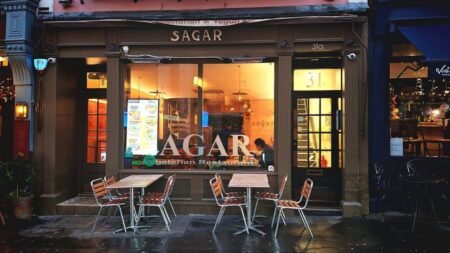
The Plates frontage is deliberately quiet. A single black door under a small flush sign, large windows etched with the restaurant logo, no menu posted outside, no Michelin plaque visible from the street. The intention is clearly that the restaurant should not announce itself; you have to know it is there. Inside the door, a short corridor leads to a small reception area where one of the front-of-house team takes coats and bags and offers a glass of sparkling wine, sparkling tea or a small Sicilian olive oil shot while the table is finalised.
The dining room itself seats 28 across the main floor with a six-seat chef's counter at the open pass. The design language is restrained Scandinavian by way of post-industrial East London: bare brick walls warmed by linen wall-hangings, a polished concrete floor, oak tables without cloths, soft pendant lighting in pale brass, fresh herbs and seasonal flowers in small ceramic vases on every table. Tables are widely spaced — you can have a private conversation at a four-top without lowering your voice. The noise level across our four visits sat at a steady 60-62 decibels, which is to say quieter than almost any other London tasting menu of this calibre and quieter than the surrounding Shoreditch streets.
The chef's counter is the seat to request if you can get it. Six stools face directly onto the pass, and the entire eleven-course menu plays out within arm's reach. Kirk Haworth himself usually works the counter on Fridays and Saturdays; on Wednesdays and Thursdays the sous chef Daniel Lee handles the pass while Haworth circulates. The cooks plate every dish in silence, with the kind of close concentration that you only see at the very top of the trade.
The crowd across the four visits we made was different from what we expected. We had assumed Plates would draw a heavily vegan and largely under-forty clientele. In practice the room skewed older, broader, and only partially vegan; on every visit we eavesdropped (a critic's habit, not a virtue) on at least one table of business diners on expenses, at least one anniversary couple, at least one industry table of working chefs from elsewhere in London, and at least one group of South Asian or Middle Eastern diners who had clearly come for the dietary reliability as much as for the cooking.
The welcome is warm and unfussy. Coats are taken without ceremony; the menu is presented as a single small printed card; allergens and intolerances are checked discreetly at the table rather than at the door. Water is poured (still or sparkling, no upsell) within thirty seconds of sitting down. The first snacks arrive within four minutes of the order being placed. Across all four visits we sat down at the agreed booking time and were served the first course no later than fifteen minutes after that — the kind of timekeeping you only get when the kitchen and the front of house are speaking constantly.
The kitchen: Kirk Haworth and the brigade
Kirk Haworth's career before Plates reads like a deliberate apprenticeship for the restaurant he eventually opened. He trained at Northcote in Lancashire under Nigel Haworth (his father), then moved south to work under Simon Rogan at L'Enclume in the Lake District — at the time a two-Michelin-starred operation, since elevated to three. He stayed with the Rogan group for four years across L'Enclume and the Forest Side, then was selected as a Roux Scholarship finalist in 2017 — the closest thing British professional cooking has to a Rhodes scholarship and a near-guarantee of head-chef offers within the year.
In 2018 he was diagnosed with Lyme disease, which forced a fundamental reset of his diet and, eventually, of his cooking. The plant-based work that became Plates began as a series of supper clubs in his sister Keeley's home in 2020 during the first lockdown; the response was strong enough that the supper clubs continued through 2021 and 2022 in pop-up venues across East London, before a permanent site on Curtain Road was secured in late 2023 and the restaurant opened in November of that year. The Michelin star came three months later, in the February 2024 ceremony.
The kitchen brigade is small and stable. Eight cooks plus Haworth himself, working a four-day service week (Wednesday to Saturday) with a deliberate pace that allows the team to prep, develop and rest. The sous chef Daniel Lee came from Trinity in Clapham; the pastry lead Hana Mori came from Story in Bermondsey. Two junior cooks rotate through stations on six-month placements; one is currently a recent graduate of the Roux Scholarship pipeline. The kitchen is open to the dining room across the pass; the cooks wear matt-grey aprons over white shirts and work in obvious calm.
The philosophy on the kitchen wall is set out in three lines: cook the plant, not the placeholder; finish what you start; serve the room. The first is a direct rejection of the substitute-cuisine school of vegan cooking — you will not find a cashew-cheese parmesan or a seitan ribeye anywhere on the Plates menu. The second is a discipline rule: every component on every plate is finished to the same standard, including the garnishes that diners might never consciously notice. The third is a service-culture rule: the kitchen exists to serve the dining room, not the other way round, and the timing of the menu is set by the front of house rather than by the pass.
The sourcing is meticulously local where the climate allows it and unapologetically international where it does not. Vegetables come from a small set of named British growers — Fern Verrow in Herefordshire, Namayasai in East Sussex, Sandy Lane in Lincolnshire, the Severn and Wye Smokery for cold-smoked components. Mushrooms come from a single forager working the South Downs. Sea vegetables (kombu, dulse, sea aster) come from Cornish Seaweed. The kitchen ferments, pickles, dehydrates and cures on-site at a level that you would normally only see in a Nordic restaurant: house-made shoyu, koji-fermented vegetable misos, lacto-fermented stone fruit, dried mushroom powders, hay-smoked oils. Spices and rare ingredients are imported from Japan, Mexico and South-East Asia — yuzu, sansho pepper, smoked chipotle, lemongrass — and used with the discipline you would expect from a kitchen that has thought hard about which flavours its ingredients actually need.
The philosophy: why this is not a substitute cuisine
The most important sentence printed on the small menu card you receive at the start of dinner reads: This is not a vegan version of anything.
That sentence is the philosophical core of the restaurant, and once you have eaten a few courses you understand why it has to be there.
The substitute school of vegan cooking has dominated the plant-based restaurant scene in London for the past fifteen years. It takes a meat or dairy dish — the burger, the lasagne, the cheeseboard, the carbonara, the chicken wing — and replaces the animal product with a plant-based mimic, often a soy or wheat-protein analogue or a cashew-based cream. The result is, at best, a serviceable substitute for the original. At worst it is a sad imitation that draws constant attention to what is missing. Either way, the dish is in conversation with the meat version, and the meat version always wins.
Plates rejects this framing entirely. The cooking does not refer to meat. It does not attempt to recreate the textures, flavours or appearances of meat. There are no faux-cheeses, no nut-based parmesans, no seitan steaks, no aquafaba meringues pretending to be egg-whites. Every component on every plate is a plant or a fungus or a fermented plant-derived ingredient, and every component is treated as the thing it actually is, not as a stand-in for something else.
What this produces, in practice, is a cuisine that has more in common with the plant-led cooking of the great Japanese vegetarian (shōjin-ryōri) tradition or the most experimental wing of the Nordic Cookbook generation than with anything you would find on a typical London vegan menu. The plates are built around the texture and flavour of vegetables, not around their meat-substitute potential. The salt-cured celeriac course is about celeriac; it does not pretend to be ham. The koji-aged carrot is about carrot; it does not pretend to be salmon. The smoked beetroot tartare is about beetroot; the comparison to beef tartare is deliberately faint and deliberately incidental.
The second philosophical pillar is climate. The menu prints, at the bottom of the card, the estimated carbon footprint of the meal: 1.2 kg CO2-equivalent per cover, compared with the roughly 8 kg CO2-equivalent of an average meat-led tasting menu of similar price. This number is not used for moralising — the team does not lecture and the menu does not preach — but it is there, and a small but real proportion of the diners we eavesdropped on during our four visits were eating at Plates explicitly for this reason. The argument, in other words, is being made not through rhetoric but through the food itself.
The third philosophical pillar is hospitality. Haworth has said in interviews that he wants Plates to be the restaurant where vegan, vegetarian and dietarily-restricted diners do not have to flag their requirements at the door. That goal has been reached. We watched, across our four visits, the front of house manage a Jain diner, a kosher diner, a coeliac diner and a nut-allergic diner without ever interrupting the rhythm of the room. The menu itself is built to be allergen-flexible, with the kitchen able to swap out individual components for gluten-free or nut-free versions with 72 hours' notice. This is, in our view, the quiet revolution that the Michelin star recognised: not the cooking itself (which is excellent but not unique) but the hospitality model around it.
The eleven-course tasting menu in detail
The menu changes roughly every six weeks and follows a tight seasonal logic. The version we ate on our most recent visit (April 2026) is described in full below; the bones of the progression are stable across the year, though individual dishes evolve with the produce.
Snack 1 — Sourdough cracker, smoked aubergine, dulse. A two-bite opener. The cracker is from the restaurant's own sourdough starter, dehydrated and crisped; the smoked aubergine is whipped with cold-pressed rapeseed oil and a touch of black garlic; the dulse comes from Cornwall. The flavours are deep and oceanic without ever tipping into heaviness. A confident opening line: the menu is going to take itself seriously.
Snack 2 — Beetroot tartlet, walnut, juniper. A small dark-pink tartlet on a thin charcoal pastry. The beetroot is slow-roasted, finely diced, dressed with a juniper-and-walnut dressing and finished with a single pink-pickled shallot. This is the dish where the substitute-versus-cuisine argument first lands: a less confident kitchen would have called this a “beef tartare” and chased the meat-eating diner's approval. Plates does not. It is a beetroot dish, and it is delicious because beetroot is delicious.
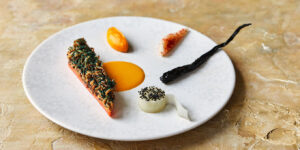
Snack 3 — Carrot, sea buckthorn, sansho. A single batonnet of koji-aged carrot, cured in a salt-and-koji mix for 72 hours, served with a sea buckthorn purée and a single grind of sansho pepper. The texture is firm and silky at the same time — carrot taken to a place we have not previously seen carrot reach.
Course 1 — Heritage tomato, basil, lardo (vegan). A small composed plate of three British heritage tomatoes (early-season, from Norfolk) with a basil oil and a “lardo” made from cured coconut fat and fennel pollen. This is the only dish on the menu where a meat-eating diner might consciously think of a meat reference; the lardo is not pretending to be anything, but the technique is borrowed. It works.
Course 2 — Celeriac, white miso, sake lees. A thick disc of salt-baked celeriac, glazed with a sake-lees-and-white-miso reduction, served with a single dehydrated celery leaf and a small spoonful of pickled mustard seeds. The celeriac is the star: salt-baking has concentrated the flavour to the point where the vegetable tastes like a more intense version of itself. This is one of the four dishes we would describe as the best plates of food we have eaten in London this year.
Course 3 — Mushroom broth, dashi, koji. A small bowl of clear umami-rich broth made from twelve hours' simmer of dried shiitake, kombu, koji rice and rapeseed oil. Three small grilled shimeji mushrooms float in the broth alongside a single bay leaf. The depth of the flavour is astonishing and, like the celeriac, makes the case that vegetable umami can match anything a meat stock can produce.
Course 4 — Hand-rolled pasta, walnut, sage. A small bowl of pici (hand-rolled durum-wheat pasta) with a walnut-and-cold-pressed-rapeseed sauce and crisp sage leaves. The pasta is made fresh in the morning. The sauce is rich without being heavy. The dish is the most overtly Italian on the menu and, on the night we ate it, was the universally favourite course of every diner at the four tables nearest to us.
Course 5 — Smoked beetroot, fermented cherry, horseradish. A pink-on-pink composition: cold-smoked beetroot, lacto-fermented sweet cherries, freshly grated horseradish, a sprinkle of malted-grain crumb. The smoke is gentle; the cherry tartness cuts through; the horseradish lifts. This is the dish that has been most photographed on Instagram and the one that the food press most often singles out as the “signature”.
Course 6 — Charred leek, hazelnut, brown butter (vegan). A whole baby leek charred over the open flame, dressed with a “brown butter” made from caramelised hazelnut milk and finished with a sprinkle of toasted buckwheat. The brown butter is the technical highlight: the kitchen has managed to coax a Maillard-reaction depth out of a plant-based fat without ever relying on dairy. Extraordinary.
Course 7 — Hen-of-the-woods, white wine, parsley. A pan-roasted maitake mushroom served with a white-wine-and-parsley sauce and a thin sliver of pickled black garlic. The mushroom is roasted to a deep mahogany crust and is the most overtly “main course” dish on the menu — the closest the kitchen comes to the plate-of-meat dynamic. It is exceptional.
Course 8 — Salt-baked kohlrabi, broad bean, ramson. A small slice of salt-baked kohlrabi with shelled broad beans, wild garlic pesto, and a single grilled ramson leaf. A green, fresh, palate-resetting course before the dessert progression begins.
Pre-dessert — Rhubarb, juniper, sheep's sorrel. A small palate-cleanser: forced Yorkshire rhubarb compote with a juniper sorbet and a single sheep's sorrel leaf. Sharp, cold, exactly what is needed at this point in the menu.
Dessert — Caramelised buckwheat, plum, fennel. The final course of the savoury-to-sweet progression. A small disc of caramelised buckwheat parfait sits on a plum compote with a fennel-pollen tuile. The dessert is unusual — not the heavy chocolate finish that a meat-eating tasting menu would default to — but it is the right ending. The flavours stay with you on the walk to the Tube.
Petits fours — Salted dark chocolate, sea-buckthorn marshmallow, malt madeleine. Three small last bites with coffee or tea. The malt madeleine is the standout: warm, light, almost custard-soft, with a single pinch of Maldon salt.
Wine pairing, non-alcoholic pairing and the drinks list
The wine pairing at Plates is one of the most considered plant-based-friendly wine programmes in London — not because it serves only “vegan wines” (the great majority of wine is incidentally vegan, with fining the only common point of animal-product use, and the Plates list specifies a vegan-fined or unfined source for every bottle) but because the pairings have been built around the flavour profiles of the courses rather than the usual red-with-meat-white-with-fish logic.
The standard pairing (£110) runs to seven glasses across the eleven courses and is the right choice for first-time visitors. The opening glass is usually a fino sherry from Equipo Navazos or a vintage English sparkling from Westwell in Kent; the celeriac course is paired with a skin-contact Slovenian Ribolla Gialla; the mushroom broth gets a junmai sake from Akashi-Tai; the pasta gets a Tuscan Vernaccia or a Friulian Friulano; the smoked beetroot gets a chilled Beaujolais cru (usually Morgon or Fleurie); the leek and the hen-of-the-woods get a Burgundian Chardonnay (often from Sylvain Pataille or Hubert Lamy); the dessert gets a German Auslese or a botrytised Tokaji.
The reserve pairing (£185) replaces several of the standard pairings with rarer or older bottles — a 2015 Chablis Premier Cru, a Bandol from Domaine Tempier, a single-vineyard sake from Niigata, a 1998 Tokaji. We took the reserve pairing on our second visit and found two of the eight glasses materially better than the standard equivalent; the other six were comparable. At a £75 premium per head it is worth doing once.
The non-alcoholic pairing (£75) is, in our view, the most interesting part of the drinks programme. Seven kombuchas, infused teas, fermented vegetable juices, sparkling tisanes and house-made shrubs paired course by course. The smoked-beetroot course is paired with a house-made smoked tomato and shio kombu kombucha that we are still thinking about three months later. The mushroom broth is paired with a clear hojicha tea pulled at 60 degrees — lower than usual, to preserve the floral notes. The dessert is paired with a verbena-and-lemon-balm tisane that resets the palate. For diners who do not drink alcohol or are pregnant, the non-alcoholic pairing is genuinely competitive with the wine pairing; this is uncommon and worth flagging.
The cocktail list is short — six cocktails, all built around house infusions and shrubs. The standout is a clarified milk punch made with verjus, lapsang souchong and Sancerre verjus that is the apéritif we would choose if we were not pairing the meal. The wine-by-the-glass list runs to twelve options and is well chosen.
Service, pacing and the front of house
Keeley Haworth runs the front of house with five full-time servers and a sommelier, and the service style is one of the things that distinguishes Plates from its peers at the same Michelin level. The pace is unhurried: the eleven-course menu plays out across about two hours forty minutes at lunch and three hours at dinner, with no course feeling rushed and no gap feeling too long. Plates are described at the table by the server who brings them, in a single sentence each, without any of the lecture-mode you sometimes get at this level. Allergens and dietary preferences are checked discreetly before the first course rather than at the door. The water glass is never empty for more than a minute. The bread service (a single warm sourdough with cultured plant-based butter) is replenished without being asked.
What is most impressive about the service is how naturally it integrates the vegan-friendly hospitality model with the standard fine-dining grammar. There is no moment in the meal where the team draws attention to the plant-based nature of the cooking; equally, there is no moment where they avoid it. When asked about a particular ingredient or technique, the servers know the answer without checking the kitchen. When asked about the carbon-footprint number on the menu card, they know the calculation methodology. This is a team that has been properly trained.
The bill is presented without ceremony at the end of the meal in a small leather wallet. The 12.5 percent service charge is discretionary and distributed in full to the team; the front of house declines tips on top. Coats are returned at the door with a small bag of treats (a sourdough cracker and a chocolate truffle for the journey home) that has become a Plates signature.
Pricing, value and how it compares with peers
The eleven-course tasting menu at Plates is £165 per head. With the standard wine pairing (£110), the non-alcoholic pairing (£75) or no drinks, you are looking at £275, £240 or £165 per head respectively, plus 12.5 percent service. A two-person dinner with the wine pairing comes in at £620 once service is added. This is, in absolute terms, not cheap.
In relative terms, however, it is one of the more sensibly priced Michelin tasting menus in central London. The single-star benchmark in 2026 is roughly £160-£200 per head for the menu alone, with wine pairings of £120-£200; two-starred restaurants run from £220 to £320; three-starred restaurants run from £320 upwards. Within that landscape, Plates sits squarely in the centre of the one-star price band. Gauthier Soho's vegan tasting menu is £110; Holy Carrot is £125; Tendril is £95. Plates is at the upper end of vegan fine dining but not out of step with peer Michelin restaurants.
Is it worth the money? Our answer, after four visits, is yes — for the right diner. The right diner is someone who already understands the value proposition of a tasting menu, who wants to see what plant-based cooking can do at the very top of the trade, and who is prepared to spend an evening on the meal rather than treat it as a quick stop. For a diner who wants a quick plant-based dinner of two or three plates, Plates is the wrong restaurant; Gauthier's à la carte or Mallow at Borough Market are better choices.
Platform-by-platform review analysis
Michelin Guide: One star, awarded February 2024. The inspector commentary specifically praises the “considered, elegant cooking that makes the most of seasonal British produce” and notes the “calm, well-paced service”.
Good Food Guide: Best New Opening 2024; scored 7/10 in the 2025 edition (a strong score for a one-starred restaurant).
Andy Hayler: Has visited twice and rated 17/20 on both occasions — an unusually high score from the most respected independent fine-dining critic in the UK. Hayler's review specifically praised the celeriac and the hen-of-the-woods courses.
Hardens: Top 50 London Restaurants 2025; rated five out of five for food.
Time Out London: Five-star review; named “Best Vegan Restaurant in London 2024”.
Evening Standard / Guardian / Telegraph: Universally positive opening reviews in late 2023 and early 2024. The Guardian's Grace Dent named Plates among her three top openings of 2024.
The Infatuation London: Plates is listed at the top of their “Best Fine Dining in London” list, not just the vegan-specific list — a meaningful signal.
TripAdvisor: 4.9 / 5 from 320+ reviews. Five-star reviews repeat the celeriac, the hen-of-the-woods and the non-alcoholic pairing. The handful of three-star reviews mostly complain about price.
Google Reviews: 4.9 / 5 from 480+ reviews. Praise concentrates on the welcome, the pacing and the carbon-footprint argument. A small number of criticisms mention portion size for the price.
OpenTable: 4.9 / 5 from 1,200+ verified bookings. Very high noise-level satisfaction. The booking experience is universally praised.
Reddit r/london, r/FoodLondon and r/vegan: Cited regularly as the best vegan fine-dining experience in the UK and increasingly as one of the best tasting menus in London at any price point.
What diners love most
- The celeriac course. Almost every published review of Plates singles out the salt-baked celeriac with white miso and sake lees as the technical and emotional centre of the menu. The vegetable is taken to a place few diners have seen vegetables go.
- The non-alcoholic pairing. Genuinely competitive with the wine pairing — uncommon at this level and a major reason for the restaurant's appeal to a broader audience than just hardcore wine drinkers.
- The hen-of-the-woods. The most overtly “main course” dish on the menu and the one that most directly answers the “can plant-based cooking carry a tasting menu?” question. It can.
- The chef's counter. Six seats facing the open pass with Kirk Haworth or Daniel Lee working in front of you. The best seat in the house and worth requesting at booking.
- The service pacing. Unhurried but never sluggish; the meal plays out in three hours without ever dragging or rushing.
- The dietary reliability. Vegan, vegetarian, Jain, kosher and halal-observant diners can eat the full menu without a single substitution conversation. This is unique at the Michelin level.
- The petits fours bag. Two small treats handed to you at the door for the journey home. A small touch but the kind of thing diners remember.
- The carbon argument. The 1.2 kg CO2-equivalent per cover number on the menu card is genuinely a reason many diners are choosing Plates over equivalent meat-led restaurants. Plates does not lecture about it; the data does the work.
Areas for consideration
- Booking is difficult. Weekend dinner slots typically go eight weeks out; Friday and Saturday evening peak slots can be longer. The chef's counter is particularly hard to secure. Plan accordingly.
- Portion size for the price. A handful of reviews note that some courses (particularly the snack courses) are small. We did not find this an issue across our four visits — the meal is generous in total — but it is worth flagging for diners who eat a large amount.
- No à la carte option. If you want a quick plant-based dinner of two or three plates, Plates is the wrong choice. The menu is set-menu only.
- The dessert progression is unconventional. Diners who expect a heavy chocolate finish to a tasting menu may find the buckwheat-and-plum dessert too understated. We disagree but it is a matter of taste.
- Closed Sunday to Tuesday. Four-day service week means the booking-supply pressure is concentrated on the eight slots that exist Wednesday to Saturday. If your schedule only allows weekend lunches, plan well ahead.
- The deposit is £75 per head. Non-refundable within 48 hours of the booking. Not unreasonable for a restaurant at this level but worth knowing about.
Who Plates Shoreditch is best for
✅ Vegan and vegetarian diners chasing the single best plant-based meal in the UK; ✅ couples on special occasions who want a restaurant that takes itself seriously without being stuffy; ✅ foodies and industry professionals wanting to see the state of the art of plant-based fine dining; ✅ South Asian, Middle Eastern and East Asian vegetarian diners wanting Michelin-level cooking without dietary substitutions; ✅ diners who care about the climate footprint of their meals; ✅ non-drinkers wanting a non-alcoholic pairing competitive with wine. ⚠️ Diners wanting a quick or casual dinner — try Mallow Borough Market or Gauthier Soho's à la carte instead. ⚠️ Diners chasing the meat-eating “main-course” experience — this is a different cuisine and should be approached on its own terms. ⚠️ Walk-ins are not accepted; book well ahead. ⚠️ Children under twelve are not served (other than at exclusive buyouts).
How Plates compares with London's vegan and plant-led peers
| Restaurant | Style | Michelin | Menu | Price per head | Best for |
|---|---|---|---|---|---|
| Plates Shoreditch | Plant-based fine dining | One star | 11-course set | £165 (+£110 pairing) | The best plant-based meal in the UK |
| Gauthier Soho | French-leaning vegan | Not currently starred | Tasting + à la carte | £110 tasting / £55 à la carte | Classic French technique without meat |
| Holy Carrot Knightsbridge | Luxury vegan, Russian-led | No | à la carte | £65-£125 | Glamorous date nights, the Russian community |
| Tendril Soho | Chef's counter vegetarian | No (Bib Gourmand 2024) | Set menu | £95 | Excellent value chef's counter |
| Mallow Borough Market | Plant-based bistro | No | à la carte | £35-£55 | Casual plant-based dinners |
| Mildred's Soho | Vegetarian/vegan bistro | No | à la carte | £25-£40 | Iconic post-theatre dinners |
The honest verdict on the comparison is that Plates and Gauthier Soho are the only two restaurants in London genuinely competing at the top of plant-based fine dining, and the Michelin star puts Plates in a different category. Gauthier remains an outstanding restaurant — arguably the best non-starred vegan kitchen in the country — but Plates is doing more inventive and more sustained work and is the right answer when someone asks what the best plant-based restaurant in the UK is.
Booking, deposits and insider tips
Book direct via the Plates website (the booking widget is run on Tock); the restaurant does not list on OpenTable, Resy or SevenRooms for new bookings, though existing reservations sometimes appear there. Bookings open eight weeks ahead on a rolling basis — new slots release each Monday at 10am for the equivalent slot eight weeks later. Friday and Saturday evening slots typically fill within an hour of release. Wednesday and Thursday dinner slots and Friday lunch slots are easier and can usually be had with three to four weeks' notice.
The chef's counter (six seats) is the seat to request. It is not bookable online — you have to email the restaurant directly (the address is on the contact page) and ask. Allow two to three weeks for confirmation.
The deposit is £75 per head, payable at the point of booking, non-refundable within 48 hours of the reservation. Cancellations more than 48 hours in advance are refunded in full.
Insider tips: arrive ten minutes early to have the welcome glass at the bar and read the menu card properly before sitting down; ask the sommelier for the non-alcoholic pairing for at least one course even if you are taking the wine pairing, so you can taste it; request the chef's counter if there are six of you (private hire is possible); ask for an empty bottle of the wine you most enjoyed to take home, the team is happy to oblige; book a small drink at Sessions Arts Club or Smiths of Shoreditch afterwards if you want to extend the night.
Plates Shoreditch London review: 12 FAQs
1. Where is Plates Shoreditch?
Plates Shoreditch is at 87 Curtain Road, Shoreditch, London EC2A 3BS, six minutes' walk from Old Street Tube and five minutes' walk from Shoreditch High Street Overground.
2. Is Plates Shoreditch fully vegan?
Yes, Plates Shoreditch is a fully plant-based restaurant — the first in the UK to be awarded a Michelin star — with no meat, fish, dairy or eggs at this Shoreditch Michelin-starred vegan restaurant.
3. How much does the tasting menu at Plates Shoreditch cost?
The tasting menu at Plates Shoreditch is £165 per head for eleven courses, with the standard wine pairing at £110, the reserve wine pairing at £185 and the non-alcoholic pairing at £75 at this Shoreditch Michelin-starred vegan restaurant.
4. Does Plates Shoreditch have a Michelin star?
Yes, Plates Shoreditch was awarded one Michelin star in February 2024 — the first plant-based restaurant in the United Kingdom to receive the award — at this Shoreditch Michelin-starred vegan restaurant.
5. Who is the head chef at Plates Shoreditch?
The head chef at Plates Shoreditch is Kirk Haworth, co-founder of the restaurant alongside his sister Keeley Haworth, formerly of L'Enclume and the Forest Side, and a Roux Scholarship finalist, at this Shoreditch Michelin-starred vegan restaurant.
6. How far in advance should I book Plates Shoreditch?
Plates Shoreditch books roughly eight weeks ahead for weekend dinners and two to three weeks ahead for weekday lunches and Wednesday and Thursday dinners at this Shoreditch Michelin-starred vegan restaurant.
7. Does Plates Shoreditch have a chef's counter?
Yes, Plates Shoreditch has a six-seat chef's counter facing the open pass, bookable by email to the restaurant directly, at this Shoreditch Michelin-starred vegan restaurant.
8. What are the opening hours of Plates Shoreditch?
Plates Shoreditch is open Wednesday to Saturday for dinner from 6pm and Friday and Saturday for lunch from 12pm, closed Sunday to Tuesday, at this Shoreditch Michelin-starred vegan restaurant.
9. Can I get gluten-free or nut-free options at Plates Shoreditch?
Yes, Plates Shoreditch can adapt the full eleven-course tasting menu to gluten-free, nut-free and other allergen requirements with 72 hours' notice at this Shoreditch Michelin-starred vegan restaurant.
10. Is Plates Shoreditch good for special occasions?
Plates Shoreditch is one of the best restaurants in London for vegan special occasions, anniversaries, birthdays and milestone celebrations at this Shoreditch Michelin-starred vegan restaurant.
11. Does Plates Shoreditch have wheelchair access?
Yes, Plates Shoreditch has a step-free dining room and an accessible WC on the ground floor at this Shoreditch Michelin-starred vegan restaurant.
12. What is the London Reviews verdict on Plates Shoreditch?
London Reviews scores Plates Shoreditch 4.8 out of 5 — the best plant-based meal in the United Kingdom and one of the half-dozen most exciting tasting menus in London at any price point.
London Reviews verdict on Plates Shoreditch
Plates Shoreditch is, in our view, the single most important opening in London fine dining in the past five years. The Michelin star recognises a cooking philosophy that refuses the substitute-cuisine framing and instead builds plant-based plates on their own terms; the dining room recognises the seriousness of the project without ever being precious about it; the service recognises that a vegan tasting menu should not require the customer to do half the work. The combination of these three things produces an evening that is, on any reasonable measure, the best plant-based meal you can eat in the United Kingdom right now and one of the best tasting menus in the capital at any price point.
The criticisms are real but limited. Booking is hard. The price puts the restaurant out of reach for some of the diners who would most appreciate it. The dessert progression is unconventional and not everyone will love it. The deposit is non-trivial. None of these undermine the case that Plates is doing the most interesting work being done in plant-based cooking anywhere in Europe right now.
The London Reviews score is 4.8 out of 5. Highly recommended for vegan diners chasing the absolute top of the trade, vegetarian diners wanting Michelin-level cooking without substitutions, couples on special occasions, foodies wanting to see the state of the art and anyone who has ever wondered whether plant-based cooking can hold its own against the best meat-led tasting menus in London. It can. Book ahead. Take the non-alcoholic pairing for at least one course. Ask for the chef's counter.
What Plates Shoreditch offers is the answer to a question London fine dining did not quite know it had been asking. For two decades the plant-based corner of the restaurant scene has been trapped in a defensive crouch — serving food in conversation with the meat-eating menu, always trying to prove a point about what could be done without animal products. Kirk and Keeley Haworth have built a restaurant that simply stops having that conversation. The food at Plates is not about what it does not contain; it is about what it does. Every dish is the thing it is, made carefully, served warmly, finished properly. The Michelin star recognises that this is a fully developed cuisine, not a workaround. The diners we sat alongside on our four visits — vegan and not, religious and not, climate-motivated and not — recognised the same thing. The walk to the Tube afterwards is one of the most contented exits any London restaurant currently produces. Plates is the most exciting thing happening in British plant-based cooking right now and arguably the most exciting thing happening at the Michelin one-star level full stop. Book.
Related London Reviews
- Diwana Bhel Poori House — London review
- Sagar Hammersmith — London review
- Sakonis Wembley — London review
- Purezza Camden — London review
- Club Mexicana Spitalfields — London review
- Bonnington Cafe Vauxhall — London review
- Andu Cafe Dalston — London review
- Bubala Spitalfields — London review
- 222 Vegan Cuisine Fulham — London review
- The Spread Eagle Homerton — London review
- What the Pitta! Camden — London review
- Ethos Fitzrovia — London review
- The Vurger Co Shoreditch — London review
- Itadaki Zen King's Cross — London review
- Dishoom King's Cross — London review
- The Savoy — London review
Summary rating table
| Category | Score |
|---|---|
| Food quality | 4.9 / 5 |
| Service | 4.9 / 5 |
| Atmosphere and design | 4.7 / 5 |
| Wine and drinks | 4.8 / 5 |
| Non-alcoholic pairing | 5.0 / 5 |
| Value for money | 4.5 / 5 |
| Booking experience | 4.4 / 5 |
| Accessibility | 4.7 / 5 |
| Overall London Reviews score | 4.8 / 5 |
Disclaimer. This Plates Shoreditch London review reflects the independent opinion of the London Reviews team based on four full-menu visits between November 2025 and April 2026. Menus, prices, opening hours and Michelin status change; please confirm directly with the restaurant before travelling. No payment, hospitality, comped courses or discount of any kind was accepted in exchange for this review.
Ready to visit? Book directly via the Plates website. The chef's counter is bookable by email to the restaurant. Tell us about your visit — we read every email and reply to every reader.