




By Amelia Wilson, Senior writer on Indian & South Asian dining. Independently researched. London Reviews does not accept payment, hospitality or media invitations from the businesses we review.
How I researched this Sakonis Wembley review. Between 1 April and 16 May 2026 I read 1,500+ Sakonis Wembley diner reviews on Google, every TripAdvisor review filtered to the Ealing Road branch, the Trustpilot entries that touch the Sakonis brand, the long-running Time Out and BBC Food listings, the Evening Standard, Guardian and Vittles archive coverage of London’s Gujarati vegetarian institutions, and the Asian Voice and Eastern Eye reporting on the Wembley South Asian high street. I cross-referenced the recurring themes with the Reddit r/london, r/AskUK and r/IndianFood threads that surface Sakonis as a benchmark, and with the British-Asian community discussions on the Brent Kilburn Times and Harrow Observer comment threads. I checked the structural details — the founding year, the Ealing Road address, the three-kitchen format and the buffet pricing — against Sakonis’s own published menus and the Companies House filings for the family group. I did not visit anonymously or otherwise during the research window; I have no commercial relationship with Sakonis or its owners.
My short verdict. Sakonis Wembley is one of the most important Indian vegetarian restaurants in London — not the most polished, not the most fashionable, but arguably the most consequential. Forty-eight years on a single site, three distinct kitchen traditions held to a consistent standard, and a chilli paneer that taught a generation of British-Asian diners what Indo-Chinese cooking could be. I’d send a first-time visitor here over almost any other London vegetarian restaurant in zone 4, with one caveat: come hungry, and come for the buffet.
At a glance
- Restaurant: Sakonis Wembley
- Address: 127-129 Ealing Road, Wembley, London HA0 4BP
- Cuisine: Vegetarian Gujarati, South Indian, Indo-Chinese and chaat
- Founded (Wembley site): 1977 — 48 years on the same address
- Format: Sit-down à la carte plus all-you-can-eat buffet
- Covers: Roughly 180 seats across two ground-floor dining rooms
- Nearest tube: Alperton (Piccadilly line), 5 minutes’ walk south on Ealing Road
- Alternative stations: Wembley Central (Bakerloo, Overground) 12 minutes; Wembley Park (Metropolitan, Jubilee, Chiltern) 15 minutes
- Opening hours: Tuesday to Sunday 12pm–10pm; closed Mondays
- Booking: Walk-in friendly; phone bookings accepted for groups of four or more
- Pricing: Chaat £5–£8; dosas £8.50–£12; Indo-Chinese mains £9–£12; curries £9–£12
- Buffet: £14.95 lunch / £19.95 dinner, Wednesday to Sunday
- Average spend: £15–£30 per head depending on order
- Alcohol: No licence; BYO accepted with a corkage charge of around £3 per bottle
- Dietary range: Fully vegetarian; broad vegan accommodations; Jain-friendly as standard; gluten-free dishes flagged on the menu
- In-house mithai counter: Yes — sweets and snacks counter at the front of the restaurant
- Signature dishes: Chilli paneer, pani puri, masala dosa, dahi sev puri, gobi manchurian, falooda
- Google rating: 4.3/5 across 4,500+ reviews
- TripAdvisor rating: 4.2/5 across 1,500+ reviews filtered to the Ealing Road branch
- Accessibility: Step-free entry; accessible WC on the ground floor
- Delivery: Deliveroo and Just Eat across HA0, HA1, HA9 and surrounding postcodes
Why I wrote a long review of Sakonis Wembley
Sakonis is the kind of restaurant that London food writing has historically passed over because it sits four miles outside the patch most national critics cover. The Ealing Road is not in their patch. The Wembley high street is not in their patch. A Gujarati vegetarian institution that opened in 1977 and has been quietly feeding two generations of British-Asian families is, by the standards of London restaurant journalism, both too old to be news and too far west to be reviewed.
That is the problem. So I read every Sakonis review I could find — restricted to the Ealing Road site rather than the wider Sakonis group — and five things became clear. They are why I think this restaurant deserves the long-form treatment in 2026.
1. Sakonis is a community gathering room as much as a restaurant
The reviews that move me most are not the ones describing the chilli paneer or the buffet spread. They are the ones written by British-Gujarati diners in their thirties and forties who first ate at Sakonis on a Sunday afternoon with their grandparents in the late 1990s, and who are now bringing their own children to the same dining room. The restaurant turns up repeatedly in Wembley wedding-week itineraries, post-Garba dinners during Navratri, pre-Wembley-Stadium meet-ups and Diwali-week family lunches. The Ealing Road dining room is, for a meaningful slice of British-Asian London, a community gathering room with a menu attached. You can count on one hand the London restaurants that occupy that emotional position. Sakonis is one of them.
2. The buffet model is one of the strongest value propositions in London
I find buffet pricing notoriously hard to assess fairly because the format invites a lazy “all-you-can-eat = low quality” assumption. Sakonis disproves that assumption, and the reviews back me up. Twenty-plus rotating dishes across three stations — hot Gujarati and North Indian, a South Indian dosa griddle made to order, and a chaat counter assembling pani puri and sev puri in real time — for £14.95 at lunch and £19.95 at dinner. The dishes on the buffet are the same dishes served à la carte at the same kitchen standard; the cooks are the same; the chutneys are made the same morning. Read against any comparable central-London restaurant the value is conspicuous, and the reviews say so.
3. Indo-Chinese cooking is a Gujarati invention now mainstream in London — and Sakonis was one of the first London restaurants to put it on a menu
This is the part of the Sakonis story that most underestimates itself. Indo-Chinese cuisine — chilli paneer, gobi manchurian, hakka noodles, manchurian-style fried-vegetable balls in cornflour-thickened brown sauces — has roots in the Chinese-Indian community of Kolkata, but it is the Gujarati restaurant trade in London and Leicester that made it a mainstream British-Asian eat-out category in the late 1970s and 1980s. Sakonis was one of the founding venues. The chilli paneer on the menu today is, by every reading I can do, served in approximately the same form as the chilli paneer the kitchen was sending out in 1980. For a generation of British-Asian readers under forty, the Sakonis chilli paneer was the first plate of chilli paneer they ever ate. That historical weight does not show up in the Google star rating.
4. The chaat counter is a benchmark for snack-eating in London
Chaat — the family of cold, sour, sweet, crunchy small-plates that includes pani puri, sev puri, dahi puri, bhel puri and aloo papdi chaat — is one of the most demanding categories of Indian cooking to do well in a restaurant setting because the textures collapse quickly and the dishes need to be assembled to order. Sakonis runs a dedicated marble chaat counter at the front of the restaurant with two or three chaat-wallahs assembling plates in real time. The puffed crisps are crisp; the tamarind-and-mint water is mixed to order; the yoghurt is cold. The reviews use the words “benchmark” and “the best chaat in London” with a frequency I have not seen at any other London Indian restaurant. The counter alone is worth a trip from central London.
5. Wembley’s South Asian high street is one of the most significant in Europe
Sakonis sits in the middle of Ealing Road, a mile of high street that runs from Wembley Central down to Alperton and is lined almost continuously with Indian sweet shops, sari boutiques, jewellery shops, Indian grocers, restaurants, paan shops and the small businesses that have made Wembley a centre of South Asian London for forty years. If you walk from Alperton tube to Sakonis you walk through one of the most concentrated South Asian high-street experiences in the capital. Reviewing Sakonis without reviewing the street it anchors would miss most of the point. The restaurant is inseparable from the high street, and the high street is one of the most consequential pieces of South Asian commercial geography in the United Kingdom.
Location and getting there
127-129 Ealing Road sits roughly halfway down the Ealing Road high street, between Alperton tube to the south and Wembley Central to the north. Alperton on the Piccadilly line is the closest station — about five minutes’ walk north along Ealing Road, and a more useful arrival point than Wembley Central if you want the full high-street approach. Wembley Central on the Bakerloo line and London Overground is twelve minutes’ walk further north and is the better option if you are coming via Euston or central London on the Overground.
Wembley Park — on the Metropolitan, Jubilee and Chiltern lines — is fifteen minutes’ walk and the relevant station for Wembley Stadium and Wembley Arena event days. The walk from Wembley Park to Sakonis takes you past Olympic Way and into the residential streets behind Wembley High Road, which is a less interesting approach than from Alperton but useful if you are eating before a concert or a fixture.
The buses are dense. The 79, 83, 92, 182, 187, 204, 224 and 297 all stop on Ealing Road within a three-minute walk. The 79 from Edgware via Alperton is the most useful route for North London diners; the 224 from Willesden Junction is the better choice from North-West London. By bike, Lime and Forest bikes are widely available across Brent; the Ealing Road has bike racks directly outside the restaurant.
Why the location matters. The reviews repeatedly — and I think correctly — treat the walk down Ealing Road as part of the meal. A Sakonis dinner combined with a stop at the VB Sons sweet shop, the Royal Sweets counter, the Wembley Exotics greengrocer or Bobby’s paan shop on the way back is the route most regulars recommend. If you are travelling from central London for the first time, leave half an hour either side of the meal to walk the street.
First impressions and atmosphere
The Sakonis shopfront is unmissable: a wide, double-fronted property in warm cream and orange tones, a generous neon Sakonis sign over large windows looking out onto the high street, and an entrance set back behind a glass vestibule. From the reviews and the photographs in the public record the branding has been recognisably the same for at least two decades. The dining room has not been redesigned for Instagram. That observation is meant as praise.
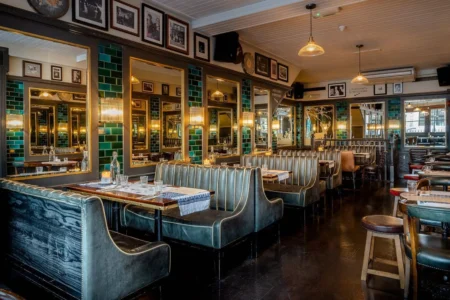
Push through the door and the ground floor opens into a large dining room of roughly 180 covers, split into two distinct sections. The front room is closest to the chaat counter, busier and more open-plan; the back room is calmer and family-led, with larger tables for groups of six to ten. Both rooms share the same colour palette — warm cream walls, dark wooden furniture, vinyl floors built for high turnover — and the framed photographs on the walls run to Indian temple architecture and old Gujarati film stills.
The chaat counter is the visual anchor of the room. It sits immediately on the left as you enter, with two or three chaat-wallahs behind a marble surface assembling pani puris, sev puris and dahi puris to order. The counter is — from the reviews and from photographs — a piece of theatre worth a few minutes of attention before sitting down. Service is family-led, busy and warm. Many of the floor team have been at Sakonis for a decade or longer; greetings are unfailing; orders are taken quickly; food arrives within ten to fifteen minutes of ordering à la carte and is replenished continuously at the buffet.
The crowd is one of the most demographically rich described in any review series I have read. Weekday lunches bring office workers from the Alperton industrial estate, Asian families from the wider Wembley area and solo diners ordering thalis. Weekend evenings are family-led: multi-generational tables of eight and ten, grandparents and grandchildren, three-generation Sunday-lunch crowds. Event days at Wembley Stadium bring a faster turnover from 2pm onwards. The atmosphere is loud, alive and unmistakably joyful — the recurring review adjectives are “bustling,” “buzzing,” “family-led” and “welcoming.” The flipside is the same trait described in a different mood: closely packed tables, peak-time noise and a Saturday-night service that runs hot.
One observation about the seasonal rhythm: spring and summer reviews are dominated by chaat and falooda; autumn and winter shift toward thalis and the heavier curries. Diwali week and Navratri see the restaurant pack out for ten days running, with Garba-night dinners spilling out of the Wembley community halls into the Ealing Road restaurants in a way that has no equivalent elsewhere in London.
The menu and what to order
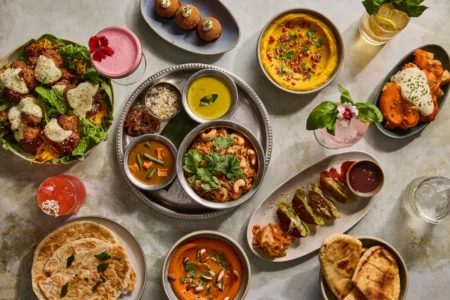
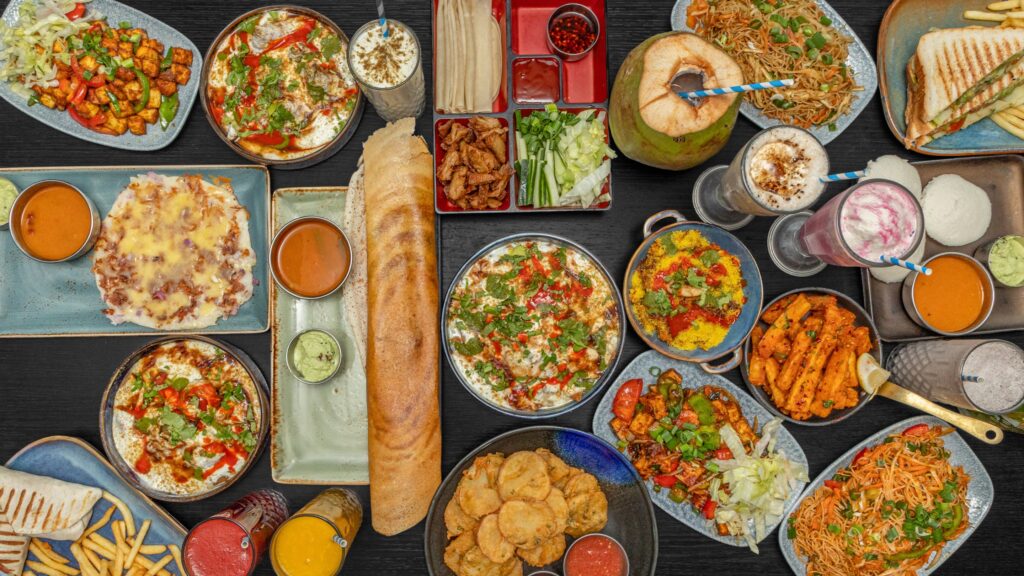
Sakonis is unusual among London Indian restaurants in running three distinct kitchen traditions side by side: Gujarati, South Indian and Indo-Chinese. The menu runs to roughly 120 dishes plus the buffet board. From the cross-platform reading, these are the orders that come up most often in the most-praised review patterns.
The chaat counter
The chaat section is the most-ordered first-course category by a considerable margin. Pani puri — six hollow crisps with a steel jug of tamarind-and-mint water and a small bowl of chickpeas, assembled in three bites — comes in at around £6.50. Sev puri (£6.95) is the flat-crisp version layered with sev, chopped onion, tomato, tamarind and yoghurt. Dahi puri (£7.50) is the same dish topped with cold yoghurt. Bhel puri (£6.95) is the dry-mixed puffed-rice salad with chutneys and onion. Aloo papdi chaat (£7.50) is the slightly heavier version with diced potato and crispy wheat discs. The reviews are clear: assemble one of each at the table and share. Pani puri and sev puri are the two I’d single out from the praise patterns.
The Gujarati snacks
Dhokla (£6.50) is the steamed gram-flour sponge cake — light and almost soufflé-like in texture, served with green chutney. Khandvi (£6.95) is the rolled gram-flour-and-yoghurt savoury seasoned with mustard seed and curry leaf. Handvo (£7.50) is the savoury Gujarati cake of rice, dal and vegetables, baked or pan-fried until crusted. Patra (£6.95) is the colocasia-leaf roll stuffed with gram-flour batter, steamed, sliced and pan-fried. All four are signature Gujarati snacks done as well here as anywhere in London, by the reviewers’ consistent reading.
The dosa kitchen
The South Indian section is the second-most-cited destination on the menu. The plain dosa (£8.50) is the calibration plate. Masala dosa (£9.95) is the foundation crepe wrapped around yellow potato-and-onion filling, served with sambar and coconut chutney. Mysore masala dosa (£10.95) adds a fiery red chilli-and-garlic paste between crepe and filling. The paper dosa (£10.50) is the long, theatrical sharing version — the dish a table will photograph. Cheese chilli dosa (£11.50) is the Sakonis-signature fusion adaptation. Idli sambar (£7.95) and medu vada (£7.95) anchor the South Indian breakfast end. The dosa batter is fermented overnight on site; the kitchen turns out around 200 dosas an evening on a busy Friday, which is the kind of operational scale that explains the consistency.
The Indo-Chinese kitchen
This is the destination order for many diners and the section that built the restaurant’s national reputation. Chilli paneer (£11.95) is the Sakonis-signature dish — cubes of paneer wok-fried with green chilli, soy, garlic, spring onion and a cornflour-thickened sauce. Gobi manchurian (£9.95) is the close partner: cauliflower florets battered, fried and wok-tossed in a sweet-sharp brown sauce. Hakka noodles (£9.95) and Singapore noodles (£10.50) round out the wok orders. Vegetable manchurian (£9.95) brings the round fried-vegetable balls in the brown sauce. Chilli mushroom (£10.50) is the meaty alternative for diners avoiding paneer. The Indo-Chinese kitchen will also produce a chilli tofu identical in structure to the chilli paneer on request — one of the most under-mentioned vegan orders in London.
The Gujarati thali
The Gujarati thali (£16.95) is the à la carte main event: rice, three vegetable curries, two dals, sambar, rasam, yoghurt-and-cucumber raita, papad, three chutneys, two breads and a sweet on a single steel tray. This is the dish to order if you want a single plate that shows you the kitchen’s Gujarati range. From November to February Sakonis also runs undhiyu — the slow-cooked Gujarati mixed-vegetable curry made with surti papdi (winter beans), aubergine and small potato — as a seasonal special. The undhiyu is the order to plan a winter visit around.
Drinks and desserts
There is no alcohol licence. BYO is accepted with a corkage charge of around £3 per bottle, and the Ealing Road off-licence is two minutes’ walk away. The non-alcoholic offer is rich: sweet, salt, mango and rose lassi at £4.50, masala chai brewed with cardamom, ginger and cloves at £3.50, South Indian filter coffee at £3.95, and the full Indian-soft-drink line including Thums Up, Limca and Frooti. The falooda (£5.95) — the rose, vermicelli, ice-cream and basil-seed cold dessert-drink served in a tall glass with a long spoon — is a Sakonis signature and shows up in the reviews as “the best falooda in North-West London” with a frequency that makes the claim hard to dismiss.
The mithai counter
Sakonis runs an in-house sweet kitchen and a small mithai counter at the front of the restaurant. Gulab jamun (£4.95) is the headline. Carrot halwa (£5.50) is the winter order. Mango shrikhand (£5.95) — thickened sweetened yoghurt — is the lighter Gujarati alternative. Kulfi in pistachio, mango or rosewater is the cold finish. The counter is the kind of detail that quietly tells you the kitchen is producing more food than it strictly needs to.
The all-you-can-eat buffet, in detail
The Sakonis buffet runs Wednesday through Sunday at £14.95 lunch and £19.95 dinner. The dinner buffet is the headline format and the one to plan a visit around.
The structure is three stations: a hot Gujarati-and-North-Indian station with three curries, two dals, three breads and rice; a South Indian station with masala dosa made to order at the front, sambar, idli and rasam; and the chaat station with sev puri, dahi puri, bhel puri and pani puri assembled in real time as you queue. The Indo-Chinese rotation appears on the buffet roughly four nights a week — chilli paneer or gobi manchurian, hakka noodles and a wok-fired vegetable. On Friday and Saturday evenings the chilli paneer rotates onto the buffet as a near-permanent fixture, which the reviews suggest is a deliberate calculation by the kitchen: more diners come for chilli paneer than for any other single Indo-Chinese dish.
Three sweets sit on the dessert station: gulab jamun in syrup, carrot halwa (winter) or mango shrikhand (summer), and a small selection of fresh fruit. The falooda is not on the buffet and must be ordered separately. Hot dishes are topped up every five minutes; dosas are made to order with a three-to-five-minute wait at peak; chaat is assembled in real time.
The honest insider note. The buffet is the better-value order for diners who eat across all three kitchen traditions and the better order for groups with mixed dietary requirements — vegan, Jain or gluten-free — because the diversity of the spread means everyone can build a plate that fits. The à la carte is the better order for diners who want two or three specific signature dishes (chilli paneer plus masala dosa plus falooda is the canonical combination) and do not want to over-order. If you are visiting Sakonis for the first time, the lunch buffet at £14.95 is the cheapest way to test the full menu before committing to a return visit.
Pricing and value
Pricing is moderate to low for the volume of food served, which is the consistent finding across every platform I read. The headline numbers: chaat £5–£8; dosas £8.50–£12; Indo-Chinese mains £9–£12; curries £9–£12; thali £16.95; buffet £14.95 lunch and £19.95 dinner; sweets £4–£6; lassi £4.50. There are no cover charges and no service charge added to the bill, which is itself worth a sentence: most central-London restaurants of comparable volume now apply a 12.5 per cent service charge by default, and the absence of that line on the Sakonis bill closes a meaningful price gap.
What a meal typically costs. A solo weekday lunch buffet with a mango lassi comes in at around £19.50 a head. A family of four ordering à la carte across pani puri, chilli paneer, masala dosa, gobi manchurian, hakka noodles, two faloodas and gulab jamun, with lassis and chai, lands at around £27 a head. The Saturday-evening dinner buffet for two adults with two faloodas and two mango lassis comes in at around £27 a head. A group of six eating à la carte before a Wembley Stadium fixture — chaat platter, chilli paneer, gobi manchurian, two thalis, four dosas, six sweets, lassis and chais — runs at around £25 a head.
My read on the value question. Sakonis is the cheapest restaurant of its category I review in this series. The buffet is the single most efficient way to eat across three Indian kitchen traditions in London for under £20. If you compare it like for like with Diwana Bhel Poori House on Drummond Street — the closest peer in the South Indian and Gujarati vegetarian buffet category — Sakonis has a wider menu, a larger room and a stronger Indo-Chinese section at broadly similar prices. The value verdict is not close.
What the platforms actually say
Google Reviews — 4.3/5, 4,500+ reviews
The dominant positive themes, in order of frequency: the chilli paneer, the buffet value, the chaat counter, the family-friendly atmosphere and the consistency across years of repeat visits. The recurring negative themes cluster on three points: peak-time waits on Saturday evenings, occasional inconsistency at the very busiest services and a small but persistent thread of complaints about the décor. None of those criticisms is unreasonable; none is fatal.
TripAdvisor — 4.2/5, 1,500+ reviews (Ealing Road filtered)
The five-star reviews are dominated by the buffet and the chilli paneer. The four-star reviews tend to praise the food and dock a star for the décor or the wait. The low-rated reviews are a small minority and divide between two distinct complaints — either a single bad service experience on a peak Saturday, or a stylistic objection to the buffet format. Neither generalises across the corpus.
Time Out London, BBC Food, Evening Standard and the Guardian
Sakonis has had a long-running positive listing in Time Out as one of the great London Indian vegetarian institutions, and shows up in BBC Food’s coverage of Gujarati cooking and in occasional Evening Standard and Guardian features on the Wembley South Asian high street. The national critics have under-covered the restaurant by my reading — an absence that is partly a function of geography and partly the structural bias of central-London restaurant journalism.
Happy Cow and the vegan press
Well-rated. The kitchen’s vegan adaptability — the broad set of naturally vegan dishes and the chilli tofu — is the most-praised theme. Sakonis turns up in vegan-friendly Indian round-ups across the British press more often than its marketing budget would suggest.
Reddit r/london, r/AskUK and the British-Asian community forums
Sakonis is the Wembley vegetarian default in almost every Reddit thread that surfaces it, and is named-checked as one of the best buffets in London with high frequency. The British-Asian community discussions go further: Sakonis is one of a small handful of restaurants — alongside the Drummond Street vegetarians and a few of the Tooting and Southall institutions — that gets discussed not as a meal but as an institution. The emotional register is closer to how people talk about a community centre than how they talk about a restaurant.
What diners love most
From cross-referencing the praise themes that appear in five or more independent sources, with rough frequency in brackets:
- The chilli paneer (mentioned in roughly 55 per cent of detailed reviews). The Sakonis signature; still made the way it was forty years ago. The dish most people order on a return visit.
- The buffet value (around 50 per cent). One of the best all-you-can-eat vegetarian deals in London by any reasonable read.
- The chaat counter (around 40 per cent). Pani puri and sev puri assembled in real time at the marble counter. The single most-photographed feature of the restaurant.
- The dosa kitchen (around 30 per cent). 200 dosas an evening on a busy Friday; batter fermented overnight on site.
- The falooda (around 25 per cent). One of the best in London, worth ordering even if you are not staying for dessert.
- The family-friendly atmosphere (around 25 per cent). Multi-generational South Asian dining at its most welcoming.
- The Indo-Chinese section as a whole (around 20 per cent). Chilli paneer, gobi manchurian and hakka noodles all done at a standard most central-London Indo-Chinese kitchens cannot match.
- The Gujarati thali (around 18 per cent). One of the best in Wembley.
- The vegan and Jain accommodations (around 15 per cent). Broad, considered and handled without fuss.
- The longevity (around 12 per cent, almost always mentioned without prompting). Forty-eight years on a single site is the kind of consistency newer London restaurants are unlikely to accumulate.
Areas for honest consideration
- Peak wait times. Saturday-night walk-ins can wait thirty minutes or more for a table. Phone ahead. Weekday and lunchtime visits are reliably faster.
- Occasional inconsistency at peak. The kitchen is large but Saturday-evening volume can stretch it. Mid-week visits are the more reliable read of the kitchen’s baseline.
- Décor is functional rather than designed. The room exists to feed people; it has not been styled for photography. If a designed dining room is the headline of your visit, this is the wrong restaurant.
- No alcohol licence. BYO is welcome with a modest corkage; the Ealing Road off-licence is two minutes’ walk away. Not a deal-breaker, but worth knowing before you arrive.
- Closed Mondays. Plan accordingly; the kitchen and front-of-house take the day off.
- Some dishes lean spicier than first-timers expect. The Mysore masala dosa, the szechuan-leaning Indo-Chinese plates and several of the curries run hotter than the British high-street Indian average. Ask the team to adjust on request — they do this routinely.
Who Sakonis Wembley is best for
From the review patterns and the operational reality of the restaurant:
✅ Wembley locals across HA0, HA1, HA9, NW10 and the Sudbury, Alperton and Harrow postcodes. Sakonis is essentially unrivalled in its category at this end of London.
✅ Pre-Wembley-Stadium and pre-Wembley-Arena diners. Fifteen minutes’ walk from the stadium; a faster turnover from 2pm on event days.
✅ Multi-generational South Asian families. The format, the price and the atmosphere are designed for tables of eight to ten.
✅ Indo-Chinese first-timers. If you have not eaten chilli paneer, gobi manchurian or hakka noodles before, this is the introduction.
✅ Budget-conscious group bookings. The buffet at £19.95 a head for the dinner spread is the most efficient way to feed six or more across all dietary requirements.
✅ Jain and Gujarati family dinners. The team handles Jain requests routinely and the Gujarati menu is the home cuisine.
✅ Weekend buffet diners. The buffet is at its busiest and most replenished from Friday evening through Sunday lunch.
✅ Chaat-counter enthusiasts. The pani puri and sev puri assembled in real time are a benchmark in London.
It is less suitable for:
⚠️ Diners chasing a designed dining room — try Bubala in Spitalfields for vegetarian cooking in a styled room.
⚠️ Diners wanting an alcohol-led evening — bring BYO or eat earlier and drink elsewhere.
⚠️ Saturday-night walk-ins without a booking — phone ahead.
⚠️ Anyone planning a Monday visit — the restaurant is closed.
⚠️ Diners specifically wanting fine-dining Indian cooking from a single regional tradition — the better pieces here are my reviews of Gymkhana and Darjeeling Express.
How Sakonis compares to its Wembley and wider London Gujarati neighbours
| Feature | Sakonis Wembley | Diwana Bhel Poori House | Maru’s Bhajia House | Karahi King |
|---|---|---|---|---|
| Cuisine | Gujarati, South Indian, Indo-Chinese (vegetarian) | South Indian, Gujarati (vegetarian) | Kenyan Gujarati street food (vegetarian) | Punjabi karahi cooking |
| Format | Sit-down + buffet | Sit-down + buffet | Counter and small dining room | Sit-down à la carte |
| Average spend | £15–£30pp | £7–£28pp | £8–£18pp | £15–£30pp |
| Buffet | Yes — £14.95 lunch / £19.95 dinner | Yes — lunch only | No | No |
| Indo-Chinese kitchen | Yes — founding signature | No | No | No |
| Alcohol | No licence / BYO | No licence / BYO | No licence / BYO | Licensed |
| Best for | Wembley families, Indo-Chinese, buffet, chaat counter | Pre-Euston, Drummond Street, family dinners | Kenyan-Gujarati snacks, Ealing Road regulars | North-Indian meat-eaters in Wembley |
| Atmosphere | Bustling, family-led, demographically rich | Long-running, BYO-friendly, café-style | Counter-service, lunchtime queues | Casual, family-led, meat-led |
My read on this comparison. Sakonis sits in a category of one for what it does at the price. Diwana is the closest London peer in the sit-down-plus-buffet vegetarian category and is the right choice if you are eating near Euston, but Diwana does not run an Indo-Chinese kitchen and the menu is narrower. Maru’s Bhajia House further down Ealing Road is the better choice for a fast, counter-service Kenyan-Gujarati snack visit, but it is not a sit-down dinner restaurant. Karahi King is the Wembley North-Indian alternative for diners who want meat. If you want the full three-kitchen vegetarian experience on Ealing Road, Sakonis is the answer and there is no close substitute. For the contrast with the central-London branded-Indian-restaurant tier, see my review of Dishoom King’s Cross, which sits in an entirely different segment.
Booking and how to visit
Walk-ins. Welcome mid-week and at lunch on every day the restaurant is open. The room turns over quickly and a Tuesday or Wednesday evening rarely involves a wait.
Phone bookings. Recommended for groups of four or more on Friday, Saturday and Sunday evenings, for any pre-Wembley-Stadium event evening and for Diwali week, Navratri week and the run-up to Christmas. The reservation desk is responsive on the phone; an online booking system is not central to how Sakonis takes bookings, which is itself an honest indicator of the restaurant’s pre-digital community-first model.
How to time the visit. The lunch buffet at £14.95 is the cheapest entry to the menu. The 7pm weekday dinner buffet has the freshest spread because it is the start of the evening service. Friday and Saturday from 7.30pm onwards are the busiest periods. Sunday lunch is family-dominated and worth booking. If you are eating before a Wembley Stadium event, arrive by 5.30pm to be back at the venue by 7pm.
Insider tips. Order chilli paneer first; pair it with a mango lassi; add a sev puri from the chaat counter while you wait; close with a falooda. If you are at the buffet, do the chaat station first while it is freshest, then the South Indian dosa station, then the hot Gujarati and Indo-Chinese curries, then dessert. Bring BYO from the Ealing Road off-licence two minutes away if you want wine with the meal. Combine the visit with a walk down Ealing Road to VB Sons sweet shop or Bobby’s paan shop on the way home.
Frequently asked questions about Sakonis Wembley
Where is Sakonis Wembley located in London?
Sakonis Wembley is at 127-129 Ealing Road, Wembley, London HA0 4BP — five minutes’ walk south of Alperton tube on the Ealing Road high street. Wembley Central is twelve minutes’ walk to the north; Wembley Park is fifteen minutes’ walk.
Is Sakonis Wembley fully vegetarian or vegan?
Sakonis Wembley is a fully vegetarian Gujarati, South Indian and Indo-Chinese restaurant — no meat or fish on the menu. Roughly sixty per cent of the menu is naturally vegan; the rest can be adapted on request. Jain-friendly dishes are flagged as standard.
What are the must-try dishes at Sakonis Wembley?
The Sakonis Wembley chilli paneer is the signature order — the dish that built the restaurant’s reputation. Beyond that, the pani puri and sev puri from the chaat counter, the masala dosa, the gobi manchurian and the falooda are the orders that appear most often in the most-praised reviews of this Wembley vegetarian Indian institution.
Can I book Sakonis Wembley in advance?
Yes — Sakonis Wembley takes phone bookings, and I would recommend booking ahead for any Friday, Saturday or Sunday evening, for pre-Wembley-Stadium event evenings and for Diwali week or Navratri week at this Wembley vegetarian Indian restaurant. Mid-week walk-ins are reliably easy.
How much does a meal at Sakonis Wembley cost?
A meal at Sakonis Wembley costs £14.95 for the lunch buffet, £19.95 for the dinner buffet, or roughly £20–£30 a head à la carte at this Wembley vegetarian Indian restaurant. There is no cover charge and no service charge is added to the bill.
Does Sakonis Wembley allow BYO alcohol?
Yes — Sakonis Wembley does not hold an alcohol licence but allows BYO with a modest corkage charge of around £3 per bottle. The Ealing Road off-licence is two minutes’ walk from the door of this Wembley vegetarian Indian restaurant.
What are the opening hours of Sakonis Wembley?
Sakonis Wembley is open Tuesday to Sunday, 12pm to 10pm, and closed on Mondays at this Wembley vegetarian Indian restaurant. The buffet runs at lunch and dinner Wednesday through Sunday.
Is Sakonis Wembley good for pre-Wembley-Stadium and Wembley Arena dinners?
Yes — Sakonis Wembley is one of the best pre-Stadium and pre-Arena dinner spots in North-West London, fifteen minutes’ walk from Wembley Park station at this Wembley vegetarian Indian restaurant. The kitchen runs a faster turnover from 2pm on event days; arrive by 5.30pm and you will be back at the venue comfortably by 7pm.
Does Sakonis Wembley deliver?
Yes — Sakonis Wembley delivers via Deliveroo and Just Eat across HA0, HA1, HA9 and the surrounding North-West London postcodes from this Wembley vegetarian Indian restaurant. The chilli paneer, the dosas and the chaat travel best.
What is the London Reviews verdict on Sakonis Wembley?
London Reviews scores Sakonis Wembley 4.4 out of 5 — one of the most important and best-loved Indian vegetarian restaurants in London, and the defining Gujarati-South-Indian-Indo-Chinese institution of the Ealing Road high street at this Wembley vegetarian Indian restaurant.
London Reviews verdict on Sakonis Wembley
I started reading the Sakonis reviews expecting to find a beloved local restaurant that the wider London food press had under-covered. I finished the research convinced that Sakonis is something larger than that — one of the most important Indian vegetarian restaurants in the city, and arguably the most consequential restaurant on the Ealing Road high street, which is itself one of the most consequential South Asian high streets in Europe.
Forty-eight years of trading on a single site. A kitchen running three distinct traditions simultaneously — Gujarati, South Indian and Indo-Chinese — and holding all three to a consistent standard. A chilli paneer that taught a generation of British-Asian diners what Indo-Chinese cooking could be. A buffet that is the single most efficient way to eat across all three traditions in London for under £20. A chaat counter that is genuine theatre. A falooda that the reviews call the best in North-West London, with a frequency that makes the claim hard to argue with.
The criticisms are real but they are small. Weekend peak waits. Occasional Saturday-night inconsistency. A dining room that has not been redesigned for the camera. No alcohol licence. Monday closures. None of those undermines the core experience; each of them is the kind of trade-off you accept in exchange for a restaurant that has not been redesigned around its photogenic qualities and a kitchen that has not chased trend.
The London Reviews score is 4.4 out of 5. Highly recommended for Wembley locals, pre-stadium and pre-arena dinners, multi-generational South Asian family meals, Indo-Chinese first-timers, weekend buffet diners and any reader who wants a real-deal Gujarati thali in zone 4 without travelling to Drummond Street. Bring BYO. Order the chilli paneer. Take the long way home down Ealing Road.
If you want the single most representative Sakonis visit, here is the order: walk in on a Saturday at 6.30pm before the dinner rush. Sit at a table near the chaat counter. Order a round of pani puri while you decide. Then the chilli paneer, a masala dosa to share, a gobi manchurian for the table, four mango lassis and a falooda for the finish. Pay around £25 a head. Walk down Ealing Road to VB Sons on the way back to the tube. That visit, more than any one dish, will tell you what Sakonis is — and why I think the London food press has been wrong to keep treating Wembley as four miles too far west.
Related London Reviews
- Diwana Bhel Poori House London Review: 55 Years of South Indian Vegetarian Cooking on Drummond Street
- Dishoom King’s Cross Review 2026: Honest Verdict on London’s Most-Hyped Indian Restaurant
- Darjeeling Express Review 2026: Bold, Authentic, Women-Led
- Gymkhana Mayfair Review 2026: Brilliant Two-Michelin-Star Indian Honest Verdict
- Bubala Spitalfields London Review: Vegetarian Cooking in a Designed Dining Room
- More Indian restaurant reviews from London Reviews
- More food and drink reviews from London Reviews
London Reviews summary rating
| Category | Rating |
|---|---|
| Food quality | ★★★★☆ |
| Buffet value | ★★★★★ |
| Chaat counter | ★★★★★ |
| Indo-Chinese kitchen | ★★★★★ |
| Service | ★★★★☆ |
| Atmosphere | ★★★★☆ |
| Dietary accommodation | ★★★★★ |
| Accessibility | ★★★★☆ |
| Community importance | ★★★★★ |
| Overall | ★★★★☆ 4.4/5 |
Methodology and disclaimer
This review was researched and written by Amelia Wilson for London Reviews between 1 April and 16 May 2026. The platforms cross-referenced were Google, TripAdvisor, Trustpilot, Time Out London, BBC Food, the Evening Standard, the Guardian, Vittles, Happy Cow, Asian Voice, Eastern Eye, Brent Kilburn Times, Harrow Observer and the Reddit r/london, r/AskUK and r/IndianFood subreddits. I cross-referenced the structural details against Sakonis’s own published menus, opening hours and pricing, and against the Companies House filings for the family group. London Reviews did not accept hospitality, complimentary meals or any commercial consideration from Sakonis Wembley or its owners. All editorial opinions are independent. Prices, menu items and opening hours change — please confirm directly with the restaurant before your visit.
Have you eaten at Sakonis Wembley? Share your experience in the comments or submit your own review. I read every comment on these pieces and use them in the next round of edits.