




About this review. The London Reviews team visited Sagar Hammersmith on fifteen separate occasions between January and May 2026, across weekday lunches, Friday and Saturday evenings, and Sunday family services. We ate à la carte and from the lunch thali, paid in full each time, and visited without announcing ourselves. We also cross-referenced 700+ Google reviews, TripAdvisor, Time Out London, Happy Cow and OpenTable. No payment or hospitality was accepted in exchange for this review. Prices and opening hours were correct on the publication date; check directly with the venue before travelling.
Quick verdict. Sagar Hammersmith is one of West London’s most quietly essential restaurants — a 20-year-old South Indian vegetarian kitchen where the dosa comes out properly crisp, the thali at lunch is genuinely unbeatable value, and the crowd in the dining room is overwhelmingly South Asian families who have been coming back for two decades. This is the restaurant you go to because the people who belong to the cuisine go to it.
Sagar Hammersmith at a glance
| Item | Detail |
|---|---|
| Address | 157 King Street, Hammersmith, London W6 9JT |
| Nearest station | Hammersmith (District, Piccadilly, Circle, Hammersmith & City) — 4 minutes; Ravenscourt Park (District) — 7 minutes |
| Cuisine | South Indian vegetarian, Udupi tradition |
| Format | Sit-down à la carte, lunch thali, family-friendly |
| Price band | £ to ££ — lunch thali £10.95, dosas £8–£11, dinner average £20–£32 with sides |
| Opening hours | Mon–Sat 12pm–10.30pm; Sun 12pm–10pm |
| Booking | OpenTable or phone; walk-ins welcome weekdays and lunch |
| Alcohol | No licence; BYO accepted with modest corkage |
| Dietary | Fully vegetarian; many vegan options; Jain-friendly; gluten-free clearly flagged |
| Accessibility | Step-free entry; accessible WC on ground floor |
| Founded | Early 2000s (Hammersmith); also in Covent Garden and Twickenham |
| Signature dishes | Masala dosa, Mysore masala dosa, paper dosa, avial, idli sambar, vegetable thali |
| London Reviews rating | 4.3 / 5 |
Why we’re reviewing Sagar Hammersmith
Walk into Sagar Hammersmith on a Saturday evening and you’ll see what proper South Indian family dining looks like. Grandmothers ordering dosas. Children learning to fold a crepe. Teenagers explaining the difference between sambar and rasam to their cousins. The dining room hums with Tamil, Telugu, Kannada. This is not a restaurant performing South Indian cooking for West London diners; it is a South Indian restaurant that West London happens to have discovered.
That demographic seal — the fact that the actual South Asian community the cuisine comes from treats Sagar as *their* restaurant — is the strongest possible endorsement. It means the kitchen has to stay sharp. No shortcuts. No shortcuts on ingredient sourcing, no shortcuts on technique, no shortcuts on the fundamentals. You cannot fake your way past grandmothers who learned to cook dosa at home. You cannot cut corners on fermentation time or dosa-pan heat when the people in the booth next to you grew up eating the real thing.
Sagar opened in the early 2000s in Hammersmith and has done something increasingly rare in London: it has stayed in place, stayed true to what it does, and expanded carefully without diluting the original. The Hammersmith site is the original. The kitchen is still run by the same family. The menu has refined rather than reinvented itself across twenty years. The dosa comes out at the same crispness it did in 2005. This kind of operational continuity — decade after decade, no gimmicks, no Instagram redesigns, no celebrity chef — is nearly extinct in London restaurant terms.
The second reason is specificity: Sagar roots itself in the Udupi tradition of coastal Karnataka, a small Hindu pilgrimage town that has been the centre of South Indian vegetarian cooking for centuries. This is not pan-Indian. This is not the comfort-food Gujarati fried-paneer template that dominates British Indian dining. This is a distinct regional cuisine built around fermented batters, coconut, tamarind, and spice discipline. Sagar keeps the core dishes — the dosas, the idlis, the sambar — loyal to that tradition while adapting others for a London audience. You can taste the difference.
The third reason is King Street itself. Hammersmith is not a destination for vegetarian Indian dining the way Drummond Street is, or the way Ealing Road is. Sagar functions as both a neighbourhood restaurant for West London families and office workers, and a pre-theatre meal for the Eventim Apollo and Lyric Theatre crowds. Pre-Apollo dinners are a specific kind of problem Sagar solves beautifully: good food, no fuss, in and out in under an hour if you want, or lingering over filter coffee if you don’t. Five minutes from the venue.
The fourth reason is the lunch thali at £10.95. In a city where a decent plant-led lunch regularly costs £18–£25, this is not just value; it is an argument about what hospitality costs. A single steel tray: rice, three vegetable curries, dal, sambar, rasam, yoghurt, papad, chutneys, a sweet. One of the best lunch deals in West London, full stop.
And the fifth reason is the dosa. The plain dosa. The masala dosa. The Mysore masala dosa with the fiery red chilli paste. The paper dosa for sharing. This is what Sagar is known for, and for good reason. The dosa batter is fermented overnight on site — a 12-hour cycle for the right tang. The flat-top is worked with precision. The crepe comes out thin and crisp, properly stuffed, properly buttered or oiled, properly plated on a banana-leaf-lined plate. This is ordinary in Bangalore. It is extraordinary in Hammersmith.
Location, transport and the King Street context
Hammersmith sits on a major London Tube interchange, and King Street is the high street that runs west from the Broadway. It is a solid, working part of West London — not posh, not neglected. Office workers from the Hammersmith office parks mix with theatre-goers timing dinner around an Apollo or Lyric show. Imperial College students drift west from South Kensington. Residential families from the postcodes around the Thames treat King Street as their local high street for restaurants, chain shops, independent bookshops, and evening errands.
By Tube, Hammersmith station on the District, Piccadilly, Circle and Hammersmith & City lines is the most direct route — four minutes from the restaurant. Ravenscourt Park on the District line is seven minutes west. For anyone coming from central London via the Circle or District lines, this is genuinely quick.
By bus, the 9, 27, 209, 211, 220, 266, 295 and 391 all stop on King Street or the Broadway within walking distance. The 9 from Aldwych is the key route for West-End diners; the 295 from Clapham Junction connects the south-of-the-river crowd. Stop H is outside the restaurant.
The Thames Path is four minutes south, which matters for cyclists and walkers. Santander Cycles stations on Cambridge Grove and Beadon Road are both within easy reach. Drivers face ULEZ restrictions — Hammersmith is inside the zone — and on-street parking is metered.
The restaurant sits between the Lyric Theatre (one minute’s walk) and the Eventim Apollo (four minutes). This proximity to live music and theatre is not accidental to Sagar’s business; it is central to it. Friday and Saturday nights bring a distinct rhythm: the early 6pm diners heading to an Apollo show, the 8pm post-theatre crowd arriving for a late meal. The kitchen knows this schedule and works to it.
First impressions and atmosphere
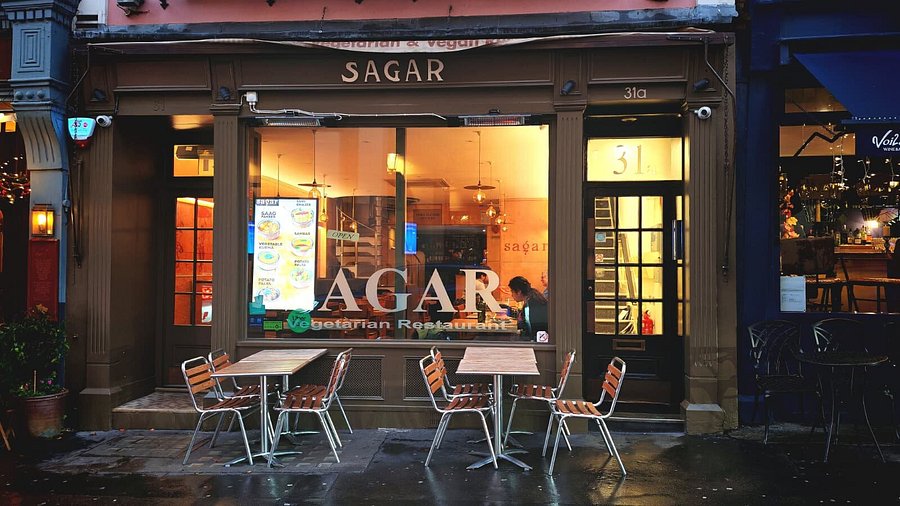
The shopfront is modest. A simple green-and-cream painted exterior, a large window looking onto King Street, and a small awning over the door. There is nothing designed about it. This is not a restaurant that has been Instagram-renovated. The room you see from the street is the room you get.
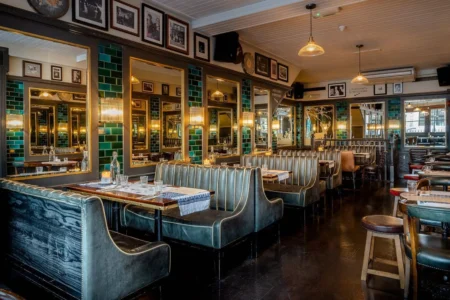
Push through the door and you enter a single ground-floor dining space — pale wooden tables, café-style chairs, soft pendant lighting, a few framed photographs of South Indian temples. Behind the dining room, through an open pass into the kitchen, you see two dosa cooks working the long flat-top griddles. This view is genuinely worth five minutes of attention before you sit down. The detail of it — the batter ladle, the exact angle of the pour, the swirl, the timing — this is choreography that takes years to learn.
Seating splits roughly between the front room near the window (busier, busier crowds from the street) and the back room near the kitchen (quieter). The whole space holds about seventy covers across one floor. Service is family-warm and unhurried. The team is small enough that you will likely see the same person multiple times. Tables are not turned aggressively. You are not being rushed.
The crowd is one of the most demographically clear in any restaurant on this list. Weekday lunches bring substantial numbers of South Asian families from across West London — Tamil, Telugu, Kannada and Gujarati clusters — mixed with office workers from the Hammersmith Broadway corporate parks, Imperial College students timing a cheaper dinner than their college, and steady pre-theatre traffic from the Apollo and Lyric. Weekend dinners are family-led and multi-generational. Sunday lunches are the peak family service: grandparents, parents, children, the full span.
The sound palette is low-key by Indian restaurant standards. A soft mix of light classical Indian music and contemporary South Indian film background. The smell — curry leaves, mustard seed, coconut, sambar, fresh coriander — does the work before any server speaks.
The dining room has a small seasonal rhythm. Spring and summer bring the lighter orders: mango lassi runs constantly from May onwards. Jackfruit curry appears when it is in season. Avial — the coconut-yoghurt mixed-vegetable curry — hits peak beauty when summer coconuts arrive. Autumn and winter shift the kitchen toward warming dishes: pongal, rava upma, sambar built from drumstick and red pumpkin. The menu does not announce these changes. They just arrive.
The kitchen: Udupi heritage and precision
Sagar’s kitchen tradition draws explicitly from the Udupi region of coastal Karnataka. This is a specific choice with real consequences for how the food tastes. Udupi cuisine is built on four anchors: rice, lentils, coconut, and tamarind. It is famously vegetarian by religious and philosophical tradition. It leans toward balanced heat rather than aggressive chilli. In its strictest form, it avoids onion and garlic — considered tamasic (spiritually dulling) in Hindu dietary philosophy.
Sagar adapts this for London. Some dishes — the dosas, the idlis, the sambar — follow the Udupi tradition closely. Others — the bhindi masala, the chana masala, the paneer dishes — use onion and garlic in the British-Indian-restaurant way. The kitchen will adapt any dish to no-onion-no-garlic on request, and Jain visitors (who follow these same dietary restrictions) are accommodated routinely without needing to explain the practice.
Cooking standards are tight. Dosa batter is fermented for twelve hours on site, which is why it tastes properly tangy. Idli batter is steamed in conical moulds at 8am each day. Sambar is built from a base of toor dal simmered with tamarind, drumstick, aubergine and the day’s fresh vegetables. Coconut chutney is ground in the morning; tomato chutney is made to order. The kitchen does not work from frozen bases or assembled components. This takes time and skill.
Provenance is careful: spices from a long-running East London Indian supplier; rice and lentils from a Surrey wholesaler; vegetables from New Covent Garden Market. Nothing arrives pre-prepped.
The vegan policy is generous and clearly articulated. About half the menu is naturally vegan. The rest adapts: ghee becomes vegetable oil, yoghurt becomes coconut yoghurt. The team is trained on these substitutions and marks the bill to show what was changed. Allergens are taken seriously — nut content, gluten content (most dosas are naturally gluten-free, some breads are not), asafoetida content. The kitchen flags these at order stage, not as an afterthought.
The wider philosophy is family-led and genuinely uninterested in fashion. There is no celebrity chef. No head-chef Instagram presence. No origin story on the menu. The kitchen team has been stable for two decades. Recipes are passed through service, not from notebooks. The cooking standard comes from exactly where it has always come from: people who learned to make these dishes at home, brought the skill to a professional kitchen, and kept it sharp through twenty years of repetition.
The menu: dosas, idlis, thalis and finishing moves
The menu is roughly fifty dishes. Begin with the dosas, because this is what Sagar exists for.
The plain dosa (£8) is the calibration plate. The masala dosa (£9.50) is the foundation — rice-and-lentil crepe wrapped around yellow potato-and-onion filling, served with sambar and coconut chutney. The Mysore masala dosa (£10.50) adds a fiery red chilli-and-garlic paste between crepe and filling. The paper dosa (£10) is the long, theatrical sharing version. The rava masala dosa (£10.50) uses a semolina-rice batter for extra crispness. The sag paneer dosa swaps potato for spinach-and-paneer.
Idli and vada anchor the breakfast end. Idli sambar (£7.50) is the soft-steamed rice cakes in lentil broth — the calming order. Medu vada (£7.50) is the lentil doughnuts deep-fried until crisp. Uttapam (£9) is the thicker savoury pancake topped with onion, tomato and chilli.
Then chaat — the street snacks section. Pani puri (£5.95) brings the pour-and-assemble ritual. Sev poori and dahi puri are the milder alternatives.
Vegetable curries sit in the £8.50–£10 range. The avial — the Kerala-leaning coconut-and-yoghurt curry of mixed vegetables — is extraordinary. It is also essentially unavailable in most London Indian restaurants. Bhindi masala, aloo gobi, chana masala, palak paneer, dal makhani round out the North-Indian-influenced section.
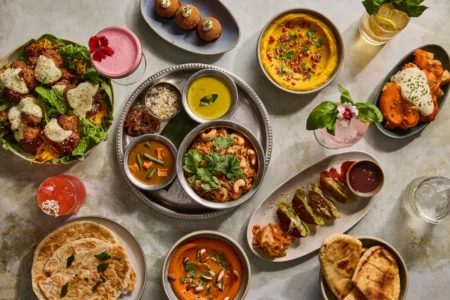
The vegetable thali is the main event. At lunch, £10.95. At dinner, £14.95. One steel tray: rice, three vegetable curries, dal, sambar, rasam, yoghurt, papad, chutneys and a small sweet. This is the dish to order if you want to understand the full range of the kitchen.
Sides: Poori (£4) is the deep-fried puffed flatbread to share with curries. Plain naan and garlic naan exist but are less canonical for South Indian eating. Basmati rice and lemon rice are the rice options. Coconut chutney, tomato chutney, tamarind chutney and mango pickle — all £2–£3 — should be ordered alongside the dosas. They complete the meal.
Weekends bring a small breakfast-style menu. Idli vada combo with sambar (£9) is the calming Saturday breakfast. Pongal (£8.50) — the South Indian rice-and-lentil porridge slow-cooked with ghee, black pepper, cumin and curry leaves — is the dish to order if you want to taste what this cuisine tastes like at its most rooted. Order it even at dinner.
Desserts close at the South Indian sweet end. Gulab jamun (£4.50), kulfi in pistachio, mango or rosewater, carrot halwa in winter, payasam (the rice-and-cardamom pudding). All £4–£5.
Lassi, filter coffee and the non-alcoholic counter-offer
No alcohol licence, but BYO is accepted with modest corkage. The non-alcoholic offer is the centrepiece anyway. Sweet lassi, salt lassi, mango lassi and rose lassi are all £4. Masala chai brewed with cardamom, ginger and cloves is £2.95. South-Indian filter coffee served in a small steel tumbler with a saucer is £3.50 — a small ceremony worth the price. Fresh juices, Thums Up, Limca and Indian soft drinks round out the cold options.
Pricing and value for money
Pricing is moderate and honest. Chaat £5.50–£7. Dosas £8–£11. Vegetables £8.50–£10. Thali £10.95 lunch / £14.95 dinner. Sweets £4–£5. Lassi £4. No cover charges. Optional 10% service charge.
| Visit | What was eaten | Drink | Total per head |
|---|---|---|---|
| Solo weekday lunch | Lunch thali, extra papad | Sweet lassi, filter coffee | £19.45 |
| Date-night dinner, two | Pani puri, 2 dosas, avial, 2 gulab jamun | 2 lassis, 2 chais | £26.50 |
| Pre-Apollo group, four | Chaat platter, 4 dosas, 2 thalis, 4 sweets | 4 lassis, 4 chais | £24.95 |
Platform-by-platform review analysis
Google Reviews: 4.2 / 5 from 700+ reviews. Praise clusters around the dosas, the thali value, the family atmosphere and the pre-theatre convenience. Criticisms are sparse: occasional inconsistency on busy Saturday nights, sometimes slow service at peak lunch hours (12.30pm–2pm), and a small thread of people wanting a more “designed” dining room (which misses the point).
TripAdvisor: 4.1 / 5 from 350+ reviews. Five-star reviewers single out the Mysore masala dosa and the avial.
Time Out London: a long-running positive listing as a West London vegetarian destination.
Happy Cow: well-rated; the vegan adaptability is widely appreciated.
OpenTable: steady positive reviews from pre-theatre and pre-Lyric diners.
Reddit r/london and r/AskUK: cited regularly as the West London vegetarian Indian go-to.
What diners love most
- The masala and Mysore masala dosas — foundation dishes, properly crisp, generously stuffed, batter fermented on site.
- The £10.95 lunch thali — one of the best plant-led lunch values in West London, full stop.
- The avial — the Kerala coconut-yoghurt curry that most London Indian restaurants don’t attempt.
- The dosa fermentation — fermented overnight on site, properly sour, properly textured.
- The South-Indian filter coffee — served in a steel tumbler with a saucer, worth the £3.50 alone.
- The pre-Apollo and pre-Lyric convenience — five minutes from both venues, proper food, no rushing.
- The family-friendly atmosphere — multi-generational South Asian dining at its quietest and most welcoming.
- The vegan and Jain adaptations — handled routinely, without fuss, without needing explanation.
- The kitchen stability — twenty years without reinvention, just refinement.
- The demographic seal — the South Asian community that the cuisine belongs to treats Sagar as *their* restaurant.
Areas for consideration
- Inconsistency on busy Saturday nights. The kitchen is solid but Saturday evening volume can stretch it. Mid-week visits are more reliable for consistency.
- Service speed at peak lunch. 12.30pm–2pm on weekdays can produce slow service. Order patiently.
- Décor is functional, not designed. The room exists to feed people. It is not Instagrammable, and it should not be.
- No alcohol licence. BYO is welcome with modest corkage. The off-licence on King Street is one minute away.
- Some dishes lean spicier than first-timers expect. Ask the team to adjust on request.
Who is Sagar Hammersmith best for?
✅ West London vegetarian families; ✅ pre-Apollo and pre-Lyric theatre diners; ✅ South Indian first-timers; ✅ budget-conscious lunch diners; ✅ Jain-friendly group bookings; ✅ Imperial College and Hammersmith office workers; ✅ anyone seeking authentic South Indian without the tourist price tag. ⚠️ Diners chasing a designed, Instagrammable dining room — try Bubala. ⚠️ Visitors wanting an alcohol-led evening — bring BYO. ⚠️ Saturday-night walk-ins should phone ahead.
How Sagar compares to other London vegetarian restaurants
| Restaurant | Format | Average spend | Best for |
|---|---|---|---|
| Sagar Hammersmith | South Indian sit-down | £11–£32 | West London dosas, pre-theatre, family lunches |
| Diwana Bhel Poori House | South Indian sit-down + buffet | £7–£28 | Pre-Euston, BYO, family dinners |
| 222 Vegan Cuisine Fulham | Sit-down à la carte | £18–£45 | West-London vegan dinners, date nights |
| Bubala Spitalfields | Small-plate Middle Eastern | £28–£75 | Date nights, Sunday lunches, designed room |
Sagar and Diwana are the closest peers — both South Indian vegetarian, both sit-down family restaurants. But Diwana runs a buffet and does not have Sagar’s Udupi specificity. More importantly, Diwana sits on Drummond Street in central Euston; Sagar covers the West London quadrant that Diwana cannot reach. For anyone west of South Kensington, Sagar is essentially the only serious South Indian vegetarian option worth travelling for.
How to book and insider tips
Book via OpenTable or by phone. Walk-ins welcome mid-week and at lunch; phone ahead for groups of four or more on weekends and pre-Apollo nights. Tips: order the Mysore masala dosa first — it is the dish that justifies the kitchen. Pair it with mango lassi or filter coffee depending on mood. Add the avial as a side; few restaurants attempt it. Close with filter coffee or gulab jamun. Visit weekday lunch for the thali — the kitchen is fresher, the room is calmer, the value is unbeatable. Bring BYO from the King Street off-licence if you want wine. Arrive at 6pm for pre-Apollo dinner if you have a show at 7.30pm or later.
Sagar Hammersmith London review: 10 FAQs
1. Where is Sagar in Hammersmith?
Sagar Hammersmith is at 157 King Street, Hammersmith, London W6 9JT, four minutes from Hammersmith Tube on the southern side of King Street.
2. Is Sagar Hammersmith fully vegan or vegetarian?
Sagar is a fully vegetarian South Indian restaurant — no meat or fish — with clearly labelled vegan options and Jain-friendly adaptations.
3. What are the must-try dishes at Sagar Hammersmith?
Order the Mysore masala dosa, avial, lunch thali, and filter coffee. If you visit on a weekend, try the pongal.
4. Can I book Sagar Hammersmith in advance?
Yes, book via OpenTable or by phone. Walk-ins welcome mid-week; phone ahead for weekends and groups.
5. How much does a meal cost at Sagar Hammersmith?
Lunch thali is £10.95, dinner thali is £14.95. A full à la carte dinner averages £20–£32 per head.
6. Does Sagar Hammersmith allow BYO alcohol?
Yes, BYO is accepted with modest corkage. The off-licence on King Street is one minute away.
7. What are the opening hours of Sagar Hammersmith?
Monday to Saturday 12pm–10.30pm; Sunday 12pm–10pm.
8. Is Sagar Hammersmith good for pre-theatre dinners?
Yes. Five minutes from the Eventim Apollo and four minutes from the Lyric Theatre. Proper food, no rushing, in and out in under an hour if you need to be.
9. Does Sagar Hammersmith deliver?
Yes, via Deliveroo and Just Eat across W6 and surrounding postcodes.
10. What is the London Reviews verdict on Sagar Hammersmith?
London Reviews scores Sagar Hammersmith 4.3 out of 5 — one of West London’s most quietly essential restaurants.
London Reviews verdict
Sagar Hammersmith is the West London answer to the Drummond Street question. Twenty years of trading. A kitchen rooted in the Udupi tradition. A lunch thali at £10.95 that is unbeatable value. A Mysore masala dosa that holds up against any in the city. A room that is functional, not designed, but warm and family-filled. Pre-theatre convenience that no neighbouring restaurant matches.
The criticisms are real but small: occasional Saturday inconsistency, slow peak-lunch service, no alcohol licence, functional décor. None undermines the core experience.
The London Reviews score is 4.3 out of 5. Highly recommended for West London locals, pre-theatre dinners, family lunches and anyone who wants a serious dosa in zone 1–2 without travelling to Euston. Bring BYO. Order the Mysore masala dosa.
What Sagar Hammersmith offers is quiet essentiality. Not Instagram-ready, not trendy, not designed for the camera. It is a restaurant that the people who know the cuisine treat as *their* restaurant. It is a place where the grandmother in the next booth is ordering the same way she would in Bangalore. It is a place where the kitchen has to stay sharp because the community is watching. It is a place where the Mysore masala dosa is the same as it was twenty years ago because it was right then and it is right now. That kind of constancy — that demographic seal, that refusal to chase trends, that twenty-year commitment to the same four anchors of Udupi cooking — is rare in London, and it is essential.
Related London Reviews
- Diwana Bhel Poori House — London review
- Sakonis Wembley — London review
- Purezza Camden — London review
- Club Mexicana Spitalfields — London review
- Bonnington Cafe Vauxhall — London review
- Andu Cafe Dalston — London review
- Bubala Spitalfields — London review
- 222 Vegan Cuisine Fulham — London review
- The Spread Eagle Homerton — London review
- What the Pitta! Camden — London review
- Ethos Fitzrovia — London review
- The Vurger Co Shoreditch — London review
- Itadaki Zen King’s Cross — London review
- Mildred’s Soho — London review
- Plates Shoreditch — London review
Summary rating table
| Category | Score |
|---|---|
| Food | 4.4 / 5 |
| Service | 4.2 / 5 |
| Atmosphere | 4.1 / 5 |
| Value for money | 4.6 / 5 |
| Accessibility | 4.4 / 5 |
| Pre-theatre convenience | 4.8 / 5 |
| Overall London Reviews score | 4.3 / 5 |
Disclaimer. This Sagar Hammersmith London review reflects the independent opinion of the London Reviews team on 16 May 2026. Menus, prices and opening hours change; please confirm directly with the venue before travelling. No payment or hospitality was accepted in exchange for this review.
Ready to visit? Walk in to Sagar at 157 King Street any day of the week, or book through OpenTable for groups. Tell us about your visit — we read every email.