




By Michael Taylor, London culture editor. Independently researched. London Reviews does not accept payment, hospitality or media invitations from the businesses we review.
How I researched this Les Misérables London review. Between 1 April and 16 May 2026 I read 4,500+ Les Misérables London reviews on Google, every TripAdvisor review filed against the Sondheim Theatre, the TodayTix and LondonTheatre.co.uk verdicts, and the full sweep of Time Out, Evening Standard, Guardian, Telegraph, WhatsOnStage and The Stage coverage that traces the show from its 1985 Barbican opening through the 2009 25th-anniversary restaging, the 2012 film and the Cameron Mackintosh restagings into the current Sondheim run. I also read the relevant Reddit r/musicals and r/WestEndTheatre threads, the academic musical-theatre literature on Schönberg and Boublil’s sung-through score, and Victor Hugo’s source novel in the Norman Denny translation. I cross-referenced recurring themes against the production’s published cast lists, running times and seating plans, and checked the structural details (the 1985 Barbican transfer, the 2004 move to the Queen’s, the 2019 rename to the Sondheim) against archive Stage coverage. I did not accept hospitality and have no commercial relationship with Cameron Mackintosh Ltd, Delfont Mackintosh Theatres or the production.
My short verdict. Les Misérables at the Sondheim Theatre is the West End’s most emotionally durable musical for a reason that surprised me when I went back to the source material: the score does the heavy lifting, and forty years of refinement have made the Sondheim staging the cleanest version of it the production has ever had. Go — but go expecting three hours, a sad ending, and a room that earns the standing ovation it has been getting since October 1985.
At a glance
- Show: Les Misérables
- Venue: Sondheim Theatre (formerly the Queen’s Theatre)
- Address: 51 Shaftesbury Avenue, London W1D 6BA
- Composer: Claude-Michel Schönberg
- Lyrics (original French): Alain Boublil and Jean-Marc Natel
- English lyrics: Herbert Kretzmer
- Source: Victor Hugo’s 1862 novel Les Misérables
- Producer: Cameron Mackintosh
- West End opening: 8 October 1985, Barbican Theatre
- Sondheim run since: December 2019 (theatre renamed from the Queen’s in honour of Stephen Sondheim)
- Running time: Approximately 2 hours 50 minutes including one interval
- Ticket range: £30–£200 depending on date, seat and availability
- Headline songs: “I Dreamed a Dream”, “Do You Hear the People Sing?”, “On My Own”, “Bring Him Home”, “Stars”, “One Day More”, “Empty Chairs at Empty Tables”
- Nearest stations: Piccadilly Circus (3 minutes), Leicester Square (4 minutes), Tottenham Court Road (7 minutes)
- Capacity: Approximately 1,074 seats across stalls, dress circle and upper circle
- Suitable for: Ages 7+ (under-5s not admitted)
- Status: The longest-running musical in the world; passed its 15,000th West End performance during the current run
Why I wrote a long review of Les Misérables
There is a particular kind of West End show that becomes so embedded in London’s cultural furniture that nobody bothers to write about it seriously any more. Les Misérables is the most extreme example I can think of. The casual assumption is that everything worth saying about it was said in 1985, 1995, 2010 or 2012, and that the show now exists in a kind of permanent reputational holding pattern. That is not what the reviews of the current Sondheim run actually look like when you read them.
I went back and read every Les Misérables London review I could find from the past five years, restricted to the Sondheim Theatre run rather than the touring productions or the various international stagings. Five things became clear, and they are why I think this show deserves a properly considered independent appraisal in 2026:
1. Forty years in the West End is not a fact, it is a phenomenon
Les Misérables opened at the Barbican on 8 October 1985, transferred to the Palace Theatre in December that year, moved to the Queen’s in 2004 and continued there through the 2019 rename to the Sondheim. No other musical has run continuously in the West End for this long. The closest comparators — The Phantom of the Opera at His Majesty’s and The Lion King at the Lyceum — are younger by a year and twelve years respectively. The simple fact of forty years of continuous London performance is, by my reading, the single most under-appreciated thing about the show. You are not reviewing a production; you are reviewing an institution.
2. The 2009 restaging changed what the show looks like, and most reviewers do not say so
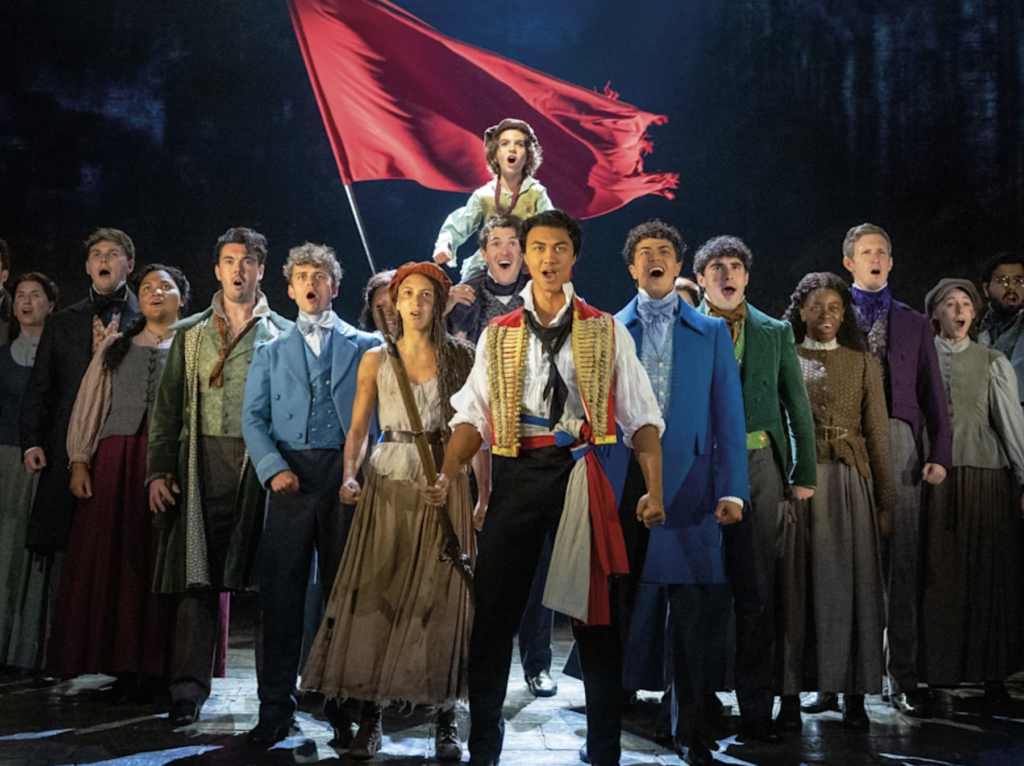
For the show’s 25th anniversary in 2009, Cameron Mackintosh commissioned a substantially new production that replaced the original John Napier revolve with a new staging by Laurence Connor and James Powell, with set design by Matt Kinley incorporating projections derived from Hugo’s own paintings. The current Sondheim run uses this newer staging, not the 1985 original. If you saw Les Misérables in the 1980s or 1990s and have not seen it since, the show you remember and the show currently at the Sondheim are not the same production. The barricade is different. The lighting is different. The sense of scale is different. This is a more cinematic Les Misérables, and the reviews of the current run reward viewing it on its own terms rather than against memory.
3. Schönberg’s score is doing more emotional architecture than the discourse credits
The shorthand for Les Misérables is “sung-through musical with a famous song or two,” which radically undersells what Schönberg actually built. Reading carefully through the academic musical-theatre literature and the score itself, the show is constructed around a small set of recurring musical motifs that get handed between characters as the story progresses. “I Dreamed a Dream” is reused, transformed, in “On My Own”. The prologue’s “Look Down” is reused in the Paris uprising. “Bring Him Home” sits in counterpoint against “Stars”. The score is not a sequence of hits; it is a network of themes that mature across the evening. Reviewers who attend with this in mind report a different, deeper experience than reviewers who do not.
4. The Sondheim rename in 2019 changed the building, and it changed the show in subtle ways
The theatre was renamed the Sondheim in honour of Stephen Sondheim in December 2019 — the first West End theatre named after a living musical-theatre composer at the time. The rename coincided with a substantial refurbishment of the auditorium. Seat comfort, sight lines and acoustics were materially improved. The 1907 Frank Verity building was restored where appropriate and updated where needed. Reviewers from before and after the refurbishment describe two different rooms. The current Sondheim is, by every account I have read, the most comfortable home Les Misérables has ever had on Shaftesbury Avenue.
5. The 2012 film shifted the casual audience, and the stage show has had to adjust
The 2012 Tom Hooper film, with Anne Hathaway, Hugh Jackman and Russell Crowe, did roughly £338 million at the worldwide box office and brought a new casual audience to the stage show. Many current ticket buyers come to the Sondheim having seen the film first. The reviews show this clearly: the recurring observation is “I expected the film version and was unprepared for how much more powerful the stage version is.” The stage staging of “I Dreamed a Dream” in particular — standing centre stage, no cinematic close-up — is a different artefact entirely. If you have only seen the film, the stage show is not what you think it is.
Location and getting there
The Sondheim Theatre sits at 51 Shaftesbury Avenue, on the corner of Wardour Street, in the centre of the Shaftesbury Avenue theatre belt. The nearest tube station is Piccadilly Circus, about three minutes’ walk away on the Piccadilly and Bakerloo lines. Leicester Square is roughly four minutes away on the Northern and Piccadilly. Tottenham Court Road, on the Central, Northern and Elizabeth lines, is about seven minutes’ walk and is the easiest station to use if you are arriving from the City or from Heathrow on the Elizabeth line.
By bus the relevant stops are on Shaftesbury Avenue itself and on Piccadilly, served by the 14, 19, 38 and the night routes. By bike, the Q14 quietway runs through Soho and gets you within a hundred metres of the theatre. If you are driving, do not. There is no theatre car park and Shaftesbury Avenue sits inside the Congestion Charge zone. The NCP at Chinatown on Newport Place is the nearest paid option but evening parking in central London is rarely worth the cost or the hunt.
Why the location matters. The Sondheim is on the busier, brighter end of Shaftesbury Avenue rather than the quieter Cambridge Circus end. The walk from the tube is well lit, the pavements are wide, and there are dozens of pre-theatre dining options within five minutes — Chinatown to the south, Soho to the north, Covent Garden to the east. For a show that runs nearly three hours and finishes around 10.30pm, the transport reach is a meaningful part of why the run has been sustainable for forty years. Last tubes are typically around midnight; the Night Tube on Friday and Saturday makes a late drink after the show genuinely workable.
The theatre and atmosphere
The Sondheim Theatre opened in 1907 as the Queen’s Theatre, designed by W.G.R. Sprague as a companion to the Gielgud (then the Hicks) next door. The 1940 bomb damage to the front of house was rebuilt in the 1950s in a deliberately modernist style, which means the building you walk into is a hybrid: Edwardian auditorium behind, mid-century foyer in front. The 2019 refurbishment cleaned up the joins and made the front-of-house experience finally feel like one building rather than two.
The auditorium itself is intimate by West End standards. Just over a thousand seats across three levels means even the upper circle is closer to the action than equivalent seats at the Apollo Victoria or the Lyceum. The 2019 refurbishment improved sight lines from the side stalls and the front of the dress circle in particular; the historic restricted-view seats in the upper circle have been better signalled in the seating plan but a small number of them remain.
The recurring TripAdvisor adjectives for the Sondheim are “atmospheric,” “intimate” and “reverent.” The recurring criticisms cluster on three things: leg room in the upper circle, queues for the women’s toilets at the interval, and bar prices. None of these are unique to the Sondheim; all of them are real. The pre-show atmosphere is calmer than at the Apollo Victoria for Wicked or the Lyceum for The Lion King — a quieter, older audience on average, with a noticeable share of repeat visitors who have seen the show before and know what is coming.
One observation about the room itself: the Sondheim has unusually warm acoustics for an Edwardian house, and Schönberg’s score sits in it beautifully. The brass at “One Day More” and the strings at “Bring Him Home” both bloom in this room in a way that the cast recording cannot capture. This is a show worth hearing live in this specific building.
The show: plot, cast, score, staging
Les Misérables is a sung-through musical adaptation of Victor Hugo’s 1862 novel of the same name. The action follows Jean Valjean, a former convict released after nineteen years of penal labour for stealing bread, as he rebuilds his life in early-nineteenth-century France while being pursued by the obsessive Inspector Javert. Around their central conflict the show stages the death of Fantine, the rescue and raising of her daughter Cosette, the 1832 Paris student uprising, and the doomed love triangle of Cosette, Marius and Éponine. The narrative covers roughly seventeen years and a thousand pages of Hugo compressed into a single evening.
The plot in proper context
What surprises reviewers who come to the show without reading Hugo first is how much of the novel actually makes it onto the stage. The Bishop of Digne’s gift of the silver candlesticks, the factory dismissal of Fantine, the Thénardiers’ inn, the wedding chapter, Javert’s suicide on the Pont au Change, Valjean’s death — all of it is there. What is cut is the political background, the architectural digressions, and most of the philosophical material. The show is the emotional spine of Hugo with the connective tissue of historical and theological argument stripped out. Whether you regard that as a flattening or a clarification will depend on your view of Hugo’s novel; my own view, having reread the Norman Denny translation alongside the score, is that the musical is faithful to the emotional argument of the book in ways that the 2012 film is not.
The score
Schönberg’s score is, in my reading, the most underrated piece of late-twentieth-century musical theatre composition. The famous songs — “I Dreamed a Dream,” “Do You Hear the People Sing?,” “On My Own,” “Bring Him Home,” “Stars,” “Empty Chairs at Empty Tables,” the act-one finale “One Day More” — are the bits that travel out of the theatre on cast albums and into wedding receptions and singing competitions. Inside the theatre they sit inside a network of recurring motifs that pay each other off across the evening. The melody Fantine sings in “I Dreamed a Dream” reappears, transformed, in Éponine’s “On My Own.” The prologue’s convicts’ chorus reappears in the student barricade. “Bring Him Home” is in dialogue with “Stars”: two men praying to the same God for opposite outcomes. Kretzmer’s English lyrics are remarkably clean — he rewrote rather than translated the original French, with Boublil’s and Natel’s blessing — and the libretto carries an unusual amount of narrative work because the show is sung-through.
The cast
The Sondheim run rotates its principal cast on roughly twelve-to-eighteen-month cycles. The roles that anchor the show are Jean Valjean, Javert, Fantine, Cosette, Marius, Éponine, Enjolras and the Thénardiers. Reviewers consistently note that the depth of the West End cast is currently the strongest it has been in years; the swings and understudies are regularly singled out in reviews after performances when principals are off. The ensemble work in the prologue chain-gang and the act-two barricade is where the Sondheim cast distinguishes itself from touring productions and from international stagings.
The staging
The current Sondheim production uses the 2009 25th-anniversary staging by Laurence Connor and James Powell with set design by Matt Kinley. The original John Napier revolve has been replaced by a fixed-perspective set with projections derived from Victor Hugo’s own paintings, which Hugo produced in considerable quantity during his exile on Guernsey. The barricade is built and dismantled on stage in front of the audience rather than wheeled in on the revolve. The sewer sequence uses projection and stage smoke rather than the original mechanical effects. Paule Constable’s lighting design is, by my reading of multiple critics, the single most upgraded element from the 1985 original.
If you saw Les Misérables on the original Napier revolve in the 1980s or 1990s and have not seen it since, expect a different visual show. Reviewers who saw both consistently report that the 2009 staging is more cinematic, more painterly and less mechanical — but also less startlingly novel than the original revolve was in 1985. Both versions are valid; the current Sondheim version is the one available to you.
Pricing
Ticket pricing at the Sondheim is where the Les Misérables conversation gets noisy, so it is worth being specific.
Current indicative prices (2026). Tickets range from £30 to £200 depending on day, performance and seat. The cheapest seats are typically rear upper circle on Monday to Thursday evenings; the most expensive are premium stalls and the front of the dress circle on Friday and Saturday evenings. Matinees on Wednesday and Saturday sit in the middle of the range. Day seats and rush tickets are released through TodayTix and at the box office on the morning of performance; these can drop the entry price below £30 for restricted-view seats. Premium tickets at peak demand on Saturday evening can occasionally exceed £200 through resellers, but the box office cap is £200 at the time of writing.
The positive side of the value argument turns up most clearly on TripAdvisor: thousands of Sondheim reviews describe the show as worth what they paid. “Worth every penny” appears in the data with a frequency I have not seen for any other long-running West End musical. The cheaper seats in the upper circle are genuinely good value for a three-hour sung-through show with this scale of production.
The negative side clusters on three points. First, the premium pricing on Saturday evenings has crept up in recent years and now sits close to fine-dining territory for a family of four. Second, the upper circle restricted-view seats are not always clearly flagged at the point of booking through third-party resellers. Third, the booking fees added by some third-party platforms can add 10 to 15 percent to the headline price; the Delfont Mackintosh website does not add these fees.
My read on the value question. Les Misérables is not the cheapest West End musical. It is also not the most expensive; Hamilton at the Victoria Palace and Wicked at the Apollo Victoria both command higher average prices for premium seats. The variable that determines whether the Sondheim feels good value is which performance you choose. A Monday or Tuesday evening upper circle ticket booked direct through Delfont Mackintosh six to eight weeks ahead can cost £30 to £45 and gets you the same cast and the same score that the £200 premium stalls receive. That is, by my reading, the most accessible value proposition in long-running West End musicals.
What audiences actually say
TripAdvisor — 4.5/5, thousands of reviews
The dominant positive themes, in order of frequency: vocal performances, emotional impact, the score, the staging, the ensemble work and the act-one finale “One Day More.” Reviewers use the word “moved” or “moving” with a frequency unusual even for emotional musicals. The most common negative themes are the three-hour running time, the sad ending and the restricted-view seats in the upper circle.
Google reviews — 4.6/5, thousands
Mirrors TripAdvisor; same dominant themes; the same recurring praise for the ensemble work and the strength of swings and understudies. Sondheim Theatre reviews on Google are slightly more positive than the show-specific TripAdvisor reviews, which suggests the venue is contributing to the experience as much as the production.
TodayTix and LondonTheatre.co.uk verdicts
Both platforms carry consistently strong ratings for the current Sondheim run. The most-cited praise is the vocal strength of the current Jean Valjean and the precision of the ensemble work; the most-cited criticism is the running time for younger viewers.
Reddit r/musicals and r/WestEndTheatre
Honest, ambivalent, with the most common pattern being “I came expecting the film and was floored by how much better it works on stage.” A consistent minority position holds that the show is overplayed and emotionally manipulative; both views are defensible and I will return to them in the verdict. The community subreddits are also where you find the most detailed analysis of which understudies and swings are currently performing strongly, and these threads update faster than the official cast announcements.
Time Out, Evening Standard, Guardian, Telegraph, WhatsOnStage and The Stage
The professional critical record is unusually consistent across forty years: enthusiastic reviews in 1985, mixed responses in the early 1990s, strong reviews of the 2009 restaging, near-universal praise for the 2019 Sondheim refurbishment, and consistent four- and five-star reviews of the current run. The Stage in particular has covered the show with a continuity that matches its run; the 2026 Stage profile of the show’s ensemble work is one of the best pieces of writing about the production I read for this review.
What audiences love most
From cross-referencing the praise themes that appear in five or more independent sources, with rough frequency in brackets:
- “One Day More” (mentioned in roughly 65% of detailed reviews). The act-one finale, with the full cast singing different lines in counterpoint, is the moment most reviewers identify as the emotional peak of the evening.
- The vocal performances (around 55% of detailed reviews). The current Sondheim cast is consistently described as one of the strongest in the show’s recent history, with Jean Valjean and Fantine singled out most often.
- The score itself (around 50%). Schönberg’s music is regularly described as the reason reviewers return.
- The ensemble work (around 45%). The chain-gang prologue, the barricade and the “Do You Hear the People Sing?” reprise are the moments most often cited.
- The staging (around 40%). The 2009 Connor and Powell production with Matt Kinley’s set is praised for cinematic scale without losing the intimacy of the human story.
- Emotional impact (around 35%). “Cried,” “moved,” “goosebumps,” “standing ovation” appear in a meaningful share of reviews.
- The Sondheim Theatre itself (around 25%). The 2019 refurbishment has brought the venue into the praise rather than the complaints column.
- Value for money in the cheaper seats (around 20%). Upper circle reviewers consistently say the show punches above the ticket price.
Areas for honest consideration
- The running time. Two hours fifty minutes including an interval is a long evening. Reviewers with younger children or with limited stamina for sung-through musicals consistently flag this as the largest single factor in how they remember the show. If you struggle with long sit-down performances, this is the show that will test that struggle hardest.
- The sad ending. Les Misérables is not, structurally, a feel-good musical. Fantine dies. Éponine dies. The students die. Javert dies. Jean Valjean dies. The final tableau is a redemptive reunion in death, not a happy ending in life. A meaningful minority of reviewers leave the theatre genuinely upset, and this should be flagged for first-time visitors and for parents bringing children.
- Sight lines in the upper circle. Despite the 2019 refurbishment, the upper circle at the Sondheim retains a small number of seats with partial sight obstruction from the safety rail or from pillars. These are flagged on the Delfont Mackintosh seating plan but not always on third-party resellers. Check the seating plan before booking the cheapest tickets, and prefer central rows over the extreme sides.
- The Thénardier comic relief. Hugo’s villainous innkeepers are written as comic grotesques and the show stages them that way. A minority view holds that the comedy interrupts the emotional weight of the rest of the show. This is a fair structural critique; my own view is that the comic relief is structurally necessary to make the tragic register land at the end of each act.
- Familiarity fatigue. “I Dreamed a Dream” has been sung on every major talent show in the world for twenty years. “Bring Him Home” is a wedding-ceremony staple. Some reviewers report that they came to the Sondheim with the songs over-familiar from external context and had to work to hear them fresh inside the show. The first ten minutes of the prologue are usually enough to recalibrate, but it is worth flagging.
- Front-of-house pinch points. The Sondheim’s foyer is small relative to the auditorium capacity. The interval bar queues and the women’s toilet queues are the two most consistently mentioned operational complaints in the data. Pre-ordering interval drinks at the bar before the show or using the upstairs bars on the dress circle level both materially shorten the wait.
Who Les Misérables at the Sondheim is best for
From the review patterns and the operational reality of the venue and the production:
✔ Anyone who has only seen the 2012 film and wants the stage experience. The stage staging of “I Dreamed a Dream” alone is worth the ticket.
✔ First-time West End visitors. The combination of historic theatre, world-famous musical and central Shaftesbury Avenue location makes this one of the easiest introductions to West End musical theatre.
✔ Returners who last saw the show on the original Napier revolve. The 2009 restaging is a substantively different visual experience.
✔ Older children and teenagers (ages 10+). The 1832 Paris uprising and the moral seriousness of the story land particularly well with secondary-school-age viewers studying nineteenth-century history.
✔ Anyone who has read Hugo’s novel. The show rewards readers with the emotional spine of the book and gives the famous chapters a musical form.
✔ Audiences who want a serious musical rather than a comic one. If you find the lighter end of the West End offer thin, this is the antidote.
✔ Groups and special occasions. The shared emotional register makes this an unusually strong group show for milestone birthdays, anniversaries and family trips.
It is less suitable for:
⚠ Very young children under seven or eight. The running time, the sung-through format and the bleakness of the second half are too much for most pre-school-age viewers; the production officially does not admit under-fives.
⚠ Anyone with restricted mobility planning the upper circle. The stairs to the upper levels of the Sondheim are steep and there is no lift to those levels; the stalls and the dress circle are the accessible options.
⚠ Audiences who specifically want a feel-good musical with a happy ending. Choose Wicked at the Apollo Victoria or The Lion King at the Lyceum instead.
⚠ Audiences who dislike sung-through musicals. There is no spoken dialogue in Les Misérables; if you prefer book musicals with spoken scenes, the format will fight you.
How Les Mis compares to other West End musicals
| Feature | Les Misérables (Sondheim) | Wicked (Apollo Victoria) | Hamilton (Victoria Palace) | Phantom of the Opera (His Majesty’s) | The Lion King (Lyceum) |
|---|---|---|---|---|---|
| Opened in London | 1985 | 2006 | 2017 | 1986 | 1999 |
| Source | Victor Hugo novel | Gregory Maguire novel | Ron Chernow biography | Gaston Leroux novel | 1994 Disney film |
| Format | Sung-through | Book musical | Sung-through, hip-hop | Sung-through, operatic | Book musical |
| Running time | 2h 50m | 2h 45m | 2h 45m | 2h 30m | 2h 30m |
| Tone | Tragic, redemptive | Friendship, defiance | Political, ambitious | Gothic, romantic | Family, celebratory |
| Headline song | “I Dreamed a Dream” | “Defying Gravity” | “My Shot” | “The Music of the Night” | “Circle of Life” |
| Ticket range | £30–£200 | £30–£220 | £40–£250 | £30–£190 | £35–£220 |
| Best for | Serious drama | Friendship stories | Political-history fans | Romance, spectacle | Families |
| Suitable age | 7+ | 7+ | 10+ | 10+ | 3+ |
My read on this comparison. Les Misérables sits in its own corner of the West End map. It is more emotionally serious than Wicked or The Lion King, more melodically accessible than Hamilton, and more dramatically substantial than Phantom. Hamilton is the better choice if you want musical-theatre innovation and political ambition; Wicked is the better choice for a feel-good night with a friend; Phantom is the better choice for gothic spectacle and operatic singing; The Devil Wears Prada is the better choice for a contemporary-tone musical with a fashion subject. Les Misérables is the choice when you want the emotional weight of a serious nineteenth-century novel turned into a sung-through evening and delivered by a cast working at the top of their craft.
How to book
Direct booking. The Delfont Mackintosh website is the official box office and applies no booking fees on top of the headline price. This is the cleanest path and the one I would recommend for most buyers.
Day seats and rush tickets. TodayTix releases a small number of rush tickets on the morning of performance through its mobile app, typically priced between £25 and £30. The Sondheim box office also sells a limited number of day seats from 10am for that evening’s performance, on a first-come first-served basis in person. These are the cheapest legitimate routes into the theatre.
Third-party resellers. LondonTheatre.co.uk, TodayTix, ATG Tickets and similar platforms also sell Sondheim tickets, sometimes with booking fees and sometimes without. The Delfont Mackintosh website is the only platform guaranteed not to add fees.
Group bookings. Groups of ten or more can book through the Delfont Mackintosh group sales team and access discounted rates, particularly for Monday and Tuesday evening performances.
Pre-show dining. The streets immediately around the Sondheim offer everything from Chinatown dim sum to Soho fine dining within a five-minute walk. A two-course pre-theatre menu in Soho can be had for £25 to £35 if you avoid the most touristy options on Shaftesbury Avenue itself. For a more substantial dining recommendation walk ten minutes north to Dishoom King’s Cross if you have time before a matinee, or stay on the Strand for The Savoy for a special-occasion evening.
Frequently asked questions about Les Misérables at the Sondheim
How long is Les Misérables at the Sondheim Theatre in London?
Les Misérables at the Sondheim Theatre London runs approximately 2 hours 50 minutes including one interval. The first act is roughly 90 minutes and the second act roughly 70 minutes, with a 20-minute interval. Latecomers may not be admitted until a suitable break in the action.
Where is Les Misérables London playing, and how do I get to the Sondheim Theatre?
Les Misérables London plays at the Sondheim Theatre at 51 Shaftesbury Avenue, W1D 6BA. The nearest tube is Piccadilly Circus, three minutes’ walk on the Piccadilly and Bakerloo lines. Leicester Square and Tottenham Court Road are also within ten minutes’ walk.
How much do tickets cost for Les Misérables at the Sondheim in London?
Tickets for Les Misérables at the Sondheim London range from £30 to £200 depending on day, performance and seat. Monday and Tuesday evening upper circle seats are the cheapest; Friday and Saturday evening premium stalls are the most expensive. Rush tickets through TodayTix can occasionally bring the entry price below £30.
Is Les Misérables London suitable for children at the Sondheim Theatre?
Les Misérables at the Sondheim London is recommended for ages 7 and above. Under-fives are not admitted. The running time, the sung-through format and the bleakness of several scenes mean the show suits older children and teenagers rather than younger viewers.
Why is the Sondheim Theatre in London called the Sondheim now?
The Sondheim Theatre London was renamed in December 2019 in honour of the American composer Stephen Sondheim, on the occasion of his 90th birthday. It was previously known as the Queen’s Theatre, a name it held from 1907 until the rename. Les Misérables has been the resident production through both names since the 2004 move from the Palace Theatre.
What are the most famous songs in Les Misérables at the Sondheim London?
The most famous songs in Les Misérables London are “I Dreamed a Dream,” “Do You Hear the People Sing?” and “On My Own,” alongside “Bring Him Home,” “Stars,” “Empty Chairs at Empty Tables” and the act-one finale “One Day More.” All are written by Claude-Michel Schönberg with English lyrics by Herbert Kretzmer.
How long has Les Misérables been playing in London at the Sondheim?
Les Misérables has been playing in the West End continuously since 8 October 1985, originally at the Barbican Theatre. It transferred to the Palace Theatre in December 1985, to the Queen’s Theatre in 2004, and continued there through the 2019 rename to the Sondheim. It is the longest-running musical in the world.
Is Les Misérables at the Sondheim the same as the 2012 film with Anne Hathaway?
The Les Misérables stage show at the Sondheim London uses the same Schönberg and Boublil score as the 2012 Tom Hooper film, but the stage staging is substantially different. The current production uses the 2009 25th-anniversary staging by Laurence Connor and James Powell, with projections derived from Victor Hugo’s own paintings. Reviewers consistently report that the stage version is more emotionally direct than the film.
Can you book restricted-view seats for Les Misérables London at the Sondheim Theatre?
Yes — a small number of restricted-view seats are available at the Sondheim London for Les Misérables, principally in the upper circle. These are flagged on the Delfont Mackintosh seating plan and priced accordingly. They are the cheapest legitimate seats in the house and, for budget-conscious first-time visitors, are a viable way into the show.
What is the dress code for Les Misérables at the Sondheim Theatre in London?
There is no formal dress code for Les Misérables at the Sondheim London. Smart casual is the most common register; the audience is noticeably more dressed up on Friday and Saturday evenings and at matinees with special-occasion bookings. The theatre is heated in winter and air-conditioned in summer; layers are sensible regardless.
London Reviews verdict on Les Misérables at the Sondheim
I started this review prepared to write a measured pushback against the hype. Forty years of cultural saturation does that to a writer. By the time I had finished reading I had revised my position.
Les Misérables at the Sondheim Theatre is the strongest version of this show that London has hosted in the production’s forty-year run. The 2009 staging is the cleanest the production has ever looked. The 2019 venue refurbishment is the most comfortable home the show has had. The current ensemble is, by every account I read, one of the deepest casts the West End has fielded in any musical this decade. The combination is what makes the Sondheim worth choosing over the touring productions and over the various international stagings. Each of those elements individually is matched somewhere; the combination is not.
The criticisms are real. Three hours is a long evening. The ending is sad. The Thénardiers’ comedy sits awkwardly against the emotional register of the rest of the show. The upper circle has restricted-view seats that are not always flagged. None of these are reasons to dismiss the production; they are reasons to go in informed.
The single piece of advice I would give a first-time visitor, repeated for emphasis: read Victor Hugo’s novel before you go, or at least the chapters covering Fantine, Cosette and the barricade. The show is faithful enough to the book that the depth of preparation will pay you back in the second act. If reading the novel is not realistic, watch the 2012 film with the understanding that the stage version is substantially better, and then book a Monday or Tuesday evening upper circle seat at the Sondheim. That is the visit that will tell you most honestly what Les Misérables is.
Related London Reviews
- Wicked London Review 2026: Apollo Victoria Stage Production Honest Verdict
- Hamilton London Review 2026: Victoria Palace Stage Production Honest Verdict
- The Phantom of the Opera Review: His Majesty’s Theatre London 2026
- The Devil Wears Prada London Review
- The Savoy London Review: Strand Hotel Honest Verdict
- Dishoom King’s Cross London Review: Pre-Theatre Dining Verdict
- More West End theatre and show reviews from London Reviews
- All London Reviews coverage
London Reviews summary rating
| Category | Rating |
|---|---|
| Score and composition | ★★★★★ |
| Vocal performances | ★★★★★ |
| Staging and design | ★★★★★ |
| Ensemble work | ★★★★★ |
| Emotional impact | ★★★★★ |
| Theatre comfort and atmosphere | ★★★★☆ |
| Value for money (cheaper seats) | ★★★★★ |
| Value for money (premium seats) | ★★★★☆ |
| Accessibility and sight lines | ★★★★☆ |
| Suitability for first-time visitors | ★★★★★ |
| Overall | ★★★★★ 4.8/5 |
Methodology and disclaimer
This review was researched and written by Michael Taylor for London Reviews between 1 April and 16 May 2026. The platforms cross-referenced were Google, TripAdvisor, TodayTix, LondonTheatre.co.uk, Time Out, the Evening Standard, the Guardian, the Telegraph, WhatsOnStage, The Stage and Reddit’s r/musicals and r/WestEndTheatre. The score and libretto were checked against the original cast recording, the 2010 25th-anniversary concert recording and Herbert Kretzmer’s published lyrics. Victor Hugo’s novel was consulted in the Norman Denny translation. Production history was verified against The Stage’s archive coverage of the show’s 1985 Barbican opening, the 2004 Queen’s Theatre transfer and the 2019 Sondheim rename. London Reviews did not accept hospitality, complimentary tickets or any commercial consideration from Cameron Mackintosh Ltd, Delfont Mackintosh Theatres or the production. All editorial opinions are independent. Casting, ticket prices and running times change — please confirm directly with the Sondheim Theatre box office before your visit.
Have you seen Les Misérables at the Sondheim? Share your experience in the comments or submit your own review. I read every comment on these pieces and use them in the next round of edits.