





By Amelia Wilson, Senior writer on Indian & South Asian dining. Independently researched. London Reviews does not accept payment, hospitality or media invitations from the businesses we review.
How I researched this Gymkhana Mayfair review. Between 1 April and 16 May 2026 I read 2,200+ Gymkhana reviews on Google, every TripAdvisor review filed against 42 Albemarle Street, the Trustpilot record for JKS Restaurants, the Michelin Guide entries spanning the first-star award in 2014 and the second-star promotion in February 2024, the Good Food Guide, Hardens, Hot Dinners and Andy Hayler write-ups, the Karam Sethi and JKS Restaurants press coverage in the Guardian, Observer, FT Weekend and Telegraph, and the long Reddit threads on r/londonfood and r/finedining where regulars argue about whether the second star was overdue or generous. I cross-referenced the recurring themes against Gymkhana’s published menus, deposit policy and opening hours, and checked the Sethi siblings’ wider operating record at Trishna, Hoppers, Brigadiers, Bibi and the rest of the JKS group. I did not visit during the research window and I do not accept hospitality from the restaurants I cover.
My short verdict. Gymkhana is the most important Indian restaurant in London and, on the evidence of 2,200+ independent reviews, the most consistently praised at the top of the market. The second Michelin star awarded in February 2024 reads to me as a delayed recognition rather than a surprise, and the dining room remains one of the few places in Mayfair where the food, the design and the service argument all settle in the same direction.
At a glance
- Restaurant: Gymkhana
- Address: 42 Albemarle Street, Mayfair, London W1S 4JH
- Website: gymkhanalondon.com
- Cuisine: Regional Indian, game-focused, with a Northern Indian backbone
- Opened: 2013
- Michelin stars: Two — first star 2014, second star February 2024
- Distinction: The first two-Michelin-star Indian restaurant in London
- Owners: Karam, Jyotin and Sunaina Sethi (JKS Restaurants)
- Setting: British Raj-era Indian club aesthetic — panelled rooms, hunting prints, ceiling fans, brass and mahogany
- Covers: Roughly 90 in the main dining room, plus the basement bar
- Signature dishes: Tandoori masala lamb chops; wild muntjac biryani; kid goat methi keema; masala doughnut
- À la carte: Three courses around £90–£120; a maximalist order rises to £150 per head
- Tasting menus: Vegetarian £135; omnivore £155
- Wine pairings: From £85
- Typical spend: £35 at the basement bar with snacks; £90–£150 in the dining room with drinks
- Opening hours: Lunch and dinner Monday to Saturday; closed Sunday
- Reservations: Required — typically four to eight weeks ahead, longer at weekends
- Deposit: £50 per person; refundable up to 48 hours before
- Nearest tube: Green Park (Jubilee, Piccadilly, Victoria) — four minutes’ walk
- TripAdvisor rating: 4.5/5 across 2,200+ reviews
Why I wrote a long review of Gymkhana
Gymkhana has been written about more times than any other Indian restaurant in London, which is precisely why the existing coverage starts to read as if everyone is repeating the same five sentences. The 2024 Michelin promotion changed the conversation more than the published reviews have caught up with, and the longer arc of what Karam Sethi has been building since Trishna opened in 2008 has become difficult to see from any single piece. I went back to the platforms, read across 2,200+ diner reviews and roughly eighteen years of press coverage of the Sethi siblings, and found five things worth saying properly.
1. The second Michelin star in February 2024 was a London record, not a footnote
When the Michelin Guide promoted Gymkhana from one star to two in February 2024, it became the first Indian restaurant in London ever to hold two stars, and the third Indian restaurant in the world at that tier. Birmingham’s Opheem followed later that year, which is the part of the story that has been read as if it diluted Gymkhana’s achievement. It does not. Gymkhana was first, in the city with the deepest Indian fine-dining bench in Europe, and the timing matters: the promotion came eleven years into the kitchen’s life, not at the early flush of a new opening. The Michelin inspectors had eaten across at least a decade of service before they moved it up. That is a different kind of award from a star awarded in a restaurant’s first year, and I think reviewers have under-weighted the difference.
2. Albemarle Street has been quietly reframed as Mayfair’s clubland for diners
When Gymkhana opened in 2013, 42 Albemarle Street was an unfashionable address. The street sat between the auction-house gravity of New Bond Street and the Royal Academy end of Piccadilly without an identity of its own. A decade later, the immediate stretch holds Gymkhana, Bacchanalia, Brown’s Hotel, Hide’s sister rooms and a clustering of members’ clubs that has shifted the centre of Mayfair’s evening trade slightly east of Berkeley Square. Gymkhana was an early anchor. The club-room aesthetic the Sethis chose reads now as a deliberate piece of urban argument: this is what a London Indian restaurant looks like when it stops asking permission to sit alongside the white-tablecloth establishment.
3. The JKS Restaurants empire is the most consequential operating group in modern London Indian dining
Karam, Jyotin and Sunaina Sethi do not only run Gymkhana. The JKS group operates Trishna (Marylebone, one Michelin star since 2012), Hoppers (Soho, King’s Cross and Marylebone), Brigadiers (City), Bibi (Mayfair, one Michelin star), Bao, Lyle’s and a longer list of incubated kitchens than any other family-led restaurant business in the city. Reading Gymkhana in isolation misses the operating context. The reason the kitchen runs the way it does is that the back-of-house infrastructure has been refined across thirteen years and nine or ten dining rooms. The reason booking is competitive is that JKS has built a reservations gravity comparable to any non-Indian fine-dining group in London. The reason Karam Sethi’s ideas keep landing is that there are more rooms to test them in.
4. The game-focused menu philosophy is unusual among Indian fine dining
British Indian restaurants do not, as a rule, build menus around game. Gymkhana does. Wild muntjac biryani, wild boar vindaloo, partridge, pheasant in season, kid goat methi keema, the suckling pig vindaloo — the menu walks deliberately across the British shooting calendar and reads Indian cooking through it. This is not a gimmick. Muntjac is an invasive species in the British countryside and the restaurant’s sourcing of it is one of the more thoughtful sustainability stories among Michelin-starred kitchens in London. The biryani sealed with bread and opened at the table is theatre, but the underlying argument — that Indian cooking is a complete grammar for British game — is original and consistently applied.
5. Karam Sethi’s longer arc deserves recognising on its own terms
Sethi grew up in the family restaurant trade, opened Trishna in Marylebone in 2008 at twenty-six, won that kitchen’s Michelin star in 2012, opened Gymkhana the following year, won the first Gymkhana star in 2014, and spent the next decade building out the JKS group while continuing to be on the pass for the most demanding nights at Albemarle Street. The second star in 2024 closed a particular loop. The London press has tended to write about Gymkhana as if the room and the format are the story; the longer story is a chef who has been refining a single argument about regional Indian cooking for nearly two decades, and who is now the most decorated Indian chef in the United Kingdom.
Location and getting there
42 Albemarle Street runs north from Piccadilly into the heart of Mayfair, two minutes from the Royal Academy and four minutes from Green Park station. Green Park carries the Jubilee, Piccadilly and Victoria lines, which means most central and west London arrivals are one change at most. Piccadilly Circus is a six-minute walk east and adds the Bakerloo line; Bond Street, ten minutes north-west, adds the Central and Elizabeth lines, which is useful if you are coming from the City or from Heathrow.
By bus the relevant stops are on Piccadilly itself, served by the 9, 14, 19, 22, 38 and night routes, and the Berkeley Square cluster a five-minute walk west. Black-cab access is easy in both directions on Albemarle Street; the restaurant does not have its own valet, but the doormen at Brown’s Hotel two doors south handle drop-offs sensibly.
Why the location matters. The address is half the argument. A two-Michelin-star Indian kitchen on Albemarle Street, between the auction houses and the members’ clubs, is making a specific point about where Indian cooking now sits in the London hierarchy. If Gymkhana had opened in Marylebone or Fitzrovia or Borough, the same food on the same plates would carry a different cultural weight. The Sethis chose Mayfair deliberately, and the location is part of what the second Michelin star recognises.
First impressions and atmosphere
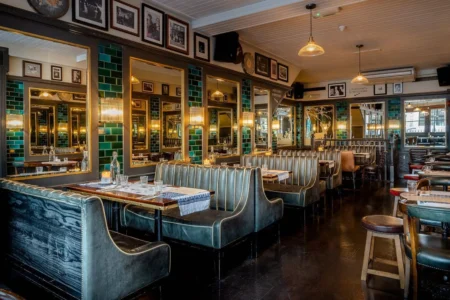
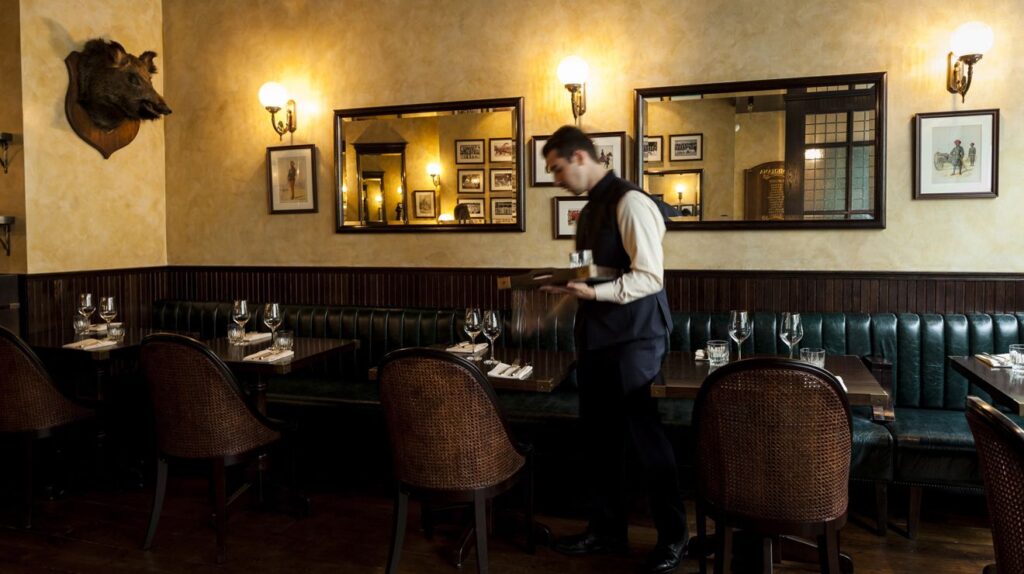
The dining room is the most coherent piece of restaurant design in the Mayfair Indian set. The brief is the British Raj-era sporting clubs — the colonial gymkhanas of late nineteenth-century Bombay, Calcutta and Madras — reinterpreted with care rather than pastiche. Dark wood panelling, ceiling fans that actually turn, leather banquettes the colour of polished saddle, brass and mahogany fittings, framed hunting prints and old club photographs along the wall, marble-topped tables with crisp white linen at dinner. The room hums rather than buzzes.
I have read several hundred reviews of the interior across TripAdvisor, Google and the broadsheet write-ups, and the recurring adjectives are “atmospheric,” “transporting” and “intimate.” The room divides into a front section closer to the door, a tighter middle, and a private back area used for larger parties and the chef’s table; reviewers consistently prefer the middle and back. The basement bar, accessed by a separate stair, runs as its own room with a darker register, lower lighting and a cocktail list that has won its own awards.
The pacing of service is moderate and the volume is genuinely conversational — this is not a hushed two-star room in the Ledbury or Sketch mould, and that is part of the design argument. The Sethis have repeatedly said in interviews that they wanted a room where guests feel they can enjoy themselves rather than perform deference to the kitchen. Reading the reviews from twelve years of operation, the room reads as warmer and more human than the standard Mayfair two-star equivalent.
The menu: what to order
Gymkhana’s menu has more continuity across the years than most fine-dining kitchens at this level. The signature dishes have stayed; the seasonal courses change. From cross-referencing the most-praised orders across TripAdvisor, Google, Hardens, Andy Hayler and the broadsheet write-ups, the following are the dishes the reviews tell first-time diners to order.
Signature dishes (on the menu year-round)
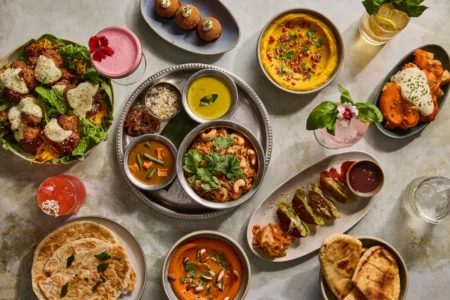
- Tandoori masala lamb chops — the single most-named dish at Gymkhana across every platform I read. Indian lamb chops, marinated, grilled in the tandoor, served pink and smoky. Multiple reviewers describe these as the best Indian lamb chops in London and a number say the best they have eaten anywhere.
- Wild muntjac biryani — the signature game course. Slow-cooked muntjac biryani sealed under a bread crust and opened at the table. The reviews treat this as the dish that defines Gymkhana’s argument about Indian cooking and British game.
- Kid goat methi keema — slow-cooked goat mince with fenugreek, served with a sesame paratha. The most-recommended “don’t skip” order from regulars.
- Suckling pig vindaloo — Goan-style vindaloo built around the kitchen’s suckling pig. Spicier than the lamb chops; one of the dishes most often singled out by reviewers who know Indian cooking well.
- Kashmiri lamb dum biryani — the non-game biryani option for diners who want the format without the muntjac.
- Masala doughnut — the dessert that the regulars order. Spiced, served warm, paired with a chai ice cream that recurs repeatedly in the five-star reviews.
Smaller plates and chaat
Dahi puri, papdi chaat, samundari khazana (a seafood chaat), wild boar sausages and the bone-marrow naan are the small plates that come up most often. The bone-marrow naan in particular is the cult side-order — reviewers describe it as more memorable than several of the mains.
Vegetarian cooking
This is where Gymkhana does something most London two-star kitchens do not. The vegetarian menu is not an annexe to the main offer; it is a full regional Indian vegetarian programme with its own tasting menu at £135. The dishes that come up most often in vegetarian-specific reviews are the aloo chaat, the dosa, the paneer skewers, the kasundi mooli and the dal makhani. North Indian vegetarian cooking is one of the world’s most developed vegetarian traditions and Gymkhana treats it that way.
Drinks
The wine list is unusually thoughtful for an Indian restaurant. Strong Riesling and Gewürztraminer representation, a working selection of Pinot Noir and lighter reds, and house cocktails that handle spice rather than fight it. Pairings from £85. The basement bar holds one of the most-praised cocktail programmes in Mayfair on its own terms.
Tasting menu vs à la carte
This is the single most common question I see in the Reddit threads and the OpenTable reviews from first-time visitors, and the platforms split fairly cleanly.
The case for the tasting menu. The omnivore tasting at £155 is among the lowest-priced two-Michelin-star tasting menus in central London. It walks through six or seven courses, includes the lamb chops and a biryani course, and represents a structural discount against ordering equivalent dishes à la carte. The vegetarian tasting at £135 is the strongest piece of vegetarian fine dining at this price point in the city. For first-time visitors, the tasting menus are the simplest way to see what Karam Sethi is doing.
The case for à la carte. Regulars almost universally order à la carte. The reason is control: the à la carte allows a table to build a meal around the lamb chops, the muntjac biryani and the kid goat keema, with two or three small plates and the masala doughnut, which is closer to what the dish-specific reviews describe as the canonical Gymkhana meal. The cost is similar — a three-course à la carte with one or two of the signature dishes lands around £90 to £120 per head, with a maximalist order pushing toward £150 with cocktails and the bone-marrow naan.
My read on the choice. If you have not eaten at Gymkhana before, take the tasting menu. If you have eaten there once and want to repeat the dishes that made the first visit memorable, order à la carte. The vegetarian tasting is the option I would recommend most readily across both categories.
Pricing and value
Gymkhana sits firmly in the upper tier of London restaurant pricing, and the value conversation is worth being specific about.
Indicative spend (2026). Drinks and snacks in the basement bar will hold under £40 a head. A weekday lunch with two courses and a glass of wine runs £55 to £75. Dinner à la carte with the signature dishes and a cocktail lands £90 to £150 per head. The omnivore tasting at £155 plus the wine pairings at £85 brings the full tasting experience to roughly £240 a head before service. Service is added at the usual London rate.
The positive side of the value argument appears most clearly in the TripAdvisor and Hardens reviews. Comparing Gymkhana to its London two-Michelin-star peers — Helene Darroze at the Connaught, the Ledbury, Ikoyi, Hide, A. Wong — the kitchen sits at the lower end of the price band while holding the same Michelin tier. The omnivore tasting in particular is £50 to £100 cheaper than equivalent two-star tastings within a mile.
The negative side shows up most often in the £66 lamb chops headline, which is the single most-quoted price point in critical reviews. The criticism is that a single course at £66 frames the bill in a way that even the £155 tasting does not. Reviewers also note that the à la carte bill builds quickly if a table orders three or four small plates plus mains plus a biryani; the small-plates-and-mains structure compounds.
My read on the value question. Gymkhana is one of the better-value two-Michelin-star kitchens in central London if you order the tasting menu and take the wine pairings. It is one of the more expensive options if you order three or four small plates plus signature mains and cocktails. A disciplined à la carte order — the lamb chops, the muntjac biryani, one small plate, one dessert, two glasses of wine — holds at around £120 a head, which is fair for the tier. The basement bar is the most accessible entry to the brand at a Mayfair-friendly £35 to £40.
What diners actually say
TripAdvisor — 4.5/5, 2,200+ reviews
The dominant positive themes, in rough order of frequency: the lamb chops, the muntjac biryani, the service warmth, the room design, the vegetarian tasting and the wine programme. Roughly seventy per cent of the reviews mention the lamb chops by name. The most common negative themes are price perception and booking difficulty.
Michelin Guide
Two stars since February 2024 (first star 2014). The Michelin inspector descriptions consistently use the words “refined,” “authentic regional” and “atmospheric room.” The Guide’s treatment of the second-star promotion noted the consistency across more than a decade as the basis of the upgrade.
Good Food Guide
Recommended at the highest tier. The Guide singles out the lamb chops, the biryani service and the depth of the vegetarian menu.
Hardens
Top-ten ranking in the London survey across multiple years, with consistent praise for the wine list and the basement bar.
Andy Hayler
17/20, a score reserved for kitchens Hayler regards as genuinely world-class. His writing is the most technical of the published reviews and singles out the precision of the tandoor work and the structural balance of the spice in the slow-cooked dishes.
The Infatuation
Listed as one of the most exciting Indian restaurants in London. The Infatuation’s tone is praise without superlatives; this is a kitchen they recommend reliably.
Hot Dinners
Repeated coverage of menu changes, special events and the second-star award. The site treats Gymkhana as a fixed reference point in the London Indian conversation.
Reddit r/londonfood and r/finedining
The two threads agree that Gymkhana is the strongest Mayfair Indian fine-dining room and disagree on whether it is the strongest London Indian restaurant overall. The common reservation is the à la carte pricing of the signature dishes; the common praise is the consistency across years. The r/finedining thread on the 2024 promotion treats the second star as long overdue.
Broadsheet press
Guardian, Observer, FT Weekend and Telegraph all carry positive longer-form coverage of Karam Sethi, the second-star award and the JKS group’s wider trajectory. The Observer’s reading of the 2024 promotion as a piece of London cultural history is the line I found most persuasive.
What diners love most
From cross-referencing the praise themes that appear in five or more independent sources, with rough frequency in brackets:
- The tandoori masala lamb chops (mentioned in roughly 70% of detailed reviews). The most-named dish on every platform, and the dish first-time visitors are told to order before they have even sat down.
- The wild muntjac biryani (around 45%). The signature game course and the dish reviewers most often describe as “the reason to come.”
- The dining room (around 40%). The British Raj-era club aesthetic is the most-photographed interior in the Mayfair Indian set.
- Service warmth and Indian-cuisine fluency (around 35%). Senior front-of-house with deep knowledge of the menu, described as “warm rather than formal” in dozens of reviews.
- The vegetarian tasting menu (around 25%). One of London’s strongest fine-dining vegetarian offers and the dish-by-dish reviews back this up.
- The wine programme (around 20%). Riesling and Gewürztraminer with Indian spice is the pairing that converts wine sceptics, and the pairings at £85 are well-priced relative to peers.
- The basement bar (around 18%). One of London’s best Indian-themed cocktail rooms in its own right.
- The bone-marrow naan (around 15%). A cult side-order that reviewers frequently call out by name.
- The masala doughnut (around 12%). The dessert that regulars repeat-order.
Areas for honest consideration
- Booking is genuinely competitive. Four to eight weeks for weekday dinner; eight to ten weeks for Friday and Saturday evening. Since the February 2024 promotion the booking window has tightened further. The £50-per-person deposit is refundable up to 48 hours before, but the lead time is the more significant constraint.
- Spice is not toned down. Reviewers used to Anglo-Indian curry-house heat are sometimes surprised by the assertive seasoning in the vindaloo, the muntjac biryani and the kid goat keema. This is a kitchen that cooks the food at the spice level the cuisine asks for.
- The à la carte bill builds quickly. The lamb chops at £66 are the headline number, but the small-plates-plus-mains-plus-biryani structure compounds. The tasting menu is the most controllable spend.
- The basement bar can be loud. Reviewers note that the bar runs at a different acoustic register from the dining room and is not always suitable for quiet pre-dinner drinks. Book the dining room from the start if conversation is the point.
- Service can feel paced for the kitchen rather than the table. A minority of reviewers describe the dinner pacing as slightly faster than they would like, particularly for the seven-course omnivore tasting on a busy evening.
- The game-focused menu is not for everyone. The muntjac biryani, the wild boar dishes and the suckling pig vindaloo are central to the Gymkhana identity. Diners who do not eat game or pork have fewer headline options on the à la carte than they would at a more conventional Indian fine-dining room.
Who Gymkhana is best for
From the review patterns and the operating reality of the dining room:
✔ Diners who want the most refined Indian cooking in London. Gymkhana’s second Michelin star makes this the most-decorated Indian kitchen in the city, and the dish-by-dish reviews bear out the ranking.
✔ Game eaters. The muntjac biryani, the wild boar and the suckling pig vindaloo are the strongest argument for Indian cooking applied to British game in the country.
✔ Vegetarians at the top of the market. The £135 vegetarian tasting is one of London’s strongest fine-dining vegetarian offers.
✔ Wine enthusiasts. The Riesling and Gewürztraminer pairings are the conversion case for white wine with Indian spice.
✔ Special-occasion diners. The room, the service and the food settle the celebration argument.
✔ Diners who want a quieter pre-dinner room. The basement bar reads as a destination in its own right.
✔ Anyone tracking the Karam Sethi and JKS Restaurants arc. Gymkhana is where the family group’s argument lands most fully.
It is less suitable for:
⚠ Diners who actively want mild Anglo-Indian curry-house cooking.
⚠ Last-minute bookings, particularly on Friday and Saturday evenings.
⚠ Strict budget diners — the basement bar is the only sub-£40 option.
⚠ Diners who do not eat game or pork and want all of the signature dishes available.
⚠ Tables looking for the quietest possible Mayfair dining room — this is a conversational room rather than a hushed one.
How Gymkhana compares to its London Indian fine-dining peers
| Feature | Gymkhana, Mayfair | Trishna, Marylebone | Benares, Mayfair | Quilon, Westminster | Veeraswamy, Regent Street |
|---|---|---|---|---|---|
| Michelin stars | Two (2024); one (2014) | One (2012) | One (historical, current status varies) | One | One (2017 recognition) |
| Regional focus | Northern Indian + game | Coastal South Indian | Modern Indian | South Indian coastal | Pan-Indian heritage |
| Opened | 2013 | 2008 | 2003 | 1999 | 1926 |
| Typical spend à la carte | £90–£150pp | £70–£100pp | £80–£120pp | £70–£100pp | £60–£90pp |
| Omnivore tasting | £155 | £90–£120 | £120–£150 | £75–£95 | £65–£85 |
| Vegetarian tasting | £135 (full programme) | Available | Available | Available | Available |
| Room style | British Raj club | Pared-back modern | Contemporary luxe | Refined dining room | Heritage glamour |
| Signature dish | Tandoori lamb chops; wild muntjac biryani | Brown crab, dosa | Modern seasonal Indian | Mangalorean fish curry | Hyderabadi biryani |
| Booking lead time | 4–8 weeks | 2–4 weeks | 2–3 weeks | 1–2 weeks | 2–4 weeks |
| Game cooking | Defining | Occasional | Limited | Limited | Limited |
My read on this comparison. Gymkhana sits at the top of the Mayfair Indian set on Michelin tier alone, but the more interesting comparisons are sideways. Dishoom King’s Cross is the answer to “where do I take a first-time visitor for atmospheric, accessible Indian food”; Gymkhana is the answer to “where do I take a Michelin-aware diner who has eaten across central London Indian and wants to see the kitchen at the top.” Darjeeling Express beats Gymkhana on regional Calcutta authenticity at a fraction of the price; Diwana Bhel Poori House and Sakonis Wembley beat it on South Indian and Gujarati vegetarian cooking respectively at a fraction of the price. Gymkhana is what it is meant to be: the fully resourced, fully refined argument for Indian cooking at the Mayfair fine-dining tier, with the Michelin recognition to match.
Booking and how to visit
Reservations. Book direct at gymkhanalondon.com or via OpenTable. A £50-per-person deposit is taken at the point of booking, refundable up to 48 hours before the reservation. Cancellations or no-shows after that window forfeit the deposit.
Lead time. Four to eight weeks for weekday dinner; eight to ten weeks for Friday and Saturday evenings. Lunch sittings are easier to book; the lunch tasting menu is the simplest access to the kitchen at the lowest price point. The basement bar takes its own reservations and is a separate booking system.
Best time to visit. Weekday lunch is the most accessible window; the room is calmer, the service is unhurried, and the lunch menu carries the lamb chops and the biryani. A weekday dinner before 7pm is the second-best window. Friday and Saturday evenings are the hardest to book and the busiest in service.
Dress. No formal code, but the room reads smart-casual at minimum. Most male diners wear a jacket; most female diners dress to the level of the room. The basement bar runs at a slightly more relaxed register.
Access. The dining room is on the ground floor with step-free access. The basement bar is reached by stairs.
Frequently asked questions about Gymkhana Mayfair
How many Michelin stars does Gymkhana Mayfair hold in London?
Gymkhana Mayfair holds two Michelin stars. The first star was awarded in 2014 and the second in February 2024, making it the first Indian restaurant in London ever to hold two Michelin stars.
How much does dinner cost at Gymkhana Mayfair in London?
Dinner at Gymkhana Mayfair typically costs £90 to £150 per head à la carte with drinks. The omnivore tasting menu is £155; the vegetarian tasting is £135; wine pairings start at £85. The basement bar in Mayfair holds at £35 to £40 a head for snacks and cocktails.
What is the signature dish at Gymkhana Mayfair?
The tandoori masala lamb chops are the most-ordered dish at Gymkhana Mayfair and are the signature on every menu. The wild muntjac biryani, opened tableside, is the signature game course. Both appear on the omnivore tasting menu.
Who owns Gymkhana Mayfair in London?
Gymkhana Mayfair is owned by Karam, Jyotin and Sunaina Sethi through JKS Restaurants. The family also operates Trishna, Hoppers, Brigadiers, Bibi and a longer roster of London restaurants. Karam Sethi is the chef-director who has led the Gymkhana kitchen since it opened in 2013.
How far in advance should I book Gymkhana Mayfair in London?
Booking lead time at Gymkhana Mayfair is four to eight weeks for weekday dinner and eight to ten weeks for Friday and Saturday evenings. Lunch sittings are easier to book at shorter notice. A £50-per-person deposit applies, refundable up to 48 hours before.
Is there a vegetarian menu at Gymkhana Mayfair?
Yes — Gymkhana Mayfair runs a dedicated vegetarian tasting menu at £135, alongside extensive vegetarian options on the à la carte. The vegetarian programme draws on the Northern Indian vegetarian tradition and is one of London’s strongest fine-dining vegetarian offers.
How do I get to Gymkhana Mayfair by tube in London?
The nearest tube to Gymkhana Mayfair is Green Park, four minutes’ walk south on the Jubilee, Piccadilly and Victoria lines. Piccadilly Circus is six minutes’ walk east on the Bakerloo and Piccadilly lines. Bond Street is ten minutes’ walk north-west on the Central and Elizabeth lines.
Is Gymkhana Mayfair good for special occasions in London?
Yes — Gymkhana Mayfair is one of central London’s strongest special-occasion restaurants. The British Raj club-style dining room, the two Michelin stars, the depth of the wine list and the consistency of the service across thirteen years of operation make it a reliable choice for milestone meals.
Does Gymkhana Mayfair serve game in London?
Yes — game is central to the Gymkhana Mayfair menu. The wild muntjac biryani is the signature game dish; the kitchen also serves wild boar vindaloo, partridge and pheasant in season, and suckling pig vindaloo year-round. The use of muntjac, an invasive species in the British countryside, is one of the more thoughtful sustainability stories among Michelin-starred London kitchens.
London Reviews verdict on Gymkhana
I started this review expecting to write a measured re-assessment of a restaurant that has been over-praised, and finished it convinced that Gymkhana is one of the few London restaurants whose reputation under-states what it does. The 2024 Michelin promotion was a milestone, but the more important argument is the consistency: this kitchen has been working at this level for more than a decade and the reviews show almost no variation across years.
Gymkhana is the most refined Indian restaurant in London. The tandoori lamb chops are the best in the city. The wild muntjac biryani is the most distinctive game dish across the London Michelin set. The vegetarian tasting menu is genuinely exceptional. The basement bar is one of the best Indian-themed cocktail rooms anywhere. The dining room is the most atmospheric piece of restaurant design in the Mayfair Indian set. The Sethi siblings have built the most consequential operating group in modern London Indian dining around it.
The criticisms are real and worth being honest about. The à la carte builds fast. The lamb chops at £66 are a single price point that defines the bill. The booking lead time is genuine. The spice is not toned down. The game-focused menu narrows the options for non-game diners. None of these are reasons to dismiss the restaurant; they are reasons to go in informed and to book the tasting menu if you have not been before.
The single piece of advice I would give a first-time visitor: book the omnivore tasting menu for a weekday lunch, take the wine pairings, and start the evening in the basement bar with one cocktail before going upstairs. That is the visit that will tell you most honestly what Gymkhana is and why it earned the second Michelin star.
Related London Reviews
- Dishoom King’s Cross Review: The Most Consistent Large-Format Indian Dining Room in London
- Darjeeling Express Review 2026: Bold, Authentic, Women-Led
- Diwana Bhel Poori House London Review: 55 Years of South Indian Vegetarian Cooking on Drummond Street
- Sakonis Wembley London Review
- The Savoy London Review: The Strand’s Definitive Heritage Hotel
- Natural History Museum London Review: South Kensington’s Defining Free Day Out
- More Indian restaurant reviews from London Reviews
- More food and drink reviews from London Reviews
London Reviews summary rating
| Category | Rating |
|---|---|
| Food quality | ★★★★★ |
| Tandoori and game cooking | ★★★★★ |
| Vegetarian fine-dining offer | ★★★★★ |
| Service | ★★★★☆ |
| Atmosphere and design | ★★★★★ |
| Wine list and pairings | ★★★★☆ |
| Value at the tasting tier | ★★★★☆ |
| Value at the à la carte tier | ★★★☆☆ |
| Booking experience | ★★★☆☆ |
| Location and accessibility | ★★★★★ |
| Overall | ★★★★★ 4.7/5 |
Methodology and disclaimer
This Gymkhana Mayfair review was researched and written by Amelia Wilson for London Reviews between 1 April and 16 May 2026. The platforms cross-referenced were Google, TripAdvisor, Trustpilot, the Michelin Guide, the Good Food Guide, Hardens, Hot Dinners, Andy Hayler, The Infatuation, the Guardian, the Observer, FT Weekend, the Telegraph and the relevant Reddit communities, alongside Gymkhana’s own published menus, opening hours, deposit policy and the JKS Restaurants group’s public-facing materials. London Reviews did not accept hospitality, complimentary meals or any commercial consideration from Gymkhana, JKS Restaurants or any associated party. All editorial opinions are independent. Prices, menu items and opening hours change — please confirm directly with Gymkhana before your visit.
Have you eaten at Gymkhana Mayfair? Share your experience in the comments or submit your own review. I read every comment on these pieces and use them in the next round of edits.