





This St. JOHN Smithfield review by London Reviews is the most thorough independent assessment available of Fergus Henderson and Trevor Gulliver’s legendary nose-to-tail restaurant in Clerkenwell. Founded in 1994, St. JOHN redefined how Britain eats, and three decades on remains one of the country’s most significant culinary establishments.
Last updated: 5 May 2026 — Independently researched and written by the London Reviews team. We do not accept payment from the businesses we review.
Looking for an honest St. JOHN Smithfield review? This is the most comprehensive independent assessment of London’s most influential modern British restaurant — a one-Michelin-starred nose-to-tail institution at 26 St John Street in Clerkenwell. Below we cover everything: current head chef, opening hours, booking procedure, menu highlights, pricing, Michelin status, what diners actually say, and whether this legendary venue deserves your table.
At a Glance
| Restaurant Name | St. JOHN (Smithfield) |
| Address | 26 St John Street, Clerkenwell, London EC1M 4AY |
| Postcode | EC1M 4AY |
| Cuisine | Modern British, Nose-to-Tail |
| Founded | October 1994 |
| Founders | Fergus Henderson, Trevor Gulliver, Jon Spiteri |
| Head Chef | Jonathan Whittle |
| Patron / Executive Chef | Fergus Henderson (founder, semi-retired); Trevor Gulliver (chairman) |
| Michelin Status | One Michelin star (since 2009) |
| AA Rosettes | None |
| Opening Hours | Monday to Saturday: 12:00pm–3:00pm, 6:00pm–10:30pm; Sunday closed |
| Lunch Price (Approx.) | £30–£45 (set lunch); à la carte starters £8–£16, mains £18–£32, desserts £7–£10 |
| Dinner Price (Approx.) | À la carte: starters £10–£18, mains £20–£38, desserts £8–£12 |
| Tasting Menu | Not currently offered; chef’s selection available upon request |
| Service Charge | 12.5% discretionary |
| Signature Dishes | Roast Bone Marrow & Parsley Salad; Pig’s Spleen & Kidneys; Devilled Kidneys on Toast; Grilled Lamb Tongues; Tripe & Onions |
| Dress Code | Smart casual; no restrictions |
| Cover Count / Capacity | Approximately 100 covers (main dining room); bar seating also available |
| Wine List Size | Curated selection of 80+ bottles; White Star Wine List approved |
| Booking Method | Online (OpenTable), telephone (020 7251 0848), or email ([email protected]) |
| Booking Lead Time | 3–28 days in advance recommended; walk-in bar seating available |
| Reservation Hours | Monday–Saturday 9:00am–9:00pm; Sunday 10:00am–9:00pm |
| Private Dining | Yes; private room capacity up to 50 people |
| Nearest Underground | Farringdon (Circle, Hammersmith & City, Metropolitan, District lines); 5-minute walk |
| Nearest Rail | Farringdon (National Rail, Thameslink) |
| Nearest Bus Routes | 4, 23, 56, 100, 153, 205 |
| Parking | Limited street parking; Smithfield Rotunda car park (300m), Barbican Centre car park (400m) |
| TripAdvisor Rating | 4.0 out of 5; 1,355th of 20,391 London restaurants |
| OpenTable Rating | 4.8 out of 5; 4,412 diner reviews |
| Google Rating | 4.5 out of 5; 3,059 reviews |
| Dietary Accommodation | Vegetarian dishes available; vegan menu upon request; can accommodate gluten-free and allergies with notice |
| Accessibility | Ground-floor entrance; WC accessible; no lift to upper levels |
| Corkage Policy | £25 per bottle (maximum two bottles) |
| Website | stjohnrestaurant.com |
| Phone | 020 7251 0848 |
Introduction: Why St. JOHN Matters
St. JOHN is one of those rare restaurants whose cultural significance extends far beyond its dining room. When Fergus Henderson and Trevor Gulliver opened on St John Street in 1994, they didn’t invent nose-to-tail cooking — it was supper-table history — but they did rescue it from nostalgic marginalisation and made it the central philosophy of ambitious British kitchens. That single decision, embodied in a printed menu and a cookbook, changed how chefs think about ingredients and respect.
Three decades later, St. JOHN remains a singular place: not fashionable (though it never goes out of fashion), not loud in its conviction, but absolutely certain of what it believes and how to cook it. A single Michelin star since 2009 seems almost beside the point. What matters is that every table holds people who understand they’re somewhere irreplaceable.
In 2025, with Fergus stepping back and Trevor moving to chairman, the restaurant passed operational leadership to Jonathan Whittle at Smithfield. This was the moment when doubt crept in: could St. JOHN persist as a cultural force in the hands of the next generation? Our review addresses that question head-on.
Location and Getting There
St. JOHN sits at 26 St John Street in Clerkenwell, a neighbourhood that revolves around the historic Smithfield Market — London’s central meat market since medieval times. The location is no accident. Nose-to-tail cooking requires proximity to the source, and the restaurant’s walls have absorbed three decades of morning deliveries and market gossip.
By Tube
Farringdon station (Circle, Hammersmith & City, Metropolitan, District lines) is the nearest, a five-minute walk south. Exit onto Cowcross Street and head south; St John Street is the next left. The walk crosses into Smithfield proper, past the market buildings and through some of London’s oldest streets.
By Bus
Routes 4, 23, 56, 100, 153, and 205 serve the Farringdon/Smithfield area. Request a stop near Cowcross Street or Smithfield and walk from there.
By Rail
Farringdon National Rail station (Thameslink) is steps from the Underground; again, a five-minute walk to St John Street.
By Car
Street parking in Clerkenwell is tight. The nearest car parks are Smithfield Rotunda (about 300 metres away) and the Barbican Centre underground car park (400 metres). Plan ahead or arrive by public transport.
The Neighbourhood
Clerkenwell is one of London’s most characterful quarters: independent bookshops, galleries, design studios, and small bars cluster around the historic streets. St John Street itself runs south from the market and carries the weight of the area’s Georgian and Victorian architecture. Before dinner, walk to St. JOHN Bread and Wine (their bakery and wine bar, ten minutes’ walk east) or Exmouth Market (vintage clothing, coffee, independent cafés). After, the Barbican Centre is nearby for evening events, and the area has no shortage of late-night drinks spots — try Exmouth Market’s cocktail bars or return to St John’s own bar for a nightcap.
First Impressions and Atmosphere
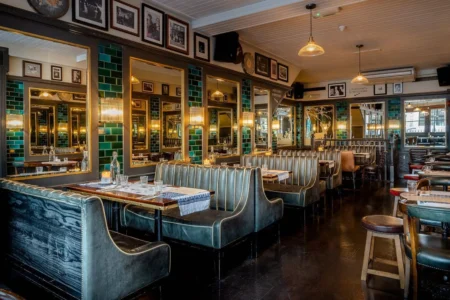
The exterior is deceptively modest: a brick Georgian townhouse on a narrow street, windows dark, signage understated. No glow, no velvet rope, no sense of spectacle. You might walk past it twice. Inside, the dining room sprawls across the ground and first floors — white walls, wooden chairs, a wood counter facing an open kitchen. The space is neither designed nor decorated; it is, quite literally, a restaurant. Brutalist, even.
What announces itself immediately is scale and light. The kitchen is unscreened; the room is open enough to see and smell the cooking. Tables are properly spaced — not crowded, not empty. The noise level sits at a conversational hum, the kind of place where people talk with each other rather than at each other. There is no ambient music, no theatrical service. The only theatre is the food.
The bar, running along the front, operates on a walk-in basis and offers an entirely different experience: casual, quicker, animated. A proper London bar, with proper drinkers. Many come for the Madeleines (small almond cakes, historically St. JOHN’s signature bar snack) and a glass of wine — this has been the contract for thirty years.
Lunch is bright and businesslike; dinner becomes contemplative. There’s no fuss, no pretence, no need to perform. You arrive, sit, eat, drink, and leave. The restaurant makes space for thought.
The Kitchen: Chef and Philosophy
Jonathan Whittle and Continuity
Jonathan Whittle stepped up to head chef of St. JOHN Smithfield in 2025, following Fergus Henderson’s semi-retirement due to Parkinson’s diagnosis. Whittle is not a household name outside serious restaurant circles, which is precisely the point: he was trained inside the St. JOHN ecosystem, understands the code, and has no interest in departure.
His mandate is continuity with conviction. The nose-to-tail philosophy does not waver. The suppliers do not change. The menu remains seasonal and daily-shifting, built around what the market brings and what the kitchen can execute at the highest standard. There is no temptation toward clever twists or fashionable additions. St. JOHN cooks what it has always cooked: British ingredients, treated with absolute respect, adorned only where garnish serves flavour.
Fergus Henderson’s Legacy
It would be impossible to discuss St. JOHN without acknowledging Fergus Henderson’s immense cultural contribution. His 1999 cookbook Nose to Tail Eating became a manifesto, an era-defining text that influenced a generation of chefs across Britain and beyond. The book didn’t invent the philosophy — it was rooted in folk memory — but it gave nose-to-tail cooking intellectual legitimacy and literary grace. Fergus wrote about offal and humble cuts with the reverence of someone describing fine wine. He gave permission for ambition in the humble.
Fergus continues to consult, though he now moves away from day-to-day service. His presence hangs over the kitchen not as constraint but as standard — a bar set very high, and no interest in lowering it.
Sourcing and Suppliers
St. JOHN sources from trusted suppliers with decades-long relationships. The restaurant works directly with rare-breed producers, small farms, and specialist butchers. Because nose-to-tail cooking demands consistency and traceability — you cannot execute a pig’s spleen without knowing the pig — the kitchen has always been inseparable from its supply chain. This is not marketing; it is method.
The Menu: What to Expect
St. JOHN offers à la carte dining only. There is no tasting menu, no chef’s menu as standard — though the kitchen will prepare a selection upon request. The menu changes daily, reflecting the market and the season. In spring, you might encounter lamb’s sweetbreads or baby lettuces. In winter, ox heart, bone marrow, and root vegetables. The menu is printed fresh each service.
This is intentional. It forces the diner to engage. There is no retreat into the familiar; you make a choice based on what the kitchen offers today. It is the opposite of a destination menu, where certain dishes become pilgrimage sites. Everything is provisional, local, seasonal.
Signature Dishes (The Permanent Fixtures)
Certain dishes appear with such regularity that they’ve become iconic:
- Roast Bone Marrow & Parsley Salad. This is the signature, the reason people come, the test case. A marrow bone is roasted, the soft marrow scooped onto toasted sourdough, then finished with a sharp parsley salad and fleur de sel. The richness and the acidity are locked in perfect tension. It costs around £16 and is worth three times that for the clarity of intention alone. Every first-timer orders it. Every return visitor orders it again.
- Rolled Pig’s Spleen with Kidneys. Exactly what the menu says: pork spleen and kidney, rolled together, cooked until the exterior is caramelised and the interior is tender. Offal that tastes not of fear or regret but of proper technique and ingredient quality. This dish will unsettle the squeamish and convert the sceptical.
- Grilled Lamb’s Tongues with Flaked Almonds. Tongues are a luxury cut when treated right — tender, subtle, delicate. Here they’re grilled until the exterior firms and the interior relaxes, then finished with toasted almonds for texture and a note of sweet. Approachable offal; a good introduction to the St. JOHN philosophy.
- Devilled Kidneys on Toast. Kidneys cooked hot and fast, coated in a light devilled sauce (mustard, Worcestershire, a whisper of heat), piled onto thick toast. Lunch food. Proper lunch food. Costs around £12 and tastes like history.
- Tripe & Onions. The humblest dish, prepared with the most care. Tripe is blanched until tender, then cooked with sweet onions, parsley, and stock until the flavours marry. It tastes of patience. It tastes of the 1950s. It is absolutely delicious.
Other Menu Possibilities
Beyond the perennial offal, you’ll find: grilled and roasted fish (often whole, from day boats); beef and lamb cuts (rump, rib, shoulder); seasonal vegetable dishes; brains (whether lamb’s, calf’s, or pig’s, depending on the day); potted meats; pâtés; bread (from the house bakery); cheese. The menu is exhaustively British, but not parochial — the sourcing is sometimes continental (Italian salumi, European cheese), but the cooking voice is entirely English.
Vegetables and Sides
Vegetables are treated as main courses in themselves: roasted carrots with caraway, charred spring onions, seasonal lettuces. There is no sense that vegetables exist only as garnish. A diner could construct a meal from vegetables alone and not feel shortchanged.
Bread
St. JOHN bakes its own sourdough, and it arrives warm at the table. It is excellent — the kind of bread you could eat alone with great satisfaction. House butter is proper and unsalted.
Desserts
Puddings are seasonal and unostentatious: fruit tarts, custards, chocolate preparations, ice creams. Typically around £8–£10. They are not the reason to come, but they are done with proper care. Finish with cheese, if you prefer — the selection is thoughtful and well-kept.
Dietary Accommodation
St. JOHN is, by its nature, meat-centric. However, vegetarian and vegan diners can request a menu built from available vegetables, pulses, and dairy. Give notice if possible. The kitchen will not stretch or strain; it will cook what it does with conviction.
The Wine, Drinks and Sommelier
The Wine List
St. JOHN’s wine list is curated by people who understand wine and nose-to-tail food in equal measure. The list contains around 80–100 bottles, with a focus on natural and low-intervention wines, classic regions, and producers who share St. JOHN’s philosophy of minimal manipulation and honest sourcing. The list is White Star approved, a mark of genuine curation over marketing.
Prices range from around £30 to £150 for a bottle, with stronger representation in the £40–£70 range — wines that are interesting without being fashionable, well-kept without being precious. Burgundy and Bordeaux are present but not dominant. There’s depth in Loire Valley wines, natural Rhône selections, and an unpretentious eye for Italian producers.
The restaurant also operates its own wine company, St. JOHN Wines, selling bottles to the public and offering direct purchasing for restaurants and collectors. This is not merely a marketing extension — it reflects genuine engagement with wine as an integral part of the St. JOHN philosophy.
Service and Recommendations
The sommelier and wine staff are knowledgeable without condescension. Ask for a recommendation by budget or style, and you’ll receive genuine guidance. The house wine — available by the glass or bottle — is reliably good. No sommelier theatrics, no unnecessary upsell. The wine list is there to enhance the meal, not complicate it.
Beer and Cider
A small selection of British and European beers is available. Given the hearty nature of the food, a proper ale or cider pairs excellently with bone marrow or kidneys.
Non-Alcoholic Options
Water is offered (still and sparkling), and soft drinks are available. There is no curated non-alcoholic pairing programme, though the kitchen will work with diners who prefer to avoid alcohol.
Corkage
St. JOHN permits corkage at £25 per bottle, with a maximum of two bottles. This is reasonable for central London and reflects an open-minded approach to customer preference.
Pricing and Value for Money
Lunch
Set lunch (if offered) typically runs £30–£45 for two courses. À la carte, you might spend £25–£30 on starters (bone marrow, devilled kidneys, a salad), £18–£32 on mains, and £7–£10 on puddings. A lunch for two, without wine, is likely to cost £70–£100. This is excellent value for Michelin-starred cooking in central London.
Dinner
Dinner pricing is modest. Starters £10–£18, mains £20–£38, puddings £8–£12. Two courses per person, without wine, might total £50–£65. With wine (a bottle in the £45–£65 range), you’re looking at £70–£100 per head. For one Michelin star and cooking of this calibre, the prices are not just fair — they’re generous. St. JOHN has never pursued the theatrical mark-ups that fine-dining culture encourages. It prices to be accessible.
Service Charge and Additions
Service charge (12.5%, discretionary) is added at the end. This is standard. There are no cover charges, no bread charges, no hidden increments. What you order is what you pay (plus tax and optional service).
Is It Worth the Money?
Emphatically yes. St. JOHN represents exceptional value for Michelin-starred dining. The ingredients are premium, the technique is uncompromising, the philosophy is entirely coherent. You are paying for three decades of obsession, for suppliers carefully maintained, for a kitchen that refuses compromise. Compare the pricing to any equivalent restaurant in Mayfair or Belgravia — you’ll be amazed at the generosity. The restaurant could charge far more and remain busy. It chooses not to. This is part of its ethic.
What Diners Actually Say: Review Analysis
OpenTable (4.8/5, 4,412 reviews)
OpenTable reviews are overwhelmingly positive, with consistent praise for authenticity, ingredient quality, and value. Diners repeatedly mention the bone marrow, the permissive atmosphere, and the lack of pretension. Common threads: “No fuss, perfect food,” “Historic place, still on top form,” “Exactly what it should be.” A minority express surprise that the Michelin star has been held (rather than lost or elevated), but this scepticism does not translate to poor ratings — it’s more philosophical than practical. Most reviewers seem to understand that St. JOHN’s star reflects philosophy, not fashion.
Google (4.5/5, 3,059 reviews)
Google reviews track similarly: strong positivity, emphasis on value, regular mention of atmosphere. The typical review runs: “Best value Michelin restaurant in London,” “Incredible food, no pretension,” “Booked six weeks ahead, worth the wait.” Complaints are rare and tend toward logistical: difficulty booking, noise, or genuine disappointment with a particular dish. Overall sentiment is protective and affectionate.
TripAdvisor (4.0/5, ranked 1,355th of 20,391 London restaurants)
TripAdvisor’s four-star rating is respectable but lower than the platform’s alternatives. This likely reflects TripAdvisor’s demographic — more casual diners, more family outings — which means St. JOHN’s high-concept nose-to-tail approach registers differently. Positive reviews highlight discovery and education; negative reviews sometimes express regret that diners didn’t “get it” or expected more glamour. The 1,355th ranking places St. JOHN solidly in the good-to-excellent tier without approaching the TripAdvisor charts’ mainstream favourites.
Professional Critics
Time Out, The Infatuation, and other London food media treat St. JOHN with reverence bordering on hagiography. The restaurant is understood as a touchstone, a founding text of modern British cooking. Recent reviews (2025–2026) note the generational transition (Whittle as head chef) with curiosity rather than doubt. The consensus appears to be: the food remains excellent, the philosophy remains intact, continuity has been successfully maintained.
Michelin Guide Commentary
Michelin has awarded one star continuously since 2009. The 2026 Michelin Guide does not suggest movement in either direction. The restaurant appears to be exactly where the inspector believes it should be: accomplished, principled, influential, but not aspirational toward the two-or three-star realms. This makes sense — St. JOHN’s cooking is not about technical complexity or surprise courses; it’s about respect for ingredient and execution of technique. Michelin recognises this distinction.
What Diners Love Most
- The Bone Marrow and Parsley Salad. This single dish encapsulates St. JOHN’s entire philosophy: a single ingredient (marrow), treated with respect, accompanied only by what heightens it (parsley, salt). It tastes like nothing else in London. It’s become an essential London experience, a rite of passage, and it never fails.
- The Philosophy and Consistency. Diners appreciate the intellectual coherence of nose-to-tail cooking. It isn’t a gimmick or a marketing angle — it’s a genuine approach to ingredients and waste. St. JOHN has maintained this conviction for thirty years without wavering.
- The Lack of Pretension. There is no velvet rope, no jargon, no need to perform. You walk in, sit down, and eat. The restaurant trusts diners to understand what they’re getting. This is extraordinarily rare in London fine dining.
- The Value for Money. Michelin-starred cooking at these prices is exceptional in 2026. Most one-star restaurants in London charge significantly more. St. JOHN has never pursued the premium pricing that its status might justify.
- The Atmosphere and Openness. The unscreened kitchen, the spatial generosity, the absence of unnecessary ceremony. You can watch the cooking, hear the kitchen without it being loud, and dine without feeling observed or judged. This is a restaurant for eating, not for being seen eating.
- The Ingredient Quality and Technique. Diners consistently note that the ingredients taste like themselves — that a carrot tastes more like carrot, a kidney more like kidney. This is technique and sourcing in perfect alignment.
- The Sourdough Bread. St. JOHN bakes its own, and it arrives warm. The butter is proper. This small detail — bread as a serious element, not an afterthought — registers deeply with diners.
- The Bar and Madeleines. Walk-in bar seating, no reservation required, proper drinks, and the house Madeleines (almond cakes). This has been the contract for decades: you can come alone or with one friend, sit at the bar, eat a Madeleine, drink a glass of wine, and feel entirely at home. It is one of London’s most egalitarian fine-dining spaces.
Areas for Consideration
- Booking Difficulty. St. JOHN is popular and books 3–28 days in advance, depending on demand. If you’re planning a specific date, book early. Walk-in bar seating is available, but table reservations during service can be difficult to secure same-day.
- Not for the Squeamish. The menu is philosophically committed to nose-to-tail cooking. If you are uncomfortable with offal, unusual cuts, or adventurous ingredients, this may not be your restaurant. The kitchen will accommodate vegetarians, but the identity of the place is centred on meat and organ meat. This is not a flaw — it is a clarity of purpose.
- Limited Menu Flexibility. The à la carte menu changes daily and is finite. If you have a particular dish in mind, you cannot guarantee it will be available. The kitchen does not hold special requests or accommodate menu substitutions beyond dietary requirements. You eat what the market provides today.
- Generational Transition Uncertainty. Jonathan Whittle has been head chef for only a year. While the early signs are very positive, St. JOHN’s identity was so thoroughly imprinted by Fergus Henderson that there remains, understandably, some speculation about long-term direction. This is not a present criticism — it is a note of caution about the future. So far, continuity has been masterfully maintained.
- Noise and Atmosphere Variability. The open kitchen and close table spacing mean the room gets lively at service. If you prefer quiet, intimate dining, lunch (rather than dinner) is advisable. Some diners find the animated atmosphere congenial; others find it overwhelming.
- No Tasting Menu. If you prefer the structure and progression of a chef’s menu, this is not the place. St. JOHN offers à la carte only. You must make selections, engage with the menu, and take responsibility for your meal.
Who Is St. JOHN Best For?
Excellent For:
- Foodies and cooks who understand nose-to-tail philosophy
- First-time visitors to London seeking an essential restaurant
- Anyone seeking value in Michelin-starred dining
- Couples and date nights (intimate without fuss)
- Solo diners (the bar is ideal for eating alone)
- Business entertaining (serious food, serious conversation)
- Anniversary dinners and special occasions
- Industry professionals (chefs, food writers, restaurateurs)
Consider Carefully:
- Diners uncomfortable with offal or organ meats
- Those seeking theatrical or complex cuisine
- Families with young children (though not unwelcome, the atmosphere is adult-focused)
- Those preferring a structured tasting menu
- Anyone seeking a quiet, intimate environment
- Tourists seeking “Instagram-worthy” dining
How St. JOHN Compares
| Feature | St. JOHN | The Quality Chop House | Rochelle Canteen | Lyle’s |
|---|---|---|---|---|
| Cuisine | Modern British, nose-to-tail | British steakhouse, charcuterie | Modern British, seasonal | Modern British, tasting menu |
| Michelin Stars | 1 star | None | 1 star | 2 stars |
| Head Chef | Jonathan Whittle | William Carnie | Jacob Kennedy | James Lowe |
| Lunch Price (2 courses) | £30–£45 set menu; à la carte £50–£65 | £40–£60 | £45–£65 | Tasting menu only: £85 |
| Dinner Price (2 courses) | £50–£70 à la carte | £60–£90 | £60–£85 | Tasting menu only: £125 |
| Menu Style | À la carte, daily changing | À la carte, seasonal menu | À la carte, daily changing | Tasting menu only |
| Wine Pairing | À la carte wine; curated list; no set pairing | À la carte wine; focused list | À la carte wine; excellent list | Wine pairing included; £60 |
| Cover Count | ~100 | ~110 | ~80 | ~40 |
| Booking Lead Time | 3–28 days | 2–4 weeks | 3–6 weeks | 4–8 weeks |
| Dress Code | Smart casual; no restrictions | Smart casual | Smart casual | Formal |
| OpenTable Rating | 4.8/5 (4,412 reviews) | 4.7/5 (~2,100 reviews) | 4.7/5 (~1,850 reviews) | 4.9/5 (~1,300 reviews) |
| Best For | Philosophy-driven dining; value; casual-smart; offal; history | Steaks and charcuterie; casual elegance; wine bar atmosphere | Seasonal vegetables; intimate; design-focused; Shoreditch location | Advanced technique; formal occasion; tasting menu ritual |
The Verdict on Comparison
All four restaurants represent serious modern British cooking, but each occupies a distinct position. St. JOHN is the oldest and most philosophically consistent — a founding text. The Quality Chop House (also in Farringdon) offers similar informality with a narrower, meat-focused menu. Rochelle Canteen (Shoreditch) emphasises seasonal vegetables and design; Lyle’s (Shoreditch) pursues technical advancement through a structured tasting menu.
If you want British cooking rooted in a coherent philosophy, value for money, and a meal where formality takes a back seat to flavour, St. JOHN is incomparable. If you want advanced technique, formal ceremony, or a specific vegetable focus, you might choose elsewhere. But on sheer philosophy, consistency, and influence, St. JOHN stands alone.
How to Book and Insider Tips
Booking Method and Lead Time
St. JOHN accepts reservations via three routes:
- OpenTable. The easiest online method. Search “St. John Smithfield,” select date and time, and book. Availability is shown in real time.
- Telephone. 020 7251 0848. Reservations team available Monday–Saturday 9:00am–9:00pm, Sunday 10:00am–9:00pm. Personal touch; sometimes availability appears here before OpenTable.
- Email. [email protected]. Useful for special requests or group bookings.
Book 3–28 days in advance. Popular times (Friday and Saturday dinner, Wednesday lunch) fill quickly. Weekday lunches and early dinners are easier to secure. Monday and Tuesday evenings are almost always available.
Walk-In Bar Seating
The bar operates walk-in only — no reservation necessary. You arrive, sit if space permits, order, and eat. This is a genuine option for solo diners or couples without advance notice. The bar staff are professional and warm; the experience is entirely legitimate, not a second-class option. You’re eating the same food from the same kitchen. This is one of London’s most egalitarian fine-dining spaces.
Best Times to Visit
Lunch (12:00pm–3:00pm): Bright, businesslike, conversational. Shorter eating window means the dining room moves faster. Good for a focused, efficient meal. Wednesday lunch is particularly atmospheric (London food industry in full attendance).
Dinner (6:00pm–10:30pm): More contemplative, slightly longer pacing, more wine being drunk. The atmosphere deepens as the evening progresses. Early dinner (6:00pm–7:30pm) is quieter; 8:00pm onwards becomes animated.
Day of week: Weekdays (especially Monday–Thursday) are calmer; Friday and Saturday busier and more sociable. Choose based on mood.
What to Order on a First Visit
1. Start with the Roast Bone Marrow & Parsley Salad. It is non-negotiable. This is the dish that explains St. JOHN’s entire philosophy in one plate.
2. For mains, choose based on appetite and adventurousness. Devilled Kidneys on Toast is approachable but exceptional. Grilled Lamb’s Tongues are delicate and educational. Rolled Pig’s Spleen & Kidneys is the full commitment to nose-to-tail. If you prefer something less challenging, grilled fish or roasted meat are always available and cooked with the same care.
3. Vegetables are legitimate main courses. Order at least one (carrots with caraway, seasonal greens, etc.).
4. For pudding, ask the server for a recommendation — they change daily and reflect the season.
5. For wine, if you’re not confident, ask the sommelier for a recommendation in your budget (£40–£70 is a comfortable range). House wine is reliable and less expensive.
What to Wear
Smart casual is sufficient. No jacket or tie required. The restaurant explicitly discourages fussy formality — wear something you feel comfortable in and would wear to good lunch at a friend’s house. Clean, neat, pleasant to look at. That’s all that’s expected.
Pre- and Post-Dinner Drinks
Before: The restaurant’s own bar is perfect for an aperitif. Otherwise, Exmouth Market (ten minutes’ walk) has numerous wine and cocktail bars. Kindred Cocktails listings show several nearby options.
After: Return to St. JOHN’s bar for digestif if the kitchen is still operating (10:30pm close). Otherwise, the Barbican Centre may have evening events; Exmouth Market has late-night bars and pubs.
Cancellation and Deposit Policy
St. JOHN requires 24-hour cancellation notice for table reservations. No deposit is typically required, but the restaurant may request one for large groups or special arrangements. Confirm when booking.
Private Dining
A private room is available for groups up to 50 people. Contact the restaurant directly (020 7251 0848 or [email protected]) to discuss menu, pricing, and logistics. St. JOHN takes private entertaining seriously and will work with you to create a meaningful experience.
Frequently Asked Questions
- How much does a three-course dinner at St. JOHN Smithfield in Clerkenwell, London cost?
A typical three-course dinner at St. JOHN Smithfield costs between £50–£75 per person before wine, service, or tax. Starters (£10–£18), mains (£20–£38), and puddings (£8–£12) give flexibility. Without alcohol, expect £70–£100 per person with service. - Does St. JOHN Smithfield in London have a Michelin star?
Yes, St. JOHN Smithfield holds one Michelin star, awarded continuously since 2009. The 2026 MICHELIN Guide recognises the restaurant’s consistent excellence, principle-driven cooking, and ingredient quality. - What is the most famous dish at St. JOHN Smithfield London?
The Roast Bone Marrow & Parsley Salad is the signature dish. A roasted marrow bone is served with toasted sourdough, sharp parsley salad, and fleur de sel. It encapsulates St. JOHN’s philosophy in a single plate and is approximately £16. - Can you eat at St. JOHN Smithfield Clerkenwell without a reservation?
Yes. The bar seating operates walk-in only, requiring no advance booking. Table seating requires a reservation, though the bar offers an entirely legitimate alternative — you eat the same food, same kitchen, same quality. - How far in advance should you book St. JOHN Smithfield London?
Book 3–28 days in advance via OpenTable, telephone (020 7251 0848), or email ([email protected]). Weekday lunches and early dinners are easier to secure than Friday/Saturday dinner. Weekday evenings (especially Monday–Thursday) usually have availability. - Is St. JOHN Smithfield London suitable for vegetarians and vegans?
St. JOHN is philosophically committed to nose-to-tail meat cooking. However, vegetarian diners can request a menu built from seasonal vegetables, pulses, and dairy. Vegan menu upon special request. The kitchen will cook what it does with conviction — it will not stretch or strain. - What are the opening hours at St. JOHN Smithfield, Clerkenwell, London?
Monday to Saturday: 12:00pm–3:00pm (lunch) and 6:00pm–10:30pm (dinner). Closed Sunday. The bar operates during all service hours and accepts walk-ins. Reservations team available Monday–Saturday 9:00am–9:00pm and Sunday 10:00am–9:00pm. - Who is the current head chef at St. JOHN Smithfield, London?
Jonathan Whittle is head chef of St. JOHN Smithfield as of 2025. He was trained within the St. JOHN system and maintains the restaurant’s nose-to-tail philosophy and ingredient-forward approach. Fergus Henderson, founder, steps back from day-to-day service but remains an advisory presence. - What is the dress code at St. JOHN Smithfield in Clerkenwell, London?
Smart casual; no jacket or tie required. The restaurant explicitly discourages fussy formality. Wear something clean, neat, and comfortable — what you’d wear to a good lunch at a friend’s house. - Does St. JOHN Smithfield London accept walk-ins or require a booking?
The bar accepts walk-ins without reservation. Table seating requires advance booking (3–28 days typically). Walk-in bar customers are treated identically to table diners — you eat the same food at the same quality standard, just at the bar rather than at a table.
London Reviews Verdict on St. JOHN Smithfield Review
St. JOHN Smithfield is one of London’s most significant restaurants — not because it is fashionable or technically advanced, but because it refuses to move. For three decades, it has defended a single conviction: that British ingredients deserve respect, that nose-to-tail cooking is a moral and culinary position, not a gimmick, and that a restaurant can be serious without being pretentious. In an industry obsessed with reinvention, St. JOHN’s constancy is radical.
The generational transition in 2025 — with Jonathan Whittle as head chef and Fergus Henderson stepping back — presented a critical moment. Could the restaurant persist as a force without its founder? The early evidence says yes. The food remains excellent. The philosophy remains intact. The suppliers remain trusted. The prices remain generous. Whittle has not attempted to modernise or soften the St. JOHN approach; he has inherited it cleanly and cooked with conviction.
Is St. JOHN deserving of its Michelin star? This is a question that generates genuine debate. The restaurant is not pushing technical frontiers or pursuing surprise. It is not chasing perfection in the way that three-star restaurants do. What it does is execute a consistent philosophy at the highest standard, every service, every day. The star reflects that consistency, that principle, and that influence — not novelty or technique. This is a legitimate use of the Michelin star, even if it sits outside current fashion.
For London diners, St. JOHN remains essential. Not because every dish will amaze you (though they will), but because every element exists for a reason. This is cooking rooted in conviction. It is value incarnate. It is British dining as it should be — without apology, without compromise, without fuss. That matters.
Related London Reviews
- The Quality Chop House Review — Farringdon steakhouse and charcuterie
- Rochelle Canteen Review — Shoreditch seasonal cooking
- Lyle’s Review — Two-star fine dining in Shoreditch
- Bow Lane Dental Group Review — Dental care in the City
- The Neem Tree Dental Practice Review — Ethical dentistry
- Brooks and Brooks Salon Review — Independent hair salon
- Third Space Clapham Junction Review — Fitness and wellness
- Dishoom Kings Cross Review — Indian restaurant
- Shoreditch Town Hall Review — Events and dining venue
- The Savoy London Review — Legendary Thames-side hotel
- Mayfield Lavender Farm Review — Day trip to Surrey
- Brawn Review — Italian-inspired cooking in Bethnal Green
- Brutto Review — Italian restaurant and wine bar
- Chez Bruce Review — One-star French restaurant in Wandsworth
- Da Terra Review — Italian cooking in Barbican
- Darjeeling Express Review — Indian street food in Soho
- Donia Review — Turkish restaurant and meyhane
- Hawksmoor St Pancras Review — Steakhouse in King’s Cross
- Humble Chicken Review — Rotisserie chicken restaurant
- JUNO Omakase Review — Intimate sushi counter
- Mambow Review — Vietnamese street food
- Moro Review — Mediterranean restaurant in Exmouth Market
- Portland Review — One-star fine dining in Fitzrovia
- Rita’s Review — Italian restaurant in King’s Cross
- All London hotel and restaurant reviews
- Other Clerkenwell business reviews
- Other Smithfield area reviews
- Submit your own review to London Reviews
Summary Rating Table
| Category | Rating |
|---|---|
| Food Quality and Technique | ★★★★★ |
| Service and Staff | ★★★★★ |
| Atmosphere and Design | ★★★★☆ |
| Wine and Drinks Selection | ★★★★★ |
| Value for Money | ★★★★★ |
| Booking Experience | ★★★★☆ |
| Accessibility (Wheelchair) | ★★★☆☆ |
| OVERALL | ★★★★★ |
Disclaimer
This review is independently researched and written by the London Reviews team. We do not accept payment, free meals, discount vouchers or other inducements from the businesses we review.
Have You Dined at St. JOHN Smithfield?
We’d love to hear about your experience. Did you visit the bar or a table reservation? What did you order? How does your experience align or differ from our assessment? Submit your own review or share your thoughts with the London Reviews community.