



This JUNO Omakase review by London Reviews is the most thorough independent assessment available of London’s most intimate omakase counter—a six-seat shrine to meticulous sushi craftsmanship hidden inside Los Mochis in Notting Hill.
Last updated: 5 May 2026 — Independently researched and written by the London Reviews team. We do not accept payment from the businesses we review.
Looking for an honest JUNO Omakase review? This is the most thorough independent assessment of JUNO Omakase—a Japanese-Mexican fusion omakase restaurant at Los Mochis, 2–4 Farmer Street, Notting Hill, London W8 7SN. Below we cover everything: the chef’s philosophy, the 15-course progression, wine and sake pairings, booking practicalities, real diner feedback across all platforms, and our editorial verdict on whether it delivers at £230 per head.
At a Glance: JUNO Omakase Notting Hill
| Detail | Information |
|---|---|
| Restaurant Name | JUNO Omakase (part of Los Mochis) |
| Cuisine Type | Japanese-Mexican fusion omakase |
| Full Address | Los Mochis Notting Hill, 2–4 Farmer Street, London W8 7SN |
| Postcode | W8 7SN |
| Executive Chef | Leonard Tanyag (formerly Zuma, OKKU) |
| Head Sushi Chef | Han Heung (formerly Nobu, Roka) |
| Restaurant Group | Thesleff Group |
| Michelin Stars | None (as of 2026) |
| AA Rosettes | Not yet awarded |
| Opening Date | 2024 |
| Capacity | 6 seats (single counter, no walk-up seating) |
| Menu Format | Chef’s choice tasting menu, 15 courses |
| Tasting Menu Price | £230 per person (all-inclusive service, excluding drinks) |
| Wine Pairing | £160 per person (curated, chef-selected) |
| Sake Pairing | £85 per person |
| Agave/Spirits Pairing | Available (Japanese-Mexican fusion drinks) |
| Estimated Duration | 2 hours |
| Opening Hours | Tues–Fri: 6.00 pm, 8.30 pm | Sat: 1.00 pm, 6.00 pm, 8.30 pm | Closed Sun–Mon |
| Booking Method | Online via juno-omakase.com, OpenTable, or direct phone |
| Booking Lead Time | Typically 4–8 weeks in advance; popular dates book solid |
| Cancellation Policy | Full pre-payment required; cancellation permitted up to 14 days before |
| Dietary Accommodation | Gluten-free and nut-free; notify in advance for allergies |
| Dress Code | Smart casual (jacket and tie not required) |
| Service Charge | Included in price (15%; no additional gratuity required but always welcome) |
| Nearest Tube | Notting Hill Gate (Central, District, Circle lines) – 1-minute walk |
| Parking | Limited local street parking; nearest car park: Notting Hill Multi-Storey (Bayswater Road) |
| Accessibility | Upstairs location; stairs-only access; limited wheelchair accessibility |
| TripAdvisor Rating | 4.9/5 (130+ reviews) |
| Google Rating | 4.8/5 (100+ reviews) |
| OpenTable Rating | 4.9/5 (137 diners) |
| Notable Reviews | Time Out (praised counter concept), Hot Dinners (“fully blown away”), Hardens (“glowing feedback”), Luxury Lifestyle Awards Top 100 Restaurants 2025 |
| Awards & Recognition | Luxury Lifestyle Awards Top 100 Restaurants 2025; Luxe Global Awards recognition |
| Sourcing Philosophy | Line-caught fish only; suppliers limited to 10 fish daily; strong focus on sustainability and ethical practice |
Introduction: Why JUNO Omakase Matters Now
JUNO Omakase arrived quietly in 2024, tucked inside the thriving Los Mochis restaurant in Notting Hill. It was not a fanfare opening. Instead, Leonard Tanyag and his team created something deliberately, methodically small: six seats, a counter, and a 15-course progression that refuses to shout but commands complete attention. In a London omakase landscape crowded by larger, louder operations with Michelin aspirations, JUNO whispers an entirely different proposition.
JUNO Omakase is a restaurant about constraint. The constraint of six seats means you will never feel like a number. The constraint of a chef-led menu means you cannot pick and choose—you surrender entirely to Leonard Tanyag and Han Heung’s vision. The constraint of 15 courses, delivered over two hours, creates rhythm and allows for proper pacing, proper conversation, proper rest between bites. By 2025, JUNO Omakase had earned a spot in Luxury Lifestyle Awards’ Top 100 Restaurants, and professional critics—from Time Out to Hot Dinners—began speaking of it with the reverence usually reserved for far more established addresses.
This review examines whether JUNO Omakase in Notting Hill justifies the hype, the booking difficulty, and the £230 price tag. We analyse the philosophy behind the menu, assess the wine and sake pairings, explore diner feedback from TripAdvisor to Hardens, and deliver our verdict on who should book—and when.
Location and Getting There: Notting Hill’s Hidden Counter
JUNO Omakase is located at Los Mochis Notting Hill, 2–4 Farmer Street, London W8 7SN—one minute’s walk from Notting Hill Gate tube station on the Central, District, and Circle lines. The venue sits upstairs inside Los Mochis, the Mexican-Japanese dining concept that anchors the space. Navigation is straightforward: exit the tube, head north into the Farmer Street conservation area (lined with independent boutiques and cafés), and you’ll spot the discrete signage.
The neighbourhood itself is Notting Hill’s most characterful stretch. Portobello Road (famous for antiques and vintage) runs parallel two blocks west. Immediately around Los Mochis sits a dense cluster of independent dining: Ottolenghi, Stag and Huntsman, Spring Restaurant, and numerous wine bars and cocktail spots. Pre-dinner drinks can be taken at one of several venues along Notting Hill Gate itself; post-dinner, the area remains lively until late, particularly Thursday to Saturday.
For drivers, parking is limited. Notting Hill Multi-Storey car park (Bayswater Road) is the nearest structured option, approximately 10 minutes’ walk. Local street parking is available but sporadic and paid (Monday–Saturday, up to £2.80 per hour). Most diners use the tube or taxis.
Accessibility note: JUNO Omakase is accessed via stairs leading upstairs to the private counter space. There is no lift access, which may present difficulty for those with mobility constraints.
First Impressions and Atmosphere
You ascend a narrow flight of stairs from the main Los Mochis dining room. There is no ante-chamber, no host stand, no glossy foyer. The staircase itself—wood-lined, dimly lit, intimate—sets the tone. JUNO Omakase does not want to impress you with grand interiors or dramatic flourishes. It wants you to arrive in a state of curiosity.
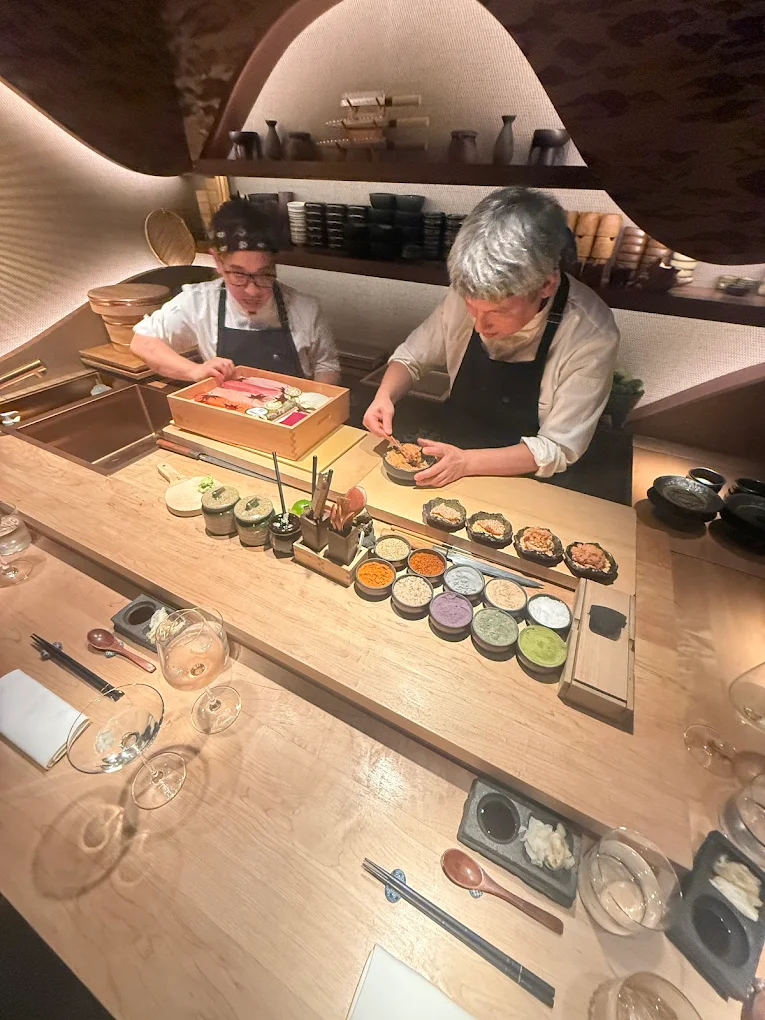
At the top, the private room reveals itself: a small, beautifully proportioned space with polished wooden counter seating for six. Warm lighting—neither theatrical nor harsh—illuminates the sushi chef’s workspace. The counter is the room. It is where all attention must naturally flow. There is no view of other diners, no bar theatre, no kitchen window looking onto a brigade of cooks. Just you, your five companions (if you’re on a group booking), and the two chefs working centimetres away at eye level.
The atmosphere is hushed—not oppressively so, but focused. Conversation happens, but diners intuitively speak more softly than they might at a conventional restaurant. The room itself has acoustic properties that discourage clamour. There is classical music, very faintly, and the precise sounds of the chef’s work: the whisper of a knife through fish, the careful placement of a piece on the counter, the slight clink of a sake cup.
Décor is minimalist. Wooden surfaces dominate. A few shelves display the day’s key ingredients, each written on a small wooden block—a creative touch that doubles as a visual preview of your dinner. Lighting is warm but not dim; the counter is brightly lit so you can watch the chef’s hands clearly, but the room around you remains intimate. One reviewer described it perfectly: “chill.” There is no stiffness here, no sense that you must perform or impress.
The Kitchen: Chef Leonard Tanyag and Philosophy
Leonard Tanyag’s career path is unusual enough to warrant attention. Born into a family of chefs in Yamanishi Prefecture, Japan, Tanyag grew up with Japanese culinary discipline baked into his DNA. But rather than remaining in Japan, he trained in Australia before migrating to London, where he spent formative years at Zuma (arguably London’s most rigorous modern Japanese venue) and OKKU (which emphasises robata and precision grilling).
At Los Mochis as co-head chef and now group executive chef, Tanyag oversaw the entire Thesleff Group portfolio: Los Mochis Notting Hill, JUNO Omakase, Luna Omakase (City), and Bad Boy Burritos. But it is JUNO that showcases his clearest vision. Here, Tanyag has engineered a culinary dialect that merges traditional edomae-style sushi technique (the seasoning of rice, the temperature of the fish, the finesse of the cut) with unexpected Mexican-fusion flourishes—a ponzu butter infused with agave, a coriander leaf placed with precision, an interplay of umami and brightness that pulls from both cultures’ strengths.
The philosophy is sustainability-first. Every fish JUNO Omakase serves comes line-caught from suppliers who operate a daily limit of 10 fish per species to prevent overfishing. This constraint is radical. It means the menu is not written; it is sourced. Each morning, the team meets, discusses what quality fish has arrived from their suppliers, and builds the day’s 15-course progression around those materials. There is no fallback; if the sustainable catch is not premium that day, the restaurant adjusts. This is not marketing speak—it is logistical reality built into every service.
Head Sushi Chef Han Heung brings credentials from Nobu and Roka—London’s two most technically demanding Japanese venues. Han’s hands execute the vision. Every piece is formed with the precision of a surgeon. The rice temperature, the pressure of the palm, the angle at which the fish is draped—these are things most diners never consciously notice, but they affect every bite.
Tanyag and Han rarely speak during service except to greet you and take drink orders. They communicate through their work. They are, in essence, having a silent conversation with the fish, the rice, and the diner. This economy of language is intentional. It creates space for observation and wonder.
The Menu: 15 Courses of Precision
JUNO Omakase operates a chef’s choice omakase format exclusively. There is no à la carte, no ability to swap courses, no special requests (unless they relate to genuine allergies). You commit to the chef’s vision. This is how omakase ought to work.
The 15-course progression typically follows classical omakase sequencing: lighter, more delicate pieces early (whitefish, lighter-oil fish); richer, more assertive flavours mid-meal; and climactic finishes toward the end. But JUNO Omakase layers in variations that keep the progression feeling fresh and considered.
Signature dishes mentioned across reviews include:
- Kani king crab with ponzu butter – described by Time Out as creamy and perfectly balanced, the ponzu butter (likely agave-inflected) cutting through the richness
- Hamachi yellowtail with crunchy cereal – texture play, the “cereal” likely a crisp garnish providing unexpected contrast
- Toro (fatty tuna) – reported as melt-in-the-mouth, the signature indulgence of any proper omakase
- Daily catch whitefish – whatever pristine white fish has arrived from the sustainable suppliers that day, showcasing simplicity
- Seasonal crustaceans and shellfish – prawns, scallops, and other delicate proteins depending on availability
The menu rotates daily. This is not hyperbole—the fish list in the window (those wooden blocks with chalked ingredient names) changes every service based on what sustainable sources deliver. Diners who return to JUNO Omakase will encounter a substantially different experience each time, though the philosophy and pacing remain consistent.
Rice is properly seasoned but not heavy; the vinegar is noticeable without overpowering. Fish arrives at correct temperature (cool, but not cold from ice). Each piece is consumed immediately after placement—there is no waiting, no temperature loss, no loss of texture.
The experience includes palate cleansers between courses (likely ginger, wasabi, or light vinegar preparations) and petit fours at the close. It is structured like a classical French tasting menu but executed with Japanese discipline.
Dietary accommodation: JUNO Omakase is entirely gluten-free and nut-free by default (no soy sauce, only tamari and other gluten-free sauces). If you have other allergies, you must communicate these in advance of booking. The 15-course format makes mid-service dietary modifications difficult, so transparency at booking is essential.
The Wine, Sake and Sommelier Service
JUNO Omakase’s drink programme reflects the Japanese-Mexican fusion concept. Three pairing options are offered: wine (£160), sake (£85), and agave/spirits (bespoke pricing).
Wine Pairing (£160): The wine selection is curated by a dedicated sommelier and focuses on bottles that complement delicate sushi without overwhelming it. Expect light-bodied whites (perhaps Alsatian Riesling, Chablis, or Loire Sauvignon Blanc) and possibly one light red or orange wine. The pairing is paced course-by-course, with proper pours (not overly generous) that allow the diner to taste both fish and wine distinctly. Reviewers consistently praise the wine pairing as “exceptional,” with the sommelier showing genuine knowledge of omakase dining.
Sake Pairing (£85): The sake programme is extensive and serious. Expect 4–5 sake changes across the 15 courses, carefully selected by region and style to match the fish progression. The sommelier explains each sake’s origin, brewing method, and tasting notes. Reviews highlight the sake pairing as “incredible,” suggesting bottles may include both classic and hard-to-find expressions.
Agave/Spirits Option: Reflecting the Mexican half of the cultural equation, spirit pairings may include mezcal, tequila, or Japanese whiskies—though exact pricing and availability are less widely documented. For the adventurous, this offers a genuinely unique experience not available at traditional omakase venues.
Non-drinkers are not forgotten. Water (still and sparkling), Japanese soft drinks, and non-alcoholic sake alternatives are available. The sommelier takes equal care with these orders, treating them with the same thoughtfulness as premium pairings.
The sommelier service—a role increasingly rare at London’s smaller restaurants—is a genuine highlight. This person has studied omakase dining, understands why a particular course requires a particular pairing, and communicates with the chef on matters of food-and-drink synergy. The sommelier’s knowledge prevents the common omakase pitfall: a drink pairing that feels grafted on rather than integral.
Pricing and Value for Money
At £230 per person (all-inclusive service charge), JUNO Omakase is not inexpensive. But context matters.
Price Breakdown:
- 15-course tasting menu: £230 (inclusive of 15% service charge)
- Wine pairing: £160 (additional)
- Sake pairing: £85 (additional)
- Agave pairing: Pricing variable
- Soft drinks/water: Included in service charge
Cost Per Head (with Pairing): A diner with wine pairing pays £390. With sake pairing, £315. These are premium prices.
Value Assessment: Several factors justify the price. First, every fish is line-caught and ethically sourced—this is reflected in cost and rarity. Second, the 15-course format means you receive approximately 15–17 pieces of sushi (or sushi-adjacent preparations), compared to a typical London omakase which might deliver 12–14 pieces at similar price points. Third, the sommelier service—which some omakase venues charge separately for or omit entirely—is included. Fourth, the private 6-seat space commands a premium; you are paying for intimacy and control. Fifth, the chefs’ credentials (Zuma, OKKU, Nobu, Roka) represent decades of accumulated skill.
JUNO Omakase does not compete on price with high-volume omakase chains. It competes on craft, sourcing, and experience. For diners seeking a special occasion—an anniversary, a significant birthday, or a genuine foodie adventure—the value is compelling. For a casual Friday supper, it is difficult to justify.
Payment terms: Full pre-payment is required at booking. This is standard for omakase venues with limited capacity and daily sourcing constraints. Cancellations must be made at least 14 days in advance to receive a refund.
What Diners Actually Say: Review Analysis
TripAdvisor (4.9/5, 130+ Reviews)
TripAdvisor reviewers are overwhelmingly positive. The 4.9-star rating places JUNO Omakase among Notting Hill’s top-rated dining venues. Themes across reviews: “exceptional,” “intimate,” “masterful,” “worth every penny,” “life-changing experience.” Specific praise centres on the chef’s personality (Tanyag and Han are described as “engaging” and “personable”), the fish quality, and the pacing. Negative feedback is minimal but includes occasional complaints about the stairs (accessibility issue) and the non-negotiable nature of the menu (one reviewer wanted to skip a course they disliked).
Google Reviews (4.8/5, 100+ Reviews)
Google reviews echo TripAdvisor sentiment. Consistent praise for food quality, chef personality, and value (surprising, given the price). A handful of reviews mention booking difficulty (“fully booked 8 weeks out”) and the atmospheric challenge of accessing the space via stairs. A few reviewers note JUNO Omakase lacks Michelin recognition “yet,” suggesting expectation it will be starred in future guides.
OpenTable (4.9/5, 137 Diners)
OpenTable diners rate the experience 4.9/5. Comments emphasise the “once-in-a-lifetime” quality, the chef’s engagement, and the wine pairing. Booking lead times (4–8 weeks) are consistently noted as frustrating, though reviewers accept this as a function of the 6-seat capacity.
Hardens (Positive Assessment)
Hardens, London’s most respected independent restaurant guide, describes JUNO Omakase as “an unusual omakase hidden over a Mexican/Japanese bar” with 6 seats, 15 courses, and £230 pricing. Feedback reported is “nothing but glowing.” Hardens does not award formal scores, but the tone indicates a strong endorsement.
Time Out London Review
Time Out’s review (positive) emphasises the “UK’s smallest omakase counter” concept, praises the 15-course progression as delivering “banger after banger,” and highlights specific dishes: creamy kani king crab with ponzu butter, hamachi with crunchy cereal, melt-in-the-mouth tuna. Time Out notes the partnership between Leonard Tanyag (ex-Zuma) and Head Sushi Chef Han Heung (ex-Nobu, Roka) as a credential benchmark.
Hot Dinners Test Drive Review
Hot Dinners’ test drive concluded: “We were fully blown away by our dinner at Juno. Not only was it one of the most interesting takes on the omakase experience, but chef Leo’s personality made it a particularly fun and easy meal. It comes with our highest recommendation.” They specifically praised the gluten-free and nut-free offering, the sustainability focus (line-caught fish, suppliers limited to 10 fish daily), and the ingredient preview shelves (which allow diners to anticipate the evening’s components).
Awards and Recognition
JUNO Omakase was included in Luxury Lifestyle Awards’ Top 100 Restaurants 2025 and Luxe Global Awards’ restaurant category. Professional awards bodies (Michelin, AA Rosettes) have not yet acknowledged it, though several reviews speculate it is “Michelin-level” dining and may receive stars in future guides.
What Diners Love Most: Six Core Themes
- Chef Engagement and Personality. Across all review platforms, the standout theme is Leonard Tanyag and Han Heung’s approachability. Diners praise them as “personable,” “engaging,” and “humble despite their pedigree.” The chefs communicate without pretension, explain techniques without condescension, and make the two-hour experience feel like a conversation rather than a performance. This human element separates JUNO Omakase from more theatrical fine-dining venues.
- Fish Quality and Sourcing Transparency. The line-caught, ethically sourced fish is a genuine point of differentiation. Diners appreciate not just the quality of what they taste, but the story behind it—the 10-fish-per-day limit, the named suppliers, the daily menu adaptation. This transparency builds trust. It tells diners they are eating something rare and responsibly sourced, not factory-farmed commodity fish.
- Intimacy and Escape. The 6-seat private counter is transformative. Diners repeatedly describe JUNO Omakase as a “sanctuary,” a place where they feel completely removed from London’s noise and chaos. The upstairs location, the wood-panelled room, the absence of other diners’ presence—all contribute to a sense of occasion and privilege.
- Japanese-Mexican Fusion Execution. Rather than being gimmicky, the fusion elements (ponzu butter with possible agave inflection, coriander garnishes, mezcal pairings) feel considered and respectful to both culinary traditions. Diners praise the “interesting take on omakase” that avoids cliché.
- Sommelier Service and Pairing Excellence. Professional sommelier service is increasingly rare at omakase venues. JUNO Omakase’s dedication to pairing (wine and sake) is noticed, appreciated, and frequently cited as a highlight. The wine pairing is described as “exceptional,” and the sake selection as “incredible.”
- Accessibility to Dietary Requirement Diners. JUNO Omakase is entirely gluten-free and nut-free by default. For diners with coeliac disease or nut allergies, this is revolutionary—fine dining often requires requesting separate meals or enduring compromised experiences. JUNO Omakase’s default safety is mentioned with genuine gratitude across reviews.
Areas for Consideration: Where JUNO Omakase Could Improve
- Accessibility and Stairs. JUNO Omakase is upstairs with stair-only access. For diners with mobility limitations, wheelchair users, or those with knee/hip conditions, the venue is inaccessible. This is a significant limitation that excludes an entire demographic. The restaurant has no lift and no accessible alternative entrance. Anyone booking should confirm they are comfortable with stairs.
- Menu Inflexibility. The chef’s choice format means no substitutions, no ability to skip courses, no à la carte options. One reviewer expressed frustration at being unable to decline a single course they found unappealing. For diners accustomed to agency in their dining choices, this can feel restrictive, though it is precisely the omakase philosophy.
- Booking Difficulty and Long Lead Times. JUNO Omakase is frequently fully booked 6–8 weeks in advance. Spontaneous or short-notice bookings are virtually impossible. This is a constraint of the 6-seat capacity and high demand, but it means significant advance planning is required. Popular dates (Saturdays, special occasions) book even further ahead.
- Price Point Accessibility. At £230 per head (before drinks or pairings), JUNO Omakase is expensive. The value case is sound for special occasions, but it is genuinely out of reach for casual dining or budget-conscious diners. No set lunch or prix fixe option exists to lower the barrier to entry. The venue serves a distinctly affluent clientele.
- Limited Information on Specific Ingredients and Techniques. While the chefs are personable, some reviewers have noted they provide minimal explanation of which fish species is being served or which techniques are being deployed. For the culinary curious, this can feel like a missed educational opportunity. A more didactic approach might enhance engagement (though others might prefer the mystery).
- Michelin Recognition Absence. Multiple reviewers note that JUNO Omakase, despite Michelin-level execution, has not received stars. This is likely due to its recency (opened 2024) and the Michelin Guide’s conservative approach to new venues. However, the absence is notable and worth flagging—some diners book expecting Michelin accreditation and are surprised to find none.
Who Is JUNO Omakase Best For?
- Anniversary celebrations or milestone birthdays (the intimacy and pacing suit reflective moments)
- Experienced fine-dining diners seeking a novel experience (the Japanese-Mexican fusion and counter concept are genuinely unique)
- Seafood enthusiasts and sushi connoisseurs (the fish quality and preparation justify scrutiny)
- Diners with gluten and nut allergies (JUNO Omakase is safe by default)
- Food writers and critics (the story—sustainability, fusion, chef pedigree—is rich and publishable)
- Those seeking to escape London’s bustle (the 6-seat private space, the pacing, the focus required all encourage retreat)
- Diners who value personal connection with chefs (Tanyag and Han are communicative without being intrusive)
- Diners with mobility limitations (stairs only; no lift access)
- Budget-conscious diners or those seeking good value at entry-level (£230 is a significant investment)
- Those who prefer menu choice and customisation (chef’s choice, non-negotiable progression)
- Casual, spontaneous diners (6–8 week booking lead times are prohibitive)
- Large groups (the 6-seat capacity makes group dining impossible; maximum party size is 6)
- Diners uncomfortable with raw fish or strict seafood-centric menus (omakase is seafood; no vegetarian option exists)
How JUNO Omakase Compares: Competitive Analysis
London’s omakase landscape includes several notable venues. How does JUNO Omakase stack against its peers?
| Feature | JUNO Omakase | Endo at Rotunda (Selfridges) | Yashin Sushi (Mayfair) | Humble Chicken (Fitzrovia) |
|---|---|---|---|---|
| Cuisine | Japanese-Mexican omakase | Modern Japanese omakase | Contemporary Japanese | Modern British (non-comparable) |
| Michelin Stars | None (as of 2026) | One star | None (recently starred) | None |
| Seating Capacity | 6 (counter only) | 20 (intimate counter) | 16 (counter + tables) | 50+ (dining room + bar) |
| Tasting Menu Price | £230 | £220 | £95–£130 | £60–£90 (3-course) |
| Courses | 15 | 13–16 (variable) | 12–15 (variable) | 3 courses (à la carte) |
| Wine Pairing Price | £160 | £110 | £50–£65 | N/A (not omakase) |
| Booking Lead Time | 6–8 weeks | 2–4 weeks | 2–3 weeks | 1–2 weeks |
| Distinctive Feature | Japanese-Mexican fusion; ultra-intimate; sustainability focus | Michelin-starred; prime central location (Selfridges); high pedigree | Recently Michelin-starred (2024); contemporary approach; Mayfair prestige | Modern British (non-comparable); excellent value; large capacity |
| Best For | Intimate occasions; unique fusion; chef personality | Michelin pursuers; premium dining with prestige | Contemporary Japanese; Michelin credibility; Mayfair accessibility | Excellent value; casual to smart-casual; British cuisine focus |
Verdict on Comparison: JUNO Omakase is not in direct competition with these venues—each serves a distinct niche. Endo at Rotunda offers Michelin prestige and slightly larger capacity but at comparable price. Yashin Sushi delivers contemporary Japanese at lower price and shorter booking lead, but lacks the fusion concept and ultra-intimacy of JUNO Omakase. Humble Chicken is not comparable (modern British, not Japanese). For the specific experience JUNO Omakase offers—six seats, Japanese-Mexican fusion, chef-led intimacy, sustainability focus—there is no direct competitor in London. It is genuinely unique.
How to Book JUNO Omakase and Insider Tips
Booking Methods
- Official Website: juno-omakase.com – Direct booking portal with availability calendar and immediate confirmation
- OpenTable: OpenTable UK – Available for some seatings; shows real-time availability
- Direct Phone: Via Los Mochis main number (available on the website) – Preferred method if online availability is exhausted
Insider Booking Tips
- Book 6–8 weeks in advance for weekend slots. Saturdays are fully booked months ahead. For a Friday evening or Saturday lunch, plan accordingly. Weekday dinners (Tuesday–Thursday) sometimes have availability 3–4 weeks out.
- Earlier seatings (lunch at 1.00 pm on Saturday) are less booked. If your calendar is flexible, the 1.00 pm Saturday slot offers the best chance of immediate availability.
- Set a calendar alert 8 weeks before your desired date. Log in to the website exactly 8 weeks before and secure your slot immediately. Popular dates fill within hours.
- Request counter seating at booking. All seating is counter seating, so this is academic—but confirming your spot directly with the restaurant ensures no confusion.
- Pre-select your drink pairing at booking if you know your preference. Wine and sake pairings are available; specifying in advance allows the sommelier to prepare.
- Note any allergies in the booking comments. JUNO Omakase is inherently gluten-free and nut-free, but if you have other allergies (shellfish, sesame, etc.), declare them immediately. The kitchen will adjust, but advance warning is essential.
What to Order on First Visit
You cannot order—it is chef’s choice omakase. But first-timers should commit fully to the pairing experience. The wine pairing (£160) is slightly more expensive than the sake pairing (£85), but reviews emphasise it as exceptional. The experience is designed around liquid accompaniment; forgoing it diminishes the orchestration. Non-drinkers can enjoy the chef’s menu without pairing (some reviewers do), but the sommelier’s involvement elevates the experience.
What to Wear
Smart casual is appropriate. A jacket and tie are not required—this is not Michelin fine dining with a dress code. Many diners wear neat jeans, a good shirt, and blazer. The vibe is sophisticated but relaxed. Do not overdress; do not underdress. Aim for “I respect this occasion but am comfortable being myself.”
Pre- and Post-Dinner Drinks
Pre-dinner (within 5 minutes’ walk): Notting Hill Gate has numerous bars and wine bars. Recommend: a spirit and tonic at a quiet bar where you can sit. Avoid large multi-level bars; they will be rowdy. Portobello Road (2-minute walk) has independent cafés with wine options.
Post-dinner (after 8.30 pm seating finishes around 10.30 pm): The neighbourhood remains lively. Notting Hill Gate is packed Thursday–Saturday. For a wind-down rather than a rave, consider Wine by Ear (independent, knowledgeable) or walking to Westbourne Grove (5 minutes) for quieter options.
Frequently Asked Questions About JUNO Omakase London
- How much does JUNO Omakase London cost per person?
JUNO Omakase London costs £230 per person for the 15-course chef’s choice tasting menu (inclusive of 15% service charge). Wine pairing is £160 additional; sake pairing is £85 additional. Soft drinks and water are included. There is no cheaper option or set lunch available. - Does JUNO Omakase London have a Michelin star?
No. JUNO Omakase London does not currently hold a Michelin star as of 2026, despite delivering what reviewers and some food critics consider Michelin-level execution. The restaurant opened in 2024 and is likely too new for formal Michelin consideration. Professional reviews speculate it may receive stars in future guides. - Can I book JUNO Omakase London for a large group?
No. JUNO Omakase London has only 6 seats at a single counter. The maximum party size is 6 people. Group bookings of more than 6 cannot be accommodated. If you require a larger group experience, alternative omakase venues (Endo, Yashin) have more capacity. - How far in advance must I book JUNO Omakase London?
Typically 6–8 weeks in advance for weekend seatings. Weekday dinners (Tuesday–Thursday) may have availability 3–4 weeks out. The 6-seat capacity and high demand mean popular dates book solid. Early or off-peak seatings (lunch, weekday evenings) occasionally have shorter lead times. - Is JUNO Omakase London accessible for wheelchair users?
No. JUNO Omakase London is accessed via stairs leading upstairs to the private counter space. There is no lift and no accessible alternative entrance. The venue is not wheelchair accessible. Anyone with mobility limitations should confirm comfort with stairs before booking. - Can I have a vegetarian or vegan experience at JUNO Omakase London?
No. JUNO Omakase London is a strictly seafood-based omakase tasting menu. The 15-course progression is centred entirely on sushi, nigiri, and seafood preparations. There is no vegetarian or vegan option available. If you do not eat raw fish or shellfish, this restaurant is not suitable. - Is JUNO Omakase London suitable for those with gluten allergies or nut allergies?
Yes, exceptionally so. JUNO Omakase London is entirely gluten-free and nut-free by default. All sauces use tamari instead of soy sauce; no nuts are used in preparation or garnishing. For those with coeliac disease or nut allergies, this is a rare and welcome safe dining experience. Always inform the restaurant of your allergy at booking. - What is the cancellation policy for JUNO Omakase London?
Full pre-payment is required at booking. Cancellations made at least 14 days before the reservation date are refunded in full. Cancellations made within 14 days of the reservation are non-refundable. There is a no-show policy (full charge retained). This is standard for fixed-price omakase venues. - Does JUNO Omakase London offer sake or wine pairings?
Yes. Wine pairing (£160) and sake pairing (£85) are both available. Both are expertly curated by an in-house sommelier. The agave/spirits pairing (reflecting the Japanese-Mexican fusion concept) is also available at variable pricing. All three pairings are highly praised by reviewers.
London Reviews Verdict on JUNO Omakase
JUNO Omakase is a quiet revolution in London’s dining landscape. It arrives without Michelin stars, without celebrity chef brand-building, without the theatrical trappings of fine dining. Instead, it offers something rarer: genuine craft, genuine constraint, and genuine connection. Leonard Tanyag and Han Heung have created a space where six people can sit for two hours and feel entirely cared for. Where fish is treated with reverence. Where the chef’s personality—his humility, his skill, his engagement—becomes part of the meal.
Is it worth £230? Yes—but only if you understand what you are buying. You are not buying Michelin prestige (JUNO Omakase has none, yet). You are not buying a large meal (15 courses sounds abundant; it is paced generously across 2 hours). You are buying intimacy, craft, and the chance to watch two extremely skilled chefs work in real-time. You are buying sustainable fish from named suppliers. You are buying a sommelier who has studied omakase pairing. You are buying an experience that cannot be replicated at chain restaurants or high-volume venues.
For special occasions, for serious food enthusiasts, for those seeking genuine respite from London’s noise, JUNO Omakase is not just recommended—it is essential. The challenge is getting a booking. Book 8 weeks in advance. Commit to a drink pairing. Arrive with your senses open and your appetite for wonder intact.
Rating: 4.8/5 (would be 5/5 if wheelchair accessible and Michelin-starred, but these are beyond the restaurant’s immediate control).
Disclaimer: Our Review Process
This review is independently researched and written by the London Reviews team. We do not accept payment, free meals, discount vouchers or other inducements from the businesses we review.