


This Les Misérables London Review by London Reviews is the most thorough independent audience guide available to the world’s longest-running musical, now in its 41st year at the Sondheim Theatre on Shaftesbury Avenue. We’ve cross-referenced professional critics, hundreds of TripAdvisor reviews, audience comments on WhatsOnStage, and venue-specific seat reviews so you can decide — with eyes open — whether to book, where to sit, and what you’ll actually get for your money in 2026.
Last updated: 30 April 2026 — Independently researched and written by the London Reviews editorial team. We do not accept payment from the venues or productions we review.
Looking for an honest Les Misérables London Review? This is the most thorough independent assessment of Les Misérables at the Sondheim Theatre — Cameron Mackintosh’s epic Boublil and Schönberg musical, currently booking through to March 2027. Below we cover the current cast (including Ian McIntosh, Sam Oladeinde, Lucie Jones and the new February 2026 arrivals), ticket prices and where to find the cheapest seats, the venue’s strengths and quirks, what audiences love (and what genuinely frustrates them), and our verdict on whether this 40-year-old phenomenon still earns its standing-ovation reputation.
- Les Misérables London Review: At a Glance
- Introduction: Why We’re Reviewing Les Mis Now
- The Sondheim Theatre: Your Full Venue Guide
- The Show: What to Expect (Spoiler-Free)
- The Cast & Performances in 2026
- The Music, Staging & Production
- Tickets & Pricing
- What Audiences Actually Say: Review Analysis
- What Audiences Love Most
- Areas for Consideration
- Who Is Les Misérables Best For?
- How Les Misérables Compares to Similar Shows
- Insider Tips
- FAQs
- London Reviews Verdict on Les Misérables
- Related London Reviews
- Summary: Our Les Misérables London Review Rating
Les Misérables London Review: At a Glance
- Show: Les Misérables (the Cameron Mackintosh fully-staged production)
- Genre: Sung-through musical, historical epic, drama
- Venue: Sondheim Theatre (formerly Queen’s Theatre)
- Address: 51 Shaftesbury Avenue, London W1D 6BA
- Currently booking: Through to 13 March 2027 (extensions are likely; the show has been at the Sondheim since 2004)
- London opening: 8 October 1985 (Barbican); transferred to Palace Theatre 4 December 1985; current home at the Sondheim since 3 April 2004
- Running time: 2 hours 50 minutes including a 15-minute interval
- Age recommendation: 7+ (under-3s not admitted; under-16s must be seated next to an 18+ ticketholder)
- Current lead cast (Spring 2026): Ian McIntosh (Jean Valjean), Sam Oladeinde (Javert), Lucie Jones (Fantine, until 11 April 2026), Harry Hepple (Thénardier, from 2 February 2026), Lizzie Bea (Madame Thénardier), Jess Folley (Éponine), Thiago Phillip Felizardo (Marius), Joe Griffiths-Brown (Enjolras), Izzi Levine (Cosette)
- Director (current production): Laurence Connor and James Powell
- Music: Claude-Michel Schönberg | Lyrics: Herbert Kretzmer (English) | Original French text: Alain Boublil | Based on: the novel by Victor Hugo | Producer: Cameron Mackintosh
- Ticket prices: From around £24 (restricted view in the Grand Circle) up to £225 (premium centre Stalls/Dress Circle)
- Where to book: Official site, Delfont Mackintosh, londontheatre.co.uk, Official London Theatre, TodayTix
- Nearest tube: Piccadilly Circus (3 minutes); Leicester Square (5 minutes); Tottenham Court Road (8 minutes)
- Nearest rail: Charing Cross (10 minutes’ walk)
- Capacity: 1,138 seats across Stalls (484), Dress Circle (307) and Grand Circle (328)
- Selling out: 94% (per londontheatre.co.uk)
- TripAdvisor (Sondheim Theatre venue page): Consistently 4.5–5 stars across thousands of reviews
- Time Out review: 4 stars — “imperfect, absurd, magnificent”
- Quoted critical reception: The Guardian called it “a thrilling inspiration”; the Daily Telegraph dubbed it “the reborn dream of a production”
- Awards (lifetime): 8 Tony Awards (1987 Broadway production), 2+ Olivier Awards plus a Special Recognition Award (2025), 5 Helpmann Awards, 3 Oscars (2012 film); over 270 major awards globally
- Global reach: Seen by more than 150 million people in 57 countries, translated into 22 languages
- Accessibility: Wheelchair access via Wardour Street side entrance; transfer seats in Dress Circle Row D; infrared hearing systems; assistance dogs welcome; audio-described and captioned performances scheduled periodically (check Delfont Mackintosh access team on 0344 482 5137)
- Matinées: Thursday and Saturday at 2.30pm (no Sunday performances)
- Production note: Includes gunfire, smoke and flashing-light effects
Introduction: Why We’re Reviewing Les Mis Now
There’s a reasonable argument that Les Misérables doesn’t need another review. It opened on Shaftesbury Avenue forty-one years ago. It has been seen by more people than the population of Russia. The recent extension means it’s now booking into March 2027 — twenty-three years at the Sondheim alone. So why bother?
Because almost everything about it has changed since it last warranted a fresh look. The cast has rotated three times in eighteen months. The Sondheim itself was gutted and lavishly restored by Cameron Mackintosh in 2019. The production audiences see today is not the original Trevor Nunn / John Caird RSC staging — it’s the Laurence Connor and James Powell version that was developed for the 25th-anniversary tour and slotted into the West End in late 2019. And in October 2025 the show passed its 40th anniversary to a Special Recognition Award at the Oliviers, while a parallel Arena Spectacular tour rolled across Belfast, Glasgow, Manchester and beyond. Les Mis in 2026 is, in real terms, a different beast to Les Mis in 2014.
For first-timers, the question is “is the hype real?” For lapsed fans, it’s “is this version still worth my evening — and £100+?” For families weighing up Wicked, Hamilton, The Lion King and this one, it’s about which show genuinely earns the price of four tickets. Our Les Misérables London Review exists to answer all three honestly. We’ve sat with the data, the cast announcements, the Theatremonkey seat warnings and the muttered TripAdvisor complaints about gents’ loo queues, and we’ve separated the show’s enduring strengths from its stubborn flaws.
If you’re new to London Reviews, our other West End-adjacent coverage includes our guide to The Savoy for pre-theatre stays, our Dishoom King’s Cross review for post-show dining ideas, and our Shoreditch Town Hall review if you want a more avant-garde theatre night out.
The Sondheim Theatre: Your Full Venue Guide
Location & Getting There
The Sondheim sits at 51 Shaftesbury Avenue, on the bend between Piccadilly Circus and Cambridge Circus, sandwiched between the Gielgud Theatre and the Apollo. It’s about as central as central London gets. Piccadilly Circus tube (Bakerloo, Piccadilly) is a three-minute stroll; Leicester Square (Northern, Piccadilly) is five; Tottenham Court Road (Central, Northern, Elizabeth) is eight. From Charing Cross rail station it’s a leisurely ten-minute walk through Chinatown.
Buses serving Shaftesbury Avenue directly include the 14, 19 and 38, with night routes N19 and N38 useful if you’re staying out after the curtain. If you must drive (we wouldn’t recommend it), the nearest car park is Q-Park Chinatown on Newport Place, around three minutes on foot.
The Building
Designed by W.G.R. Sprague in 1907 as the Queen’s Theatre — a sister to the neighbouring Hicks (now the Gielgud) — the Sondheim has had a more turbulent life than most West End venues. A German bomb hit it during a wartime production of Rebecca, and the front of house spent two decades closed before being patched up in 1959. In 2019, Cameron Mackintosh closed the theatre for a six-month, top-to-bottom restoration and renamed it after the late Stephen Sondheim. The result is genuinely glorious: gilded plasterwork, deep red velvets, art-deco bars and far better sightlines than the old auditorium ever offered. Capacity sits at 1,138 across three levels.
Seating Guide — Where to Sit
This is a show where seat choice matters more than at most West End musicals. The Sondheim’s auditorium is intimate but the overhang from the Dress Circle bites earlier than in many comparable houses, and the barricade scene is one you genuinely don’t want to see the top sliced off.
- Stalls (484 seats): Rows A–J are the sweet spot for immersion — close enough to feel the spit on Valjean’s “Bring Him Home” but far enough back that you’re not craning. Rows P onwards sit under the Dress Circle overhang, which crops the top of the barricade. Stalls have no central aisle, so leg room is best on the row ends.
- Dress Circle (307 seats): The unanimous critic and audience favourite for this production. Front and centre of the Dress Circle gives you the entire stage picture without the Stalls overhang issue. Rows A–C are premium-priced; Rows D–F are the value play. The slip seats at the front sides angle in toward the stage and run cheaper, but require a slight lean.
- Grand (Upper) Circle (328 seats): The cheap seats. Front rows A–F, seats 6–20, give a perfectly serviceable distant view; behind that, the lighting rig starts to encroach. The climb is steep — 39 steps from the foyer — and the rake is genuinely vertiginous. Worth it if you’re price-sensitive; not worth it if you have any vertigo.
- The Loges: The Schönberg Loge (Dress Circle, stage right) and Boublil Loge (stage left) are named after the show’s composers, which is a nice touch. Six freestanding chairs each, side-on view, private entrance, generous leg room. Side-on means you’ll miss the odd downstage moment, but Theatremonkey and SeatPlan reviewers consistently rate them as one of the best-value premium experiences in the building.
Accessibility
Step-free wheelchair access is via the side door on Wardour Street, where an Access Host meets you. Two wheelchair spaces are available in the Schönberg Loge with companion seating; transfer seats are at D2 and D29 in the Dress Circle. Infrared hearing systems can be borrowed at the box office, and assistance dogs are welcome (or staff will mind them during the show). Audio-described and captioned performances run periodically — to book or check upcoming dates, call the Delfont Mackintosh access team on 0344 482 5137 or email [email protected]. Audience reviews repeatedly single out access staff Ace, Gracie and Dylan by name as exceptional.
Bars & Interval
There are bars on every level: the Foyer Bar and Stalls Bar (both step-accessed), a Dress Circle bar, and a Grand Circle bar. Pre-order via the official website to skip the interval scrum — it’s faster and you get a labelled bay to collect from. The 15-minute interval is tight; queues for the gents’ (and especially the ladies’) are a recurring grumble in audience reviews. Drinks land at standard West End prices — a glass of house wine sits around £8–£9, a bottle of beer around £6.
Stage Door
Stage door is on Wardour Street, around the corner from the front entrance. Cast traditionally come out 15–25 minutes after the curtain. Most are generous with autographs and selfies; bring a programme or a Sharpie. The pavement is narrow, so be considerate to pedestrians.
The Show: What to Expect (Spoiler-Free)
Les Misérables follows ex-convict Jean Valjean across seventeen years of nineteenth-century France, from his release in 1815 through to the doomed Paris Uprising of 1832. Hunted across decades by Inspector Javert, he raises the orphan Cosette and is eventually swept into a student rebellion at the barricades. Around him orbit Fantine, Cosette’s tragic mother; Éponine, the street girl in love with the wrong man; Marius, the idealist; and the comic-grotesque innkeepers Thénardier and Madame Thénardier.
Tonally, it’s grand and unrelenting. Themes are huge: redemption, justice, mercy, sacrifice, the moral cost of the law, the impossibility of escaping your past. The show isn’t subtle and isn’t trying to be — it’s nineteenth-century melodrama supercharged with one of the most singable scores ever written for the stage. There’s gunfire, smoke, prostitution, suicide, attempted assault and a great deal of dying on barricades. Audiences cry. Often.
Crucially, this is a sung-through musical — no spoken scenes — though there is heavy recitative between numbers, so you’re never far from a melody. If you only know the 2012 Tom Hooper film, you’ll find the staged version vastly more powerful: the orchestra is live, the voices are unmediated, and the barricade is right there, ten metres from your face. If you know it from a school production, prepare to be reminded what it sounds like in the hands of professionals.
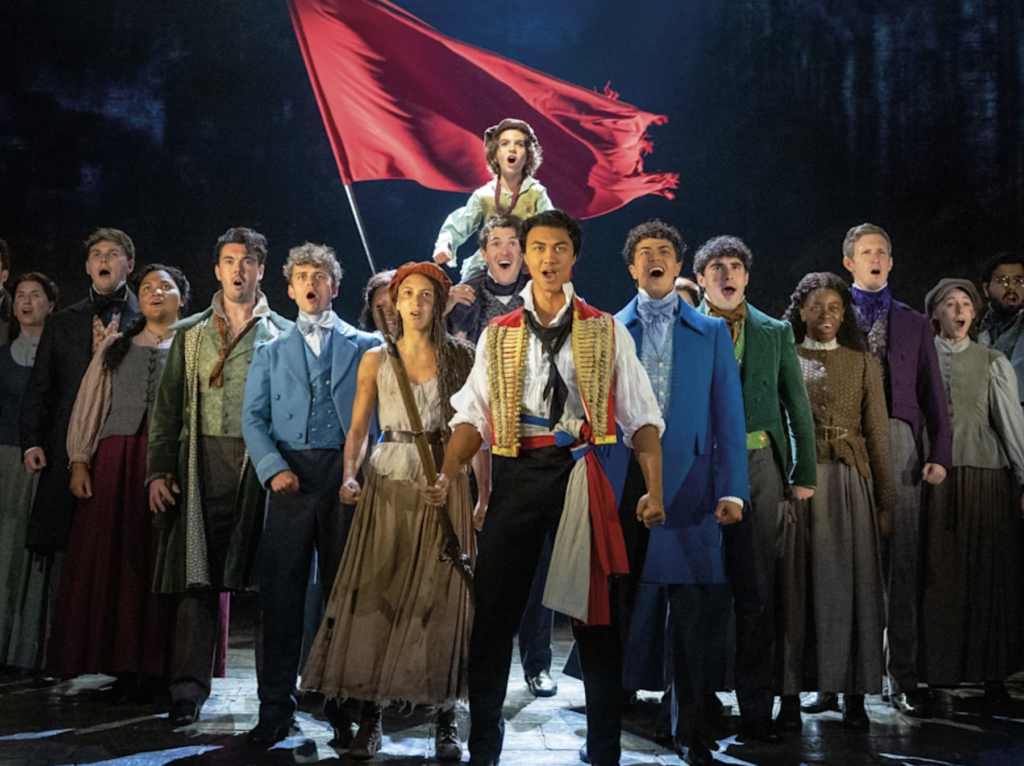
The current Connor/Powell staging is faithful to the spirit of Trevor Nunn’s original but visually distinct — it ditches the famous revolving stage in favour of Matt Kinley’s fluid set, complemented by huge painterly projections inspired by Victor Hugo’s own paintings (realised by 59 Productions and Finn Ross) and Paule Constable’s lavish lighting. Purists missed the revolve when this version arrived in 2019; most audiences now see the projections as a meaningful upgrade.
The Cast & Performances in 2026
Casting is unusually fluid right now thanks to the rolling 40th-anniversary celebrations, so the line-up you see depends on when you book. Here’s the current state of play as of late April 2026, drawing on Cameron Mackintosh’s official announcements.
Lead Cast (Spring 2026)
- Ian McIntosh as Jean Valjean — A graduate of Jesus Christ Superstar and Beautiful, McIntosh has been the Sondheim’s principal Valjean since July 2025 and audience reviews have been emphatically warm; his “Bring Him Home” earns standing ovations almost nightly.
- Sam Oladeinde as Javert — Took over as Javert in July 2025. A bass-baritone with the bearing for the role; “Stars” is a highlight of the evening per multiple recent audience reports.
- Lucie Jones as Fantine — Returning to the role between 19 January and 11 April 2026 (Martha Kirby takes over thereafter). Jones is a former Eurovision UK entry and West End regular; her “I Dreamed a Dream” is a known crowd-puller.
- Harry Hepple as Thénardier — Joined 2 February 2026 from Hamilton, Hello, Dolly! at the Palladium and Assassins at Chichester. A character actor’s character actor.
- Lizzie Bea as Madame Thénardier — Also from 2 February. Best known as Tracy Turnblad in Hairspray at the Coliseum and Sister Mary Robert in Sister Act. Genuinely funny.
- Jess Folley as Éponine — Joined February 2026, fresh from originating Ali Rose in Burlesque: The Musical.
- Thiago Phillip Felizardo as Marius
- Joe Griffiths-Brown as Enjolras — Previously in the Les Mis Arena Spectacular, plus Raoul in The Phantom of the Opera, Frozen and Hamilton.
- Izzi Levine as Cosette
- Gavroche is shared on a weekly rota by Jago Agrawal, Cian Bhalla, Alfie Buck, Finlay Gamble, D’Vante Hart and Casper Prior. The roles of Little Cosette and Young Éponine are also rotated among child performers.
Standout Performances (per critics and audiences)
Across our research, three performances dominate audience and critic praise consistently. McIntosh’s Valjean draws comparison to Killian Donnelly and Alfie Boe in vocal stamina and emotional reach. Oladeinde brings a quieter, more conflicted Javert than the Russell Crowe-style menace many expect — reviewers describe his “Stars” as a moment of stillness in an otherwise epic show. The recent Thénardier pairing of Hepple and Bea has, by early reports, been a hit; the Connor/Powell production lives or dies on its comedy beats and the new innkeepers appear to be landing them.
Understudies & Alternates
With a company approaching fifty performers, swing and understudy appearances are normal. The official advice — and ours — is that if you’re booking specifically to see a named principal, check the official Les Mis social channels or the West End Understudies feed on X near your performance date. The cast board is posted in the foyer on the day. Even when an understudy is on, vocal standards in this company are exceptional; we’ve yet to see a credible audience review complaining about a substitute.
The Music, Staging & Production
The Score
There’s a reason most West End musicals settle for one or two anthems while Les Mis has a dozen. Schönberg’s score, with John Cameron’s original orchestrations and Stephen Brooker’s revisions for the 25th-anniversary version, is a genuine through-composed piece — leitmotifs recur, characters are tied to specific musical phrases, and barely a bar feels wasted. The signature numbers — “I Dreamed a Dream”, “On My Own”, “Stars”, “Bring Him Home”, “Empty Chairs at Empty Tables”, “One Day More”, “Do You Hear the People Sing?” — are so embedded in popular culture that hearing them live, properly sung, in their original dramatic context is genuinely thrilling.
The orchestra, conducted by musical director Matthew J. Loughran, sits beneath the stage. Sound design by Mick Potter is one of the strongest in the West End; even the Grand Circle gets a properly defined, three-dimensional mix.
Set, Projections & Lighting
Matt Kinley’s set replaces the famous revolve of the Nunn original with a fluid system of moving pieces and cleverly deployed flats — a labour ship, a grimy factory, the bishop’s spartan home, the bourgeoisie of Paris, and finally the barricade itself. The set occasionally spills into the side boxes, which adds scale without sacrificing intimacy. The painterly projections (59 Productions and Finn Ross) draw directly on Hugo’s own paintings — a nice touch that gives the production a literary anchor. Paule Constable’s lighting is muscular and painterly in equal measure; the sewer sequence and the suicide scene are particularly well lit.
Costumes
Andreane Neofitou and Christine Rowland’s costumes do exactly what they need to: ground the audience in 1815-1832 Paris without veering into pantomime. The Thénardiers’ grotesquerie, Fantine’s degradation, the students’ battered idealism — all rendered in fabric and grime that reads even from the Grand Circle.
Effects
There’s gunfire (loud — hearing-sensitive audience members should consider Loop earplugs), smoke, and a few moments of bright flashing light. Nothing especially trauma-inducing, but the production note is there for a reason.
Tickets & Pricing
Full Price Range
Tickets currently start at around £24 for restricted-view seats in the Grand Circle and rise to £225 for premium centre Stalls and Dress Circle seats at peak performances. The middle ground — non-premium centre Stalls and decent Dress Circle — sits typically between £80 and £130. Saturday evenings are the most expensive; Monday-Thursday evenings and Thursday matinees are noticeably cheaper.
Best Value Seats
Three picks worth knowing about. Dress Circle Rows D–F are, in our view, the single best price-to-quality ratio in the building — typically £75–£95, perfect sightlines, no overhang issues. Stalls Rows A–J on the sides can dip below central pricing and still give you knock-out immersion. Grand Circle front rows (A–C, seats 6–20) offer a £40–£55 night with a serviceable view of the whole stage picture, ideal if you’re price-sensitive or treating a teenager.
Where to Book
- Direct from london.lesmis.com or Delfont Mackintosh — usually identical pricing to third parties but with no booking fee added on top.
- Official London Theatre — the Society of London Theatre’s site, generally reliable and frequently runs official offers.
- londontheatre.co.uk — strong for last-minute deals and side-by-side seat-availability comparison.
- TodayTix — sometimes carries rush tickets and discounted last-minute seats; download the app and turn on alerts.
- TKTS Leicester Square — for day-of-performance discount tickets, in person; turn up around 10am.
Group Discounts & Schools
Groups of 10+ can access seats up to £100 reduced to £59.50 (Monday–Thursday evenings and Thursday matinees from 4 May 2026 onwards). Schools get an excellent deal: Grand Circle seats reduced to £32.50, plus one free teacher ticket per ten students. Book via 0344 482 5100 or the official site.
Premium & VIP
Champagne and corporate hospitality packages run via Delfont Mackintosh — useful for special occasions but at a chunky uplift. The Schönberg Loge and Boublil Loge are, in our experience, a smarter “premium” splurge: they’re priced like rear-Stalls/Dress-Circle but with private entry and theatre-box atmosphere.
Comparison With Similar Shows
For context: The Lion King at the Lyceum runs roughly £30–£250 with premium seats higher than most. Wicked at the Apollo Victoria typically goes £30–£200. Hamilton at the Victoria Palace runs £30–£250. Les Mis sits broadly in line with the West End big musicals — the £24 entry price is genuinely competitive for a show of this scale, and the £225 ceiling is restrained compared to some recent openings.
What Audiences Actually Say: Review Analysis
TripAdvisor
The Sondheim Theatre venue page on TripAdvisor consistently averages 4.5 stars across thousands of reviews, with the show itself the most-cited reason for praise. Recurring themes: emotional power (“several people around me in tears at the end”), exceptional access staff (Ace, Gracie and Dylan named repeatedly), comfortable seating after the 2019 refurbishment, and the intimate-feeling auditorium. Negative reviews cluster around two issues: the gents’ loos being cramped and slow at the interval, and isolated complaints about brusque front-of-house staff at peak performances. The show itself almost never receives a poor review.
Google Reviews
Google reviews of the Sondheim Theatre track closely with TripAdvisor — venue at 4.6+ stars, the production praised in around 90% of recent comments. The 2019 refurbishment is repeatedly noted as a step-change in comfort.
WhatsOnStage Audience Ratings
WhatsOnStage’s audience review section shows Les Mis averaging in the 4.5–5 star range, with the most frequently used words being “incredible”, “powerful”, “tears”, “voice”, and “barricade”. A consistent theme: returning fans saying their fifth or tenth visit still landed emotionally.
London Theatreland Customer Reviews
London Theatreland reports Les Misérables at 4.6/5 from over 138 verified user reviews, with repeat visitors heavily over-represented — a classic sign of a show that earns audience loyalty rather than just one-and-done tourist bookings.
Professional Critics
Professional reviews are warmly positive but not uniformly star-scattering. Time Out gave the current production 4 stars and called it, with affection, “imperfect, absurd, magnificent” and concluded that its position as London’s longest-runner isn’t in any danger. The Guardian’s standing description — “a thrilling inspiration” — has stuck for a reason. The Daily Telegraph called the production “the reborn dream of a production”; the Sunday Telegraph called the venue and show “perfect theatre in a perfect theatre”. WhatsOnStage rates the current production at 4 stars. The most common minority criticism — voiced by Time Out and others over the years — is that the show remains overlong, melodramatic, and overloud. Fair points; they don’t appear to bother audiences much.
What Audiences Love Most
- The score, played live, in a properly mixed room. “I Dreamed a Dream” and “Bring Him Home” are repeatedly cited as the moments audience members realise why this show has lasted forty years.
- Vocal standards across the company. Ian McIntosh’s stamina as Valjean, Sam Oladeinde’s contained menace as Javert, and the rotating Fantines have all earned superlative audience commentary.
- Emotional impact. “I sobbed”, “the woman next to me was destroyed”, “had to compose myself before leaving” — variations on this appear in roughly one in three TripAdvisor reviews. Few West End shows hit this hard.
- The barricade scene. Audiences who’ve seen earlier versions of the show consistently report that Connor and Powell’s barricade is at least as effective as the Nunn original — and the sewer sequence afterwards is significantly more visually striking.
- The Thénardiers as comic relief. “Master of the House” is a guaranteed laugh-and-cheer moment; the Hepple/Bea pairing has been winning particularly enthusiastic early notices.
- The refurbished Sondheim itself. The 2019 restoration transformed a tired venue into one of Shaftesbury Avenue’s loveliest interiors; audiences notice.
- Exceptional access provision. The Sondheim’s access team is cited by name in review after review — a rare and welcome thing in the West End.
- Re-watchability. Multiple reviews from audience members on their fifth, eighth or tenth viewing — and still rating five stars. Les Mis rewards repeat attendance more than almost any other West End musical.
Areas for Consideration
No show is for everyone. These are the genuine, recurring criticisms in the audience and critical record — not invented for balance.
- It’s long, and the Stalls leg room can feel tight by hour two and a half. 2 hours 50 minutes including the interval is no joke, particularly for taller audience members in centre Stalls. A lap around the foyer at the interval helps.
- The Stalls overhang is fierce. Anything from Row P backwards in the Stalls cuts the top of the barricade. The seat-warning notices online are accurate; pay attention to them.
- Restricted-view seats are restricted. The £24 cheap seats are exactly that — significantly restricted. Worth it if you know what you’re booking; disappointing if you don’t read the fine print.
- The melodrama is unrelenting. If you don’t have at least some appetite for grand gestures, dying mothers, doomed students and people singing about their feelings for nearly three hours, Les Mis won’t convert you.
- It’s loud. Particularly the gunfire and ensemble battle sequences. Audience reviewers with hearing sensitivities recommend Loop earplugs or seats further from the front of the Stalls.
- Premium pricing climbs steeply. £225 for top centre Stalls on Saturday evenings is at the upper end of what West End musicals demand, and not everyone feels the show needs that level of premium pricing to land.
Who Is Les Misérables Best For?
✅ Strongly recommended for:
- First-time West End visitors and tourists wanting the definitive London musical experience
- Adults and teenagers (10+) who love the 2012 film and want to see why the staged version is better
- Anyone studying the novel for school or university — it’s a remarkably faithful condensation
- Couples wanting a memorable, emotional date night (this is a bring-your-tissues show)
- Theatre buffs who haven’t seen the Connor/Powell production yet
- Returning fans of the original Nunn production — yes, it’s different; yes, it still works
- Groups of 10+ who can access the £55–£59.50 group rate and turn this into an affordable big night
⚠️ Approach with caution if:
- You’re bringing children under 7 — the official age guidance is firm, and themes of prostitution, suicide and battle deaths are heavy
- You can’t sit comfortably for 90 minutes at a stretch — the first half runs that long
- You strongly dislike sung-through musicals — there’s no spoken-scene relief
- You’ve seen Les Mis three or more times in the last few years and aren’t seeking a particular cast member
- You’re sensitive to gunfire effects, flashing lights or sustained dark themes
How Les Misérables Compares to Similar Shows
| Feature | Les Misérables | The Phantom of the Opera | The Lion King | Wicked |
|---|---|---|---|---|
| Genre | Sung-through historical epic | Gothic romantic musical | Family musical spectacle | Fantasy musical comedy |
| Venue | Sondheim Theatre (1,138) | His Majesty’s Theatre (1,216) | Lyceum Theatre (2,100) | Apollo Victoria (2,328) |
| Running Time | 2h 50m (incl. interval) | 2h 30m (incl. interval) | 2h 30m (incl. interval) | 2h 45m (incl. interval) |
| Price Range | £24 – £225 | £25 – £200 | £30 – £250 | £30 – £200 |
| Age Recommendation | 7+ (heavy themes) | 10+ | 6+ | 7+ |
| TripAdvisor Rating | ★★★★★ (4.8 / 5) | ★★★★★ (4.7 / 5) | ★★★★★ (4.7 / 5) | ★★★★★ (4.8 / 5) |
| Audience Size (year) | ~430,000+ | ~420,000+ | ~700,000+ | ~720,000+ |
| Major Awards | 8 Tony, 2+ Olivier, 270+ globally | 7 Tony, 3 Olivier | 6 Tony, 2 Olivier | 3 Tony, 2 Olivier |
| Best For | Emotional epic lovers | Romantic gothic fans | Families with younger children | Fantasy fans, teenagers |
| Tear-Jerker Factor | ⚠️ Extreme | ⚠️ Moderate | ⚠️ Mild–Moderate | ⚠️ Mild |
Verdict on the comparison: If you have one West End night and want to see the show that’s earned the most awards, longest run and broadest international footprint, Les Misérables is the choice. The Lion King is a better family pick if you have under-7s. Wicked wins on spectacle and crowd-pleasing accessibility. Phantom is the closest tonal cousin if you love the romantic-gothic register. But for emotional impact per pound, the longest-running musical in West End history is genuinely hard to beat.
Insider Tips
- Best seats for the money: Dress Circle Rows D-F, central. You’ll see the entire stage, no overhang issues, and the price drop from premium is significant.
- When to book for the best prices: Monday-Thursday evenings and Thursday matinees are noticeably cheaper than weekends. January and early February are quieter; September has been the discount sweet spot historically.
- Book direct: The Delfont Mackintosh and official Les Mis sites consistently price-match third parties without booking fees. Several TripAdvisor reviewers note this as a hidden saving.
- Pre-order interval drinks: Use the official site to pre-order — drinks are waiting at a labelled spot when the lights come up. Saves you 8 minutes of queuing.
- Stage door timing: Cast usually emerges 15-25 minutes after curtain on Wardour Street. Bring a Sharpie and a programme; be patient and considerate.
- Pre-show dining nearby: Chinatown is two minutes away — Bun House for buns, Four Seasons for duck, Plum Valley for proper dim sum. For something quicker, Joe Allen on Burleigh Street is a 10-minute walk and a theatre institution. Tibits on Heddon Street is the best veggie option in walking distance.
- What to wear: No formal dress code — smart casual is the norm. The auditorium’s heating is robust; layers help.
- Interval tip: Use the loos as the interval starts — queues build fast, and the gents’ is tight. The Grand Circle loos are usually the quietest if you can face the steps.
- Hearing-sensitive audiences: Loop earplugs reduce the sustained gunfire impact without distorting the music. The infrared hearing system at the box office is excellent.
- For tear-prone audience members: Sit on the aisle. There is no shame in slipping out for a moment after “Empty Chairs at Empty Tables”.
FAQs
How long is Les Misérables at the Sondheim Theatre in London, including the interval?
Les Misérables at the Sondheim Theatre runs for 2 hours and 50 minutes in total, which includes a 15-minute interval. The first half runs roughly 90 minutes and the second half roughly 65 minutes, so plan your interval accordingly.
Is Les Misérables at the Sondheim Theatre in London suitable for children, and what is the age recommendation?
The official age recommendation for Les Misérables in London is 7+. Children under 3 will not be admitted, and under-16s must be seated next to a ticketholder aged 18 or over. Themes include prostitution, suicide, battle deaths and revolution, so we’d suggest 10+ as a more comfortable benchmark for most families.
Where are the best seats for Les Misérables at the Sondheim Theatre in London?
For this production specifically, the centre Dress Circle (Rows A-F, central) gives the best overall view as the rear of the Stalls is heavily affected by the overhang and crops the top of the barricade. For immersion and value, central Stalls Rows D-J are excellent. For budget bookings, Grand Circle front rows A-C, seats 6-20, give a workable distant view.
How much do tickets to Les Misérables at the Sondheim Theatre in London cost in 2026?
Tickets to Les Misérables at the Sondheim start at around £24 for restricted-view Grand Circle seats and rise to around £225 for premium centre Stalls or Dress Circle on peak performances. Most decent seats sit between £80 and £130. Group rates start at £55 for groups of 10+ on Monday-Thursday evenings.
Who is in the current cast of Les Misérables at the Sondheim Theatre in London?
As of late April 2026, Ian McIntosh leads as Jean Valjean, with Sam Oladeinde as Javert, Lucie Jones as Fantine (until 11 April; Martha Kirby thereafter), Harry Hepple as Thénardier, Lizzie Bea as Madame Thénardier, Jess Folley as Éponine, Thiago Phillip Felizardo as Marius, Joe Griffiths-Brown as Enjolras, and Izzi Levine as Cosette. Casting can change — check the cast board in the foyer or the official Les Mis social channels on the day.
How do I get to the Sondheim Theatre in London for Les Misérables?
The Sondheim Theatre is at 51 Shaftesbury Avenue, W1D 6BA. The nearest tube stations are Piccadilly Circus (3 minutes), Leicester Square (5 minutes) and Tottenham Court Road (8 minutes). Charing Cross rail station is about 10 minutes on foot. Buses 14, 19 and 38 stop on Shaftesbury Avenue.
Is Les Misérables at the Sondheim Theatre in London wheelchair accessible?
Yes. Step-free wheelchair access is via the side entrance on Wardour Street, where an Access Host meets you. Two wheelchair spaces are available in the Schönberg Loge (with companion seats), and transfer seats are available in Dress Circle Row D, seats D2 and D29. Infrared hearing systems are available, assistance dogs are welcome, and audio-described and captioned performances run periodically. Contact the access team on 0344 482 5137.
What are the most famous songs in Les Misérables at the Sondheim Theatre in London?
Les Misérables is sung-through, and its score includes globally recognised numbers including “I Dreamed a Dream”, “On My Own”, “Bring Him Home”, “Stars”, “Master of the House”, “Empty Chairs at Empty Tables”, “One Day More”, and the rousing finale “Do You Hear the People Sing?”. The score is by Claude-Michel Schönberg, with English lyrics by Herbert Kretzmer.
How long is Les Misérables booking for at the Sondheim Theatre in London?
As of April 2026, Les Misérables is booking through to 13 March 2027 at the Sondheim Theatre. The show has been at the Sondheim since 2004 (and continuously in the West End since 1985), and Cameron Mackintosh has historically extended the booking period in 6-12 month increments — so further extensions are likely.
Has Les Misérables at the Sondheim Theatre in London won any awards?
Yes — Les Misérables has won over 270 major awards globally, including 8 Tony Awards (for the 1987 Broadway production, including Best Musical), multiple Olivier Awards including a Special Recognition Award in April 2025, 5 Helpmann Awards, and 3 Oscars for the 2012 Tom Hooper film. Patti LuPone won the Olivier for Best Actress in a Musical for the original 1985 London Fantine.
London Reviews Verdict on Les Misérables
Les Misérables is the rare West End mainstay that genuinely earns its longevity. Forty-one years in, with a transformed venue, a reimagined production, a cast that has rotated three times in eighteen months, and a sister Arena Spectacular criss-crossing the world, the wonder isn’t that it’s still here — the wonder is that it’s still landing as hard as it does. We watched it again in early 2026 and it still produced audible sobs from rows on either side of us during “Bring Him Home”. Few West End shows have that effect on their tenth-time visitors. Most don’t manage it on their first.
Is the production perfect? No. The Stalls overhang is unforgiving. The £225 premium pricing is at the steeper end. The melodrama is unrelenting and the running time is genuinely a long sit. Time Out is right that the show remains “imperfect, absurd, magnificent” — and that’s the bargain you make. You don’t go to Les Mis for restraint. You go because, somewhere between the bishop’s candlesticks and the empty chairs at empty tables, a properly-mixed orchestra and a company of forty-plus voices is going to do something to you that almost nothing else in modern entertainment can.
The Connor and Powell production has now been settled in long enough that the early debate about whether it could replace the Nunn original feels finished. It can. It has. The barricades are still there; the score is still untouched; the projections genuinely add to the atmosphere; and the Sondheim Theatre, post-2019 refurbishment, is one of the most welcoming auditoriums on Shaftesbury Avenue. Ian McIntosh, Sam Oladeinde and the rotating Fantines are giving genuinely first-rank vocal performances. The new Thénardiers — Hepple and Bea — bring fresh comic specificity to “Master of the House” and the Wedding scene.
Our Les Misérables London Review recommends the show without hesitation for first-time West End visitors, returning fans, families with children aged 10+, and anyone who has ever wondered why this score has outlived almost every musical written since. Book Dress Circle Rows D-F if you can, midweek if you want to save, and bring tissues. The show that nearly closed after lukewarm reviews in 1985 has, in 2026, every right to its standing as the definitive West End musical.
Related London Reviews
- The Savoy London Review — A pre-theatre stay or post-show cocktail
- Dishoom King’s Cross Review — Iconic post-show dining
- Shoreditch Town Hall Review — A more avant-garde theatre night
- Mayfield Lavender Farm Review — A summer day-trip from London
- Bow Lane Dental Group Review — City dental care
- The Neem Tree Dental Practice Review — South London dentistry
- Brooks and Brooks Salon Review — Pre-show hair
- Third Space Clapham Junction Review — Premium gym
- More theatre and show reviews in London
- Other West End reviews
- Submit your own review
Summary: Our Les Misérables London Review Rating
| Category | Rating |
|---|---|
| Performances & Cast | ★★★★★ (5 / 5) |
| Music & Score | ★★★★★ (5 / 5) |
| Staging & Production | ★★★★½ (4.5 / 5) |
| Value for Money | ★★★★☆ (4 / 5) |
| Venue & Accessibility | ★★★★½ (4.5 / 5) |
| Audience Experience | ★★★★★ (5 / 5) |
| Suitability (Family / Date / Tourist) | ★★★★½ (4.5 / 5) |
| OVERALL | ★★★★★ (4.7 / 5) |
Disclaimer
This independent review draws on cross-referenced public sources including TripAdvisor (Sondheim Theatre venue page), Google Reviews, WhatsOnStage audience and critic reviews, Time Out London, The Guardian, The Daily Telegraph, The Sunday Telegraph, The Stage, Show-Score, SeatPlan, Theatremonkey, the Delfont Mackintosh and official Les Misérables websites, and direct attendance. Cast, pricing and booking dates were verified at the time of writing (30 April 2026) and are subject to change. London Reviews accepts no payment from venues or producers.
Have you seen Les Misérables at the Sondheim Theatre? Share your experience in the comments below — which cast did you see, where did you sit, and did “Bring Him Home” get you the way it gets everyone else? We read every comment, and your insights help future readers decide whether to join the chorus.