




This The Lion King London Review by London Reviews is the most thorough independent audience guide available to Disney’s record-breaking, six-Tony-Award-winning musical, now in its 27th year at the Lyceum Theatre on Wellington Street, just off the Strand. We’ve cross-referenced more than 10,000 verified-booking reviews, professional critics across three decades, SeatPlan’s seat-by-seat user data, the official Disney Tickets and ATG box-office systems, and the spring 2026 cast change so you can decide — clearly — whether to book, where to sit, and what you’ll actually get for your money before the booking window closes on 30 May 2027.
Last updated: 30 April 2026 — Independently researched and written by the London Reviews team. We do not accept payment from the venues or productions we review.
Looking for an honest The Lion King review? This is the most thorough independent assessment of The Lion King at the Lyceum Theatre — Julie Taymor’s genre-defining stage adaptation of Disney’s 1994 animated film, with music by Elton John and Tim Rice, additional music by Lebo M and Mark Mancina, and a cast and crew of more than 150 people from 17 countries. Below we cover the show, the venue, the seats genuinely worth booking, ticket prices from £29.50 (Magical Mondays) to £238 (premium), what audiences love (and what frustrates them), and our verdict on whether — after 10,000+ performances and 20 million London audience members — the show still earns its 4.7-star average and standing-ovation reputation.
The Lion King London Review: At a Glance
- Show: Disney’s The Lion King (Disney Theatrical Productions)
- Genre: Family musical, Disney spectacle, puppetry-driven theatre
- Venue: Lyceum Theatre
- Address: 21 Wellington Street, Covent Garden, London WC2E 7RQ
- Currently booking: To Sunday 30 May 2027 (most recent extension; booking windows have rolled forward consistently for 27 years)
- London opening: 19 October 1999 — currently in its 27th year at the Lyceum
- Running time: 2 hours 30 minutes including a 15-minute interval
- Age recommendation: 6+ (under-3s strictly not admitted, including babies in arms; under-16s must be accompanied by an adult and seated next to them)
- Director, Costume Design, Mask & Puppet Co-Design: Julie Taymor — first woman to win a Tony Award for Best Direction of a Musical
- Music: Elton John | Lyrics: Tim Rice | Additional music & choral arrangements: Lebo M | Additional music: Mark Mancina | Original film score themes: Hans Zimmer
- Book: Roger Allers and Irene Mecchi (the original film’s screenwriters)
- Choreography: Garth Fagan | Set Design: Richard Hudson | Lighting: Donald Holder | Sound: Steve Canyon Kennedy | Mask & Puppet Co-Design: Michael Curry
- Current lead cast (until 3 May 2026): Stephenson Ardern-Sodje as Simba, Merryl Ansah as Nala, with George Asprey as Scar and Shaun Escoffery as Mufasa
- New lead cast (from 5 May 2026): Posi Morakinyo as Simba and Asha Parker-Wallace as Nala — both fresh from American Psycho at the Almeida Theatre
- Continuing principals: George Asprey as Scar, Shaun Escoffery as Mufasa, Thenjiwe Nofemele as Rafiki, Gary Jordan as Zazu, Pierre van Heerden as Pumbaa, Sadia McEwen as Shenzi, Mark Tatham as Ed
- Joining 5 May 2026: Stuart Neal as Timon, Michael Jeremiah as Banzai, Simone Robinson as Sarabi
- Producer: Disney Theatrical Productions
- Ticket prices: From £29.50 (Magical Mondays) and around £40 (off-peak Grand Circle) up to £238 (premium centre Stalls or front-and-centre Royal Circle)
- Where to book: Disney Tickets (official), ATG Tickets, The Lion King official site, Official London Theatre
- Nearest tube: Covent Garden (4 minutes); Charing Cross (5 minutes); Temple (5 minutes); Embankment (7 minutes); Holborn (10 minutes)
- Capacity: Approximately 2,100 seats across three levels — Stalls, Royal Circle and Grand (Upper) Circle
- Audience rating: 4.7/5 across 10,374 verified bookings (Headout / London Theatre Tickets) — 8,400+ five-star reviews, 1,400+ four-star, only 174 one-star reviews out of more than 10,000
- Critical reception: The New York Times: “there is simply nothing like it”; consistently five and four stars from major UK critics across three decades
- Awards: Six Tony Awards (Broadway 1998, including Best Musical); two Olivier Awards (1999, Best Choreography and Best Costume Design); 1998 New York Drama Critics Circle Award for Best Musical; 1999 Grammy for Best Musical Show Album; 1999 Evening Standard Award for Theatrical Event of the Year — over 70 major arts awards globally
- Audience reach: Over 110 million people have seen The Lion King worldwide; over 20 million in London alone; 10,000+ Lyceum performances (a record-breaking milestone for the venue)
- Production scale: 232+ hand-crafted puppets and masks, 200+ costumes including 22 hand-beaded corsets, two onstage percussionists with African instruments, cast and crew of more than 150 people from 17 countries, 29 global productions in nine languages
- Accessibility: Step-free entry; wheelchair-accessible; accessible toilets; induction loops for hearing-impaired guests; companion seating; access hosts; regularly scheduled audio-described, captioned and relaxed performances via VocalEyes; assistance dogs welcome
- Performance schedule: Tuesday-Saturday 7.30pm; matinées Wednesday, Saturday and Sunday at 2.30pm
- Sensory advisories: Theatrical smoke, fog and haze; strobe lighting; loud music; some intense moments (Mufasa’s death; the wildebeest stampede). Animals parade down the Stalls aisles, which can briefly startle very small children.
Introduction: Why We’re Reviewing The Lion King Now
There is no other show in the West End quite like The Lion King. Julie Taymor’s stage adaptation of Disney’s 1994 animated film opened at the Lyceum Theatre on 19 October 1999 and has been running there continuously ever since. Twenty-seven years. More than 10,000 performances. Over 20 million London audience members. Over 110 million worldwide across 29 productions in nine languages. Six Tony Awards in 1998, including Best Musical. Two Olivier Awards in 1999. The 1999 Evening Standard Award for Theatrical Event of the Year. The 1998 New York Drama Critics Circle Award for Best Musical. The 1999 Grammy for Best Musical Show Album. The New York Times: “there is simply nothing like it.”
A show this established does not need our review to find an audience. So why review it now? Two reasons. First, the cast change on 5 May 2026. Stephenson Ardern-Sodje, who has played Simba since January 2026, hands the role to Posi Morakinyo, fresh from his much-noticed performance in American Psycho at the Almeida Theatre. Asha Parker-Wallace, his American Psycho co-star, takes over from Merryl Ansah as Nala. Stuart Neal joins as Timon, Michael Jeremiah as Banzai and Simone Robinson as Sarabi. This is the most significant cast refresh in several years and is genuinely worth waiting for if you have flexibility. Second, anyone Googling “Lion King London review 2026” is making a £150-£500 family decision and deserves more than the marketing copy on Disney’s website. We have cross-referenced 10,374 verified-booking audience reviews against three decades of professional criticism, the SeatPlan seat-by-seat user database, and the live ATG and Disney Tickets booking systems to give you the version of the truth your friend who works in theatre would tell you.
The short version: The Lion King is the rare show that has earned its reputation. The opening ‘Circle of Life’ sequence — when the puppet animals process down the Stalls aisles and onto the stage to greet the rising sun over Pride Rock — produces audible audience gasps on most nights and is the moment most audience reviews flag as the moment they cried. The puppetry, the costumes, the choreography and the score combine into something that genuinely earns the New York Times verdict. There are valid criticisms — the second half loses some of the first half’s momentum, the narrative remains the simple Disney narrative, the music can sit a long way back behind the spectacle — but for first-time London family audiences, for tourists wanting one definitive West End night, and for anyone bringing a six-to-twelve-year-old to a London theatre, this remains the safest and most spectacular bet in town.
If you’re new to London Reviews, our recent West End coverage includes our Les Misérables London Review, our Mousetrap review, our My Neighbour Totoro review, our guide to The Savoy for pre-theatre stays, and our Dishoom King’s Cross review for post-show dining.
The Lyceum Theatre: Your Full Venue Guide
Location & Getting There
The Lyceum Theatre sits at 21 Wellington Street, just off the Strand, on the eastern fringe of Covent Garden and a few minutes’ walk from the Aldwych. It is one of the easier West End theatres to reach. Covent Garden tube (Piccadilly Line) is four minutes; Charing Cross rail and tube (Northern, Bakerloo) is five minutes; Temple (District, Circle) is five minutes; Embankment (Northern, Bakerloo, District, Circle) is seven minutes; Holborn (Central, Piccadilly) is around ten minutes. Waterloo and Waterloo East are a fifteen-minute walk across the river.
Buses 1, 6, 11, 13, 23, 59, 68, 87, 168, 171, 172, 188 and 243 stop on the Aldwych within two minutes’ walk. Buses 4, 9, 15, 26, 34, 76, 91, 139 and 176 run along the Strand. Night buses follow similar routes. Santander Cycles docking stations are available on Wellington Street and around Covent Garden.
The Building
The Lyceum traces its origins to 1765 — making it one of London’s oldest theatre sites — though the current building (the work of architect Bertie Crewe) dates from 1904. The auditorium is grand, ornate and on a properly Victorian scale: around 2,100 seats across three levels (Stalls, Royal Circle and Grand Circle, sometimes called the Upper Circle), with a sweeping balcony, period plasterwork and the kind of red-and-gold opulence West End tourists expect. It has hosted everything from Shakespeare seasons under Sir Henry Irving in the late nineteenth century to Madame Tussauds exhibitions and Mecca-era ballrooms in the mid-twentieth century. Disney took over the lease in 1996, restored the building substantially, and reopened it for Jesus Christ Superstar before The Lion King moved in for what was supposed to be a fixed run.
The auditorium is one of the largest in the West End — only Drury Lane and the Coliseum are bigger — and that scale matters for The Lion King. The opening ‘Circle of Life’ sequence depends on the size and proportions of the building: animals process down the long Stalls aisles, the giant Pride Rock construction commands the full stage, and the puppetry has been engineered for audiences ranging from four metres from the front row to 30 metres from the back of the Grand Circle. Sightlines are largely good across all three levels, though the Grand Circle’s high steps can feel vertiginous and the back rows are genuinely distant.
Seating Guide — Where to Sit
The Lyceum’s three levels create three quite different experiences. SeatPlan, Theatremonkey, and the verified-booking review aggregators all converge on broadly the same advice — and it’s worth following.
- Stalls Rows L or K, aisle seats (e.g. L19, K30): The single best-value experience in the building. SeatPlan’s user community names these specifically. You’re close enough to see the puppetry detail, far enough back to take in the full set, and crucially — the animal performers parade down these very aisles in the opening sequence. You’ll feel like you’re part of ‘Circle of Life’. Premium pricing applies.
- Stalls Rows D-J, centre: The premium experience. Centre Stalls between the two aisles command the £238 top price on Saturday evenings. Worth it for first-timers who want the definitive viewing position; less essential if you’re flexible.
- Royal Circle Rows A-D, centre: The premium pick from above the action. Sweeping cinematic view of the full stage, perfect for taking in the choreography and the set. Also commands the £238 top tier on peak performances.
- Royal Circle Rows E-H: Genuine value. You sacrifice some of the immersive feel of the Stalls aisle seats but gain a complete view of the stage at significantly lower prices.
- Grand Circle (Upper Circle) centre, Rows A-C: The budget pick that still works. SeatPlan flags G8 and J38 specifically as good value. Distant — 85 steps up from street level — but unobstructed and surprisingly atmospheric for a show built on grand visual gestures.
- Seats to think twice about: Front Stalls Row A on the far ends — the rake means looking up; the very back of the Grand Circle, where distance starts to genuinely flatten the experience. Side ends of the Royal Circle can have minor sightline issues.
Accessibility
The Lyceum is fully accessible to disabled, deaf and visually impaired guests. Step-free entry, wheelchair spaces, accessible toilets, induction loops, companion seating and trained access hosts are all available. The Stalls section sits four steps below street level; the Royal Circle is up 32 steps; the Grand Circle is up 85 steps and may not be ideal for guests with mobility issues. The Lion King regularly schedules audio-described performances in association with VocalEyes; captioned and relaxed performances are also scheduled across the year. Guide dogs are welcome in the auditorium or can be left in the care of theatre staff. Access bookings can be made on 0333 009 5399 or by emailing [email protected].
Bars, Cloakroom & Interval
There are bars on all three levels and a cloakroom near the main entrance. Drink prices sit at standard West End levels: wine around £8-10 a glass, beer around £6, soft drinks around £4, ice creams from £4. Pre-ordering interval drinks at the bar avoids the worst of the queues — strongly recommended given the auditorium size. The 15-minute interval is a touch short for a 2,100-seat house; the most efficient route is to use the Royal Circle bar if you’re seated above the Stalls. Merchandise kiosks are located in multiple lobbies — the children’s puppet plushes are well-designed and properly tempting.
Sensory and Content Notes
The official sensory advisory flags theatrical smoke, fog and haze, plus strobe lighting. The opening ‘Circle of Life’ sequence is loud, bright and immersive — including animals parading down the Stalls aisles, which can briefly startle very young children sitting on the aisle. Mufasa’s death scene (the wildebeest stampede) is genuinely intense and is the moment most parents flag as too much for under-fives. The score has loud passages, particularly during ‘They Live in You’, ‘He Lives in You’ and the climactic battle sequences. The official 6+ recommendation is realistic; we’d suggest 7+ for a comfortable family experience and would recommend a relaxed performance for sensory-sensitive children.
The Show: What to Expect
If you’ve seen the 1994 animated film, you know the story. Simba, a lion cub destined to inherit the Pride Lands kingdom from his father Mufasa, is manipulated by his uncle Scar into believing he is responsible for Mufasa’s death and flees into exile. Years later, his childhood friend Nala finds him in the desert with his unlikely sidekicks Timon (the meerkat) and Pumbaa (the warthog). She convinces him to return, confront Scar, and reclaim his birthright. Roger Allers and Irene Mecchi — the original film’s screenwriters — adapted their own work for the stage, expanding the female roles (particularly Sarabi and Nala), adding new songs, and giving the world of the Pride Lands more theatrical scale.
The show opens with what is, by general agreement, the single best opening number in West End musical theatre. As the lights come up, Rafiki — the mandrill shaman, played in this production by the magnetic Thenjiwe Nofemele — climbs onto Pride Rock and sings the opening Zulu vocal of ‘Circle of Life’. From the back of the auditorium, hundreds of birds in flight begin to wheel above the audience. From the Stalls aisles, life-sized antelopes begin to leap; a giraffe walks slowly forward; a procession of elephants, zebra, cheetahs and rhinos moves down the aisles toward the stage; and at the climax, baby Simba is held aloft on Pride Rock as the animals raise their heads in salute. The sequence lasts perhaps seven minutes. It is regularly described in audience reviews as one of the most magical moments anyone has ever experienced in a theatre. The standing ovation it receives at curtain call is, more often than not, retrospective gratitude for those opening seven minutes.
From there, the show follows the film’s plot. The first act is the stronger half: Simba’s cub years, the meeting with Scar, the death of Mufasa, the wildebeest stampede (one of theatre’s great staged set-pieces), Simba’s exile, and the introduction of Timon and Pumbaa for ‘Hakuna Matata’. The second act features the famous reunion with Nala (‘Can You Feel the Love Tonight’), the climactic battle, and the final ‘King of Pride Rock’ reprise. Honestly assessed: the second act loses some of the first act’s momentum — this is the most consistent professional and audience criticism — but the score’s most beloved numbers (‘Hakuna Matata’, ‘Can You Feel the Love Tonight’, ‘He Lives in You’, ‘King of Pride Rock’) keep the energy moving.
The full musical score includes Elton John and Tim Rice’s original film songs (‘Circle of Life’, ‘I Just Can’t Wait to Be King’, ‘Hakuna Matata’, the Oscar-winning ‘Can You Feel the Love Tonight’) plus new stage-only songs by Lebo M and Mark Mancina (‘Shadowland’, ‘Endless Night’, ‘They Live in You / He Lives in You’, ‘Grasslands Chant’, ‘Chow Down’). Hans Zimmer’s original film score themes are woven throughout the production. Two onstage percussionists — placed on either side of the proscenium — play African percussion instruments throughout the show, and are part of the visual identity of the production from the moment the curtain rises.
The Cast & Performances in 2026
The current company has cast longevity that would be remarkable for any show — and is unusual even by Disney’s long-run standards. George Asprey has been the West End’s Scar for years; Shaun Escoffery has been the West End’s Mufasa since 2007 with brief breaks; Thenjiwe Nofemele has been Rafiki for several seasons; Gary Jordan has been Zazu since 2017. The May 2026 cast change refreshes the leads — Simba, Nala, Timon, Banzai and Sarabi — while keeping that experienced core.
Lead Cast (Until 3 May 2026)
- Stephenson Ardern-Sodje as Simba — Returning to the role he previously played on the UK and Ireland tour and at the Lyceum from May 2025. Other credits include Hamilton (Victoria Palace Theatre), Passing Strange (Young Vic), Once on This Island (Regent’s Park), Starter for Ten (Bristol Old Vic) and Rock Follies (Chichester Festival Theatre). His final performance is Sunday 3 May 2026.
- Merryl Ansah as Nala — A long-serving cast member moving on after extended tenure in the role. Final performance also Sunday 3 May 2026.
Lead Cast (From 5 May 2026)
- Posi Morakinyo as Simba — Joins from a much-praised performance in American Psycho at the Almeida Theatre. Other recent credits include the Olivier-winning For Black Boys Who Have Considered Suicide When the Hue Gets Too Heavy in the West End, and the Royal Shakespeare Company’s Much Ado About Nothing.
- Asha Parker-Wallace as Nala — Joining from American Psycho alongside Morakinyo. Other recent credits include the world premiere of Burlesque The Musical at the Savoy Theatre and Starter for Ten at Bristol Old Vic. The reunion of two recent Almeida co-stars in The Lion King‘s leads is a notable booking.
- Stuart Neal as Timon — Replacing long-serving Alan McHale. Stuart Neal brings significant West End musical experience and the role traditionally rewards an actor with strong physical comedy and vocal control.
- Michael Jeremiah as Banzai — Replacing Jorell Coiffic-Kamall. Banzai is the strongest comic role in the hyena trio and demands real stage presence.
- Simone Robinson as Sarabi — Replacing Rochelle Sherona. Sarabi (Simba’s mother) has been progressively expanded in this stage adaptation compared to the film and is now one of the production’s strongest secondary roles.
Continuing Principal Cast (Through Both Cast Changes)
- George Asprey as Scar — One of the West End’s longest-serving leading-role performers, with extraordinary command of one of the great musical theatre villains. His ‘Be Prepared’ is consistently named in audience reviews as a highlight.
- Shaun Escoffery as Mufasa — His baritone is the gravitational centre of the production. ‘They Live in You’ and the Mufasa-Simba scenes are the moments most reviewers describe as the show’s emotional peak.
- Thenjiwe Nofemele as Rafiki — Opens the show with the Zulu vocal that introduces ‘Circle of Life’. A performance audience reviews repeatedly call “spine-tingling”.
- Gary Jordan as Zazu — The hornbill majordomo who provides much of the production’s running comedy.
- Pierre van Heerden as Pumbaa — Forms the comic engine of the show with Timon. Their ‘Hakuna Matata’ is one of the show’s best-loved sequences.
- Sadia McEwen as Shenzi, Mark Tatham as Ed — The continuing two-thirds of the hyena trio.
Young Simba and Young Nala
The young Simba and young Nala roles rotate across multiple performers per the standard child-performer scheduling: currently Nathaniel Morgan Bennett, Jackson Daniel-Child and Jace Grant share Young Simba; Mary Bassey, Lola Rose Etuazim, Elsa-Grace Waigo and Marnie Rae Warren-Baker share Young Nala. Performances are exceptional across the cohort — children who play these roles are often graduates of the Royal Academy of Music or the Sylvia Young Theatre School, and several have gone on to West End and screen leads.
Standout Performance Themes
Across audience and critic reviews three performance threads consistently dominate praise. First, the opening number — Rafiki, the children, Mufasa — is the moment that produces the loudest audience response of any West End opening sequence. Second, Asprey’s Scar is widely recognised as one of the great long-running performances in musical theatre. Third, the company is extraordinary at the operational level: the puppetry teamwork required to move the giant elephant, the giraffes, the wildebeest stampede and the Cat Bus-equivalent climactic battle is unusually disciplined and consistently lands. Audience reviews from February to April 2026 across multiple booking platforms repeatedly use the word “incredible” — a tell-tale of authentic enthusiasm.
The Puppetry, Music, Staging & Production
The Puppetry and Costume
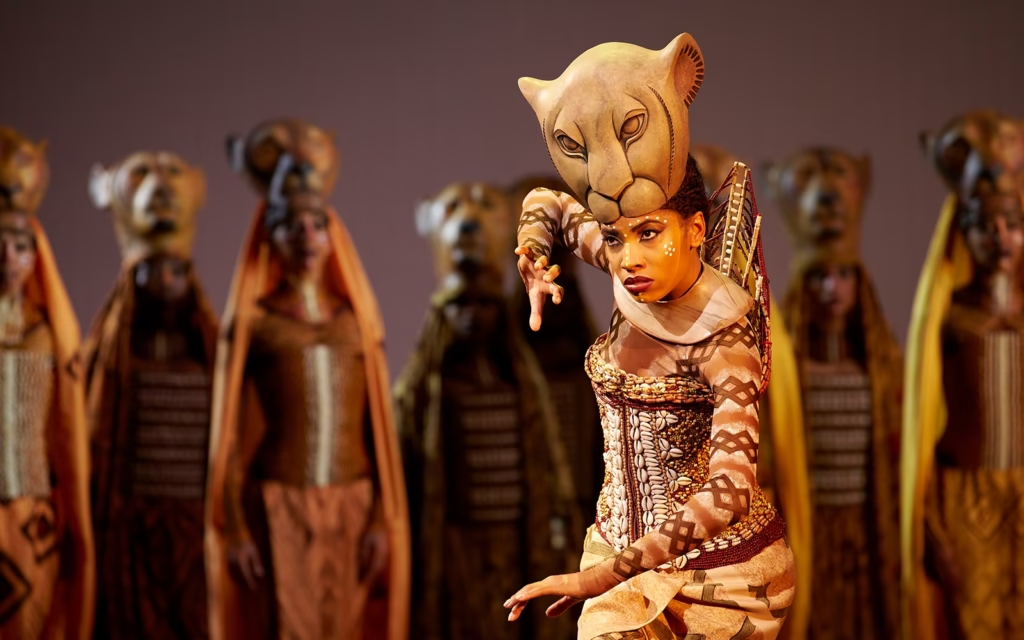
Julie Taymor’s puppet and costume design — co-designed with mask and puppet specialist Michael Curry — is the production’s defining achievement. Over 232 hand-crafted puppets and masks bring the Pride Lands to life. The aesthetic deliberately rejects naturalism in favour of the “double event” — you see the puppet animal AND you see the human performer operating it, simultaneously. A lioness moves with full grace; the human dancer-performer beneath the puppet moves with full grace too. The effect, achieved through years of design and rehearsal, is unique in the West End. Taymor herself became the first woman ever to win the Tony Award for Best Direction of a Musical for this work in 1998. Her Tony for costume design followed the same year.
More than 200 individual costumes are maintained in active rotation at the Lyceum, including 22 hand-beaded corsets that are reset and inspected before every performance. The wardrobe team is one of the largest in the West End. The animals on stage — giraffes (operated from inside on stilts), elephants (four performers per puppet), antelopes, zebra, cheetahs and rhinos — represent every level of operator-puppet integration from full-body costume to handheld articulation.
The Score and Music
Elton John and Tim Rice’s original film songs (‘Circle of Life’, ‘I Just Can’t Wait to Be King’, ‘Hakuna Matata’, ‘Can You Feel the Love Tonight’) sit at the heart of the score, but the stage adaptation roughly doubles the music. Lebo M’s choral arrangements — particularly ‘Grasslands Chant’, ‘Lioness Hunt’ and ‘Shadowland’ — give the production its distinctive Zulu and Xhosa choral identity, and his work was central to the 1999 Grammy for Best Musical Show Album. Mark Mancina’s additional music underpins the score’s transitional and incidental passages. Hans Zimmer’s themes from the film are woven throughout. Two onstage percussionists — visible at all times on either side of the proscenium — play African percussion instruments alongside the orchestra pit. The combination is one of the most distinctive sound designs in musical theatre history.
Set, Lighting, Sound
Richard Hudson’s set design — Tony-Award-winning in 1998 — uses Pride Rock as a fixed central feature with rotating, sliding and rising elements that transform the stage from the Pride Lands at sunrise to the elephant graveyard, the desert, the jungle and the climactic battle. Donald Holder’s Tony-Award-winning lighting design moves through African colour palettes — sunrise oranges, jungle greens, desert ochres, night-time blues — that have become iconic. Steve Canyon Kennedy’s sound design balances the orchestra pit, the onstage percussion, the dialogue and the choral ensemble with the kind of clarity that the Lyceum’s scale demands. Garth Fagan’s choreography, drawing on African and Caribbean dance traditions, won the 1999 Olivier Award for Best Choreography and remains one of musical theatre’s most distinctive movement vocabularies.
Tickets & Pricing — Including Magical Mondays
Full Price Range
Standard ticket prices currently range from around £40 (off-peak Grand Circle) up to £238 (premium centre Stalls and front-and-centre Royal Circle on Saturday evenings). SeatPlan’s data shows the working range as £40.60 to £238. ATG’s official box office lists tickets from £33 plus booking fee. Most decent seats sit between £60 and £130. Saturday evenings are the most expensive; midweek matinées and Tuesday-Thursday evenings can save you up to 40% on weekend prices.
Magical Mondays — £29.50 Tickets
This is the deal worth knowing about. Every Monday at noon, Disney releases a limited number of £29.50 tickets for that week’s performances of The Lion King via the Disney Tickets website. These sell quickly — log in at 11.55am at the latest, refresh at 12 noon sharp. Two tickets per customer. The seats vary by week; some are genuinely good Stalls or Royal Circle positions. This is the cheapest official route to a major West End musical and I’d recommend it strongly if you have flexibility with the date.
Other Discount Options
- TKTS Leicester Square: Day-of-performance discount tickets available roughly from 10am Monday-Saturday. Worth queuing for if you’re flexible.
- Groups of 9+: Stalls and Royal Circle reduced to £50; Grand Circle reduced to £40. Valid on selected Tuesday-Friday evenings and Wednesday matinées.
- Groups of 20+: Stalls and Royal Circle reduced to £45; Grand Circle reduced to £35. Same exclusions.
- Groups of 100+: Stalls and Royal Circle reduced to £40; Grand Circle reduced to £30. Tuesday-Thursday evenings and Wednesday matinées within specific windows (1 September – 2 October 2026, 3-26 November 2026, 5 January – 4 February 2027).
- Midweek matinées: Wednesday and Saturday matinées at 2.30pm are typically the cheapest performances of the week.
- Disney Tickets Limited Offers: Disney occasionally releases percentage-off promotions (typically 10-25%) via the official site newsletter — sign up at disneytickets.co.uk.
- ATG+ membership: ATG’s £45/year membership includes priority booking, member-only ticket prices and ringfenced seats. Worth considering if you visit West End shows three or more times a year.
Where to Book
- Disney Tickets — the official Disney box office, with full transparency on pricing and availability. The only route to Magical Mondays £29.50 tickets. Booking phone: 0800 640 8101 (lines open 7 days, 10am-7pm).
- ATG Tickets — the official Lyceum Theatre box office. Reliable, fee-transparent. Booking phone: 0333 009 6690 (freephone).
- The Lion King official site — Disney’s primary marketing site, redirects to the Disney Tickets platform.
- Official London Theatre — the SOLT site.
- TKTS Leicester Square — for day-of-performance discount tickets.
- Box office in person: The Lyceum’s box office is open from 10am most days; in-person bookings carry no booking fee.
Comparison With Similar West End Musicals
For context: Wicked at the Apollo Victoria runs roughly £30-£200. Matilda the Musical at the Cambridge Theatre runs £30-£175. Les Misérables at the Sondheim runs £24-£225. Hamilton at the Victoria Palace runs £40-£260+. The Lion King sits squarely in the middle of this band — neither the cheapest nor the most expensive, with a higher Magical Mondays floor (£29.50) than most rivals match. The £238 ceiling is broadly comparable. For first-time London family audiences, particularly tourists, The Lion King remains the safest choice in this group: open-ended booking, deep cast bench, no risk of “did I see the right cast?” concerns.
What Audiences Actually Say: Review Analysis
Verified Booking Reviews (Headout / London Theatre Tickets)
The verified-booking aggregator at London-Theater-Tickets.com shows The Lion King at 4.7/5 across 10,374 ratings — one of the largest verified-booking samples for any West End show. The breakdown: 8,400+ five-star reviews, 1,400+ four-star, 254 three-star, 84 two-star, and only 174 one-star out of more than 10,000. Recent February-April 2026 reviews repeatedly use words including “amazing”, “incredible”, “stunning”, “spine-tingling”, “perfect family night out” and “once in a lifetime”. Multiple international reviewers — Portuguese, Dutch, German, French — describe the show as exceeding already-high expectations. The few negative reviews focus consistently on three themes: the temperature in the auditorium (“very cold” or “quite hot” depending on season and seat), the second half feeling longer than the first, and a small number of audience members feeling the £238 premium pricing isn’t justified compared to cheaper Royal Circle seats.
TripAdvisor
TripAdvisor reviews track closely with the verified-booking data. Recent reviewers describe the show as “beyond any expectations”, recommend buying seats closer to the stage even at higher prices, and consistently mention the standing ovation at curtain call. The “I wished we’d booked closer” theme appears so often in reviews that we’d flag it as practical advice: if you can stretch to mid-Stalls or front-Royal-Circle, do so. The “could be more comfortable” leg-room theme is also recurrent — typical of older West End venues with original seating.
SeatPlan & Theatremonkey
SeatPlan’s user reviews skew strongly positive on both the show and the venue, with extensive seat-by-seat advice. The headline finding from SeatPlan’s user community: Stalls Row L or K with an aisle seat (L19, K30 specifically) is the single best-value experience in the building because the animal performers parade down those aisles in the opening sequence. Theatremonkey’s monkey gives the production a strong recommendation with detailed seat-by-seat guidance and consistent praise for the production values.
Professional Critics
The professional critical consensus has been positive for 27 years and remains so. The New York Times: “there is simply nothing like it.” The Daily Telegraph and The Guardian have both delivered five-star and four-star reviews across multiple cast changes. The most consistent professional caveat: the second act is weaker than the first, and the score’s ceiling is the famous Elton John and Tim Rice songs from the film rather than the new material. None of this is enough to dent the show’s reputation; almost every professional critic acknowledges the opening ‘Circle of Life’ sequence as one of the great moments of contemporary musical theatre.
The Awards Record
Six Tony Awards on Broadway in 1998 (including Best Musical, Best Direction of a Musical for Julie Taymor, Best Costume Design, Best Lighting Design, Best Choreography and Best Scenic Design). Two Olivier Awards in 1999 (Best Choreography for Garth Fagan, Best Costume Design for Julie Taymor). The 1998 New York Drama Critics Circle Award for Best Musical. The 1999 Grammy for Best Musical Show Album. The 1999 Evening Standard Award for Theatrical Event of the Year. More than 70 major arts awards globally. Across 29 productions in nine languages. The institutional acknowledgement is essentially without parallel in musical theatre history.
What Audiences Love Most
- The opening ‘Circle of Life’ sequence. Audience reviewers consistently name this as the single most magical moment they’ve experienced in any theatre. Animals processing down the Stalls aisles, hundreds of birds wheeling overhead, the giraffes walking forward, baby Simba held aloft on Pride Rock as Rafiki vocalises — it produces audible gasps and frequent tears within the first seven minutes.
- The puppetry. All of it. 232+ hand-crafted puppets and masks. The visible operators. The “double event” of seeing animal and performer simultaneously. The wildebeest stampede. The hyenas. The giant elephant. Audiences run out of superlatives.
- The score, performed live. Elton John and Tim Rice’s beloved film songs combined with Lebo M’s African choral arrangements and the two onstage percussionists creates an aural experience nothing recorded matches. The audience emotional response to ‘They Live in You’ / ‘He Lives in You’ is remarkable.
- George Asprey’s Scar. One of the great long-running performances in West End musical theatre. Audience reviews consistently call out ‘Be Prepared’ as a highlight.
- Shaun Escoffery’s Mufasa. The baritone gravity. The Mufasa-Simba scenes. The Pride Rock moments. Reviewers call him the emotional anchor of the show.
- Thenjiwe Nofemele’s Rafiki. The opening Zulu vocal that introduces ‘Circle of Life’ is frequently described as “spine-tingling”.
- The cross-generational appeal. Audience reviews describe parents bringing children, grandparents bringing grandchildren, adult Disney fans returning multiple times, and tourists making it their definitive London theatre night. The show works for every audience.
- The 4.7/5 audience verdict across 10,374 reviews. One of the largest sustained audience-rating samples for any West End show. Consistency across 27 years of London performance is the show’s most underrated achievement.
- The Magical Mondays £29.50 scheme. Genuinely the cheapest official route to a major West End musical, with seats that can be surprisingly good.
- The standing ovation. Audience reviewers across decades consistently mention the standing ovation at curtain call. This isn’t a polite West End standard ovation; it’s a sustained, emotionally charged response that often feels retrospective gratitude for the opening sequence as much as the close.
Areas for Consideration
- The second act loses some momentum. The most consistent professional and audience criticism is that Act Two doesn’t quite match Act One. The Simba-in-exile sequences, while including ‘Hakuna Matata’ and ‘Can You Feel the Love Tonight’, feel slightly long compared to the first half’s relentless invention. Most audiences forgive this; some don’t.
- The 6+ age guidance is realistic — but the wildebeest stampede is intense. Mufasa’s death scene is genuinely scary for very young children and is the moment most parents flag in audience reviews. The scene is essential to the story and is staged with restraint, but parents of under-fives should consider whether their child is ready. We’d suggest 7+ as a more comfortable threshold.
- The Lyceum’s auditorium can run hot or cold. Multiple recent audience reviews flag the auditorium as either “very cold” or “quite hot” depending on season. The summer matinées can be warm; the winter evenings can be drafty in the upper levels. Layer accordingly.
- Leg-room is typical of older West End venues. The Lyceum’s seating dates from the building’s 1904 incarnation with various refurbishments since. Tall audience members and broader-shouldered guests consistently flag this in reviews. The cushions available at the box office (£1 deposit, free) help with sightlines but not with leg-room.
- Premium pricing isn’t always worth it. Multiple reviewers report sitting in mid-Stalls or front-Royal-Circle for £100-£140 and feeling they had a better experience than friends paying £238 for centre Stalls premium. The £238 premium is genuinely the best seats in the building, but the diminishing return above £150 is real.
- The Grand Circle is genuinely distant. 85 steps up, with the back rows roughly 30 metres from the stage. Sightlines are good but the immersive feel of the Stalls aisle seats is lost. Best for budget-conscious bookings, not for first-timers wanting maximum impact.
- The new Posi Morakinyo / Asha Parker-Wallace cast launches 5 May 2026. If you’re booking for late April or early May, you’ll see the outgoing Stephenson Ardern-Sodje / Merryl Ansah cast. Both are excellent; the new cast brings fresh energy from American Psycho. Either is a legitimate choice — just know which you’re booking for.
Who Is The Lion King Best For?
✅ Strongly recommended for:
- First-time London family audiences with children aged 7-14
- Tourists making one definitive West End theatre booking on a London trip
- Adult Disney fans, particularly those who grew up with the 1994 film
- Theatre buffs collecting essential modern productions — the Tony, Olivier and Grammy sweep makes this a must-see
- Date nights wanting reliable spectacle and emotional payoff
- Multi-generational family outings — grandparents bringing grandchildren
- International visitors — the show’s themes and visual storytelling translate effortlessly across language barriers
- Schools and youth groups — the £30-£40 group rates are exceptional value
- Audiences with budget flexibility around midweek and Magical Mondays
⚠️ Approach with caution if:
- Your child is under 6, has limited attention span, or is sensitive to loud sustained sequences — book a relaxed performance instead
- You strongly dislike the original 1994 Disney film — the stage adaptation is faithful and the score is rooted in the same songs
- You expect plot complexity or moral ambiguity — this is a Disney narrative with the conventional good-villain-conflict-redemption arc
- You strongly prefer intimate, smaller-scale theatre — the Lyceum is a 2,100-seat house and the production is built for spectacle
- You’ve already seen the show twice in the last decade — cast changes refresh the experience but the production hasn’t fundamentally changed
- You’re claustrophobic or have leg-room concerns — the Lyceum’s seating is typical of its era
How The Lion King Compares to Similar Shows
| Feature | The Lion King | Wicked | Les Misérables | Matilda the Musical |
|---|---|---|---|---|
| Genre | Family musical, Disney spectacle | Pop-rock musical, Wizard of Oz reimagining | Sung-through epic, period drama | Family musical, Roald Dahl adaptation |
| Venue | Lyceum Theatre (2,100) | Apollo Victoria (2,328) | Sondheim Theatre (1,107) | Cambridge Theatre (1,231) |
| Running Time | 2h 30m (incl. interval) | 2h 45m (incl. interval) | 2h 50m (incl. interval) | 2h 40m (incl. interval) |
| Price Range | £29.50 – £238 | £30 – £200 | £24 – £225 | £30 – £175 |
| Age Recommendation | 6+ (we’d say 7+) | 7+ | 8+ | 6+ |
| Audience Rating | ★★★★★ (4.7 / 5) | ★★★★★ (4.8 / 5) | ★★★★★ (4.7 / 5) | ★★★★★ (4.8 / 5) |
| Major Awards | 6 Tony, 2 Olivier, 70+ awards | 3 Tony, 2 Olivier | 8 Tony, 2 Olivier | 7 Olivier, 5 Tony |
| Best For | First-time families, tourists, multi-gen outings | Tweens and teens, pop music fans | Adult musical theatre fans, history lovers | Families with bookish children |
| London Run | Since 1999 — booking 2027 | Since 2006 — booking 2027 | Since 1985 — booking 2027 | Since 2011 — booking 2027 |
| Defining Feature | Opening ‘Circle of Life’ | ‘Defying Gravity’ Act 1 finale | ‘One Day More’ Act 1 finale | ‘When I Grow Up’ / ‘Revolting Children’ |
Verdict on the comparison: If you have one family theatre night and your children are between 7 and 14, The Lion King remains the safest, most spectacular and most universally satisfying choice in the West End. Wicked is the right pick for tweens and teens who already love pop music. Les Misérables is for adults and older teens who want emotional depth and operatic ambition. Matilda is for bookish children with strong attention spans. Lion King‘s real advantage is universality — it works for first-time London visitors, multi-generational outings, international tourists with limited English, and adults returning to the show for nostalgia. The opening ‘Circle of Life’ alone is the single most magical seven minutes in any of these productions.
Insider Tips
- Best seats for the money: Stalls Row L or K, aisle seats specifically (L19, K30) — the animal performers parade down those aisles in the opening sequence. SeatPlan’s user community names these as the single best-value seats in the building.
- Chase Magical Mondays £29.50 tickets if you’re flexible. Open the Disney Tickets website at 11.55am Monday morning, refresh at 12 noon sharp. Two tickets per customer. The seats vary by week but can include genuine Stalls and Royal Circle positions.
- Book midweek matinées for the cheapest standard pricing. Wednesday and Saturday matinées at 2.30pm save up to 40% on Saturday evening prices.
- Front-Royal-Circle is the value sweet spot. Rows A-D centre give you the cinematic sweep view at premium prices; Rows E-H give you the same view at significantly lower prices. We’d take E-H every time.
- Avoid the back of the Grand Circle for first-time visitors. 85 steps up and 30 metres from the stage. Sightlines are fine but the immersive feel of the Stalls aisle seats is lost. Better to wait for a better seat at a different performance than book the back of the Grand Circle and regret it.
- Pre-show dining nearby: Wellington Street is steps from Covent Garden’s restaurant cluster. Hawksmoor Seven Dials is five minutes for steak. Dishoom Covent Garden is six minutes for Bombay-style brunch. The Ivy Marketplace is three minutes. Flat Iron Covent Garden offers a £14 steak in twenty minutes flat.
- The Lyceum opens 90 minutes before performance. Arrive at least 60 minutes early to clear bag checks and find your seats. Bag policy is strict — leave large rucksacks and luggage at the venue cloakroom or use Stasher (10% discount via ATG).
- Booster cushions available at the box office. Stack them just inside the theatre entrance after your tickets are scanned. £1 non-refundable deposit, card only. Genuinely helpful for shorter children — adds 3-5 inches of seated height.
- Stage door: The cast emerges briefly after the show on the side of the building. Bring a programme; be patient.
- The merchandise is exceptional. The Simba and Mufasa puppet plushes are properly designed; the masks and costume reproductions are genuine collectables. Browse pre-show — the merch counter at interval is busy.
- For sensory-sensitive audiences: Check the official Disney Tickets website for relaxed performance dates — these are typically scheduled twice a year. Audio-described and captioned performances run more frequently via VocalEyes.
- The London Zoo Lion King Exhibition. Running summer 2026 (Friday evenings 5 June – 24 July) — included free with a London Zoo ticket. A genuine bonus for families building a Lion King-themed weekend.
- Bring tissues. The opening ‘Circle of Life’ produces audible audience tears. Mufasa’s death scene, ‘They Live in You / He Lives in You’, and the final ‘King of Pride Rock’ all generate strong emotional responses.
- Don’t bring anything bulky. Cloakroom is helpful but small. Travel light.
- Arrive 30 minutes early to take in the auditorium. The Lyceum’s restored Edwardian interior is genuinely beautiful and worth a few minutes’ appreciation before the lights go down.
FAQs
How long is The Lion King at the Lyceum Theatre in London, including the interval?
The Lion King at the Lyceum Theatre runs for approximately 2 hours and 30 minutes including a 15-minute interval. Performances starting at 7.30pm finish around 10pm; matinées starting at 2.30pm finish around 5pm.
Is The Lion King at the Lyceum Theatre in London suitable for children, and what is the age recommendation?
The official age recommendation is 6+. Children under 3 will not be admitted (including babies in arms), and under-16s must be accompanied by an adult and seated next to them. All children must have their own ticket. Realistically we’d suggest 7+ for a comfortable family experience given the intensity of Mufasa’s death scene and the wildebeest stampede. The show contains theatrical smoke, fog and haze, plus strobe lighting.
Where are the best seats for The Lion King at the Lyceum Theatre in London?
Stalls Row L or K aisle seats (L19, K30 specifically) are the single best-value experience because the animal performers parade down those aisles in the opening sequence. Centre Stalls Rows D-J and front-and-centre Royal Circle Rows A-D are the premium positions at £238. For value, target Royal Circle Rows E-H. Best budget seats are Grand Circle centre Rows A-C, particularly G8 and J38.
How much do tickets to The Lion King at the Lyceum Theatre in London cost in 2026?
Tickets to The Lion King in London range from £29.50 (Magical Mondays via Disney Tickets) and around £40 (off-peak Grand Circle) up to £238 for premium centre Stalls and Royal Circle on Saturday evenings. ATG’s official box office lists tickets from £33. Group rates start at £30 (Grand Circle, groups of 100+) and £35 (groups of 20+). Booking midweek matinées can save up to 40% on weekend prices.
What are Magical Mondays for The Lion King in London?
Magical Mondays is Disney’s weekly £29.50 ticket release scheme. Every Monday at noon, a limited number of £29.50 tickets are released for that week’s Lion King performances via the Disney Tickets website. Two tickets per customer. The seats vary by week but can include genuine Stalls and Royal Circle positions. They sell quickly — log in at 11.55am at the latest. This is the cheapest official route to the show.
Who is in the current cast of The Lion King at the Lyceum Theatre in London?
As of late April 2026, the cast is led by Stephenson Ardern-Sodje as Simba and Merryl Ansah as Nala (until 3 May 2026). From 5 May 2026, Posi Morakinyo and Asha Parker-Wallace take over as Simba and Nala, with Stuart Neal as Timon, Michael Jeremiah as Banzai, and Simone Robinson as Sarabi. Continuing principals include George Asprey as Scar, Shaun Escoffery as Mufasa, Thenjiwe Nofemele as Rafiki, Gary Jordan as Zazu, Pierre van Heerden as Pumbaa, Sadia McEwen as Shenzi and Mark Tatham as Ed.
When does The Lion King at the Lyceum Theatre in London close?
The Lion King is currently booking to 30 May 2027 — the production has extended its run consistently for 27 years and there is no announced closing date beyond the rolling booking window. Disney has shown no indication of ending the London run; this is one of the most secure long-running booking commitments in the West End.
How do I get to the Lyceum Theatre in London for The Lion King?
The Lyceum Theatre is at 21 Wellington Street, Covent Garden, London WC2E 7RQ. The closest tube stations are Covent Garden (Piccadilly Line, 4 minutes), Charing Cross (Northern, Bakerloo, 5 minutes), Temple (District, Circle, 5 minutes) and Embankment (Northern, Bakerloo, District, Circle, 7 minutes). Charing Cross rail is 5 minutes’ walk; Waterloo and Waterloo East are 15 minutes across the river. Buses 1, 6, 11, 13, 23, 59, 68, 87, 168, 171, 172, 188 and 243 stop on the Aldwych.
Is The Lion King at the Lyceum Theatre in London wheelchair accessible?
Yes. The Lyceum Theatre is fully accessible to disabled, deaf and visually impaired guests. Step-free entry, wheelchair spaces, accessible toilets, induction loops, companion seating and access hosts are all available. The Stalls is four steps below street level; the Royal Circle is up 32 steps; the Grand Circle is up 85 steps. Audio-described, captioned and relaxed performances are scheduled regularly via VocalEyes. Guide dogs are welcome. Access bookings: 0333 009 5399 or [email protected].
How many awards has The Lion King at the Lyceum Theatre in London won?
The Lion King has won more than 70 major arts awards globally, including six Tony Awards on Broadway in 1998 (Best Musical, Best Direction of a Musical, Best Costume Design, Best Lighting Design, Best Choreography, Best Scenic Design); two Olivier Awards in 1999 (Best Choreography, Best Costume Design); the 1998 New York Drama Critics Circle Award for Best Musical; the 1999 Grammy for Best Musical Show Album; and the 1999 Evening Standard Award for Theatrical Event of the Year. Director Julie Taymor was the first woman ever to win the Tony for Best Direction of a Musical.
What songs are in The Lion King at the Lyceum Theatre in London?
The score combines Elton John and Tim Rice’s original 1994 film songs (‘Circle of Life’, ‘I Just Can’t Wait to Be King’, ‘Be Prepared’, ‘Hakuna Matata’, ‘Can You Feel the Love Tonight’) with new stage-only material by Lebo M and Mark Mancina (‘Shadowland’, ‘Endless Night’, ‘They Live in You / He Lives in You’, ‘Grasslands Chant’, ‘Chow Down’, ‘King of Pride Rock’). Hans Zimmer’s original film score themes are woven throughout. ‘Can You Feel the Love Tonight’ won the 1995 Academy Award for Best Original Song.
London Reviews Verdict on The Lion King
The Lion King at the Lyceum Theatre is the West End’s most enduring blockbuster — and after 27 years, more than 10,000 performances and over 20 million London audience members, it remains the safest and most spectacular family-theatre booking in town. The opening ‘Circle of Life’ is genuinely one of musical theatre’s great moments. Julie Taymor’s puppetry and costume design has aged remarkably well; the African choral arrangements by Lebo M still sit at the heart of the score’s emotional power; the Elton John and Tim Rice songs still land; and the company at the Lyceum delivers night after night with a consistency that few long-running shows manage.
What’s working? The puppetry remains world-class. The opening number is the most magical seven minutes in the West End. George Asprey’s Scar is one of the great long-running performances. Shaun Escoffery’s Mufasa is the gravitational centre of the production. Thenjiwe Nofemele’s Rafiki opening Zulu vocal still produces audible audience response. The two onstage percussionists give the production an aural identity nothing else in the West End matches. The 4.7-star audience score across 10,374 reviews is one of the largest sustained sample sizes for any West End show. The Magical Mondays £29.50 scheme makes this genuinely accessible to family budgets that other West End musicals price out. The May 2026 cast change brings Posi Morakinyo and Asha Parker-Wallace from American Psycho at the Almeida, two genuinely exciting West End names taking over the leads.
Is it perfect? Almost. The second act loses some of the first act’s momentum — this is the most consistent professional and audience criticism. The narrative remains the simple Disney narrative the source film established. The Lyceum’s seating dates from 1904 and shows it. The £238 premium pricing diminishes in returns above £150 for most audiences. The wildebeest stampede sequence is genuinely intense for under-fives. None of these are deal-breakers; all are worth flagging.
Our The Lion King review recommends the show without reservation for first-time London family audiences, tourists making one definitive West End theatre booking, multi-generational outings, theatre buffs collecting essential modern productions, and anyone wanting reliable spectacle and emotional payoff. Book Stalls Row K or L aisle seats for the most immersive experience; chase Magical Mondays £29.50 tickets if you’re flexible; or use front-Royal-Circle seats as the smart middle path. Unlike My Neighbour Totoro with its August closing date, time isn’t pressing here — the booking window runs to May 2027 with no end in sight — but the new Morakinyo / Parker-Wallace cast from 5 May 2026 makes this genuinely fresh territory. After 27 years and 10,000+ performances, this remains the easiest “yes” in the West End.
Related London Reviews
- Les Misérables London Review — The West End’s emotional epic
- The Mousetrap Review — The world’s longest-running play
- My Neighbour Totoro Review — Stage magic with an August deadline
- The Savoy London Review — A pre-theatre stay or post-show cocktail
- Dishoom King’s Cross Review — Iconic post-show dining
- Shoreditch Town Hall Review — A more avant-garde theatre night
- Mayfield Lavender Farm Review — A summer day-trip from London
- Bow Lane Dental Group Review — City dental care
- The Neem Tree Dental Practice Review — South London dentistry
- Brooks and Brooks Salon Review — Pre-show hair
- Third Space Clapham Junction Review — Premium gym
- More theatre and show reviews in London
- Other West End reviews
- Submit your own review
Summary: Our The Lion King Review Rating
| Category | Rating |
|---|---|
| Performances & Cast | ★★★★★ (5 / 5) |
| Puppetry & Design | ★★★★★ (5 / 5) |
| Music & Score | ★★★★★ (5 / 5) |
| Staging & Production | ★★★★★ (5 / 5) |
| Value for Money | ★★★★½ (4.5 / 5) |
| Venue & Accessibility | ★★★★½ (4.5 / 5) |
| Audience Experience | ★★★★★ (5 / 5) |
| Suitability (Family / Date / Tourist) | ★★★★★ (5 / 5) |
| OVERALL | ★★★★★ (4.8 / 5) |
Disclaimer
This independent review draws on cross-referenced public sources including TripAdvisor, Google Reviews, the Headout / London Theatre Tickets verified-booking platform, The New York Times, The Guardian, The Daily Telegraph, WhatsOnStage, Theatremonkey, SeatPlan, the Disney Tickets and ATG box-office systems, the official Lion King London website, and Disney Theatrical Productions’ casting announcements. Cast, pricing and booking dates were verified at the time of writing (30 April 2026) and are subject to change. London Reviews accepts no payment from venues or producers.
Have you seen The Lion King at the Lyceum Theatre? Share your experience in the comments below — which cast did you see, where did you sit, and which moment made you cry? (Almost everyone has one.) We read every comment, and your insights help future readers decide where to sit and when to book.