



On September 2, 1901, just two weeks before becoming President of the United States, Theodore Roosevelt offered his foreign policy mantra—”Speak politely and carry a big stick and you will go far.”
“If a person is constantly boastful and lacks manners, even a big stick will not save him from trouble, nor will talking softly be of any use if there is no strength and power behind that softness.”
During his two terms, Roosevelt used America’s military power to enforce the Monroe Doctrine without any fanfare.
Donald Trump’s conduct during the Iran conflict shows that he is doing exactly the opposite, he has only spoken loudly and his ‘stick’, the powerful US military, has so far failed to subdue Iran.
Also read: After Maidan-e-Jung, preparations to surround Iran in the playground, this is the demand of Trump’s envoy
Trump claims victory
The US President has repeatedly claimed that he has won the war and Iran is begging for a deal. But the reality is that Iran is not even ready for further talks with Washington. His announcement on Tuesday of unilaterally extending the ceasefire is being seen as evidence that he has once again backed down, which has further emboldened Tehran.
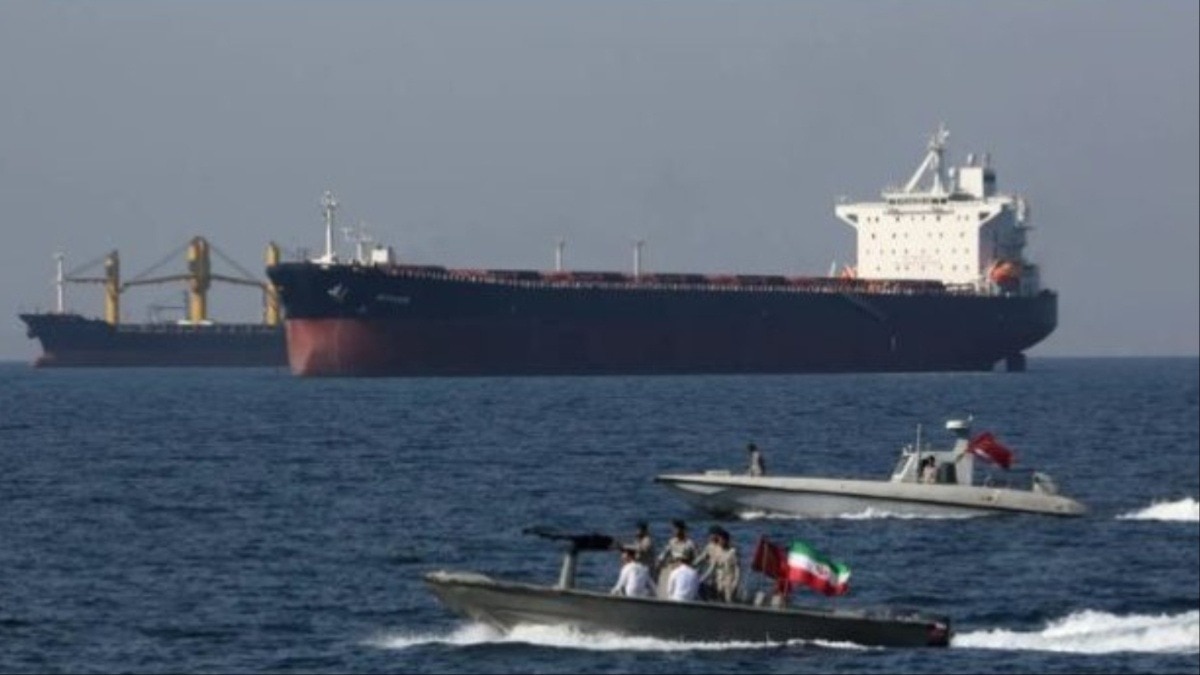
But this does not mean that this struggle is going to end soon. Rather, it seems to be taking an even more dangerous turn, as evidenced by Iran’s seizure of two ships in the Strait of Hormuz on Wednesday. This incident occurred two days after the US seized an Iranian cargo ship in the same strait. “An eye for an eye, and a tanker for a tanker,” said Ebrahim Razai, a member of the Iranian parliament and spokesman for the legislature’s national security and foreign policy committee.
Razai may not represent Tehran’s official position, but there is no doubt that Iran’s stance has hardened since the first round of talks in Islamabad. Even those members of the government, who were earlier in favor of talks, are now giving uncompromising statements.
Also read: Iran’s ‘screw’ on the Strait of Hormuz! Global shipping stalled even after ceasefire, panic in global market
Pakistan’s de facto leader and Trump’s favorite Field Marshal Asim Munir failed to persuade Iran to come to Islamabad for a second round of talks, despite spending three days in Tehran last week and continuing those efforts after returning home. Trump had prepared Vice President JD Vance, Steve Witkoff and Jared Kushner to board a flight to Pakistan for talks, but Iranian hardliners prevented the negotiators from attending.
economic war
Trump’s retaliatory blockade of the Strait of Hormuz seems to be the biggest obstacle in the way of upcoming talks. The current situation is that both sides are accusing each other of violating the ceasefire. Meanwhile, Iran’s closure of this vital waterway has proven to be a very effective ‘economic weapon’.
Similarly, the US blockade aims to strangle Iran’s economy by blocking its vital imports and exports, 90 percent of which pass through the strait. This ‘tit-for-tat’ blockade has suffocated the world economy, which is having far reaching consequences.
The blockade of Hormuz has disrupted oil supplies more than any other crisis in decades. Nearly one billion barrels of oil has already been lost. But if this conflict continues for a few more weeks, the situation will become even worse.
Also read: India paid the price for Iran war! Import of 25 lakh tonnes of urea at double rate, stir in global market
Analysts estimate that if the Strait is not fully opened soon, oil prices will average $130 per barrel this year. This would be disastrous for countries like India, which are largely dependent on oil imports. This will also increase gas prices in America, due to which the Republican Party may have to suffer in the Senate and House of Representatives elections to be held in November.
But crude oil prices are not the only problem. On Wednesday, German airline Lufthansa announced that it was reducing 20,000 flights over the next six months due to rising jet fuel prices. According to Platts Jet Fuel Price Index, global jet fuel prices have increased by more than 70 percent since the beginning of the war.
Other European airlines have also warned of similar measures. Due to the impact of fertilizer supply, food prices are also going to increase. Apart from this, the supply of refined petroleum, sulfur and helium has also been adversely affected.
nuclear threat
When the first round of talks in Islamabad remained inconclusive, Vance made it clear that the real issue was the nuclear issue. America wants Iran to remove about 450 kg of enriched uranium it has and promises never to produce uranium in the future. But the current government of Iran seems to be in no mood to accept this at all.
Trump had started the war against Iran in the hope that he would be able to repeat his success like Venezuela and would soon find a ‘Delcy Rodriguez’ (a compromise face) there, but the result of his decision could be to make Iran another North Korea, where the rule would not be in the hands of a flexible Rodriguez, but in the hands of a hardline leader like ‘Kim Jong-un’.
This situation will prove to be a nightmare for Israel. A section of the ‘Islamic Revolutionary Guard Corps’ (IRGC) is strongly against any kind of agreement on the nuclear issue, as they see nuclear weapons as a de facto ‘insurance policy’ against any future attack by Israel and the US.
Despite claims by Israel and the Trump administration, Iran, under the leadership of slain Supreme Leader Ayatollah Khamenei, was not in favor of developing nuclear weapons. He also asked his country to join the ‘Nuclear Non-Proliferation Treaty’ (NPT).
Also read: America caught another Iranian ship, this time attacked an oil tanker – VIDEO
Iran does not trust Trump
However, hard-liners in the current Iranian regime have already started talking about leaving that treaty. Others still want to use the nuclear issue as a ‘bargaining weapon’ to extract concessions from the United States.
Iran does not have even an iota of trust in America and especially Trump. One of the arguments behind Iran not being ready for the second round of talks with America is that Trump is just trying to kill time so that he can start the war again.
The outcome of this conflict depends on which side has the ability to bear more pain. Iran knows very well how desperate Trump is for a deal for political and economic reasons. At the same time, Iran has also been successful in creating the impression that it has won this war and has forced the world’s most powerful military machinery to kneel.
But Iran’s rulers also have to understand that this war has deeply hurt their country. The value of the Iranian currency has fallen flat. Even before the war, protests had started against the government there due to food shortage and rising prices. Now the American blockade of the Strait of Hormuz will put a brake on the import of food items and other essential goods, which will increase the problems further.
The blockade aims to stop Iran’s oil and gas exports, which account for a quarter of its GDP and 80 percent of its export earnings. Iran has limited oil storage capacity, so it will have to stop production to prevent damage to its infrastructure, but will this make Iran’s fundamentalist leaders bow down?
Trump is giving Iran only a few days to prepare a counter-proposal for talks and take a decision, but there are no indications that the President wants to start a war again, because this war has already become extremely unpopular in America.
So, what else can Trump do now? So far, his threats to escalate tensions have proved hollow. He has surrounded himself with people who say ‘Jee Hazoor’. He has not been seen taking advice from any expert on Iran. He trusts his conscience more than any expert’s advice.
The careless attitude of Iran’s hardliners and Trump himself has perhaps eliminated all options for a quick and honorable exit for them. Now either Iran will force them to make such concessions which can prove fatal for their political future and will further reduce America’s credibility in the world. Or else, he will be forced to escalate tensions, which could push America into another protracted foreign war, the very thing he came to power on campaign against.
(Naresh Kaushik is a former editor of BBC and Associated Press, he lives in London.)
—- End —-