





image source, Emmanuel Lafont/BBC
Chemotherapy and surgery are used to treat cancer and for the last few years, another weapon against cancer is in discussion, named immunotherapy.
After nearly 100 years of development, treatments that fight cancer by strengthening the body’s immune system are now showing results and saving patients’ lives.
71-year-old Maureen Sideres was treated for colon cancer in 2008, in which she had to undergo surgery. The treatment was successful, but recovery after the operation was very difficult.
After 14 years, Sideras, who lives in New York, was diagnosed with esophageal cancer, this time. This time he was treated under a clinical trial, which was completely different. Every three weeks she went to Memorial Sloan Kettering Cancer Center and was given a drug called ‘Dostarlimab’ for 45 minutes.
His tumor disappeared after just four months of treatment. There was no need for surgery, chemotherapy or radiation.
The only side effect he had was fatigue. “It’s hard to believe, like science fiction,” she says.
Jennifer Vargo, professor of surgical oncology and immunotherapy researcher at MD Anderson Cancer Center in Texas, USA, says, “I get emotional and I get goosebumps, people are living, and living a good quality of life. We are talking about a cure.”
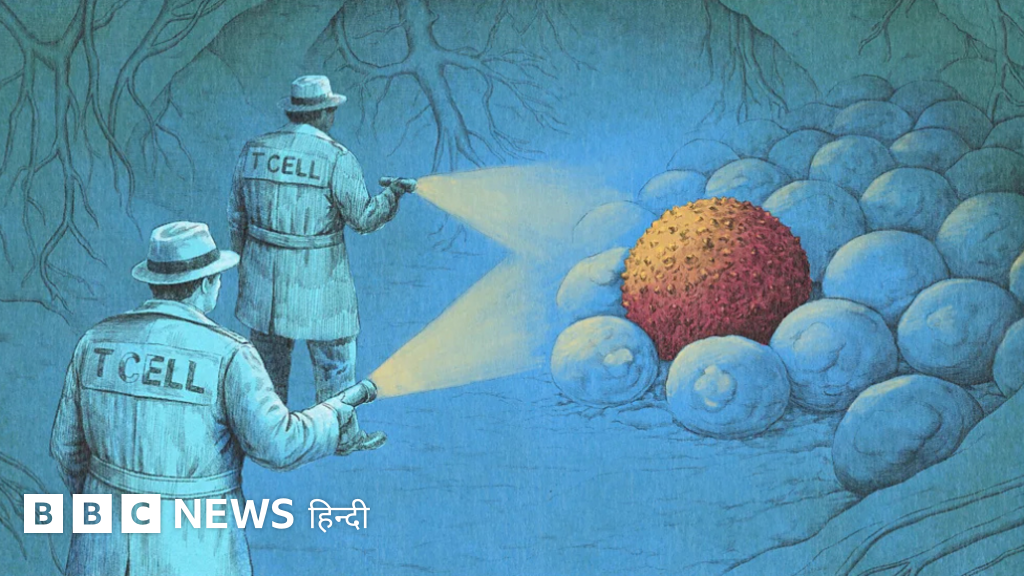
Karen Knudsen, chief executive officer of the Parker Institute for Cancer Immunotherapy, a US non-profit organization. She explains that the body has the natural ability to “recognize and eliminate cells that do not appear healthy.”
If everything is working properly, it should also include the cells that have become cancerous.
But sometimes cancer cells evade or circumvent this mechanism, leading to dangerous and uncontrolled growth.
Despite being in front, they remain hidden and are indistinguishable from the surrounding healthy cells.
The goal of immunotherapy is to expose those cancer cells so that the immune system can correctly recognize them.
It strengthens the immune system’s defense capability so that it can seek out and destroy cancer cells, and the results can be very impressive.
How does immunotherapy fight cancer?
image source, Emmanuel Lafont/BBC
The two most well-known forms of immunotherapy are CAR-cell therapy and immune checkpoint inhibitors.
CAR T-cell therapy involves extracting T-cells (highly specialized immune cells that recognize and kill specific foreign invaders) from a patient’s blood, changing them in the lab so that they can seek out and attack cancer cells, and then releasing these strengthened T-cells back into the body.
At the same time, immune checkpoint inhibitors are medicines that turn off an “off switch” present inside the immune system.
This protective mechanism has an important purpose, it prevents the reaction from spreading too quickly, which could damage healthy cells.
But some cancer cells turn on this “off switch”, causing T-cells to stop working and escape detection.
Immune checkpoint inhibitors prevent this from happening, allowing T cells to recognize cancer cells as a threat and attack them.
The scientists who developed this technology received the Nobel Prize in 2018, and today these drugs are being used in many types of cancer.
Nevertheless, both these methods have their limitations.
Although research is ongoing, scientists are struggling to make CAR T-cell therapy effective in solid tumors (as opposed to blood cancers), which account for more than 90 percent of new cases.
This treatment is expensive and requires a lot of effort and resources.
Side effects of immunotherapy
image source, Getty Images
At the same time, Samra Turajlik, a medical oncologist at the Francis Crick Institute in London, says that there can be “a number of side effects” with immune checkpoint inhibitors.
This happens because the immune system’s “off switch” prevents the body from attacking its own cells, and removing this protection can jeopardize not only the tumor but healthy cells as well.
According to the US National Cancer Institute, common side effects include skin rashes, diarrhea and fatigue, while in rare cases it can also cause inflammation in the liver, heart and kidneys.
This agreement may be beneficial if the drug controls aggressive cancer (cancer that spreads rapidly). But it doesn’t always work that way.
Turajlik says that a big problem in the entire oncology field is that no immunotherapy works for 100 percent of patients.
There can be many reasons for this, from the structure of the tumor to the characteristics of the immune cells themselves, which make it difficult for the immune system to recognize it.
In general, only about 20 percent to 40 percent of patients respond to immunotherapy. This means that many patients, in fact most patients, risk side effects, time and hope, but do not get much benefit.
Researchers working on multiple strategies
image source, Getty Images
How can more patients benefit from immunotherapy? Researchers are working on this in many different ways.
Vargo’s research, which is still in its early stages, suggests that patients who eat a higher fiber diet may have better outcomes because it alters the gut microbiome, which may influence both the immune system and tumors.
Other research suggests that statins, which are inexpensive and easily available cholesterol-lowering drugs, may enhance the effect of immunotherapy by altering communication between cells.
The timing of treatment may also be important, with some recent research suggesting that patients who take the medicine earlier in the day have better outcomes than those who take it later.
Using immunotherapy in combination with other treatments such as radiation or ultrasound can also be a way to increase the effect.
Sandra DeMaria of Weill Cornell Medical Center, who has researched this combined approach. “Radiation can actually make the tumor visible to the immune system,” she explains.
Ultrasound therapy, which attacks tumors by using high-frequency sound waves, can do the same thing.
Other researchers are taking advantage of the customization potential of immunotherapy and carefully matching patients to the treatment best suited for them.
Why is personalized medicine important?
image source, Getty Images
Personalized medicine is generating excitement in many fields, but Knudsen emphasizes that it is especially important for oncology, because the disease varies widely.
Knudsen says, “Cancer is not one disease. There are 200 different diseases, and they have different causes, so they have to be treated in different ways.”
Even in two patients with the same type and stage of cancer, the disease may differ at the cellular level.
DeMaria says, “This field is at a turning point. Now we can move forward in the direction of treating patients, not just cancer.”
Scientists at Memorial Sloan Kettering Cancer Center have already tested a promising strategy, based on the discovery that tumors with a certain genetic profile respond well to immune checkpoint inhibitors, such as dostarlimab.
In two small trials conducted in 2022 and 2024, treating rectal cancer with this profile resulted in complete tumor eradication.
After this, the team included 117 patients in their research, who had different types of tumors like esophageal, bladder and stomach cancer, but they had the same genetic characteristics.
Of the 103 people who completed the full treatment, 84 had their tumors disappear completely, and this included siderase. Only two required additional surgery.
Researchers at MD Anderson have reported similar results with a different checkpoint inhibitor.
Other groups have also shown that even if patients have to undergo surgery later, if the tumor is attacked with immunotherapy first, the results of surgery may be better in some cases.
Luis Diaz, chief of solid tumor oncology at Memorial Sloan Kettering Cancer Center, says that although more research is needed, these results offer hope because they open the way to a new era of less painful and more effective treatment.
He says, “We have to move from medieval times to modern times. We have to find a better way than removing the rectum, stomach or bladder.”
But one condition is that about 5 percent of tumors have a genetic structure that is suitable for immunotherapy without surgery, which Diaz and his team studied.
He says, “The remaining 95 percent also needs equally good treatment.”
hope for cancer vaccine
image source, Emmanuel Lafont/BBC
Toward this end, researchers continue to look for new immunotherapy methods and try to improve older methods, such as cancer vaccines.
Traditional vaccines introduce the body to parts of a pathogen, such as a virus, so the body can practice the immune system against a real attack.
Knudsen says the same idea could work in cancer, the difference being that it could be used to treat the disease rather than prevent it.
There are many types of proteins on the surface of cancer cells.
Using vaccine technology, Knudsen says, researchers can train a patient’s immune system to recognize and attack these proteins, producing a stronger response against their specific cancer.
Preliminary evidence already exists in support of this approach.
Researchers at America’s Dana-Farber Cancer Institute recently created a personalized vaccine for nine people suffering from a type of kidney cancer.
After their tumors were surgically removed, the patients were given the vaccine to kill any remaining cancer cells in the body.
In research published in 2025, the team reported that all nine patients had a targeted immune response against the cancer and remained cancer-free for many years after surgery.
Personalized vaccines have also shown promise in the treatment of melanoma.
“This is a new and bold world,” says Knudsen. “This is the definition of precision medicine. Now we can potentially very quickly develop a vaccine strategy against your specific tumor.”
Despite this enthusiasm, the road ahead is long.
Further research is needed to validate these approaches so that doctors can accurately match patients to the right treatment for their specific cancer.
“There have been many targets and new drugs that have not progressed beyond early clinical trials,” DeMaria cautions.
Diaz says it is possible that some patients may not respond to any type of immunotherapy.
He says cancers have different characteristics that help them grow, and the immune system works better against some and not against others.
But for the patients it affects, immunotherapy is proving to be life-saving and life-changing.
Sideras is a patient from New York who participated in Diaz’s trial. She considers herself a part of the bright future of oncology.
She says, “We are moving in a very good direction. One doctor told me that within 10 years, doing chemo and radiation will feel like drawing blood (old treatments).”
Published by Collective Newsroom for the BBC.