


“The whole civilised world,” reckoned the Daily Express with characteristic hyperbole, “…is gnawing its nails in a very fever of excitement over the matter of a name for the new tube”.
It was 1926, and after years of upheaval and re-tunnelling, the Northern line as we know it was preparing to open. Two lines had forged a union — the Charing Cross, Euston and Hampstead Railway (CCE&HR) and the City and South London Railway (C&SLR), with new extensions up to Edgware and down to Morden. It could scarcely be called the CCE&HR + C&SLR + E + M.
A snappier name was needed, and everyone had an opinion.
The Bakerloo portmanteau of Baker Street and Waterloo was a recent inspiration, so some suggestions played with this formula. “Edgemor, being like Sedgemoor, would give it an historical significance,” reckoned one fantasist.
Pioneer aviator and politician Lieutenant Colonel John Theodore Cuthbert Moore-Brabazon — a dubious authority on snappy names — favoured ‘the Test Tube’, in that its success would be a test case for other proposed lines around London.
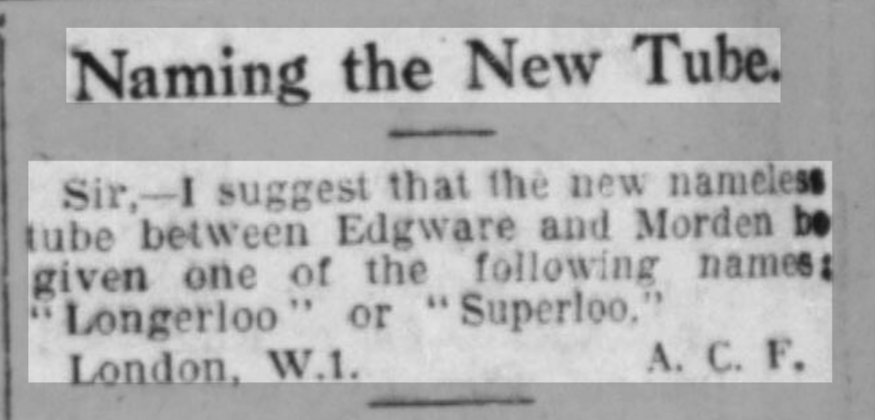
Another commentator, responding to the Express, almost coined the word ‘Superloop’ (now a fast bus service) 100 years ago:
Another correspondent to the Express had a bit of fun at the expense of Lord Ashfield, Chairman of UERL, the company that operated the merging lines:
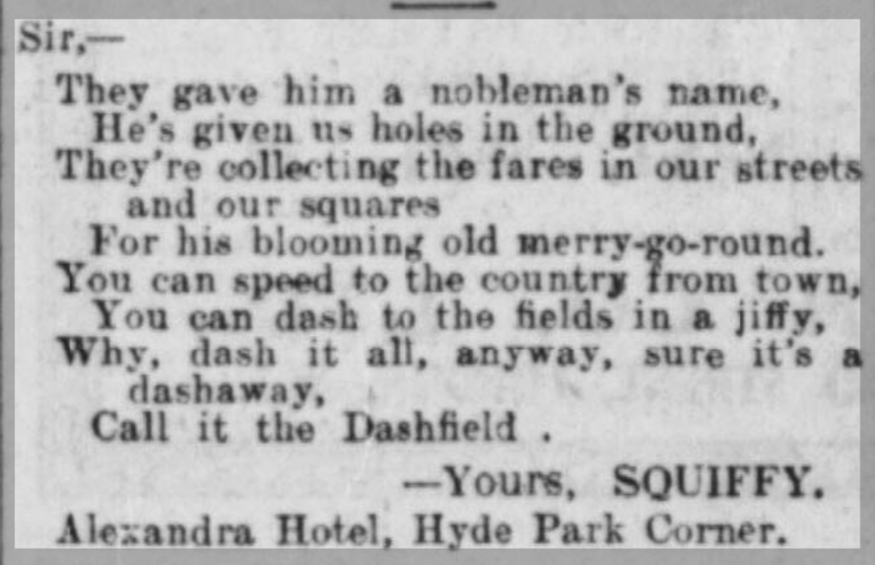
The Dashfield line has a certain ring to it, don’t you think? Meanwhile, the Sporting Times, casting about for a name, suggests “…the one that a fellow we know called it after he’d been delayed twenty minutes owing to a breakdown”. That would have quickly aged, of course, because, as we all know, the Northern line never breaks down today.
Another enterprising reader of the Express posited the N.E.S.T. line, for the Northern, Eastern and Southern Tube. “The company might then use the slogan, “Fly to your rest by N.E.S.T.”, which doesn’t quite scan, and nor does it make much sense for commuters heading to work. But never mind.
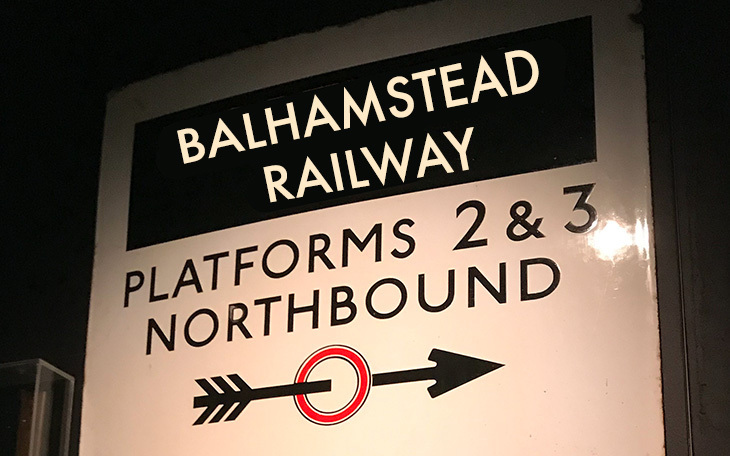
“Would not the ‘Balhamstead Railway’ be a good name,” enquires C.P.M. of Wise Road, E.15.
“No,” would be my instinctive reply.
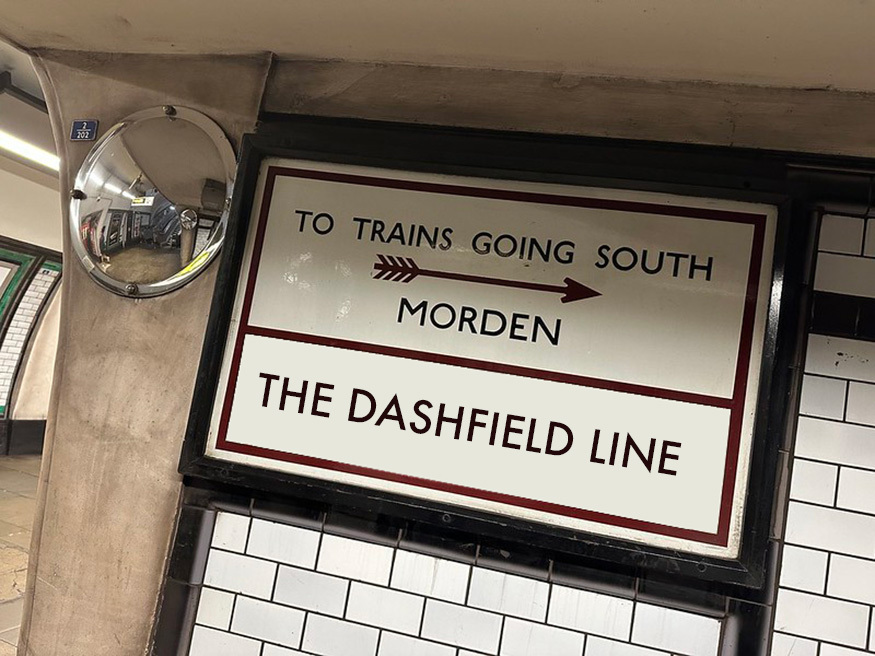
“The two districts honoured [Balham and Hampstead] are probably the most important at each end of the line, and the name is more informative than any combination of the names at the terminus stations”. Not buying it, C.P.M., but at least you inspired a crappy Photoshop session 100 years later…
Other ideas included the ‘Mordenway line’, the accurate but non-specific ‘Cross-River line’, the boring ‘E.C.M. line’ (for Edgware, City, Morden), the ‘North-South line’, the ‘Edgemorden Line’, the ‘Mordernware line’, the ‘Morware line’, and the ‘Missing Link’.
The Daily Express’s ‘Beachcomber’ column, a pen name at the time for J.B. Morton, provided the most whimsical suggestions of all. “Why not follow the example of people who name houses and give it a beautiful and appropriate name like, say, Como or Capri, or Sea View, or The Larches, or Mon Repos or Mon Sejour?”
Just imagine, today you could be catching The Larches (Bank Branch), or The Missing Link to Mill Hill East.
In the event, the consolidated line opened with no snappy name. The Morden-Edgware line was most commonly used until 1937, when the route was first officially dubbed the Northern line. It’s a name that’s never made much sense, given that this line has more stations south of the river than any other.
London Underground has a long-held ambition to decouple the two branches of the Northern line into two separate lines. If they ever do, we’ll be first on the suggestions form, arguing for the Capri and Como lines.