




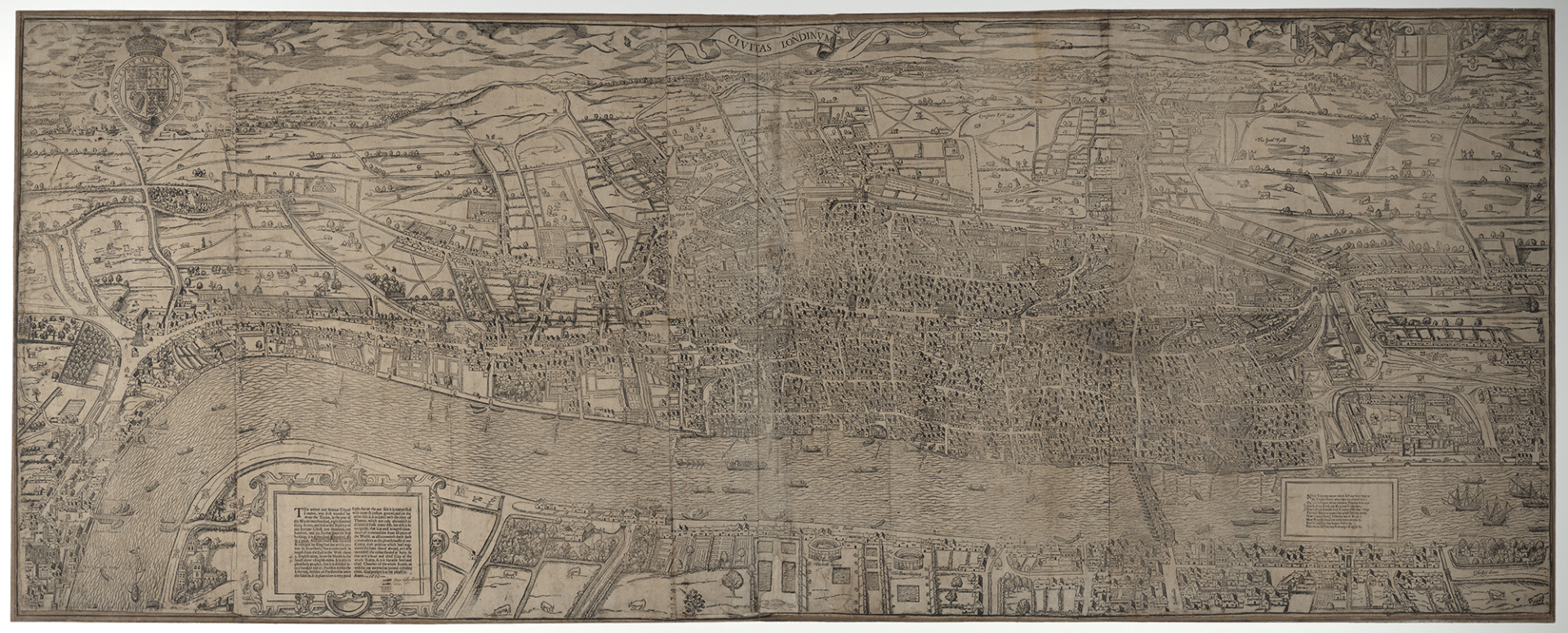
Offering a fascinating glimpse into everyday life and work in the Tudor capital, Civitas Londinum has been attracting history enthusiasts with a keen eye for detail since it went on display at the City Corporation-owned The London Archives in June.
Dating from around 1633, this rare woodcut map offers a bird’s-eye view of the landscape across the Thames – from Southwark towards the hills of Hampstead and Highgate – at a date between 1561 and 1570.
Swans glide along the Thames while elsewhere, people can be seen watching bear baiting. In open fields, laundry is being spread out to dry in the sunshine (pictured above) and London Bridge is crowded with tightly packed buildings. St. Paul’s Cathedral stands prominently – noticeably, without its spire, which was lost to a lightning strike in 1561 – and the old London Wall is clearly visible.
Featured in the ‘Shakespeare in London’ display, which runs until 2 October, the map is believed to have been based on the Copperplate Map, produced in the 1550s, and from which three of the estimated 15 plates survive.
Only three prints of Civitas Londinum survive – at The London Archives; the National Archives at Kew; and the Pepys Library in Cambridge.
Sharing the limelight with Civitas Londinum and no less remarkable for its rarity is a parchment property deed bearing William Shakespeare’s signature – one of only six in the world known to be genuine.
Small, blotchy and in places, illegible, the signature appears on a deed for a house in Blackfriars bought by Shakespeare in 1613. The exact location of the house is uncertain, but is known to have abutted on the street leading to Puddle Wharf (now, St. Andrew’s Hill) and destroyed in the Great Fire of 1666.
Most likely bought as an investment, there is no evidence that Shakespeare lived in the property, despite being within walking distance of the Globe and Blackfriars theatres.
The third item on display in ‘Shakespeare in London’ is John Keats’ personal and hand-annotated 1808 facsimile of the First Folio, which reveals the poet’s particular interest in King Lear, A Midsummer Night’s Dream, Troilus and Cressida, Romeo and Juliet, and Henry IV Part I.
Chairman of the Corporation’s Culture, Heritage, and Libraries Committee, Brendan Barns, said:
“’Shakespeare in London’ has brought together three remarkable items and it is hardly surprising that visitors are enjoying picking out tiny details in ‘Civitas Londinum’, studying Shakespeare’s signature up close, and viewing one of John Keats’ most cherished belongings.
“Always very popular and free to view, the archives’ exhibitions and displays never disappoint, and are a credit to our curators and conservators, all of whom take great pride in using their skills to tell fascinating stories about London’s past.”
The London Archives is an integral part of the Corporation’s cultural and heritage offering.
The organisation is one of the largest funders of heritage and cultural activities in the UK and invests over £130m every year. It manages a range of world-class cultural and heritage institutions, including the Barbican Centre, Tower Bridge, Guildhall School of Music & Drama, Guildhall Art Gallery and London’s Roman Amphitheatre, The London Archives, and Keats House. It also supports the London Symphony Orchestra and the new London Museum.
ENDS
';