






image source, Pradeep Gaur/Mint via Getty Images)
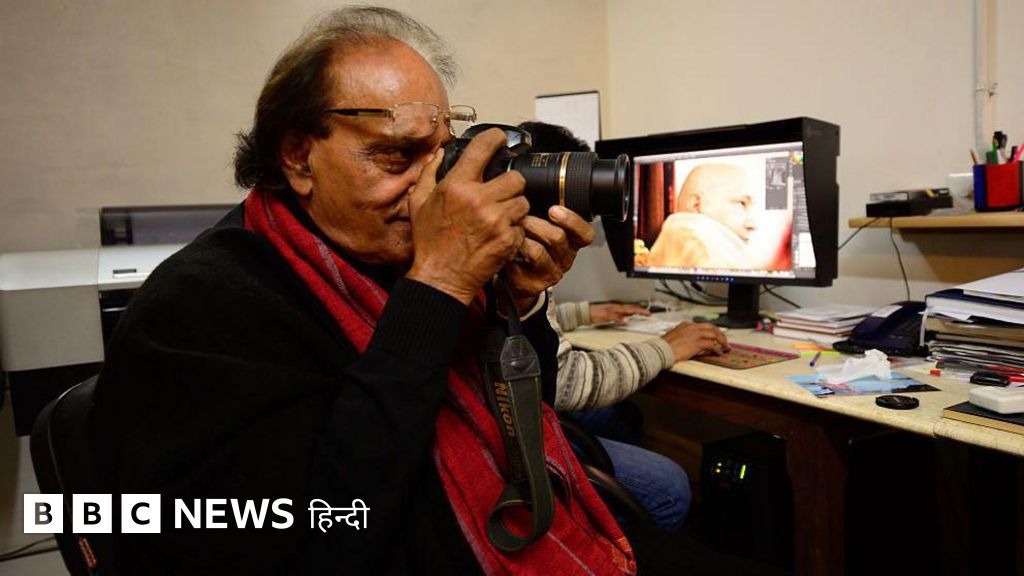
Well-known photographer Raghu Rai is no more. He died on Saturday at the age of 83.
In the world of photography, Raghu Rai has done his work with such excellence that he is considered a cult figure of this world.
His influence in the world of photography was such that despite his increasing age, he remained busier than any other young professional.
Even in his last days, he was busy preserving the history of photography amid requests to take photographs from newspapers around the world.
A few years ago, in a conversation, Raghu Rai had openly shown the picture of his life.

During the conversation, it was as if he took back the camera reel of his life.
He said, “In our times, people were not able to decide anything in their childhood. The atmosphere at home was such that he used to study and play with the children of the neighborhood and enjoy the sun. One is not allowed to stay out of the house after the evening.
Remembering his father, he paused for a moment and then said, “Father’s discipline was such that I would do whatever he wanted.” This was the trend then. They wanted me to become an engineer, so I completed my civil engineering studies at the age of 22. After this, he worked as a drawing instructor in the Jat Regiment of Firozpur for a year, but he was not interested in the work. But there was no interest in any other work.
The very first picture was published in half page in ‘London Times’
image source, Pradeep Gaur/Mint via Getty Images
However, by then Raghu Rai’s elder brother S. Paul had established himself in the world of photography. Coincidentally, Raghu came to him in Delhi in 1966.
He used to be the chief photographer of ‘Indian Express’ at that time. Some such coincidence happened that one of his friends was going to his village. Raghu Rai insisted to his brother that he should be allowed to go with them. Raghu Rai not only took his brother’s permission but also took his camera. Thought of taking some pictures in the village.
Recalling those days, Raghu Rai had said, “The thing was that I saw a donkey on the way, I should take its picture. But he started running. I started running behind him. This game continued until the donkey got tired and stopped. Then I took his picture. Later, the elder brother saw it, prepared a print of it and sent it to some newspapers abroad.
This picture did wonders in his life. The very first picture was printed on half the page in ‘London Times’.
Then he got so much money that it was equal to his monthly salary. Raghu felt that he too could do this. It was only this confidence that brought him behind the camera.
Recalling that period, he told BBC, “Call it coincidence, luck or whatever you want, Bhai Saheb would not have been a photographer. If my first photograph had not been published in the ‘London Times’, then perhaps I would never have become a photographer.”
image source, Waseem Gashroo/Hindustan Times via Getty Images
Impact of ‘The Statesman’ on life
image source, Sipra Das/The The India Today Group via Getty Images
Raghu Rai had admitted that he had no problem in getting the job. Bhai Saheb was there, then after the first picture was published in London Times, he too developed passion for photography.
He would take his scooter and go out on the streets of Delhi. Spent hours wandering here and there, searching for photo opportunities.
Raghu Rai got a job in ‘Hindustan Times’ in 1966 itself. But he did not stay there for long. Because ‘The Statesman’ used to have a lot of prestige at that time, he reached there in 1967.
Raghu Rai gives importance to the role of a statesman in his life.
According to him, “To be honest, this newspaper made me a famous photographer.” There was a news editor – R.N. Sharma. He was a traditional journalist, but the man was very nice. He used to study my pictures carefully. Everyone can see the pictures but not everyone can read them.
“The coincidence was such that after reading my pictures, they started giving me more space than expected. This strengthened my confidence. Hard work also increased. But I definitely try to make the pictures as good as possible. They said to make a photo of two columns, but I made a photo of four columns. After seeing the picture they would find its place. So he had a big contribution in my becoming.
He has many memories of his time working in ‘The Statesman’.
He became emotional while sharing these memories. He said, “I still remember one incident. This is about the time of JP movement. The movement was at its peak in Bihar. I was roaming in Bihar with JP. There was lathi charge on him during the movement but the then Home Minister denied it. The very next day, the Home Minister had to apologize in Parliament after seeing the picture of lathi charge on the front page of ‘Statesman’. JP was very impressed by this and after this we used to meet very fondly.
Closeness to Mother Teresa and Indira Gandhi
image source, Dickson Lee/South China Morning Post via Getty Images
The subjects of Raghu Rai’s photographs have always been the common man and his expressions, the splendor of the cities and the hustle and bustle of the streets, etc. whereas photographers like to capture things like rivers, ponds, mountains on camera, any reason for this choice?
As soon as he heard this question, there was a twinkle in his eyes. He immediately said, “Look, I was brought up in a society where I was taught to respect common people. We come in contact with the emotions of common people on a daily basis. Believe it or not, these are the common people whose conditions remain the same even after so many years of independence, such people have been attracting me.
He said, “The common people of India, their way of life and lifestyle are discussed all over the world, I also look at them with respect. Many times I try to draw the attention of people in power to the problems of common people through my paintings. Well, the truth is that I find more peace by taking photographs of common people.
Talking about his closeness with Indira Gandhi and Mother Teresa, he had said, “Look, let me tell you that the closeness with these celebrities was formed in connection with work. When I was working at Statesman, Indira Gandhi used to be the Prime Minister of the country. To be honest, I have never seen another political personality like him. Whatever her critics may say, she was a committed leader.
image source, Raghu Rai/The The India Today Group via Getty Images
According to Raghu Rai, the special thing about Indira Gandhi was that she gave a lot of importance to art and culture. He used to know from which angle the photographer was taking his picture. Even as a Prime Minister, the country could not find another administrative leader like him.
According to Raghu Rai, he also prepared three books on Indira Gandhi.
Talking about this, he had said, “When he announced emergency, we had opposed him.” She lost the election, went to jail but see her courage and how she made a brilliant comeback. When he was murdered, I could not believe for many days that he could be murdered, but it was a reality. Then we brought out a collectible issue of India Today on him.
Raghu Rai saw a mother in Mother Teresa.
He said about this, “As far as Mother Teresa is concerned, she was exactly like a mother. She could win anyone’s heart with her love; there will never be another example of what she did for the poor and destitute people of this country after coming away from her country. She met with the greatest love and everyone was filled with new energy after meeting her.
Distance from films and cricket
image source, Getty Images
There was also a discussion with Raghu Rai on cricket and films, two topics which dominate the Indian media.
He said, “Look, it’s not that I don’t like films, but I never felt like working in that medium. Actually, the pomp and show of Mayanagari could not impress me or we can say that I wanted to stay away from that shine.
“As far as cricket is concerned, let me tell you that I like it as a game and I liked Mansoor Ali Khan Pataudi and Kapil Dev as cricketers. But the real problem is that it is no longer just a game. So much money has gone into it that the thrill of the game has been left behind.
He was sad over the corporatization of cricket. He said, “It has now turned into a corporate business.” Our players also started focusing more on making money than playing. It is not hidden from anyone what has happened to other sports in the name of this one game. At times, it seems that nationwide corruption is becoming more prevalent than in cricket.
image source, Pradeep Gaur/Mint via Getty Images
Raghu Rai’s fame spread all over the world. When he was asked that at the height he was at, he would have received offers to work from all over the world. Still, why did India remain its base?
There was satisfaction and experience visible in Raghu Rai’s answer. He said, “Look, there is no better country than India, nor can there be.” The joy of working in the fragrance of the country’s soil cannot be found anywhere in the world.”
“There is so much diversity in India that many lifetimes can be spent working here. Leave aside the whole of India, there is so much work left to do in Delhi alone that I will have to take many births. Recently, when I was completing a book on Delhi, this belief became stronger.
What would Raghu Rai have been if he had not been a photographer?
He had the answer to this question ready, “For this I don’t have to think so much.” See, I love gardening as much as I love photography. If I had not been a photographer, I would have definitely been a gardener.
He said, “Despite being a photographer, I don’t do any work on Saturdays and Sundays.” I spend my days at my farm house. I have planted all types of flowers and plants in my farm house. I have been collecting it from all over the world. There is a lot of fun in that too and it feels like I am in the shade of nature.
Published by Collective Newsroom for the BBC