







image source, Getty Images
During the conflict with the US and Israel, Iran’s retaliation went beyond traditional targets, expanding the scope of the conflict by targeting US-linked digital hubs, cloud infrastructure and data centers in the Gulf.
Iran’s Islamic Revolutionary Guard Corps (IRGC) said it carried out drone attacks on data hubs in the United Arab Emirates (UAE) and Bahrain.
This is unprecedented in today’s warfare, with deliberate attacks on public-facing cloud infrastructure rather than mere cyber intrusions.
Iranian state media said the aim was to expose and prevent the role of these data centers in “supporting the enemy’s military and other activities.”
Click here to join BBC Hindi’s WhatsApp channel

Why the attacks on the Gulf’s digital infrastructure?
image source, Getty Images
In the current era, cloud infrastructure has now emerged as a dual-use strategic framework.
It provides services to the common people in areas like banking, aviation, healthcare, corporate functioning and e-government.
Apart from this, it also helps in the work of the army and intelligence agencies, which includes AI-based analysis, processing of satellite images, planning of logistics and helping in command-and-control.
America is especially dependent on companies providing cloud services on a large scale. These are called ‘hyperscalers’.
These companies run huge data centers all over the world. They are designed to provide unlimited computing, storage and networking resources on demand.
These include big tech companies like Amazon, Microsoft and Google.
Iran believes that targeting these centers will completely change the war strategies and can have a deep impact on the direction of the conflict.
Big American companies on target
image source, Getty Images
On the IRGC’s announcement that it is targeting American tech companies based in the Gulf region, researcher Khalid Waleed has written an article on Qatar’s economic cooperation and in the newspaper ‘Al-Quds al-Arabi’ published from London.
He says, “This shows that now there has been a big change in the strategy. Now not the places, but the system which works for surveillance is being targeted.”
He said, “From this perspective, these companies are no longer limited to just providing technical services, but they have directly or indirectly become a part of the army’s decision-making chain.”
In this context, he mentioned the “militarization of companies belonging to common people” and the “re-politicization of cyber-space”.
On March 13, Iran’s radical newspaper Keyhan reported on its Telegram channel that the IRGC ordered employees of major American tech companies operating in the Gulf countries, such as Apple, Google, Microsoft and Amazon, to evacuate.
In this order, he was directed to immediately vacate his offices located in Dubai, Riyadh, Doha, Kuwait City, Manama and Muscat.
On March 31, the IRGC had mentioned Cisco, HP, Intel, Oracle, Microsoft, Apple, Google, Meta, IBM, Dell, Palantir, Navida, JPMorgan, Tesla, German Electric, Spire Solutions, G42 and Boeing as its potential targets.
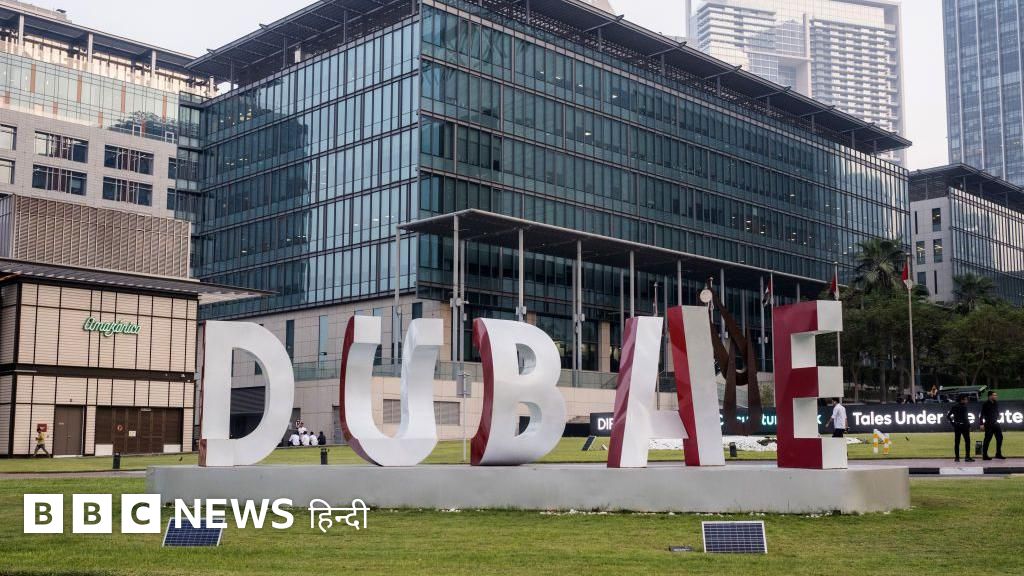
The IRGC also claimed to have attacked an Oracle data center in Dubai.
The Dubai Media Office described it as “a minor incident” caused by “debris falling on the exterior of the Oracle building in Dubai Internet City”.
How did Gulf countries emerge as digital hubs?
image source, Getty Images
For years, the issue of security in the Gulf was decided only by energy. Refineries, ports, shipping lanes and petrochemical complexes were the main causes and targets of regional tensions.
This picture has now changed, as Gulf countries have invested heavily to become global AI and cloud computing hubs in an effort to gain strategic and economic benefits.
UAE and Saudi Arabia in particular have been very eager to present themselves as the biggest hubs in the world and their region in the field of AI.
The UAE government said, “The objective of the ‘Digital Economy Strategy’, launched in April 2022, is to double the contribution of the digital economy to the country’s GDP within 10 years. That is, to increase it from 9.7% to 19.4% by 2022.”
“It also aims to further strengthen the UAE’s position as a hub of the digital economy in the region and around the world.”
Apart from this, ‘Stargate UAE’ project is also very important. It is expected to eventually have up to five gigawatts of power capacity and is described as the largest AI data-center complex outside the US.
Amazon Web Series (AWS) is also developing a new region in Saudi Arabia, which is worth more than US$5.3 billion.
How big a loss is an attack on digital infrastructure?
image source, Getty Images
Analysts argue that attacks on digital targets cause real economic and strategic losses.
Reports revealed that there were disruptions to banking systems and fintech services in the UAE and Bahrain following the AWS attacks. Airlines, ride-hailing and e-commerce platforms were affected by this. Customers were advised to move their workloads elsewhere.
Saudi Asharq News website said that the damage caused by disruptions in data centers and IT systems is huge. On average, millions of dollars per hour, and in some cases it exceeds one million dollars.
Companies suffer even greater financial losses from work stoppages, service delays, and costly recovery or relocation efforts.
Additionally, rebuilding these bases can be very expensive, as modern data centers are among the most expensive technology and infrastructure projects in the world.
Questions also arise whether the Gulf countries will move towards improving cloud security strategies around big data hubs?
And will they face more stringent risk assessments and perhaps slower foreign investment?
Another risk is that Iran’s designation of US tech companies as “legitimate military targets” could formalize attacks on digital infrastructure as strategic targets in a war. Whether such bases are related to the service of common people or are for military purposes.
Experts have warned that these steps of Iran set an example that other countries can also copy in future conflicts.
Published by Collective Newsroom for the BBC.