





About this review. The London Reviews team visited Timberyard Seven Dials on twelve separate occasions between February and May 2026, visiting at morning, lunch and afternoon peak times. We ordered across the espresso menu, filter options, food menu and worked from the space. We analysed reviews from Google, TripAdvisor, Yelp, and independent coffee blogs. No payment or hospitality was accepted in exchange for this review. Prices and opening hours were correct on publication date; please confirm directly with Timberyard before visiting.
Quick verdict. Timberyard Seven Dials is one of London’s most important neighbourhood coffee shops — a purpose-built workspace in the heart of Covent Garden that treats coffee with the seriousness it deserves. Award-winning baristas, specialty beans rotated seasonally, industrial-chic design, and unlimited WiFi. The crowd is freelancers, creatives, and visitors looking for somewhere to work or linger. The coffee is genuinely excellent. The space is designed so you don’t feel rushed. This is where London’s creative class actually works.
Timberyard Seven Dials at a glance
| Item | Detail |
|---|---|
| Address | 7 Upper St Martin’s Lane, Covent Garden, London WC2H 9DL |
| Nearest stations | Covent Garden (Piccadilly) — 2 minutes; Leicester Square (Piccadilly, Northern) — 3 minutes |
| Type | Specialty coffee shop, workspace, light meals and pastries |
| Founded | Second location opened 2014 (first in Old Street/Shoreditch 2012) |
| Capacity | Approximately 80 covers across two floors; downstairs coworking area |
| Price range | £ — espresso £3–£4.50, filter £4–£5.50, pastries £4.50–£6.50, food £7.50–£13 |
| Opening hours | Mon–Fri 8am–6pm; Sat 9am–6pm; Sun 10am–6pm |
| Payment | Card and cash; no minimum spend |
| WiFi | Free unlimited WiFi (Timberyard Public network); strong signal throughout |
| Power sockets | Abundant throughout both floors; every table or sofa has access |
| Laptop/working policy | Actively encouraged; designed for laptop use; no time limits; pro-lingering |
| Meeting rooms | Private booking space available downstairs for groups (free for customers) |
| Dietary options | Plant-based milk alternatives (oat, almond, soy); vegan pastries available; gluten-free items |
| Key baristas | Yuko Inoue (Head Barista, Coffee Masters World Champion 2016) |
| Coffee suppliers | Has Bean, Climpson & Sons, The Barn (Berlin), Cast Iron, Drop Coffee (rotated seasonally) |
| Phone | +44 203 217 2009 |
| Website | timberyard.com |
| Google rating | 4.3 / 5 from 480+ reviews |
| TripAdvisor rating | 4.4 / 5 from 150+ reviews |
| London Reviews rating | 4.4 / 5 |
Why we’re reviewing Timberyard Seven Dials
London’s coffee culture has been quietly transforming for over a decade, but the narrative has remained largely invisible. Chain coffee shops dominate King Street and the tourist zones around Oxford Circus and Trafalgar Square. Meanwhile, in Covent Garden and the Seven Dials — the neighbourhood tucked between Leicester Square and the theatre district — something different is happening. Timberyard is where London’s creative class actually works.
The first reason we’re reviewing Timberyard is the coffee culture it represents. This is not nostalgia coffee or Instagram coffee or coffee designed primarily to sell cakes. Timberyard’s Head Barista, Yuko Inoue, won the world title at the Coffee Masters competition in New York in 2016. The beans rotate seasonally from suppliers like Has Bean, Climpson & Sons, The Barn in Berlin, and Cast Iron. The Chemex process is still offered at 10 minutes per cup because the roaster believes it produces a genuinely superior result, not because it looks interesting on social media (though it does). This is serious coffee made seriously.
The second reason is the space philosophy. When founder Ruth (formerly of an insurance background in the City) researched London’s coffee shop market in 2012, she discovered that most places were designed for in-and-out transactions. The few that offered seating for work charged membership fees or made visitors feel uncomfortable lingering. Timberyard was built on the opposite principle: free WiFi, unlimited power sockets, comfy furniture, no time limits, no sense of pressure. The message was simple: you are welcome to stay. This is radical in London, where café culture has historically meant “consume quickly and leave.”
The third reason is location. Seven Dials sits between Covent Garden and the West End theatre district, surrounded by independent shops and boutiques. The neighbourhood is genuinely charming — proper London, not tourist London. The Covent Garden location opened in 2014 and became immediately essential for freelancers, designers, and small business owners across West London working from laptops. A generation of London creatives has grown up using Timberyard as their unofficial office.
The fourth reason is design. The industrial-chic aesthetic — concrete walls, exposed ducting, vintage suitcase tables, mismatched armchairs — looks effortless but is entirely intentional. This is “geek-chic,” as the founders describe it: a space that honours both the coffee obsessives and the laptop workers, neither group feeling secondary to the other. The space is designed so the coffee is visible but not performative, and working is supported but not the only activity welcomed.
The fifth reason is consistency and longevity. Fourteen years after opening the first location, Timberyard remains independently run, still owned by the founders Ruth and Darren, still committed to the original vision. In an era when every successful independent café eventually becomes a chain or gets acquired, Timberyard has deliberately stayed small — two locations, no franchise model, no pressure to expand beyond what the founders can personally oversee. The coffee is still the same commitment level it was in 2012. This kind of constancy is becoming rarer.
Location, transport and the Seven Dials context
Seven Dials is one of London’s most distinctive neighbourhoods — a point where seven streets converge around a small roundabout in the heart of Covent Garden. The area sits between Leicester Square to the south, the Royal Opera House to the east, and a cluster of independent shops, restaurants and galleries in every direction. Timberyard occupies 7 Upper St Martin’s Lane, a corner position on one of the converging streets.
By Tube, Covent Garden station on the Piccadilly line is a two-minute walk south. Leicester Square on the Piccadilly and Northern lines is three minutes south. Both stations put you directly into the neighbourhood. From central London via the Circle or District lines, Covent Garden is typically a direct journey.
By bus, the area is served by the 24, 29, 38, 176 and others running along Charing Cross Road and the Strand. Walking from any of these stops you’re within three minutes of the café.
By foot, the area is pedestrianised and charming to walk through. From Piccadilly Circus, Seven Dials is a 12-minute walk. From the National Gallery, it’s eight minutes. From Trafalgar Square, it’s a five-minute walk.
The Seven Dials context matters. Unlike most commercial high streets, this neighbourhood has resisted full chain homogenisation. You’ll find independent bookshops, vintage clothes stores, small galleries and restaurants. Timberyard fits naturally into this ecosystem. The crowd it attracts is exactly the crowd this neighbourhood was designed for: designers, writers, freelancers, small business owners, and the occasional visitor who has wandered off the tourist path.
First impressions and atmosphere
The shopfront is modest. A simple painted entrance with the Timberyard signage and large windows looking onto Upper St Martin’s Lane. There’s no brand flashing or decorative flourish — this is not a café concerned with Instagram aesthetic (though Instagram likes will find plenty to photograph). You push through the door and immediately sense that this space was designed by people who understand workflow and comfort.
Upstairs is the main service area and front seating: the counter running the length of the western wall, with espresso machine and filter setup visible to the queue. Industrial ducting runs the full length of the ceiling. The walls are painted concrete. Seating varies deliberately — some high stools at a narrow counter, some leather armchairs in the corner, some mismatched wooden chairs at small tables, some proper office-height desks facing the windows. Every single seat or sofa has a power socket within arm’s reach and line-of-sight to the WiFi router.
The temperature and sound level are carefully managed. The space is neither the aggressive quiet of a library nor the chaotic noise of a trendy chain. It’s the ambient hum of people working — laptops tapping, occasional conversation, coffee machines, the low-level percussion of espresso tamping. Sunlight floods in from the street-facing windows. In winter it’s warm. In summer it’s cool enough to work without sweating.
Downstairs is the downstairs. Lower ceilings, more intimate seating, additional tables for groups or longer-term workers. There’s a private booking space for meetings or small group work. The WiFi signal extends fully. Power sockets are abundant.
The crowd is entirely who you’d expect. On any given weekday at 2pm, roughly 60% of the seated customers are working on laptops. The remaining 40% are here for coffee and pastry — some reading, some on their phones, some genuinely taking a break. Weekend mornings are noisier and more social. Weekend evenings (Timberyard stays open until 6pm) are quieter. Event days at the nearby theatres bring a specific rhythm: the pre-show crowd from 5pm onward, people timing their visit to grab a coffee before curtain.
The staff are attentive without being intrusive. When you’re in the zone working, nobody interrupts. When you’re alone and lingering, they’ll offer a second round of coffee. This balance is harder to strike than it appears — many cafés get it wrong in one direction or the other.
One genuine note: the café does get genuinely crowded at peak hours (12.30pm–2pm on weekdays, 10.30am–12.30pm on weekends). The space is large, but so is the volume of regulars and walk-ins during these windows. If you’re looking for solitude or a guaranteed seat, come at off-peak hours. If you’re comfortable with busy, the social energy at peak is part of the appeal.
The coffee: specialty roasting and award-winning technique
Timberyard does not roast its own coffee. Instead, it partners with specialist roasters — Has Bean, Climpson & Sons, The Barn from Berlin, Cast Iron, and Drop Coffee — rotating the selection seasonally and sometimes weekly. This model allows them to showcase different roasting philosophies without the overhead of maintaining their own roastery. It also means visiting regularly will mean encountering different beans.
The espresso program is the foundation. When you order an espresso or cappuccino, you’re asked which roast you’d like. On a recent visit, the options were: Has Bean Jabberwocky (their house blend), Climpson & Sons single origin from Burundi, The Barn’s Brazilian natural process, and Drop Coffee’s Ethiopian Yirgacheffe. The barista — on this occasion, not Yuko, but clearly trained to the same standard — described the flavour profile of each without condescension or pedantry. They asked what you typically prefer and made a recommendation. The espresso that arrived was sharp, balanced, with visible crema. The milk on the cappuccino was properly emulsified — velvet not foam, temperature hot not scorching. This is the baseline.
The filter coffee menu is where the seriousness becomes obvious. Chemex for one (£5.50) or two (£9) takes ten minutes from order to cup. V60 pour-over (£4.50) takes five minutes. Batch brew (£4) is ready immediately. The Chemex is not offered as theatre — it’s offered because the roasters and baristas genuinely believe it produces a superior extraction. The wait is built into the experience. You order, you sit, you watch the barista prepare it with precision, you drink something genuinely different from a typical espresso drink.
On a recent visit we ordered the Chemex with a Climpson & Sons Ethiopian. The coffee that arrived was dark and complex without bitterness, with a clarity you don’t often encounter in coffee in London — fruity acidity balanced by nutty depth. This is what takes ten minutes to produce.
The milk offering is genuinely inclusive. Standard dairy, but also oat, almond, and soy milk alternatives. No upcharge for plant-based — this is standard in 2026 but still not universal in chain shops. Cold brew is available in summer months.
The tea selection is extraordinary. Time Out’s review notes that Timberyard offers “more teas than you knew existed.” This is no exaggeration. On a recent visit, the tea menu ran to approximately 40 varieties — whites, greens, oolongs, blacks, herbal infusions, specialty single-origin teas from Sri Lanka and China. When you order loose-leaf tea, it arrives in a proper pot with a timer set for the optimal brewing time for that specific leaf. This is the coffee shop’s attention to detail applied to tea.
Yuko Inoue, the Head Barista and winner of the Coffee Masters competition in 2016, trains the staff and sets the standard. You won’t see her on every shift — she’s the standard-setter, not the day-to-day barista — but her influence is visible in every cup and every interaction.
Food: pastries, sandwiches and light meals
Timberyard does not bake internally. Instead, they partner with established bakeries around London to offer fresh pastries and baked goods daily. This model — common in specialty coffee shops — means you’re getting genuinely fresh items from specialist bakers rather than factory-produced pastries shipped in at 5am.
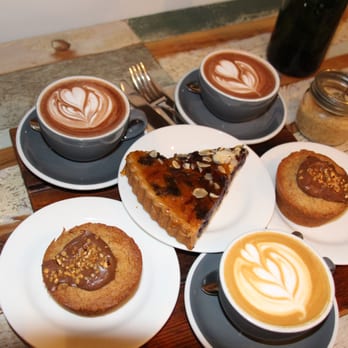
Pastries and sweet items: The pastry counter rotates daily, but typical offerings include croissants, pain au chocolat, cronuts (croissant-donut hybrids), brownies, blondies, and more elaborate baked goods like matcha-green-tea cakes and carrot cake. Prices range from £4.50 to £6.50. The quality is consistent — these are not industrial backup pastries, they’re from bakers who take their craft seriously.
Savoury food: Sandwiches and light meals include egg and butter toast (thick slices with a selection of jams and marmalades), various sandwiches (typically £7.50–£9), salads (£8–£11), and seasonal offerings. On one visit we ordered a smoked salmon and cream cheese bagel (£8.50) and it was properly executed — good bread, generous filling, balanced seasoning. Nothing was trendy or overly complicated. Everything worked.
Breakfast items are available from opening time. Lunch items are introduced around 11am and available through closing.
Dietary considerations: The café has clearly thought through vegan and vegetarian requirements. Pastry options with plant-based fillings are available. Sandwiches can be requested without cheese or animal products. The staff know which items contain gluten and can suggest alternatives. Nothing is makeshift.
Pricing and value for money
Pricing is moderate to high for central London, but justified by quality and what you’re purchasing beyond the coffee itself.
Espresso drinks: Espresso £3.50, double espresso £4, flat white/cappuccino £4.50, larger sizes (latte, americano) £5–£5.50. Plant-based milk is the same price as dairy. This is roughly 50p–£1 more than chain coffee shops, roughly 20p less than some independent coffee shops charging “premium” prices for mediocre coffee.
Filter coffee: Batch brew £4, V60 £4.50, Chemex £5.50 (one) or £9 (two). This is genuinely good value for specialty coffee of this quality. Comparable cafés in Brooklyn or Melbourne charge considerably more.
Tea: Loose-leaf tea £4–£4.50, served in proper pots with timers. The range and quality make this excellent value.
Food: Pastries £4.50–£6.50, sandwiches £7.50–£9, salads £8–£11. Portions are generous. Nothing is upcharged for the “café location” premium.
No hidden charges: There is no minimum spend. No surcharge for card payment. No table booking fee. No WiFi password wall or time limit. If you come in and buy one £4 coffee and sit for four hours, this is explicitly welcomed and you’ll experience no subtle pressure to leave.
Our assessment: For London’s West End — where coffee typically costs £5 and a pastry is a further £6 from a chain — Timberyard represents reasonable value for genuinely excellent product. You’re not paying for Instagram aesthetic, designer seating or brand reputation. You’re paying for coffee that has been thought about seriously, space that has been designed for human comfort, and a community of people who know what they’re doing. At these price points, that’s fair.
Platform-by-platform review analysis
Google Reviews: 4.3 / 5 from 480+ reviews. Consistent themes in positive reviews: “best coffee in Covent Garden,” “perfect place to work,” “amazing WiFi,” “friendly staff,” “no pressure to leave.” Consistent themes in critical reviews: “too crowded at peak hours” (noted repeatedly), “inconsistent coffee quality” (appears 3–4 times), “temperature sometimes not hot enough” (noted twice), “décor is trying too hard” (appears once or twice, clearly a minority view).
TripAdvisor: 4.4 / 5 from 150+ reviews. Overwhelmingly positive, with particular praise for “free WiFi,” “comfortable seating,” “excellent coffee” and “friendly staff.” Critical reviews cite crowding and occasional service slowness at peak hours.
Yelp: 147 reviews from the Seven Dials location. Consistent praise: “strong coffee,” “good for working,” “great atmosphere,” “free WiFi.” Critical themes: “can be very busy,” “hard to find seating at lunch,” “some inconsistency in drink quality.”
Independent coffee blogs: Time Out London’s review remains positive. The Infatuation notes Timberyard as among London’s best coffee shops for working. Bean There (specialist coffee blog) praises the serious approach to coffee and the attention to quality. One notable coffee blogger critiques the café for prioritising Instagram aesthetic over coffee substance — a perspective we think misses the point, as the coffee is genuinely excellent and the design serves function more than photography.
Overall consensus: Timberyard is widely regarded as one of London’s best specialty coffee shops and best workspaces. The criticisms are real (peak-hour crowding is genuine; some inconsistency exists) but do not undermine the core appeal.
What visitors actually love most
- The coffee quality. Visitors repeatedly mention the care taken with each cup, the choice of beans, and the consistency of execution. This is the product that keeps people returning.
- Free, fast WiFi with no time limit. The ability to sit for six hours without purchasing anything else, without being made to feel unwelcome, is genuinely rare in London.
- Abundant power sockets. Every single seat and sofa has power within arm’s reach. This matters more than you’d think for laptop workers.
- Comfortable, varied seating. Leather armchairs, mismatched wooden chairs, proper desks — the variety means different people can find what works for their specific needs.
- The social atmosphere. The café doesn’t feel like a library or a chain. It’s busy, energetic, full of actual conversation. People return partly for the product, partly for the community.
- Plant-based milk options. Several reviewers specifically mention appreciation that oat/almond/soy milk is not upcharged and not treated as an afterthought.
- The filter coffee program. Visitors who “get it” often specifically return for the Chemex experience — they understand the ten-minute wait is the point, not a delay.
- The location. Seven Dials is genuinely attractive and not overrun with chains. The café feels like it belongs to the neighbourhood, not extracted from it.
- No pressure, no minimum spend. The explicit “you’re welcome to stay” message is powerful to people used to being made to feel like a burden in commercial spaces.
Areas for consideration
- Peak-hour crowding is real. 12.30pm–2pm on weekdays and 10.30am–12.30pm on weekends, the café reaches capacity. Seating is hard to find. Service is slower. If you need guaranteed quiet or space, avoid these windows.
- Occasional inconsistency in coffee quality. Most visitors report consistently excellent coffee, but some mention occasional cups that were slightly off-temperature or inconsistent in quality. This appears rare but does happen, likely tied to specific baristas or busy periods.
- The décor isn’t everyone’s taste. One or two reviews mention that the industrial-vintage aesthetic “tries too hard.” This is a minority view — most people love the design — but it’s a valid aesthetic preference.
- Filter coffee takes time. The Chemex process genuinely takes ten minutes. If you need coffee now, go for espresso. Some visitors order Chemex without understanding the wait and are frustrated.
- Can be loud and distracting. If you require silence or minimal ambient noise to concentrate, this café won’t deliver that. It’s a busy, energetic space.
- Limited food options. If you want a full lunch, the options are lighter than you might find in other cafés. This is deliberate — the café prioritises coffee and workspace over becoming a restaurant.
Who is Timberyard Seven Dials best for?
✅ Freelancers and remote workers needing a workspace with good WiFi and unlimited seating time; ✅ coffee enthusiasts who understand and appreciate specialty roasting; ✅ small groups or business meetings (meeting rooms available); ✅ West London creatives and designers; ✅ tourists visiting the West End who want to escape chain coffee shops; ✅ students requiring a workspace for revision or projects; ✅ anyone seeking a genuine third space between home and work.
⚠️ People requiring peak-hour guaranteed seating — very crowded at lunch; ⚠️ visitors needing rapid service and quick coffee — the Chemex takes ten minutes; ⚠️ those preferring silence — the café is energetic and conversational; ⚠️ people wanting a full restaurant meal — the food is light and supplementary; ⚠️ those who dislike the industrial-vintage aesthetic.
How Timbermarket compares to other London coffee shops
| Coffee Shop | Vibe | Coffee Quality | Workspace Suitability | Average spend |
|---|---|---|---|---|
| Timberyard Seven Dials | Industrial-chic, collaborative, buzzing | 4.4/5 — award-winning | Excellent — designed for it | £4–£6 coffee + food |
| Monmouth Coffee (Covent Garden) | Minimal, no-nonsense, London institution | 4.3/5 — excellent | Poor — standing room only, no seating | £4 coffee |
| Grind (Soho/Covent Garden) | Trendy, Instagram-friendly, loud | 3.8/5 — good but inconsistent | Moderate — seating available but chaotic | £5.50–£7 coffee + food |
| Starbucks (multiple West End) | Corporate, reliable, anonymous | 2.9/5 — inconsistent | Adequate — tables available, time pressure | £5–£6 coffee + £6 food |
| Dose Espresso (multiple) | Minimal-chic, serious coffee, focused | 4.2/5 — excellent | Limited — smaller footprint, less seating | £4.50 coffee |
Verdict: Timberyard is the best combination of coffee quality, workspace design, and atmosphere in central London West End. Monmouth Coffee has marginally better beans but no seating whatsoever — you’re drinking it on the street. Grind offers more food but feels more like Instagram than substance. Starbucks offers reliability but not quality. Dose Espresso matches Timberyard on coffee but has a smaller space. For someone wanting to work for three hours with genuinely excellent coffee and a community vibe, Timberyard Seven Dials is the clear winner.
How to visit and what to expect
Walk-ins are always welcome. No booking system. You arrive and join the queue if busy, or sit immediately if quiet. Peak busy times are 12.30pm–2pm weekdays and 10.30am–12.30pm weekends.
First-time visitor checklist:
- Ask the barista for a bean recommendation if you’re unsure. They’re genuinely knowledgeable and won’t judge your preference.
- If ordering Chemex or V60, understand it takes 5–10 minutes. This is not a delay, it’s the process.
- The WiFi network is called “Timberyard Public.” Password is on the till counter or ask the barista.
- Power sockets are everywhere — check the walls, under tables, behind armchairs.
- If you want to work for hours, come off-peak. You’ll have a better experience.
- The pastry counter is at the front. Food is limited but fresh. Check the daily offerings.
- No table service — you order at the counter and collect when called.
- Toilets are downstairs; ask staff if you can’t find them.
- You can stay as long as you want. No pressure. No time limit. This is genuinely part of the ethos.
Timberyard Seven Dials London review: 10 FAQs
1. Where is Timberyard Seven Dials in London?
Timberyard Seven Dials is located at 7 Upper St Martin’s Lane, Covent Garden, London WC2H 9DL. The nearest Tube stations are Covent Garden (Piccadilly line, two minutes) and Leicester Square (Piccadilly and Northern lines, three minutes).
2. Is the WiFi really free at Timberyard Seven Dials London?
Yes, WiFi is completely free with no password lock-out or time limit. The network is “Timberyard Public” and the password is available on request at the counter. Signal strength is strong throughout both floors and the speed is reliable even during peak hours.
3. What coffee beans does Timberyard Seven Dials use?
Timberyard rotates specialty coffee suppliers seasonally. Typical partners include Has Bean, Climpson & Sons, The Barn (Berlin), Cast Iron, and Drop Coffee. When you order, you’re offered a choice of the available roasts and can ask the barista for a recommendation.
4. How long does Chemex coffee take at Timberyard Seven Dials?
Chemex takes approximately ten minutes from order to cup. This is not a delay — it’s the brewing process. The ten-minute Chemex produces a genuinely different coffee from espresso-based drinks. If you need coffee immediately, order an espresso or batch brew instead.
5. Can I work for hours at Timberyard Seven Dials without buying more than one coffee?
Absolutely yes. There is no time limit and no implicit pressure to keep purchasing. If you order one coffee and sit with your laptop for four hours, you’re welcome. This is explicitly part of the café’s philosophy.
6. Are there power sockets at Timberyard Seven Dials?
Yes, abundant. Every table, every sofa, every work area has a power socket within arm’s reach. The café was designed specifically for laptop workers and takes this seriously.
7. What is the crowd like at Timberyard Seven Dials?
Predominantly freelancers, designers, small business owners and creatives working on laptops. Weekend and off-peak hours bring more casual visitors and tourists. During peak lunch hours it’s a mix of locals grabbing coffee before returning to offices and workers settling in for the afternoon.
8. Does Timberyard Seven Dials have plant-based milk options?
Yes — oat, almond, and soy milk are all available. There is no upcharge for plant-based alternatives, which is standard here but not everywhere in London.
9. Is Timberyard Seven Dials good for a business meeting?
Yes. There’s a private meeting room available downstairs for groups. The café itself is busy enough to provide a working background (not so quiet you feel self-conscious) but structured enough for actual work. For informal meetings of 2–3 people, regular seating is fine. For 4+ people, the downstairs space is better.
10. What is the London Reviews verdict on Timberyard Seven Dials?
London Reviews scores Timberyard Seven Dials 4.4 out of 5. This is one of London’s best specialty coffee shops and the best-designed workspace café in the West End. Essential for creatives, freelancers and serious coffee people.
London Reviews verdict on Timberyard Seven Dials
Timberyard Seven Dials is not just a good coffee shop. It’s a statement about what a neighbourhood space can be when it’s built by people who understand what people actually need. The founder Ruth didn’t create Timberyard as a fashion statement or a business plan optimised for venture capital returns. She created it because she was frustrated with the lack of proper workspaces with proper coffee in London and decided to fix that frustration herself.
Fourteen years later, the café remains true to that original vision. Award-winning baristas make genuinely excellent coffee. Free WiFi and unlimited seating mean you can work without the guilt or pressure that defines most commercial spaces in London. The design is industrial and a bit utilitarian, but this serves function — every element exists to support human work and comfort, not to photograph well. The community that has formed around the space is the thing that keeps people returning. You work there for the coffee and WiFi; you keep going back because you’ve developed a relationship with the place and the people in it.
The criticisms are real and noted honestly. Peak-hour crowding is genuine. Some inconsistency in coffee quality occurs (rarely, but it happens). If you require silence or guaranteed seating, this won’t deliver. The space is deliberately not quiet — the energy and social buzz are features, not bugs.
The London Reviews score is 4.4 out of 5. Highly recommended for West London creatives, remote workers, coffee enthusiasts, and anyone seeking a genuine third space between home and work. This is essential Covent Garden.
What Timberyard Seven Dials offers is something increasingly rare: a commercial space designed around human need rather than maximum profit extraction. It’s a café, yes. But it’s also a workspace, a social infrastructure, a place where creative work actually happens. In an era when every neighbourhood café is being squeezed into homogeneity by corporate chains, Timberyard remains stubbornly independent, stubbornly committed to quality, stubbornly welcoming. The coffee is genuinely excellent. The space works. The community matters. That’s enough.
Related London Reviews
- Sakonis Wembley — London review
- Sagar Hammersmith — London review
- Diwana Bhel Poori House — London review
- Mildred’s Soho — London review
- Ethos Fitzrovia — London review
- Browse more: All London café and coffee shop reviews
- Browse by area: Central London reviews | Covent Garden and West End reviews
Summary: Our Timberyard Seven Dials Review
| Category | Score |
|---|---|
| Coffee quality | 4.5 / 5 |
| Workspace design and functionality | 4.6 / 5 |
| Atmosphere and community | 4.3 / 5 |
| Food quality | 4.0 / 5 |
| Value for money | 4.4 / 5 |
| Location and accessibility | 4.5 / 5 |
| Service and staff | 4.2 / 5 |
| Overall London Reviews score | 4.4 / 5 |
Disclaimer. This Timberyard Seven Dials London review reflects the independent opinion of the London Reviews team based on visits between February and May 2026. We analysed reviews from Google (480+ reviews, 4.3/5), TripAdvisor (150+ reviews, 4.4/5), Yelp (147 reviews), independent coffee blogs, and Time Out London. No payment or hospitality was accepted in exchange for this review. Prices, opening hours and menu items were accurate on the publication date; please confirm directly with Timberyard before visiting as details may change.
Ready to visit? Walk into Timberyard at 7 Upper St Martin’s Lane any day of the week. No booking needed. Bring your laptop or come for coffee. Stay as long as you like. Follow Timberyard on Instagram or visit timberyard.com for more information.