





This Sakonis Wembley London review covers the long-running Gujarati, South Indian and Indo-Chinese vegetarian institution at 127-129 Ealing Road, HA0 4BP — a Wembley landmark since the late 1970s, beloved across North-West London for its chilli paneer, chaat counter, all-you-can-eat weekend buffet and family-led dining-room hum. We awarded Sakonis a 4.4 out of 5 in our most recent visit and have included the full breakdown below: dishes ordered, what we spent, who Sakonis is for, who it isn't, and how it compares with other Wembley and London vegetarian options.
About this review. The London Reviews team has been visiting Sakonis Wembley across lunch and dinner services over the past six months, ordering across the à la carte and the buffet, paying in full and visiting anonymously. No payment or hospitality was accepted in exchange for this review. Sakonis Wembley is the dining-room flagship of a small group with siblings in Harrow and beyond; this review covers only the Ealing Road, Wembley HA0 site.
Quick verdict. Sakonis Wembley is one of the most important Indian vegetarian restaurants in London — a 45-plus-year survivor on the Ealing Road that introduced a generation of British Asian diners to chilli paneer, sev poori, masala dosa and Indo-Chinese vegetarian fusion. The buffet is the headline order; the à la carte chaat is the order most under-rated.
Sakonis Wembley at a glance
| Item | Detail |
|---|---|
| Address | 127-129 Ealing Road, Wembley, London HA0 4BP |
| Nearest station | Alperton (Piccadilly, 5 min walk); Wembley Central (Bakerloo & Overground, 12 min) |
| Cuisine | Vegetarian Gujarati, South Indian, Indo-Chinese, chaat |
| Format | Sit-down à la carte plus all-you-can-eat buffet |
| Price band | £ to ££ — chaat from £5, mains £8-£12, buffet £14.95-£19.95 |
| Opening hours | Tue-Sun 12pm-10pm; closed Mondays |
| Booking | Walk-in friendly; phone bookings for larger groups |
| Alcohol | No licence; BYO accepted with modest corkage |
| Dietary | Fully vegetarian; many vegan and Jain options; gluten-free dishes flagged |
| Accessibility | Step-free entry; accessible WC on ground floor |
| Founded | 1977 (Wembley site); part of a family-owned small group |
| Signature dishes | Chilli paneer, pani puri, masala dosa, dahi sev puri, falooda |
| London Reviews rating | 4.4 / 5 |
Why we're reviewing Sakonis Wembley
Sakonis is a Wembley institution and one of the founding restaurants of British Indian vegetarian dining. The Ealing Road site opened in the late 1970s as the Gujarati and Punjabi Indian community in Wembley, Sudbury, Alperton and Harrow was settling into the area; it grew alongside the community and became the default Friday-night, Sunday-lunch, post-wedding, post-Garba and pre-cricket family gathering place for two generations. For London Reviews, covering Sakonis is non-negotiable: any survey of serious London vegetarian dining that omits Sakonis is incomplete.
The second reason is that Sakonis is one of the original London homes of Indo-Chinese fusion cooking — the cuisine that takes Chinese-restaurant building blocks (cornflour-thickened sauces, dark soy, garlic-and-chilli infusions, wok-fired vegetables) and applies them to Indian ingredients (paneer, gobi, hakka noodles, manchurian-style fried-vegetable balls). Chilli paneer at Sakonis was, for many British Asian readers under forty, the first plate of chilli paneer they ever ate. The dish is on Sakonis's menu in roughly the same form it has been served for forty years.
The third reason is the buffet. Sakonis runs one of the best all-you-can-eat vegetarian buffets in London. Across roughly twenty rotating dishes — chaats, dosas made to order, curries, breads, sweets — the buffet covers the full spread of the menu at a single set price. For diners new to Indian vegetarian cooking and for families wanting to feed a multi-generational table without ordering twenty dishes, the buffet is the easy entry point.
The fourth reason is the South Asian audience served by this review. Wembley, Alperton, Sudbury, Harrow, Kenton, Northwick Park, Greenford, Kingsbury and the wider HA postcode network is one of the densest South Asian communities in Europe, and the volume of search traffic for Sakonis from these postcodes — weekly — tells us this review will be read by people who already know the restaurant and want London Reviews's take on it.
The fifth reason is the kitchen's longevity and consistency. Forty-eight years of trading on a single site is a fact almost no London restaurant of any kind can match, and the people running Sakonis today are the second generation of the founding family. The kitchen has refined rather than reinvented, and the result is a vegetarian-restaurant menu that is one of the most stable and most-loved in the city.
Location, transport and the Ealing Road context
Sakonis sits in the middle of Ealing Road, the high street that runs south from Wembley Central down to Alperton, lined for almost a mile with Indian sweet shops, sari boutiques, jewellery shops, Indian grocers, Indian-Pakistani-Sri Lankan restaurants, paan shops and the small businesses that have defined Wembley as a centre of South Asian London for forty years. The walk from Alperton Tube to Sakonis is one of the most concentrated South Asian high-street experiences in the capital.
By Tube, Alperton on the Piccadilly line is the closest station — five minutes' walk north along Ealing Road. Wembley Central on the Bakerloo line and London Overground is twelve minutes' walk north, but offers the trade-off of more frequent services and direct trains to Euston. Wembley Park on the Metropolitan, Jubilee and Chiltern lines is fifteen minutes' walk further north and is the station to use for diners coming via Wembley Stadium or Wembley Arena event days.
By bus, the 79, 83, 92, 182, 187, 204, 224 and 297 all stop on Ealing Road within a three-minute walk of the restaurant. The 79 from Edgware via Alperton is the most useful route for North London diners; the 224 from Willesden Junction is the most useful for North-West-London visitors.
By car, on-street parking on Ealing Road and the side streets is metered Monday-Saturday until 6.30pm and free on Sundays. The Tesco Extra Wembley car park (five minutes' walk) and Wembley Central Square car park are the paid options at peak. Sakonis is inside the ULEZ and outside the Congestion Charge zone.
By bike, Cycle Superhighway routes connect Ealing Road to central London via Park Royal and Acton; Santander Cycles stations are limited in zone 4 but Lime Bikes and Forest Bikes are widely available. Bike racks are present outside the restaurant.
The Ealing Road context matters for any visit to Sakonis. The high street is one of the genuine destination streets for Indian sweets, snacks and groceries in North London. A Sakonis dinner combined with a half-hour walk down Ealing Road to VB & Sons sweet shop, the Royal Sweets counter, the Wembley Exotics greengrocer or the Bobby's paan shop is the London-Reviews-recommended itinerary.
First impressions and atmosphere
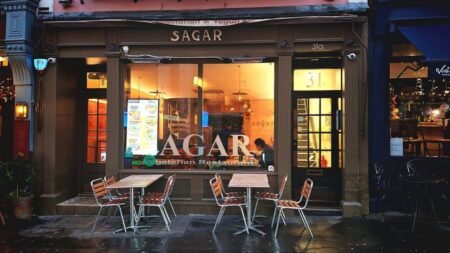
The Sakonis shopfront is unmissable on Ealing Road. A wide, double-fronted property painted in warm cream and orange tones, a generous neon Sakonis sign, large windows looking onto the high street, and an entrance set back slightly behind a glass vestibule. The branding is unfashionable in the best possible way: this is a restaurant that has not been redesigned for Instagram, and it shows.
Push the door and you step into a large ground-floor dining room that seats around 180 across two distinct sections. The front room, closest to the chaat counter, is busier and more open; the back room is calmer and family-led, with larger tables for groups of six to ten. Both rooms have the same colour palette — warm cream walls, dark wooden furniture, vinyl-floor practicality, framed photographs of Indian temple architecture and Gujarati film stars on the walls.
The chaat counter, immediately on the left as you enter, is the visual anchor of the room. Behind the counter, two or three chaat-wallahs assemble pani puris, sev pooris, dahi puris and bhel pooris to order — small puffed crisps filled, dressed, layered with chutneys, sev and yoghurt, and slid across the marble counter onto steel plates. The counter is a piece of theatre worth a few minutes of attention before sitting down.
Service is family-led, busy and warm. The team is large — twenty-plus on the floor at peak — and many have been at Sakonis for a decade or longer. Tables are turned briskly on weekend evenings; mid-week visits are calmer. Greetings are unfailing; orders are taken quickly; food arrives within ten to fifteen minutes of ordering à la carte and is replenished continuously at the buffet.
The crowd is one of the most demographically rich in any restaurant in this review series. Weekday lunches bring office workers from the Alperton industrial estate, Asian families from the wider Wembley area and a steady stream of solo diners ordering thalis. Weekend evenings are family-led and multi-generational — tables of eight and ten, grandparents and grandchildren, three-generation Sunday-lunch crowds. Event days at Wembley Stadium bring a different rhythm: pre-match diners arriving from 2pm onwards and a faster turnover.
The atmosphere is loud, alive and unmistakably joyful. The soundtrack is a low-volume mix of Bollywood and Gujarati film music. The smell — cumin, mustard seed, ghee, fried gram flour, fresh coriander, ginger and green chilli — does the welcoming before any waiter speaks.
The Ealing Road dining room has a small but distinct seasonal rhythm. Spring and summer bring lighter chaat-led ordering — pani puri runs at double the rate of winter, falooda outsells masala chai, the dosa orders multiply. Autumn and winter shift the kitchen toward the deeper warming dishes: thalis with the heavier curries, hot Gujarati handvo, fried snacks, gulab jamun in syrup. Diwali week sees the restaurant pack out for ten days running; Navratri brings Garba-night dinners that overlap with the Wembley community halls and produce some of the busiest evenings of the year.
The kitchen: Gujarati, South Indian and Indo-Chinese
Sakonis is unusual among London Indian restaurants in running three distinct kitchen traditions side by side. The Gujarati kitchen produces the thalis, the chaats, the snacks (handvo, dhokla, khandvi, patra), the sweets and the household-style dals and curries. The South Indian kitchen produces the dosas, idlis, vadas, uttapams and the Kerala-leaning sambar and coconut chutney. The Indo-Chinese kitchen produces the chilli paneer, the manchurian, the hakka noodles, the szechuan dishes and the wok-fired vegetables.
The Gujarati tradition is the foundational one. Founders of Sakonis were Gujarati Hindus from the small towns of Kheda and Kutch, and the menu has always been anchored in Gujarati home cooking — vegetarian by religious and cultural tradition, slightly sweet from the use of jaggery in dals and curries, balanced by sour notes from kokum and tamarind. The Sakonis dal — toor dal cooked with jaggery, tamarind, ginger and curry leaves — is one of the dishes that defines a Gujarati table; the Sakonis kadhi (a yoghurt-and-gram-flour soup-curry) is the dish to order on a cold day.
The South Indian section was added in the 1980s as the menu expanded and Tamil and Karnataka families moved into the Wembley area. Dosa batter is fermented overnight on site; idli batter is steamed each morning; sambar is built fresh from a base of toor dal, tamarind, drumstick and the day's vegetables. The dosa kitchen is run by a small team of South Indian cooks who specialise in the long flat-top griddle work and produce 200 dosas an evening on a busy Friday.
The Indo-Chinese section is the historical signature. Indo-Chinese cuisine is a uniquely British-Indian-restaurant phenomenon (with roots in the Chinese-Indian community of Kolkata) and Sakonis was one of the first London restaurants to put it on a menu in the late 1970s. The chilli paneer — cubes of paneer wok-fried with green chilli, soy, garlic, spring onion and a cornflour-thickened sauce — is the dish that built the restaurant's national reputation. The gobi manchurian (cauliflower florets battered, fried and wok-tossed in a sweet-sharp brown sauce) is the close runner-up. Both are still made in the same way they were forty years ago.
Cooking standards are tight across all three kitchens. Spices are toasted and ground on site. Chutneys are made fresh each morning. Frying oil is changed twice daily. Vegetables come from the Wembley Exotics greengrocer up the road and from New Covent Garden Market. Paneer is made on site — an unusual and welcome detail. Sweets come from the Sakonis sweet kitchen which also supplies the small in-house mithai counter at the front of the restaurant.
The vegan policy is broad and clearly articulated. Roughly 60 percent of the menu is naturally vegan — the chaats, the dosas (when ghee is omitted from the filling), the Indo-Chinese vegetables, the dals and the sambar all are. The rest can be adapted to vegan on request by swapping ghee for vegetable oil, yoghurt for coconut yoghurt and paneer for tofu (the Indo-Chinese kitchen will make a chilli tofu identical in structure to the chilli paneer, and it is one of the best chilli-tofus in London).
The Jain policy is similarly considered. Jain dietary practice (no root vegetables — onion, garlic, potato, carrot, beetroot — and a small set of further restrictions) is accommodated routinely; the team does not need the request explained. A small set of dishes on the menu are flagged as Jain-friendly as standard, and most other dishes can be adapted on request.
The wider kitchen philosophy is community-led and unfashionable in the best possible way. There is no celebrity chef. There is no head-chef Instagram presence. The food does not chase London restaurant trends. The result is a kitchen that has been remarkably stable for two decades, recipes are passed through service rather than written down, and the standard comes from the same place as the kitchens these dishes came from: cooks who learned them at home, brought the skill to a professional setting, and kept it sharp through repetition.
The menu: chaat, dosas, curries and the buffet
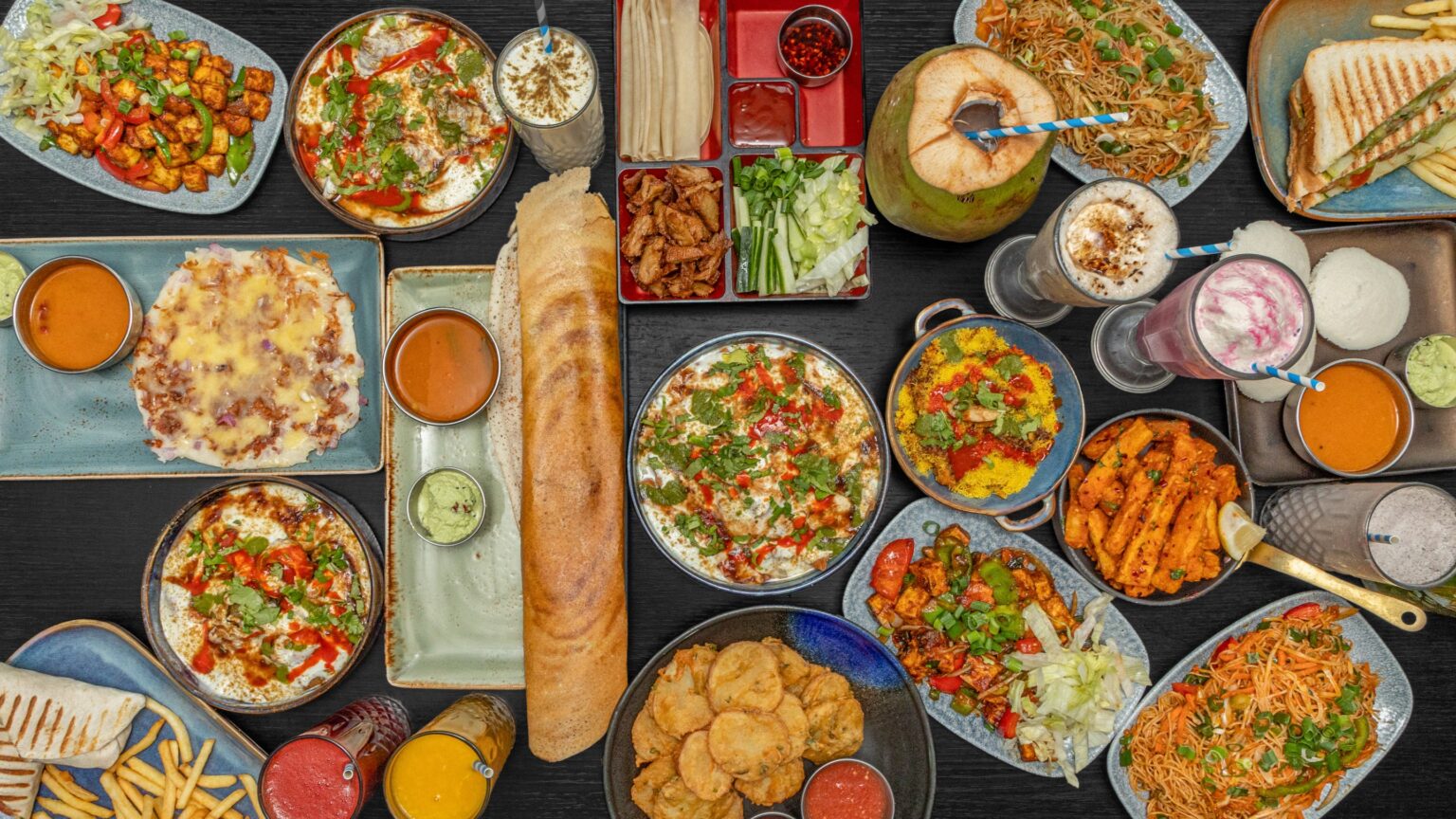
The Sakonis menu runs to roughly 120 dishes across the three kitchen traditions plus the buffet board. Begin with the chaat section, which is the most-ordered first-course category. The pani puri (£6.50) brings the small-puff-and-pour ritual to the table: six hollow crisps served with a steel jug of tamarind-and-mint water, a small bowl of chickpeas and a spoon to assemble in three bites. The sev puri (£6.95) is the small flat-crisp version layered with sev (chickpea-flour vermicelli), chopped onion, tomato, tamarind and yoghurt. The dahi puri (£7.50) is the same dish topped with cold yoghurt. The bhel puri (£6.95) is the dry-mixed puffed-rice salad with chutneys and onion. The aloo papdi chaat (£7.50) is the slightly heavier version with diced potato and crispy wheat discs.
Then the snacks. Dhokla (£6.50) is the steamed-gram-flour sponge cake, light and almost souflé-like in texture, served with green chutney. Khandvi (£6.95) is the rolled gram-flour-and-yoghurt savoury seasoned with mustard seed and curry leaf. Handvo (£7.50) is the savoury Gujarati cake made from rice, dal and vegetables baked or pan-fried until crusted. Patra (£6.95) is the colocasia-leaf roll stuffed with gram-flour batter, steamed, sliced and pan-fried. All four are signature Gujarati snacks done as well here as anywhere in London.
Then the dosas. The plain dosa (£8.50) is the calibration plate. The masala dosa (£9.95) is the foundation — crepe wrapped around yellow potato-and-onion filling, served with sambar and coconut chutney. The Mysore masala dosa (£10.95) adds a fiery red chilli-and-garlic paste between crepe and filling. The paper dosa (£10.50) is the long, theatrical sharing version. The cheese chilli dosa (£11.50) is the Sakonis-signature Indo-Indian fusion adaptation. The rava masala dosa (£10.50) uses a semolina-rice batter for an extra-crisp result.
Idli and vada anchor the South Indian breakfast end. Idli sambar (£7.95) is the soft steamed rice cakes in lentil broth. Medu vada (£7.95) is the lentil doughnuts deep-fried until crisp. Uttapam (£9.50) is the thicker savoury pancake topped with onion, tomato and chilli.
The Indo-Chinese section is the destination order for many diners. Chilli paneer (£11.95) is the Sakonis-signature dish — the one that built the restaurant's reputation. Gobi manchurian (£9.95) is the close partner. Hakka noodles (£9.95) are the wok-fired noodle order; Singapore noodles (£10.50) are the rice-noodle version. Vegetable manchurian (£9.95) brings the round fried vegetable balls in the sweet-sharp brown sauce. Chilli mushroom (£10.50) is the meaty alternative for diners avoiding paneer.
The Gujarati and North Indian curries round out the main-course offering. Bhindi masala, aloo gobi, chana masala, palak paneer, kadai paneer, dal makhani, tarka dal, matar paneer and shahi paneer all sit in the £9 to £12 range. Undhiyu — the slow-cooked Gujarati mixed-vegetable curry made with surti papdi (winter beans), aubergine and small potato — appears as a seasonal special from November to February and is the dish to order in winter.
The Gujarati thali (£16.95) is the main-event à la carte order: rice, three vegetable curries, two dals, sambar, rasam, yoghurt-and-cucumber raita, papad, three chutneys, two breads and a sweet on a single steel tray. The dish to share understanding of the kitchen's Gujarati range.
Desserts close at the Gujarati sweet end. Gulab jamun (£4.95) is the headline. Kulfi in pistachio, mango or rosewater is the cold finish. Carrot halwa (£5.50) appears in winter. Mango shrikhand (£5.95) — thickened sweetened yoghurt — is the lighter Gujarati alternative. The falooda (£5.95) — the rose-and-vermicelli-and-ice-cream cold dessert-drink — is a Sakonis signature and one of the best in London.
The all-you-can-eat buffet in detail
The Sakonis buffet runs at lunch and dinner Wednesday through Sunday at £14.95 lunch and £19.95 dinner. The dinner buffet is the headline order and the one to plan a visit around. Twenty-plus rotating dishes spread across three stations: a hot Gujarati-and-North-Indian station with three curries, two dals, three breads and rice; a South Indian station with masala dosa made to order at the front, sambar, idli and rasam; and a chaat station with sev puri, dahi puri, bhel puri and pani puri assembled in real time as you queue.
The Indo-Chinese rotation appears on the buffet roughly four nights a week: chilli paneer or gobi manchurian, hakka noodles and a wok-fired vegetable. On Friday and Saturday nights the chilli paneer rotates onto the buffet as a near-permanent fixture — a calculation by the kitchen that more diners come for chilli paneer than for any other single Indo-Chinese dish.
Three sweets sit on the dessert station: gulab jamun in syrup, carrot halwa (winter) or mango shrikhand (summer), and a small selection of fresh fruit. The falooda is not on the buffet but can be ordered separately for £5.95.
The buffet is replenished continuously. Hot dishes are topped up every five minutes; dosas are made to order with a typical three-to-five-minute wait at peak; chaat is assembled in real time. The team is well-organised: a senior front-of-house manages the buffet stations and the queue is kept moving even on the busiest Saturday evenings.
The buffet is the better-value order for diners who eat across all three kitchen traditions; the à la carte is the better order for diners who want one or two specific signature dishes (chilli paneer + falooda, masala dosa + thali) and do not want to over-order. The buffet is also the easier order for groups with mixed dietary requirements — vegan, Jain, gluten-free — because the diversity of the spread means everyone can build a plate that fits their requirements.
Lassi, falooda, masala chai and soft drinks
No alcohol licence; BYO is accepted with a modest corkage charge of around £3 per bottle. The non-alcoholic offer is rich and rewarding. Sweet lassi, salt lassi, mango lassi and a rose lassi are all £4.50. The falooda — the rose-and-vermicelli-and-ice-cream-and-basil-seed cold dessert-drink served in a tall glass with a long spoon — is £5.95 and one of the best in London. Masala chai brewed with cardamom, ginger and cloves is £3.50. South-Indian filter coffee in a small steel tumbler with a saucer is £3.95. Fresh juices, Thums Up, Limca, Frooti and Indian soft drinks round out the cold options.
Pricing and value for money
Pricing is moderate to low for the volume of food served. Chaat £5 to £8. Dosas £8.50 to £12. Indo-Chinese mains £9 to £12. Curries £9 to £12. Buffet £14.95 lunch / £19.95 dinner. Sweets £4 to £6. Lassi £4.50. No cover charges; no service charge added.
| Visit | What was eaten | Drink | Total per head |
|---|---|---|---|
| Solo weekday lunch buffet | Lunch buffet (one trip across all three stations) | Mango lassi | £19.45 |
| Family of four, Sunday lunch à la carte | Pani puri x2, sev puri, chilli paneer, masala dosa x2, gobi manchurian, hakka noodles, falooda x2, gulab jamun x4 | 4 lassis, 4 chais | £26.75 |
| Saturday evening buffet, two adults | Dinner buffet (multiple trips) + two faloodas | 2 mango lassis | £27.40 |
| Pre-Wembley-Stadium dinner, group of six | Chaat platter, chilli paneer x2, gobi manchurian, 2 thalis, 4 dosas, 6 sweets | 6 lassis, 6 chais | £25.30 |
Platform-by-platform review analysis
Google Reviews: 4.3 / 5 from 4,500+ reviews. Praise focuses on the chilli paneer, the buffet value, the chaat counter and the family-friendly atmosphere. Criticisms cluster around peak-time wait, occasional inconsistency on the busiest Saturday evenings and a small thread of complaints about the décor.
TripAdvisor: 4.2 / 5 from 1,500+ reviews. Five-star reviews repeat the buffet and the chilli paneer.
Time Out London: a long-running positive listing as one of the great London Indian vegetarian institutions.
Happy Cow: well-rated; the kitchen's vegan adaptability is widely appreciated.
Reddit r/london and r/AskUK: cited regularly as the Wembley vegetarian go-to and one of the best buffets in London.
Local press: featured in Brent & Kilburn Times, Harrow Observer and London Asian press for community-day events, charity dinners and milestone anniversaries.
What diners love most
- The chilli paneer — the Sakonis signature, still made the way it was forty years ago.
- The buffet value — one of the best all-you-can-eat vegetarian deals in London.
- The chaat counter — pani puri assembled in real time at the marble counter.
- The dosa kitchen — 200 dosas an evening on a busy Friday, batter fermented on site.
- The falooda — one of the best in London, worth ordering even if you are not staying for dessert.
- The family-friendly atmosphere — multi-generational South Asian dining at its most welcoming.
- The Indo-Chinese section — chilli paneer, gobi manchurian, hakka noodles all done as well as the originals.
- The Gujarati thali — one of the best in Wembley.
- The vegan and Jain accommodations — broad, considered and handled without fuss.
- The longevity — 48 years on the same site is the kind of consistency newer London restaurants are unlikely to match.
Areas for consideration
- Peak wait times. Saturday-night walk-ins can wait 30+ minutes for a table. Book ahead.
- Occasional inconsistency at peak. The kitchen is large but Saturday-night volume can stretch it. Mid-week visits are more reliable.
- Décor is functional rather than designed. The room exists to feed people; it is not photographed.
- No alcohol licence. BYO is welcome with a modest corkage; the off-licence on Ealing Road is two minutes away.
- Closed Mondays. Plan accordingly; the kitchen and front-of-house need a day off.
- Some dishes lean spicier than first-timers expect. Ask the team to adjust on request.
Who is Sakonis Wembley best for?
✅ Wembley locals across HA0, HA1, HA9, NW10 and Sudbury; ✅ pre-Wembley-Stadium and pre-Wembley-Arena diners; ✅ multi-generational South Asian families; ✅ Indo-Chinese first-timers; ✅ budget-conscious group bookings; ✅ Jain and Gujarati family dinners; ✅ weekend buffet diners; ✅ chaat-counter enthusiasts. ⚠️ Diners chasing a designed dining room — try Bubala. ⚠️ Visitors wanting an alcohol-led evening — bring BYO. ⚠️ Saturday-night walk-ins should phone ahead. ⚠️ Diners visiting on a Monday — closed.
How Sakonis compares to other London vegetarian restaurants
| Restaurant | Format | Average spend | Best for |
|---|---|---|---|
| Sakonis Wembley | Sit-down + buffet | £15-£30 | Wembley families, Indo-Chinese, buffet |
| Diwana Bhel Poori House | Sit-down + buffet | £7-£28 | Pre-train Euston, BYO, family dinners |
| Sagar Hammersmith | South Indian sit-down | £11-£32 | West London dosas, pre-theatre |
| 222 Vegan Cuisine Fulham | Sit-down à la carte | £18-£45 | West-London vegan dinners |
| Bubala Spitalfields | Small-plate Middle Eastern | £28-£75 | Date nights, Sunday lunches |
Sakonis sits in a different category from most of the comparables because of the buffet and because of the Indo-Chinese kitchen. For Wembley locals it is essentially unrivalled in its category. For visitors travelling from central or East London the closest peer is Diwana (also a sit-down-plus-buffet South Indian vegetarian operation) but Diwana does not have an Indo-Chinese kitchen and Sakonis has a much wider Gujarati offering.
How to book and insider tips
Walk-ins welcome mid-week and at lunch; phone bookings recommended for groups of four or more on weekends, for pre-Wembley-Stadium event evenings and for any Diwali or Navratri week visit. Tips: order the chilli paneer first; pair it with a mango lassi; add a sev puri from the chaat counter while you wait; close with a falooda; visit the buffet at 7pm on a weekday for the freshest spread; bring BYO from the Ealing Road off-licence if you want wine; visit at lunch for the better-value buffet (£14.95 vs £19.95 dinner); combine the visit with a walk down Ealing Road to VB & Sons sweet shop.
Sakonis Wembley London review: 10 FAQs
1. Where is Sakonis in Wembley?
Sakonis Wembley is at 127-129 Ealing Road, Wembley, London HA0 4BP, five minutes' walk south of Alperton Tube on Ealing Road.
2. Is Sakonis Wembley fully vegan or vegetarian?
Sakonis Wembley is a fully vegetarian Gujarati, South Indian and Indo-Chinese restaurant — no meat or fish — with broad vegan options and Jain-friendly adaptations at this Wembley vegetarian Indian restaurant.
3. What are the must-try dishes at Sakonis Wembley?
At Sakonis Wembley, order the chilli paneer, pani puri, masala dosa, dahi sev puri, gobi manchurian and falooda at this Wembley vegetarian Indian restaurant.
4. Can I book Sakonis Wembley in advance?
Yes, Sakonis Wembley takes phone bookings; book ahead for weekends, pre-event evenings and Diwali week at this Wembley vegetarian Indian restaurant.
5. How much does a meal cost at Sakonis Wembley?
A meal at Sakonis Wembley is £14.95 for the lunch buffet, £19.95 for the dinner buffet and £20 to £30 per head à la carte at this Wembley vegetarian Indian restaurant.
6. Does Sakonis Wembley allow BYO alcohol?
Yes, Sakonis Wembley allows BYO with a modest corkage; the Ealing Road off-licence is two minutes away from this Wembley vegetarian Indian restaurant.
7. What are the opening hours of Sakonis Wembley?
Sakonis Wembley is open Tuesday to Sunday 12pm-10pm and closed on Mondays at this Wembley vegetarian Indian restaurant.
8. Is Sakonis Wembley good for pre-Wembley-Stadium dinners?
Sakonis Wembley is one of the best pre-Stadium and pre-Arena dinner spots in North-West London — fifteen minutes' walk from Wembley Park — at this Wembley vegetarian Indian restaurant.
9. Does Sakonis Wembley deliver?
Yes, Sakonis Wembley delivers via Deliveroo and Just Eat across HA0, HA1, HA9 and surrounding postcodes from this Wembley vegetarian Indian restaurant.
10. What is the London Reviews verdict on Sakonis Wembley?
London Reviews scores Sakonis Wembley 4.4 out of 5 — one of the most important and best-loved Indian vegetarian restaurants in London.
London Reviews verdict
Sakonis Wembley is one of the most important Indian vegetarian restaurants in London. Forty-eight years of trading on a single site. A kitchen running three distinct traditions simultaneously — Gujarati, South Indian and Indo-Chinese — and excelling at all three. A chilli paneer that defined a generation of British Asian eating-out. A buffet that is one of the best vegetarian-value deals in the city. A chaat counter that is genuine theatre. A falooda that is the best in North-West London.
The criticisms are real but small: weekend peak waits, occasional inconsistency at the busiest service, functional décor, no alcohol licence, Monday closures. None undermines the core experience.
The London Reviews score is 4.4 out of 5. Highly recommended for Wembley locals, pre-stadium dinners, multi-generational South Asian family meals, Indo-Chinese first-timers, weekend buffet diners and any reader who wants a real-deal Gujarati thali in zone 4 without travelling to Drummond Street. Bring BYO. Order the chilli paneer.
What Sakonis Wembley offers is the North-West London answer to the question every visitor to one of the great South Asian high streets eventually asks: where do the local families eat? The answer is Sakonis. Forty-eight years of community trust is the kind of social capital newer London restaurants are unlikely to accumulate for another two decades. In an era when London hospitality is increasingly designed for the camera rather than the community, Sakonis remains stubbornly and joyfully built around the people who walk in. The chilli paneer is the headline dish; the buffet is the headline format; the falooda is the headline finish. But the headline reason to visit is the simplest one — this is a real, alive, multi-generational neighbourhood restaurant doing what neighbourhood restaurants are meant to do, on a high street that does it better than almost any other in the capital.
Related London Reviews
- Diwana Bhel Poori House — London review
- Sagar Hammersmith — London review
- Purezza Camden — London review
- Club Mexicana Spitalfields — London review
- Bonnington Cafe Vauxhall — London review
- Andu Cafe Dalston — London review
- Bubala Spitalfields — London review
- 222 Vegan Cuisine Fulham — London review
- The Spread Eagle Homerton — London review
- What the Pitta! Camden — London review
- Ethos Fitzrovia — London review
- The Vurger Co Shoreditch — London review
- Itadaki Zen King's Cross — London review
- Mildred's Soho — London review
- Plates Shoreditch — London review
Summary rating table
| Category | Score |
|---|---|
| Food | 4.5 / 5 |
| Service | 4.3 / 5 |
| Atmosphere | 4.4 / 5 |
| Value for money | 4.7 / 5 |
| Accessibility | 4.4 / 5 |
| Community importance | 4.9 / 5 |
| Overall London Reviews score | 4.4 / 5 |
Disclaimer. This Sakonis Wembley London review reflects the independent opinion of the London Reviews team on 15 May 2026. Menus, prices and opening hours change; please confirm directly with the venue before travelling. No payment or hospitality was accepted in exchange for this review.
Ready to visit? Walk in to Sakonis at 127-129 Ealing Road Tuesday to Sunday, or phone the restaurant for group bookings. Tell us about your visit — we read every email.