




On February 20 and 21, the volume Liberi dall’invisibilità, signed by Ciprian Apetrei, was presented to the Sicilian public in two consecutive events, held at the Diocesan Library in Ragusa and at the Mondadori Bookstore in Vittoria. They were not simple book releases, but moments of collective consciousness, where literature, art and community met to give face and voice to a reality too long ignored.
The book was born from a creative writing laboratory organized together with Caritas and Save the Children, involving members of the Romanian community in Marina di Acate – people living and working in the greenhouses of southern Sicilyin a context often marked by precariousness, lack of visibility and social fragility. The project aimed to transform their testimonies into literature, without losing their authenticity, giving them dignity and public space.
Ragusa: to cross the threshold of the invisible
Friday’s event, in Ragusa, was preceded by an artistic installation signed by French-Canadian artist Aurélie Bizouard: a greenhouse film, incised with two essential phrases from the volume and opened symbolically like a door. The audience was invited to pass through that “veil”, assuming the gesture of entering a world that exists but often remains at the edge of our gaze.
“We’re finally home.”
Two emblematic voices rang out: that of a woman who works in the greenhouses of Marina di Acate, grateful for faith, family and the power to work, and that of a child who, returning from a short vacation in Romania, said: “We are finally home.” Two simple but revealing phrases for the complexities of identity and belonging.
The event opened with greetings from the Director of the Diocesan Library, Don Giuseppe Di Corrado, and the Director of Diocesan Caritas, Domenico Leggio. A representative of the Romanian Consulate was also present, a sign of institutional attention to this diasporic reality.
The dialogue with the author was moderated by Vincenzo La Monica, who supported and promoted the laboratory from which the book was born. In his intervention, Ciprian Apetrei explained the symbol of the stone on the cover – a “living stone” from the Romanian tradition, which the myth says grows over time. Without knowing the story, only a stone remains; without memory and cultural code, humans also become opaque, even if they look like us.
Vittoria: the word becomes light
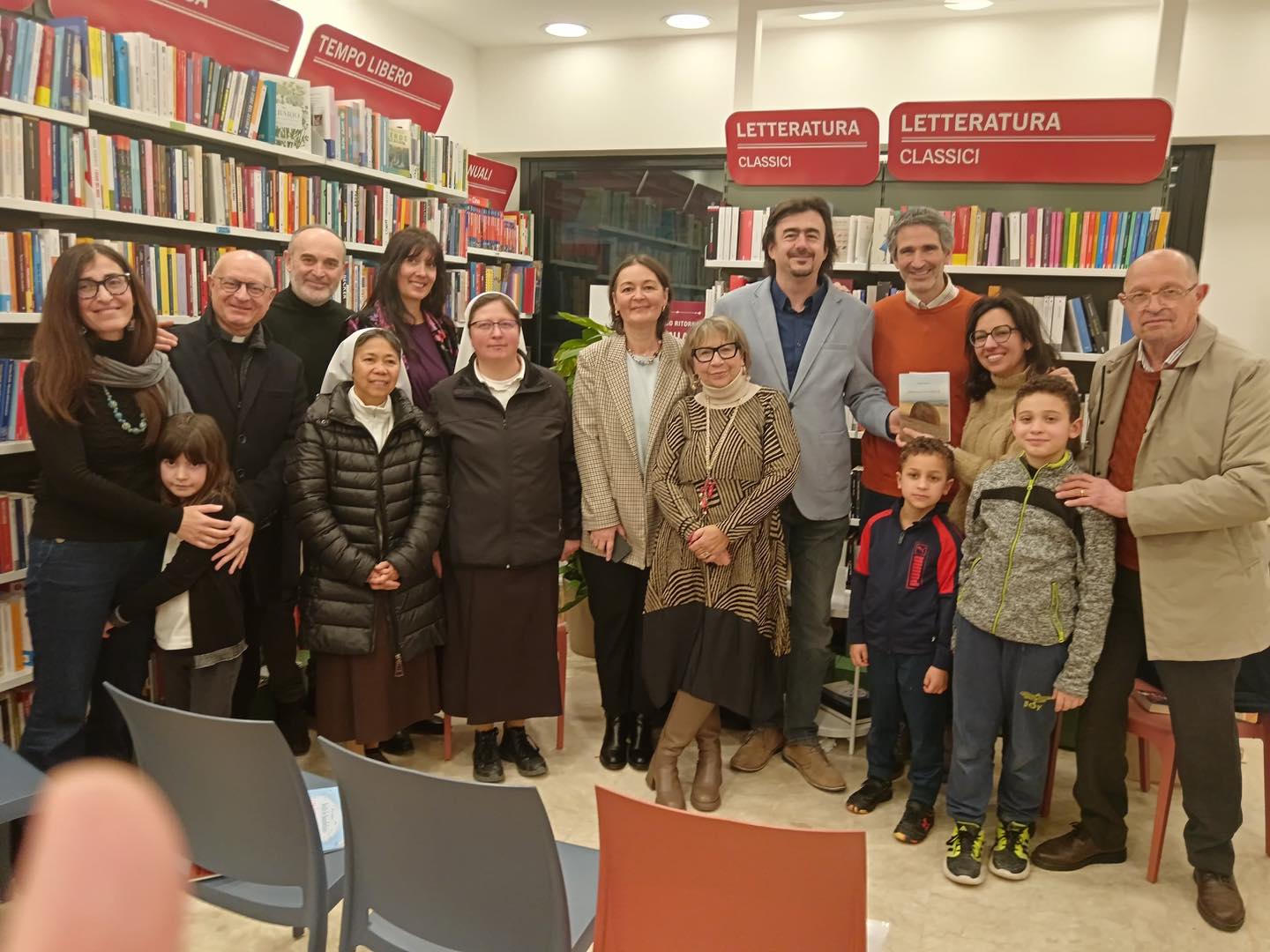
On Saturday, at Vittoria, the presentation continued in an equally intense atmosphere, marked by lively dialogue and participation. The event was opened by the intervention of Vincenzo La Monica, in a lucid and generative dialogue that brought back to the fore the roots and meaning of the project.
Alina Catrinoiu, as editor and translator of the volume, emphasized the importance of transforming a community experience into a responsible editorial act, capable of crossing cultural borders. Domenico Leggio and Sister Claudia, missionary at Marina di Acate, also spoke, giving a direct testimony of the reality described in the book. Isabella Papiro’s reading turned the written pages into a living presence, into a silent communion with the audience.
The most powerful moment, however, was Aurélie Bizouard’s artistic installation: transparent sheets, incised with phrases from the volume, were illuminated by the phones of those present, and the words were projected onto the walls. In that collective gesture, the testimonies came alive again. Each participant became, for a moment, a bearer and witness of those stories. A simple and profound act, in full coherence with the stake of the book: to make visible what risks remaining in the shadows.
A “crossing” made together
Liberi dall’invisibilità is not just a book about migration or marginality. It is an invitation to look beyond appearances, to recognize the dignity of a communityand which silently contribute to the economy and social life of the Sicilian territory. It is also a bridge between Romania and Italy, between memory and the present, between identity and belonging.
The two days in February proved that literature can become experience, and the word – light. And when art, faith and civic responsibility meet, the invisible begins to take shape.