




A short train ride from London, Gravesend makes an ideal day trip.
Fancy a day out in Gravesend? Our London ancestors certainly did. Catching the ‘steam packet’ downriver to this Kentish port was one of the most popular excursions of the first half of the 19th century. The town has changed much in the interim, but it’s still a fascinating place to visit. Below, we’ve packed in more than enough ideas to get the most from a day visit, or even a short stay.
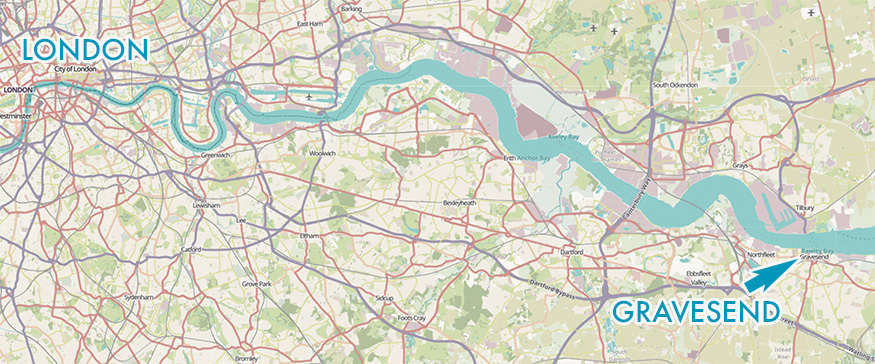
First, where is Gravesend?
It’s about seven miles east of the Greater London boundary, on the south shore of the Thames opposite Tilbury, and at the point just before the river starts to widen into an estuary. It’s served by regular trains from London, and occasional boat services (see below).
12 things to do, in and around Gravesend
Gravesend offers a mix of the very modern and the very historic. Let’s start at the place where, traditionally, most Londoners first encountered the town:
1. Town Pier
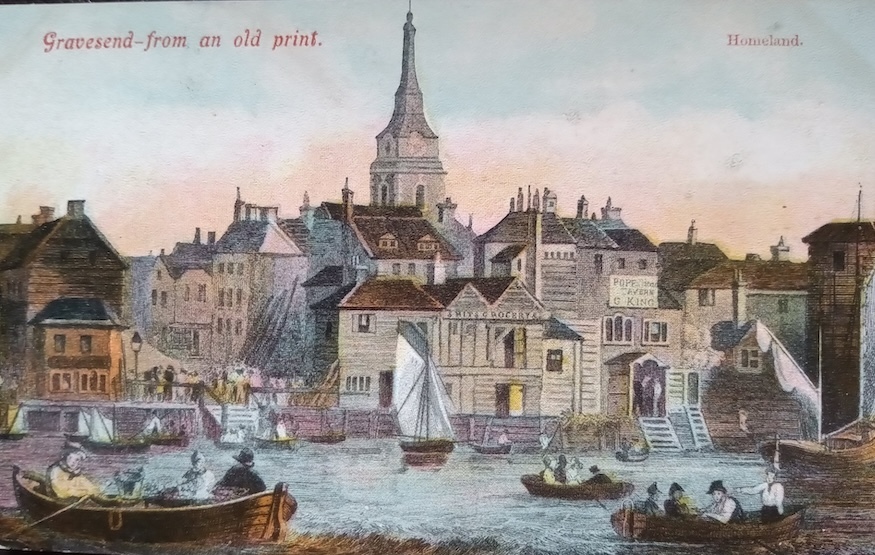
Gravesend has been an important port since antiquity, both for its ferry to Essex, but also for boats arriving from overseas and down from London. A Royal Charter was granted as early as 1401 for a ferry service between the capital and Gravesend. That route hit its peak in the first half of the 19th century, with the coming of the steam ships. Gravesend responded to demand by building the Town Pier.
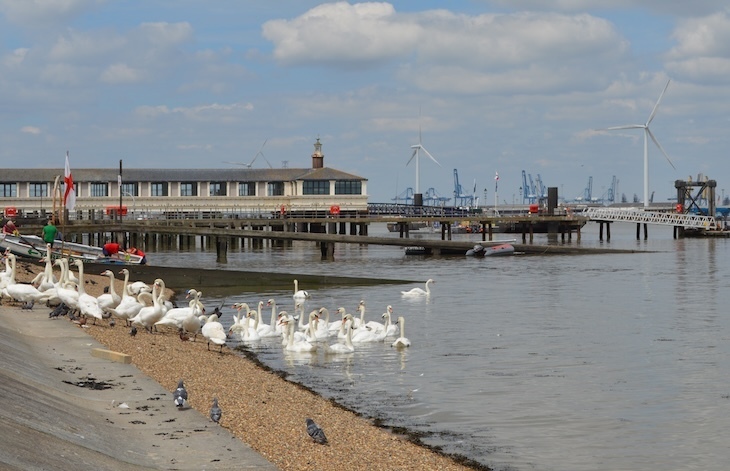
There are longer piers. There are more famous and more dainty piers. But nothing can match Gravesend’s unique antiquity. This is the world’s oldest-surviving cast iron pier, dating back to 1834, when the local press described the new infrastructure as “elegant and commodious”. It was designed by William Tierney Clark, who’d recently wowed Londoners with Hammersmith suspension bridge. A second, similar structure, known as the Royal Terrace Pier, was added to the east in 1844.
The coming of the railways reduced the pier’s importance, but it has never entirely fallen out of use. It was recently purchased by Thames Clippers, with a view to restarting regular services to and from the capital, and perhaps the ferry service across the water to Tilbury.
2. Watch the river go by
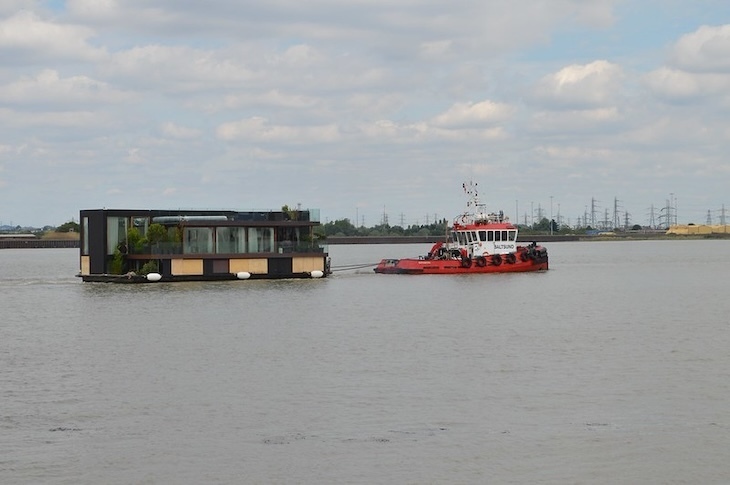
While you’re on the riverside, take a few moments to watch the boats go by. The river is nowhere near as busy as its 19th century heyday, but you can still see all manner of craft, some of which you wouldn’t find in central London.
You can also ponder one of Gravesend’s forgotten wonders. During the First World War, a pontoon bridge was strung out across the water to Tilbury, to aid troop movement and protect the Thames. This was the first bridge ever built east of central London, and it remains the furthest downriver ever constructed. Sadly, no trace remains today.
3. Visit historic defences
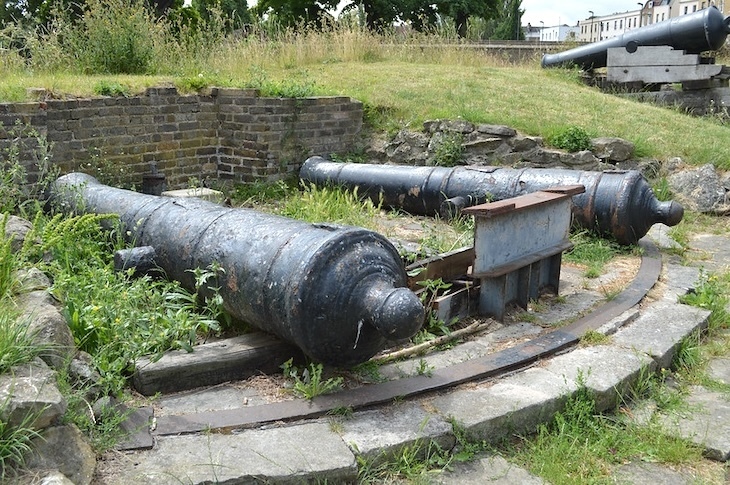
Tilbury Fort across the water (see below) might be more spectacular, but the remnants of Gravesend’s defences are also intriguing. The ‘New Tavern Fort’ was first set up here in the late 18th century to ward off Spanish or French incursions. It retained some form of military use right up to and including the Second World War. The fort today presides over a public park (Gordon Gardens, named after the General whose statue stands here), with guns and defence works of different eras scattered around.
Still older fortifications can be glimpsed back towards the Town Pier. The so-called Blockhouse was a gun emplacement dating back to Henry VIII’s reign, and standing into Victorian times. Only the foundations remain today.
An even more senior building — Gravesend’s oldest — can also be found on the western edge of New Tavern Fort. Milton Chantry, named after a former parish, recently marked its 700th birthday. The small stone building was originally used to say prayers for the dead, but it later became a house, a farm, and then an inn (after which the New Tavern Fort was eventually named). It contains a small heritage centre and is free to visit most weekends from April to September.
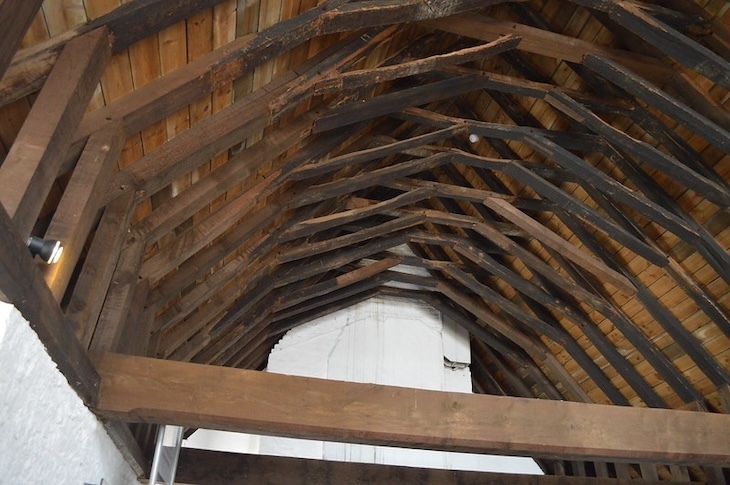
4. Or how about a nuclear bunker?
Don’t be alarmed, but there’s a nuclear bomb in Gravesend. You’ll find it beneath Woodlands Park, a short walk towards the south of the town. The park is home to a Cold War bunker, from which the emergency response would have been coordinated in the event of a nuclear attack. Built in the 1950s, the bunker has been restored to period conditions, and is now occasionally open to the public. Beside the spartan rooms, you’ll also find that bomb — a WE177 air-drop nuclear bomb to be precise, stripped of its fissile material. Gravesend, then, is among the few towns that can boast Tudor, Georgian and Cold War defences.
5. On your bike
In case you were starting to worry that Gravesend is all wartime heritage, we should probably note at this point that Gravesend has no shortage of modern diversions. One of the best is to the south of the town, where the humongous Cyclopark provides acres of cycling facilities on a bypassed and disused stretch of the old A2 (Watling Street). Here you’ll find 6km of off-road course, along with a racing track, BMX facilities and a skate park. It’s one of the biggest cycling facilities in Europe, and also includes a cafe and playground.
Sponsor message
Your new home in Gravesend, less than half an hour from St Pancras

Always dreamed of living beside the Thames, but thought it was out of reach? Take a look at Cable Wharf in Gravesend. The riverside neighbourhood features a range of new one- and two-bedroom homes, available through Shared Ownership, and all less than a 30-minute train ride away.
Cable Wharf’s homes will be available with shares from 25%, making pricing more accessible than trying to buy on the open market. You’ll have the option to staircase, buying additional shares in your home over time, all the way up to 100%. It’s the more accessible way to step onto the property ladder, with all of Gravesend’s amenities, culture and history on your doorstep.
Every apartment at Cable Wharf comes with its own balcony, allocated parking and access to a rooftop garden. The apartments themselves are thoughtfully designed, with open-plan living areas, carpeted bedrooms and integrated kitchen appliances. Most apartments at Cable Wharf have now been sold, and a final selection will shortly be released. This is your last chance to secure one for yourself. Prices will be available in Spring 2026, but prospective buyers can register their interest now.
I’d like to know more about apartments at Cable Wharf
6. Pocahontas trail

The most famous person to reside in Gravesend probably never heard of the place. Pocahontas was, as per Disney, the daughter of a Native American Chief, who got into a tangle with English colonists in 1613. Eventually, she married one of them (John Rolfe) and sailed over to England in 1616. After a few months in London, the couple set return sail for Virginia. Unfortunately, Pocahontas fell ill aboard ship (possibly from a disease like smallpox, unknown to her immune system), while still in the Thames, and subsequently died. She was laid to rest in Gravesend. Her body still lies somewhere beneath or around St George’s church, though nobody is sure quite where because the church was rebuilt after a fire in 1727.
The town commemorates its unlikely ‘princess’ in a number of ways. The most obvious is the statue beside St George’s, unveiled in 1958, but cast from a 1922 original by WA Partridge. Meanwhile, a mural from 1994 by Graham Chalcroft can be found on Clive Road opposite the station.
7. Liquid refreshments
Amid all this exploring, you might want to seek some liquid refreshments. Of Gravesend’s numerous pubs, Three Daws on the riverside has the most history and the best views. This weatherboarded landmark reckons to date back 450 years, though it’s been much altered over the years. It serves traditional food and cask ales. Meanwhile, the seeker of craft beer might head to the Iron Pier Brewery, tucked away in an industrial unit to the south-west of the town. Its popular tap room serves a number of styles brewed on site, as well as Dockyard Gin from nearby Chatham.
8. A bite to eat
Street food and casual options abound in Gravesend. For a traditional taste of the East End (albeit the extreme East End, here), try Sie’s Pie and Mash at St George’s shopping centre, which does the whole eels and liquor thing. PHAT BITE near the station serves up a mighty range of burgers, kebabs and the like at affordable prices. Meanwhile, New York3rs on the High Street does something similar with fusion twists. Asian cuisine thrives too, with Taste of Punjab and Cafe Taj delivering excellent Indian dishes, and Golmok representing Korean flavours.
For classic Italian fare, the long-established Julius Caesar is a local favourite for wood-fired pizzas, pasta and Mediterranean dishes, while the diminutive Alto Gusto and Mad in Italy 2 bring modern Italian flair to the High Street. For contemporary and refined dining, Studio 7 Restaurant earns top marks for quality and service.
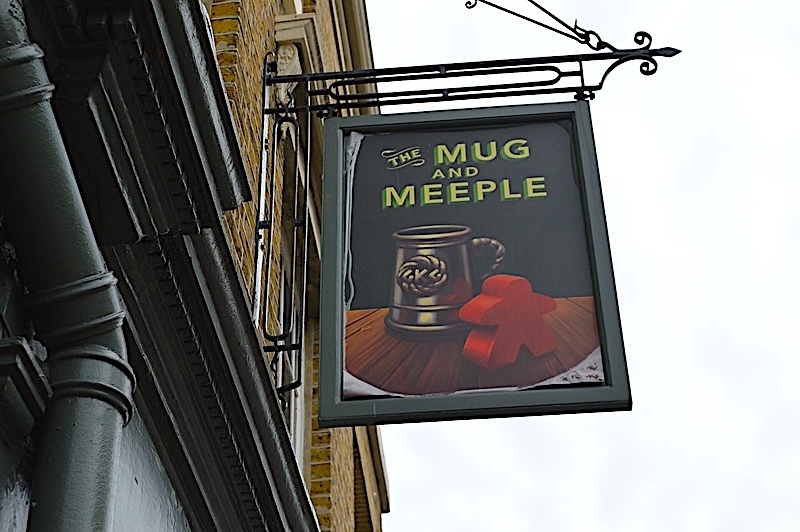
Finally, if you’re game, give the Mug & Meeple a go. This is Gravesend’s gamer cafe (a ‘meeple’ is the human-shaped playing piece, which can be seen on the sign), where you can indulge in a spot of dice casting or card swapping while you eat (though you don’t have to).
9. A multicultural town
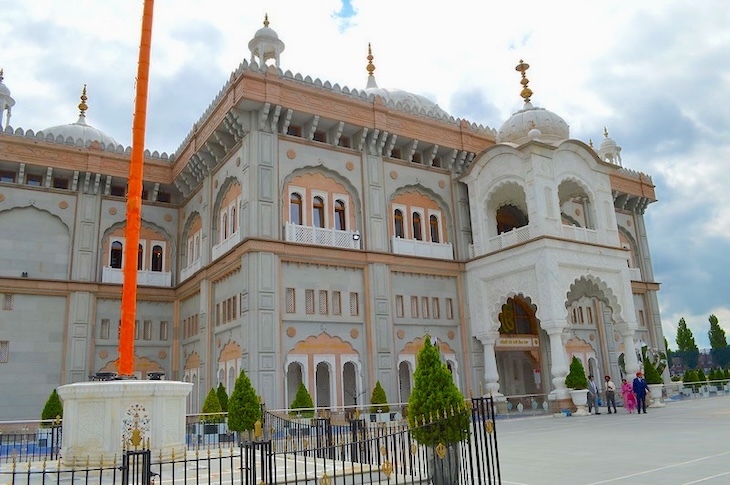
Gravesend’s diverse community isn’t just reflected in its eateries. Any visitor should climb the hill to the Guru Nanak Darbar Gurdwara. This impressive Sikh temple took 10 years to build, and is reckoned to be the largest Gurdwara in Europe. The most famous member of the Sikh community here was Squadron Leader Mahinder Singh Pujji, one of the first Sikh pilots to volunteer with the RAF during the Second World War.
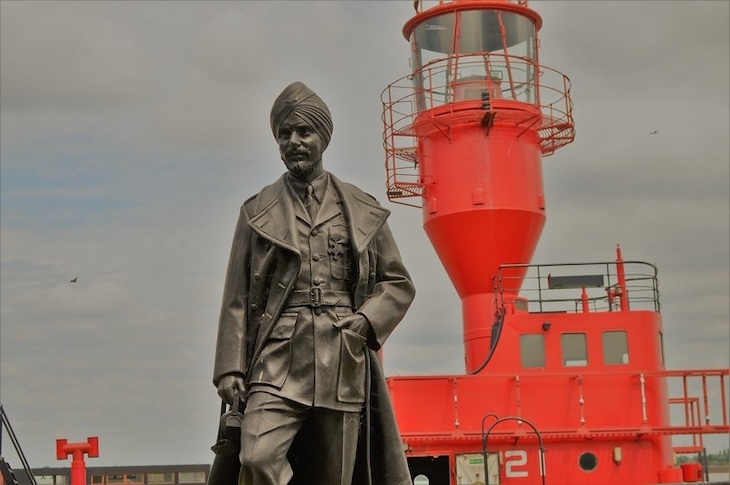
A statue of Pujji, erected in 2014, can be found in St Andrew’s Gardens. Its sculptor, Douglas Jennings, has since unveiled a statue of Queen Elizabeth II in the same gardens, to mark the 2018 occasion of Her Majesty becoming the longest-reigning British monarch.
10. Track down some oddities
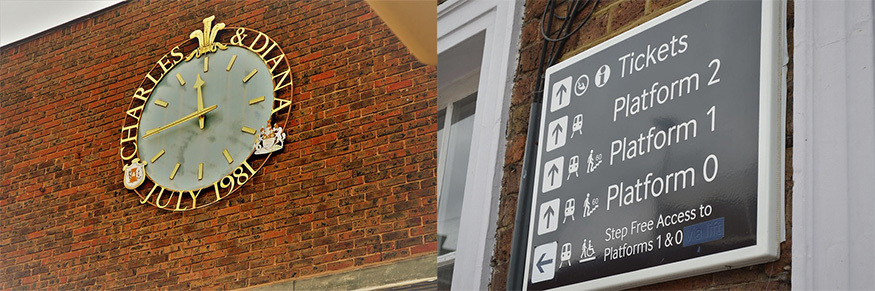
As with London, keep your eyes peeled when exploring Gravesend, as you never know what historical oddity might be round the next corner. Visitors by train might notice one immediately upon their arrival. Gravesend station is one of the very few to have a Platform Zero. Meanwhile, if you head into the main shopping centre, you might find the clock pictured above. At first glance, it looks to be nothing special, and then you notice that it commemorates the ill-fated marriage of Charles and Diana. Gravesend residents have debated whether to remove the clock, given subsequent events, but it remains a quirky survivor.
11. Walk the Saxon Shore Way
Gravesend is the starting point for the epic Saxon Shore Way. This 163-mile trail broadly sticks to the coast as it sweeps round the corner of Kent and on to Hastings. Along the way, you’ll encounter many sites connected to the Romans and Saxons who squabbled over this coastline around 1,600 years ago.
12. One for the future… Tilbury Fort
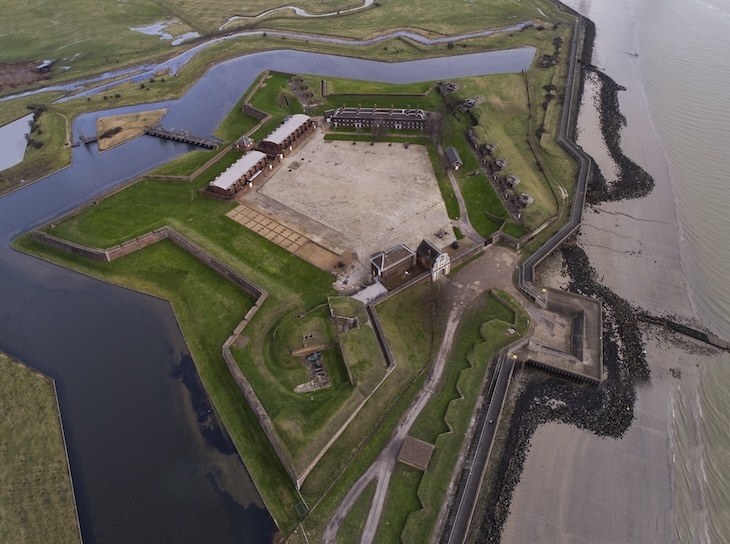
Until very recently, it was possible to hop on a ferry from Gravesend over to Tilbury on the north shore. Alas, the ferry service was discontinued in 2024 owing to financial pressures. However, the local council hopes to find a way to restart the service. One option is to seek money from the planned Lower Thames Crossing, which would run under the Thames a couple of miles east of Gravesend. If service ever does resume, then a trip over the water to see Tilbury Fort (and the charming World’s End pub beside it) is a must.
Getting to Gravesend
Gravesend is an easy train ride out of London. Trains from St Pancras take just 23 minutes, while those out of London Bridge or Blackfriars take almost an hour. Thames Clippers/Uber Boats run occasional services from London Bridge and North Greenwich to Gravesend. This may be increased in the future. Finally, Gravesend is a short drive from London. Just follow the old Roman Road (A2), or turn off at junction 2 of the M25.