





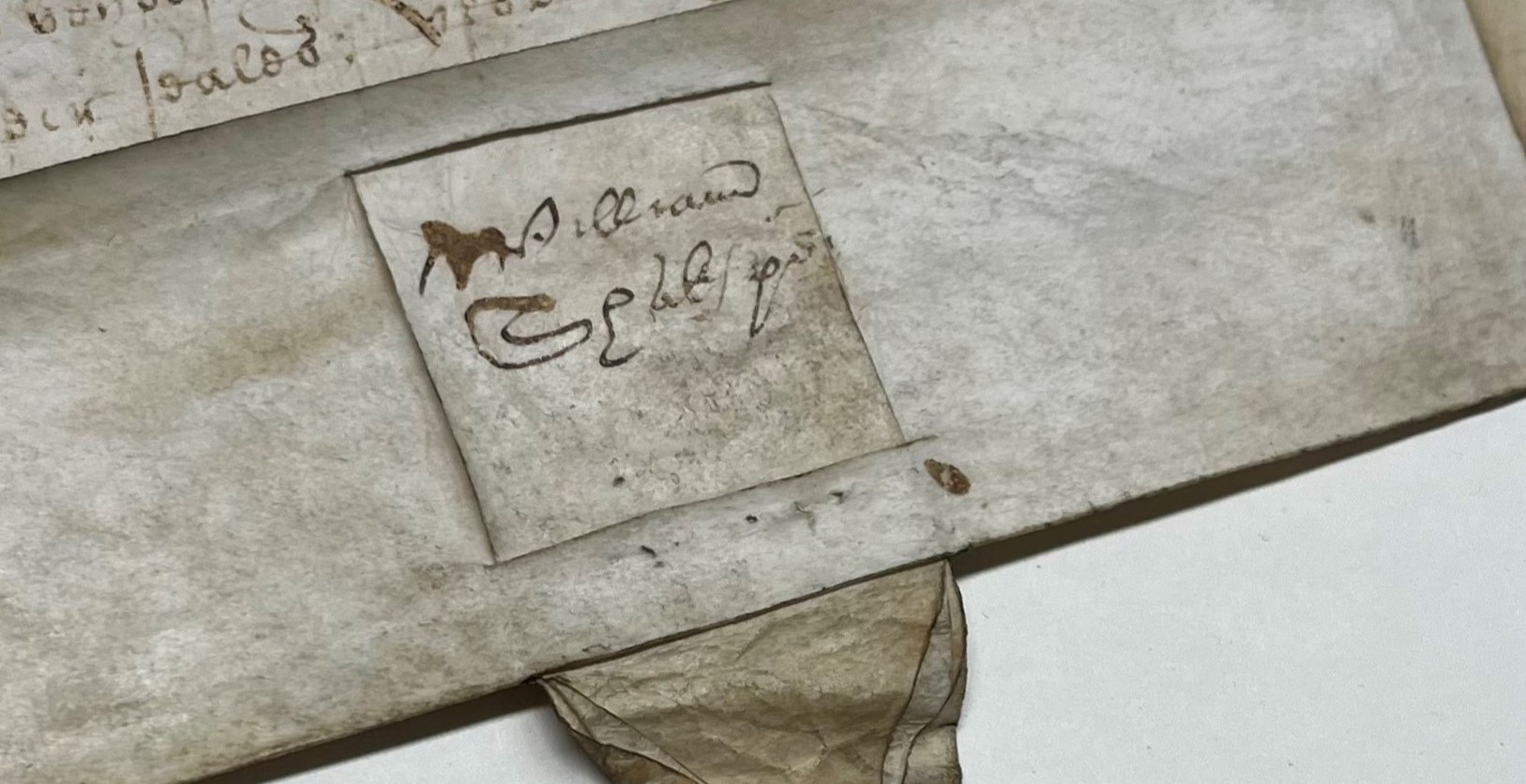
William Shakespeare’s signature and a map of sixteenth-century London, showing the streets that he would have walked along and the area where he bought property, will be displayed at The London Archives later this month.
Brought together for ‘Shakespeare in London’ at the Corporation’s archives in Clerkenwell for the first time, these two remarkable items will be on display from 30 June to 25 September. FREE admission – tickets available here.
Small, blotchy and in places, illegible, the signature – one of only six in the world known to be genuine – appears on a parchment property deed for a house in Blackfriars bought by Shakespeare in 1613, probably, as an investment, and within walking distance of the Globe and Blackfriars theatres.
Shakespeare’s signature can be seen on the bottom left of the deed, which was purchased by the City Corporation in 1843. The exact location of the house is uncertain, but is known to have abutted on the street leading to Puddle Wharf, now, St. Andrew’s Hill, and destroyed in the Great Fire of 1666.
Offering an extensive view across the Thames from Southwark towards the hills of Hampstead and Highgate, Civitas Londinum (c.1633) shows London at a date between 1561 and 1570. Gray’s Inn is clearly visible and St. Paul’s Cathedral appears without its spire, which was destroyed by a lightning strike. Beyond London Wall, animals, windmills, and trees can be seen, along with people drying their washing on the fields.
The woodcut map is believed to have been based on the Copperplate Map, which was produced in the 1550s, from which three of the estimated 15 plates survive. Only three prints of Civitas Londinum survive, including the copy at the archives.
Complementing this display will be Romantic poet, John Keats’ personal and hand-annotated facsimile published in 1808 of the First Folio, which brings together Shakespeare’s complete works and published seven years after his death.
Chairman of the Corporation’s Culture, Heritage, and Libraries Committee, Brendan Barns, said:
“If London’s history is your thing, you can’t fail to be impressed when these iconic documents, maps, books, and images are brought out of the archives’ huge storerooms and put on display – often, for several months and sometimes, for the first time ever – to be viewed and enjoyed.
“Whether you are a fan of Shakespeare’s work or just never expected to see his signature up close, or are intrigued to see London’s streets and landmarks depicted in this extraordinarily detailed map, The London Archives and this new display are definitely well worth visiting.”
The London Archives is an integral part of the Corporation’s cultural and heritage offering.
The organisation is one of the largest funders of heritage and cultural activities in the UK and invests over £130m every year. It manages a range of world-class cultural and heritage institutions, including the Barbican Centre, Tower Bridge, Guildhall School of Music & Drama, Guildhall Art Gallery and London’s Roman Amphitheatre, The London Archives, and Keats House. It also supports the London Symphony Orchestra and the London Museum.
ENDS
';