






image source, Reuters
Not one, but two ceasefires are underway in the Middle East. So should we now assume that the stage is set for two historic successes simultaneously?
Both the ceasefires in force in Iran and Lebanon are being described as ‘fragile’, as is usually the case.
But as the noise of war subsides, risks along with opportunities have started appearing.
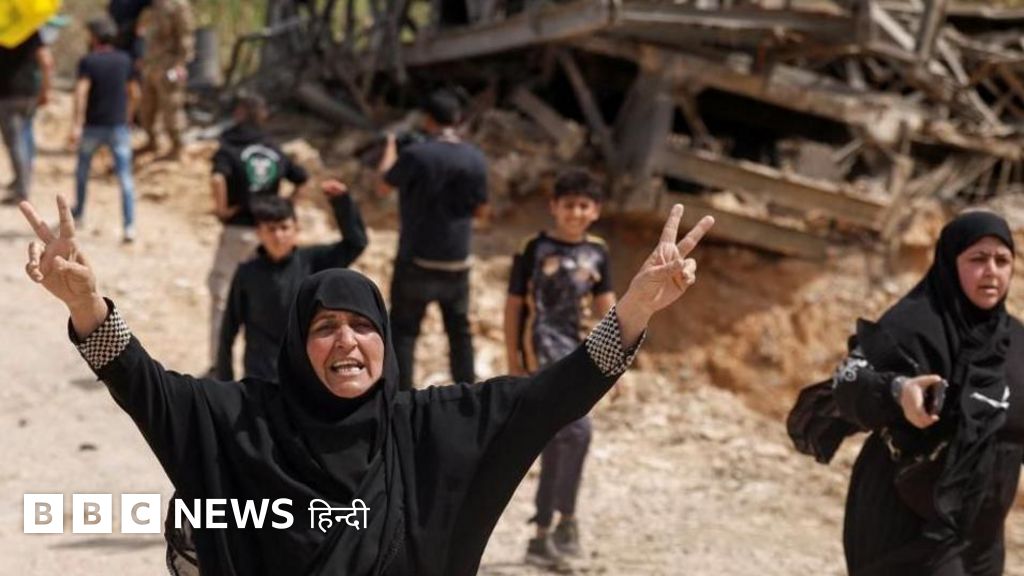
At first glance, the ten-day ceasefire announced Thursday night between Israel and Iran-backed Hezbollah appears to be a victory for Iran.
The Iranian government had demanded a ceasefire in Lebanon. He said that without this, talks with America cannot proceed.
The long talks held in Islamabad last weekend made it clear that even if the fighting in Lebanon continues, the talks will not progress.

During this period, Israel refrained from further attacks on Beirut.
But both Iran and Pakistan insisted that Lebanon should be included.
Now this has happened, due to which many Israeli people living near the northern border are angry.
He believes that Israeli Prime Minister Benjamin Netanyahu succumbed to American pressure. Whereas they should have ensured that Hezbollah did not fire rockets again.
In the eyes of some people in Israel, this ceasefire directly benefits Iran, giving its biggest enemy the opportunity to dictate the course of events.
Shirit Avitan Cohen of the right-wing newspaper Israel Hayom wrote, “This ceasefire actually puts Israel’s seal of approval on a situation that the country wanted to avoid: legitimizing relations between Iran and Lebanon’s military zone.”
“Yesterday, Hezbollah also realized that it and Lebanon’s patron are still in control of the situation and are deciding what happens in the region.”
In fact, all parties involved in these interconnected conflicts have gained something from this new agreement.
‘Major obstacle in the path of agreement’
image source, Shawn Thew/EPA/Bloomberg via Getty Images
This is an opportunity for US President Donald Trump and Iran’s leadership team to take credit for brokering the ceasefire.
Netanyahu can say that Israeli troops are still present in southern Lebanon, while the Lebanese government, after several months of efforts, has now got the opportunity for direct talks with Israel.
Hezbollah says it will abide by the ceasefire, although it also says its “finger remains on the trigger”. He is neither defeated nor is he ready to give up his weapons.
Senior Hezbollah leader Wafiq Safa told the BBC on Thursday: “There is no true ceasefire until Israeli forces withdraw. That means before the return of prisoners, before the return of displaced people and before reconstruction. And until then it is not possible to talk about Hezbollah’s weapons.”
Lina Khatib of London-based think tank Chatham House says that this ceasefire opens the way for face-to-face talks between Israel and Lebanon, but there are major obstacles in the way of a peace agreement.
“The issue is very complex, it concerns border demarcation, the disarmament of Hezbollah and Israel’s withdrawal from Lebanese territory,” she says.
Israel and Lebanon have technically been at war since 1948 and the two countries do not have diplomatic relations.
But Khatib says that rather than strengthening Iran’s grip in the region, direct talks this week between Israeli and Lebanese ambassadors in Washington have begun the process of removing Lebanon from Iran’s influence.
According to him, “the regional balance of power is shifting away from Iran; it will no longer be able to use Lebanon as a bargaining chip.”
But a lot still depends on the diplomatic process between America and Iran.
If the next round of talks takes place in Islamabad, then reducing Iran’s behavior in the Middle East will be on America’s agenda. Both America and Israel consider this behavior dangerous.
In particular, it is important for Israel to reduce Iran’s support for Hezbollah, Hamas and Yemen’s Houthis, in order to end its so-called “Axis of Resistance” that has repeatedly challenged the Jewish state for decades.
What does Iran want?
image source, AFP via Getty Images
Iran will not easily give up this important means of its regional influence. But this is just one of many big challenges ahead.
Other major challenges are Iran’s nuclear program and the future of the Strait of Hormuz, which will require lengthy negotiations.
Trump, as always, maintains that he is in control of the situation and says that the deal with Iran is “very close”. The war is going “very smoothly”.
He told reporters that Iran had already agreed to hand over about 440 kilograms of highly enriched uranium, which he called “nuclear dust.” It is being said that he was buried under the debris after the bombing in Isfahan last year.
Iran’s Foreign Ministry spokesman Ismail Baqai rejected the claim and told state TV, “No option has been offered to hand over the uranium to the US.”
“Iran’s enriched uranium is as sacred to us as our land and will not be sent anywhere else under any circumstances.”
For a nuclear deal, it will also be necessary for Iran to promise that it will never make nuclear weapons.
Besides, it will also have to be decided for how long he is ready to stop the enrichment.
Apart from this, Iran has another weapon, which has always been with it. It was also used recently. That weapon is to close the Strait of Hormuz.
Iran says it wants new rules for maritime traffic in this waterway, which would replace the current controls with a legal framework.
In this, along with Oman, its rights over the ships going to and from the Gulf should be recognized.
Meanwhile, Iran’s Foreign Minister Abbas Araghchi welcomed the ceasefire in Lebanon, saying the Strait of Hormuz will remain “fully open for the remaining period of the ceasefire”, i.e. for the next one week.
However, there is one condition. Ships will have to follow a “co-ordinated route” that has already been announced by Iran’s Ports and Maritime Organization.
This probably points to new routes that pass closer to mainland Iran, to the north of those used before the war.
What’s the point of reaching a hasty compromise?
image source, Reuters
It remains to be seen how quickly this will reduce the congestion of ships stuck in the bay.
In his own style, Trump says that this strait is “completely open and ready for complete movement.” The markets have responded positively. But ship captains can remain alert.
Trump has said that the US ban on Iranian ports will continue.
Despite these positive developments, it is clear that the negotiators still have a long way to go.
The 2015 major deal with Iran, the Joint Comprehensive Plan of Action (JCPOA), took about 20 months and covered only the nuclear issue.
Trump took America out of it in 2018, due to which this agreement broke.
Trump likes to portray himself as a leader who makes quick deals, but often ignores what those agreements achieve.
Despite his meetings with North Korean leader Kim Jong Un in 2018-19, no significant results were achieved. He is continuing his nuclear program.
But after the turmoil of the last six weeks, the diplomatic process has now started and has got a further boost after the ceasefire in Lebanon.
Will this be enough to prevent future corrosion? Even Trump doesn’t know the answer to this.
Published by Collective Newsroom for the BBC