





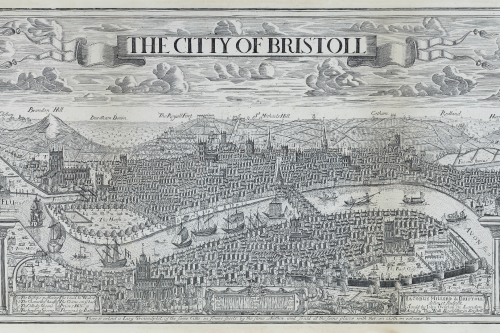
People living in Bristol’s rural areas may have been inherently safer from disease outbreaks, according to a new study by Bristol historians. The research reveals parallels between the Great Plague of 1603 and the COVID-19 pandemic.
While one of Bristol’s most significant plagues claimed about 2,500 lives, this latest study, conducted by former University of Bristol undergraduate Matthew Kilner, shows that the disease was more devastating for those in the centre of the city.
While many historians have studied plague outbreaks in particular towns and cities, few have considered how they impacted their rural surroundings. This study in one of the world’s leading demographic history journals, Local Population Studies, sheds fresh light on the patterns of epidemics, suggesting that those living beyond city perimeters benefited from their geographic ability to isolate.
Matthew conducted the study as part of his BA in History during research that he began amid the COVID-19 pandemic. Drawing on manuscript material in Bristol Archives, he explored how and why the Bubonic Plague spread to Bristol, before going on to kill a fifth of the city’s population.
According to Matthew’s research, Bristol City Council had become worried the epidemic would spread to Bristol two months after the outbreak started in London in April of 1603. As with COVID-19, quarantines were imposed on those travelling from infected cities, efforts were made to disinfect goods that might have been in contact with plague carriers, while the sick were subject to enforced household quarantine, known as ‘locking up’.
Yet by 18 July, cases were being reported in in St Stephen’s parish, in the heart of Bristol. This was just before the start of the St James’ Fair (25-31 July), which brought people to the city from across the country, exacerbating disease spread.
By September 1603 hundreds were dying in Bristol each week, in a city of just 12,000 people. Most notably, while the Plague ravaged the centre of Bristol, it barely spread beyond the city’s boundaries. The village of Clifton, just a mile away, was barely affected; Brislington, Mangotsfield and Henbury, not at all suggesting that these rural communities were able to isolate themselves, quarantining from the outside world.
The nearby communities of Pill and Shirehampton, meanwhile, were not so lucky. As part of Bristol’s ‘outer port’ near Avonmouth, their inhabitants could not cut themselves off from Bristol due to their dependence servicing Bristol’s maritime trade. Nonetheless, the outbreak in these small settlements where about one in 20 people died, was not as bad as in Bristol itself.
Bristol’s richer central parishes were ultimately able to control the outbreak better over time. By 1604 the death rate was down in the central parishes. But poorer industrial areas, such as Temple, St Thomas, and St Philip & St Jacob, across the River Avon, were still being hit hard.
“People often think of Plague as being a disease of the poor,” said Matthew, who since graduating from Bristol in 2021 has become a history teacher in Windsor. “But that’s not necessarily true. Rich areas and poor areas were hit.”
By the time of 1665’s Great Plague, Bristol had learned to take a more forceful response, including bans on public gatherings and the establishment of isolation hospitals, staffed by doctors. This helped prevent another major outbreak as shown by fellow lockdown student Alex Beard.
Dr Evan Jones, Associate Professor in Economic History from the Department of History, and Matthew’s dissertation supervisor, added: “The most enduring legacy of Plague, which devastated Britain many times between 1348 and 1665, was that it set the conditions for how we deal with outbreaks. Students often remark on how similar the reaction to COVID-19 was to the reaction to Plague, but it’s not a coincidence.
“The public health ‘toolkit’ we use today to limit epidemics was one developed to combat Plague. While much has changed: in the face of a poorly understood disease and without effective treatments, the approach is still fundamentally the same: ‘Isolation, isolation, isolation’.”
Paper:
‘The spread of the Great Plague of 1603-4 to Bristol and its rural hinterland’ by M. Kilner in Local Population Studies