






Close Menu
London ReviewsLondon Reviews
  • Home
  • What’s On News
  • Going Out
  • Reviews
  • Spotlight
  • AI News
  • Tech & Gadgets
  • Travel
  • Horoscopes
  • Web Stories
  • Forgotten eBooks

Subscribe to Updates

Get the latest creative news from FooBar about art, design and business.

What's Hot
Wider services and support available to UK Armed Forces and Veterans

Wider services and support available to UK Armed Forces and Veterans

March 31, 2026
How to integrate modern Metros into unplanned neighbourhoods & local transport

How to integrate modern Metros into unplanned neighbourhoods & local transport

March 31, 2026
Report finds ‘optimism bias’ in council projections

Report finds ‘optimism bias’ in council projections

March 31, 2026
Facebook X (Twitter) Instagram
  • Privacy
  • Terms
  • Advertise
  • Contact
Facebook X (Twitter) Instagram
London ReviewsLondon Reviews
Subscribe
  • Home
  • What’s On News
  • Going Out
  • Reviews
  • Spotlight
  • AI News
  • Tech & Gadgets
  • Travel
  • Horoscopes
  • Web Stories
  • Forgotten eBooks
London ReviewsLondon Reviews
Home » February: Global analysis of wildlife decline warns conservation action must be coordinate | News and features
Travel

February: Global analysis of wildlife decline warns conservation action must be coordinate | News and features

February 14, 20263 Mins Read
Facebook Twitter Pinterest LinkedIn Tumblr Email Telegram WhatsApp
February: Global analysis of wildlife decline warns conservation action must be coordinate | News and features
Share
Facebook Twitter LinkedIn Pinterest Email

Efforts to stop declines in vertebrate wildlife populations should aim to address multiple threats simultaneously, rather than focusing on pressures one by one, a new study led by the University of Bristol has found.

The new study provides the first global, population-level evidence quantifying how interacting threats drive biodiversity loss across animal populations. The findings have been published this week in Science Advances.

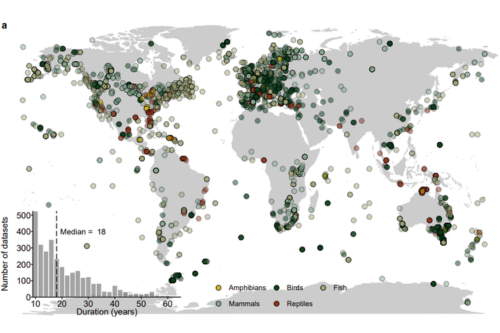
Researchers analysed population trends from 3,129 vertebrate populations worldwide between 1950 and 2020 and found that those exposed to combinations of threats such as climate change, disease, pollution and invasive species, are declining faster than those only affected by more widely recognised pressures such as habitat loss or exploitation.

“Conservation efforts have traditionally focused on the most widespread threats, such as habitat destruction or overexploitation,” said co-lead author Dr Pol Capdevila, who carried out the research while at the University of Bristol but is now based at the University of Barcelona. “Our results show that other pressures, including disease, invasive species, pollution, and climate change, can lead to even faster population declines, especially when they occur together,” he added.

While biodiversity loss has been extensively studied, much of the existing research has focused on species-level assessments or global summaries that do not capture how threats interact over time within individual populations.

The study combined data from WWF’s Living Planet Database with Bayesian statistical models to analyse population trends across time, geography, and taxonomic groups. The modelling framework allowed the team to estimate how populations might have changed if threats had been removed individually or as a group.

To explore solutions, researchers used advanced statistical models to simulate ‘what-if’ scenarios, estimating how vertebrate populations might respond if threats were reduced or removed.

Co-lead author Dr Duncan O’Brien, Senior Research Associate in Bristol’s School of Biological Sciences, added: “Our findings make it clear that conservation action must be coordinated across multiple pressures. Tackling threats one at a time will not be enough to halt ongoing biodiversity loss.”

Their analysis showed that mitigating multiple threats together is essential to achieving stable or recovering vertebrate populations, and that single-threat interventions are unlikely to reverse global decline trends. However, if only one threat can be prioritised, then reducing overexploitation, habitat loss, or climate change impacts would likely deliver the greatest global benefits.

The findings have important implications for governments, conservation organisations, and international biodiversity agreements. The research suggests that effective conservation strategies should combine actions such as habitat protection, climate mitigation, pollution reduction, and invasive species control, rather than focusing on individual threats in isolation.

Paper:

‘Halting predicted vertebrate declines requires tackling multiple drivers of biodiversity loss’ by P. Capdevila et al, in Science Advances

Share. Facebook Twitter Pinterest LinkedIn Tumblr Email

Related Posts

Report finds ‘optimism bias’ in council projections

Report finds ‘optimism bias’ in council projections

March 31, 2026
NHS Staff Earnings Estimates, January 2026

NHS Staff Earnings Estimates, January 2026

March 31, 2026
Princesses Beatrice and Eugenie will not join King Charles in Windsor this Easter

Princesses Beatrice and Eugenie will not join King Charles in Windsor this Easter

March 30, 2026
Before You Retile Your Kitchen, Consider The Alternatives

Before You Retile Your Kitchen, Consider The Alternatives

March 30, 2026
Review: Moonlight – The Philip Lynott Enigma at Eventim Apollo

Review: Moonlight – The Philip Lynott Enigma at Eventim Apollo

March 30, 2026
‘Easily influenced’ boy, 17, who raided Boots for £137K now ‘wants to be with grandad’

‘Easily influenced’ boy, 17, who raided Boots for £137K now ‘wants to be with grandad’

March 30, 2026
Editors Picks
How to integrate modern Metros into unplanned neighbourhoods & local transport

How to integrate modern Metros into unplanned neighbourhoods & local transport

March 31, 2026
Report finds ‘optimism bias’ in council projections

Report finds ‘optimism bias’ in council projections

March 31, 2026
Tackling the youth justice system’s persistent challenges

Tackling the youth justice system’s persistent challenges

March 31, 2026
David Hoffman’s Easter In Stepney

David Hoffman’s Easter In Stepney

March 31, 2026
Latest News
NHS Staff Earnings Estimates, January 2026

NHS Staff Earnings Estimates, January 2026

By News Room
Nestle update on KitKat shortage fears after 400,000 bars stolen

Nestle update on KitKat shortage fears after 400,000 bars stolen

By News Room
Ofsted to inspect early years providers more frequently

Ofsted to inspect early years providers more frequently

By News Room
London Reviews
Facebook X (Twitter) Instagram Pinterest Vimeo YouTube
  • Privacy Policy
  • Terms of use
  • Advertise
  • Contact
  • Disclosure
© 2026 London Reviews. All Rights Reserved.

Type above and press Enter to search. Press Esc to cancel.