






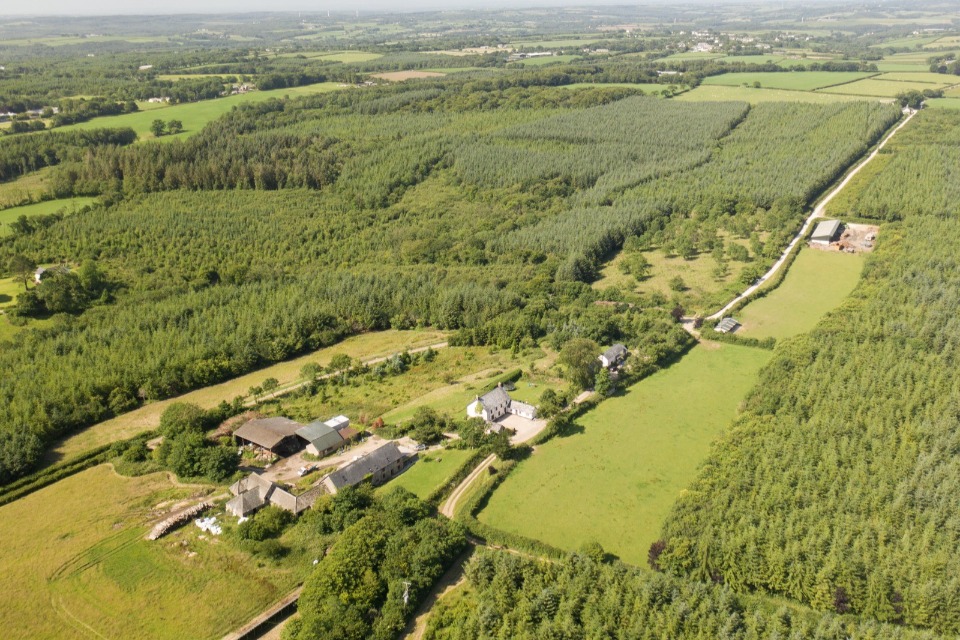
Forester Sam Whatmore reflects on his 85 hectare woodland creation project that has allowed local wildlife to thrive whilst also bringing long-term value to his business.
Grascott Farm facts
- location: Devon
- size: 212 acres
- type: conifer woodland with areas of broadleaf
- species: predominantly Douglas fir, together with Sitka spruce, field maple, ash, chestnut and oak
- date established: 1998-2000
- grants: Forestry Commission woodland grant and South West Forest grant
- main objective: grow high-quality Douglas fir to produce timber and wood fuel, combined with delivery of multi-objective and continuous cover management principles
An aerial view of woodland on Grascott Farm. Copyright Grascott Farm.
Establishing a thriving forest
Set in over 85 hectares within the North Devon UNESCO Biosphere Reserve, Grascott Farm boasts a thriving woodland that is home to barn owls, badgers and elusive otters, as well as providing a steady income through timber, biomass, and recreation. But it hasn’t always been like this – so what is the story behind Grascott Farm’s success?
Over 25 years ago, expert forester Sam Whatmore was determined to create his own forest. Having spent years managing other people’s woodlands with short-term objectives, Sam wanted to focus on a longer-term goal: maintaining continuity of forest management to see the fruits of his labour in the years to come. When the opportunity arose to purchase an initial 25 acres of woodland in 1993, Sam jumped at the chance, supplementing his holding with the addition of a larger mixed farm in 1998.
The primary objective of the forest was to grow high-quality Douglas fir to produce timber and other wood products. Following extensive woodland planning, trees were planted during the 1998-99 and 1999-00 planting seasons, as part of the then South West Forest, taking advantage of Forestry Commission grants and local incentives.
With over 150,000 trees to put in the ground, this was no mean feat. Devon has ideal growing conditions for Douglas fir with the warm and wet climate, and the landholding has sloping freely draining soils to support establishment. Slightly wetter soils around the site were more appropriate for Sitka spruce, and broadleaves were planted to complement and diversify the conifer species. Careful management was critical particularly in the first 5 years of establishment, with a lot of time dedicated to weeding, pest control, and beating up, to ensure full stocking.
Sam Whatmore, Owner, Grascott Farm said:
The most important thing for forestry is continuity of management.
Watch the video on how Sam Whatmore diversified his business to generate income from timber.
Opportunity and innovation
Establishing a woodland brings challenges, with innovative thinking required to fill the income gap between tree establishment and future returns to turn those challenges into opportunities. Holiday cottages were built in the early years on Grascott Farm to generate revenue through recreation. Deer stalking led to the creation of a successful venison business, selling high-quality burgers and sausages at shows across the county.
In 2000, the biomass renewable energy market was only just emerging, and with it the development of a whole new avenue for the forestry sector. Aiming to be ahead of the curve, Sam installed a biomass boiler in 2003 – the third in the UK – providing heat to the holiday cottages. From this point onwards, Sam was at the forefront of wood fuel development as it grew into an established market, changing the face of the UK forestry economy. Alongside delivering hundreds of seminars across the country, Sam set up his own wood fuel business in 2006.
This start-up evolved into the biggest biomass supply company in the UK, and has since merged with an international energy company that continues to flourish to this day.
Sam Whatmore, Owner, Grascott Farm said:
I absolutely love the woodland! It is my total pleasure in life and key to my wellbeing.
Top tips for timber production
- Consider stocking density if you’re looking to grow high-quality timber, a greater density will result in straighter trees.
- Woodland management is essential for creating a well-stocked forest: the more work you put in during establishment, the greater your future returns.
- Think outside the box to generate income, anything is possible.
- Remember the impact trees have on wellbeing!
Delivering value through woodlands
The principle of using woodlands to deliver long-term value to people and society is central to Sam’s management plan; generating products that people need and use. Grascott Farm now has a healthy turnover as a successful business, incorporating:
- timber and firewood: no part of the tree goes to waste, with saw logs going to the sawmill, smaller roundwood being used as firewood, and the canopy woodchip feeding the biomass boiler, which in turn is used to heat both the holiday cottages and the kiln to dry the firewood
- biomass, supported by the Renewable Heat Incentive scheme
- 4 prospering holiday lets for recreation and tourism
- innovative forest products: from wooden poles for glamping tepee construction and window displays for large retailers, to a ship’s mast and foliage for florists, to sawdust for horse bedding and pokers for the steel industry – the opportunities are endless
Alongside delivering economic benefits and valuable wood products, Grascott Farm has boosted local biodiversity, with springtime carpets of bluebells and orchids, and even a family of lively otters.
A bridleway running through the heart of the woodland provides public access for the local community to enjoy and explore, and visitors to the holiday cottages are spoilt with nature trails, lakes, and cycle paths on their doorstep.
The enterprise is also involved in delivering wider benefits such as educational activities and seminars, and working in collaboration with Forest Research through ongoing sample plots and experiments across the forest.
View the brochure for this case study: .