





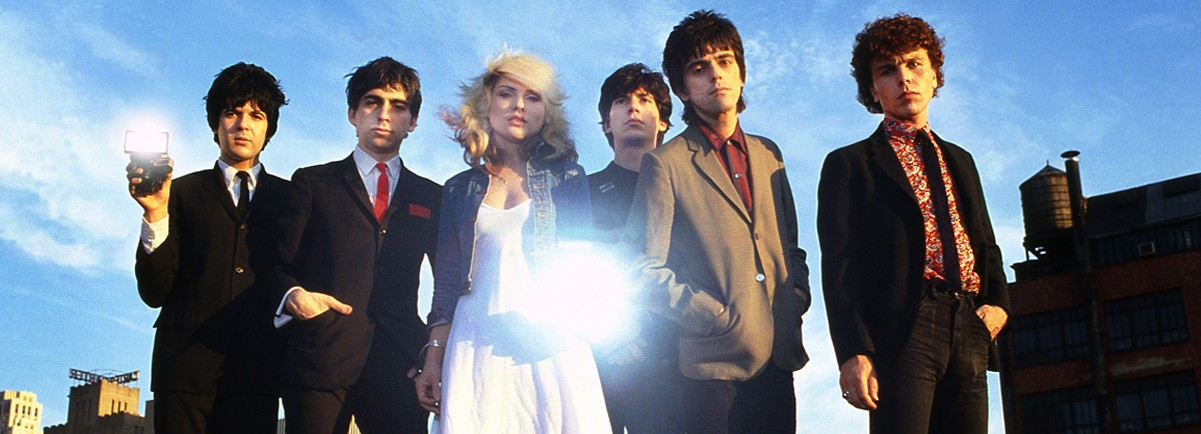
Opening on 14 August, Blondie takes centre-stage in a free photographic exhibition at the Corporation’s Barbican Music Library, which celebrates the American rock band’s ‘breakthrough year.
Photographer Martyn Goddard, who was commissioned to record the band’s return to New York in 1978, has selected 50 prints – shot during four major photo assignments in New York – at concerts, backstage, in the recording studio, and during photo sessions. His iconic images will feature in ‘Blondie in Camera 1978’, alongside poster prints, album covers, tour and concert memorabilia, period cameras, and photographic equipment.
Items from the private collection of Alan Edwards, who has handled Blondie’s PR since 1978, will also be on display. His extensive archive covers 100 years of popular music history, mostly collected following his career as PR for some of the biggest music acts of all time, including David Bowie (for nearly 40 years), Prince, The Rolling Stones, Spice Girls, Amy Winehouse, Sir Elton John, and Usher.
Fronted by Debbie Harry and initially regarded as an underground band, Blondie enjoyed huge success with their ‘Parallel Lines’ album in 1978 and scored a number one hit in the singles charts in 1979 with ‘Heart of Glass.’
Tracks such as ‘Dreaming’, ‘Call Me’, ‘The Tide is High’, and ‘Atomic’ were played on FM radio and slots on national TV shows, promoting Blondie’s headline tours in the UK, Europe, and the USA, and assuring the band’s meteoric rise to superstardom.
Blondie disbanded in 1982 and reformed in 1997, returning to touring and working on new material. ‘Maria’ reached number one in the singles charts in 1999, exactly 20 years after the band’s first UK number one single, ‘Heart of Glass’.
Blondie was inducted into the Rock and Roll Hall of Fame in 2006 and has now sold over 40 million records worldwide. A new album is expected to be released this year.
Martyn Goddard said:
“When I boarded the plane in May 1978 to photograph Blondie’s lead singer, Debbie Harry, in New York, I could not have conceived that there would still be a demand for my images over 45 years later.
“Those assignments produced a body of work that resulted in magazine cover stories, album and single covers, tour programmes, posters, a book, and two photo exhibitions.
“‘Blondie in Camera 1978’ at Barbican Music Library is my visual record of those images and memorabilia collected during a seminal time in the band’s history, and I hope that visitors to the exhibition will enjoy being reminded of the band’s energy, rawness, and style.”
The exhibition’s launch coincides with the publication of Martyn Goddard’s ‘Blondie in Camera 1978’ book, which he will be available to sign on selected dates during the five-month run.
Chairman of the Corporation’s Culture, Heritage, and Libraries Committee, Brendan Barns, said:
“Looking back with much fondness to this moment in rock music history, Martyn Goddard’s superb images of Blondie were everywhere – in newspapers, magazines, record covers, and on posters adorning teenagers’ bedroom walls around the world.
“As pioneers of the ‘New Wave’ genre, the band produced so many memorable hits, and this new exhibition will certainly bring back many vivid memories of one of the most electrifying bands of their generation.”
‘Blondie in Camera 1978’ supports Destination City, the City Corporation’s growth strategy for the Square Mile, and forms part of the ’s wider arts and cultural offer.
The City Corporation is one of the largest funders of heritage and cultural activities in the UK, investing over £130m every year. It manages a range of world-class cultural and heritage institutions, including the Barbican Centre, Tower Bridge, Guildhall School of Music & Drama, Guildhall Art Gallery and London’s Roman Amphitheatre, The London Archives, and Keats House.
The City Corporation also supports the new London Museum and is the principal funder of the London Symphony Orchestra, based at the Barbican Centre.
ENDS
';