



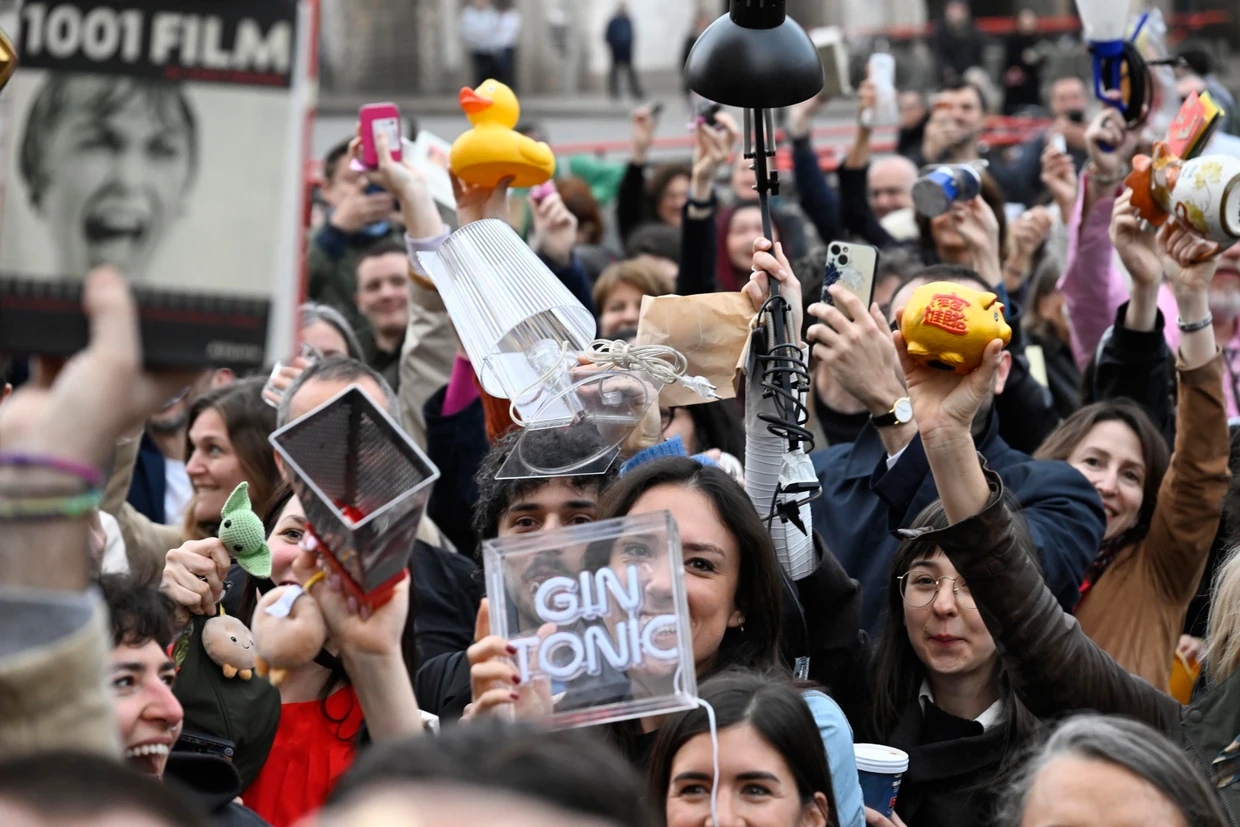




Design Week began in Milan this Monday and conceptual artist Maurizio Cattelan invited people to a fun activity: a breakfast with the exchange of design objects. The rules shared in advance on social media are simple: Bring an item that is strange, funny or original and only large enough to hold in your hands. Meeting point and time: At seven o’clock in the morning in the Piazza Duomo at the Palazzo dell’Arengario, a fascist monumental building that was supposed to serve as a stage for Mussolini’s speeches, but this no longer happened because of the war.
A good three hundred people are standing there shortly after dawn; younger and older Milanese, visitors to the design week and admirers of the artist who became famous for a banana stuck to the wall with tape that sold for several million dollars. On the piazza there is coffee from Lavazza and a brioche for everyone. Trumpeter Raffaele Kohler plays a wake-up call from the terrace of the palazzo. Milan’s cultural councilor Tommaso Sacchi says a few words and with that Design Week is officially opened. Let’s start swapping.
Almost like a Fellini film
Everyone wants to see what the other has to offer: cups, lamps, lots of homemade items and kitsch are held up; A Gameboy and also a mirror with massive wooden frames – surprisingly – change hands immediately. In addition, the Milanese brass band La Banda d’Affori, founded 170 years ago, plays lively marches and “Volare” in historical uniform. Salvo, the city’s well-known solo entertainer, also known as the “King of the Squares”, performs a dance show to music from the 80s in a rainbow-colored outfit. Within seconds, a Fellini-esque scene unfolds in front of the cathedral. It is entirely to Cattelan’s taste, who recently made a name for himself by hearing confessions from others via the telephone hotline.
Now he meanders through the crowd in a good mood with sunglasses and a dog tag, as military identification tags are also called. Everyone wants to be near him and exchange words with him. A group of students wave yellow and black flags and scarves – it says “It’s fake but we like it”. “We are ultras for Maurizio,” explains a student. The Italian establishment, especially in Milan, where Cattelan lives part of the year, also idolizes him: as an artist, court jester, figurehead. Would you be able to exchange something with him yourself?
Cattelan only has a large stamp in his hand. He happily presses it on the back of his hand and forearms as he makes his way across the pitch, and I get hit too. He leaves behind the black lettering “White Trash”. “Siete tanti!” he shouts: “There are many of you!” One of the first to feel the mark on his neck is Gianfranco Maraniello, the director of the Museo del Novecento, which is housed in the Palazzo dell’Argenario. Maraniello takes the lettering on the neck in stride; As an exchange item, he brought a cardboard cutout showing the leader of the workers’ procession from the painting “Il Quarto Stato” (The Fourth Estate) by Giuseppe Pellizza da Volpedo.

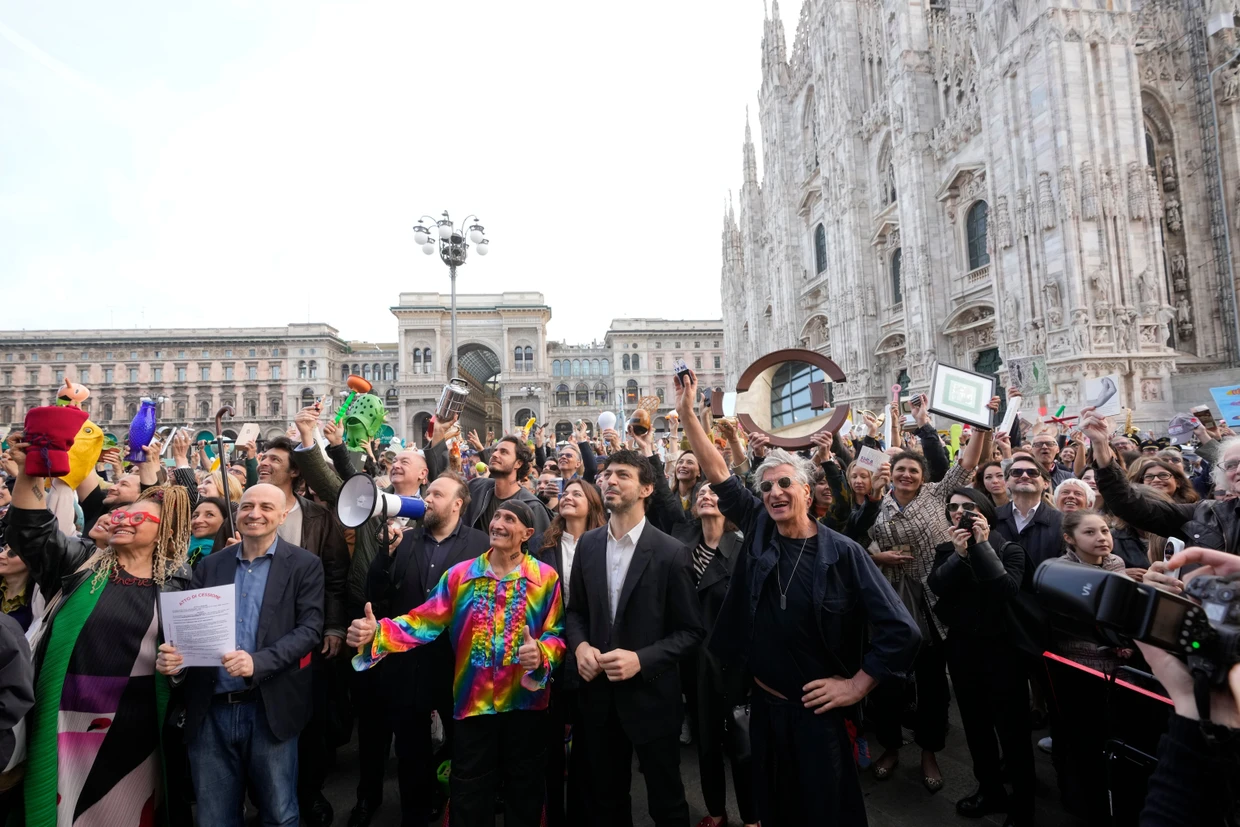
A few real designers also came: Marcantonio mounted a drawer handle on a large pebble; Stefano Seletti has a colorful drain tamper from Seletti with him. “Do you want to send a message with this?” art critic Nicolas Ballario asks him through the megaphone. “I think that’s self-explanatory,” Seletti replies. “Pace, è per la pace!” Cattelan shouts: “For peace!”
The textile artist Laura Guilda likes my rhinestone-studded candlestick, which was tolerated as a household gift for a while. In return she gives me a red and white polka dot alarm clock. The other object I brought with me, which I wear on a strap around my neck, is a cord switch type 450, designed in 1968 by Achille and Pier Giacomo Castiglioni. You usually use it to turn on lamps. I bought it in the Fondazione Castiglioni museum shop about a year ago. She makes necklaces out of the switches. Castiglioni once said that of all his objects, this switch fills him with the greatest pride because of the pleasant clicking sound it makes and because it is bought countless times in electronics stores without people knowing the name of the designer.
In the piazza, industrial and furniture designer Stefano Giovannoni, known for his colorful household goods and plastic furniture, is interested in the chain. He holds out a bouquet of paper flowers in a yoghurt cup to me: “I bought it from a street vendor in Marrakech during a holiday; he made it himself.” London-based designer Mathias Hahn is willing to trade one of his stainless steel Parker pens, which he says he loves to draw with, for the switch chain. But I already have a favorite writing instrument.
The Dutch industrial designer Marcel Wanders offered a glass fountain pen with gold ink. He exchanged it straight away, he says, and then exchanged it eighteen more times. The end result is extremely remarkable: a cast-iron, waist-high bar with a holder for a wine glass. After a good two hours, shortly before the spectacle ends, Maurizio Cattelan stands in front of me again. He sees the chain. “Castiglioni,” he says, takes off his Dog Tap and hands it to me. The dog tag says: “Do nothing”.