






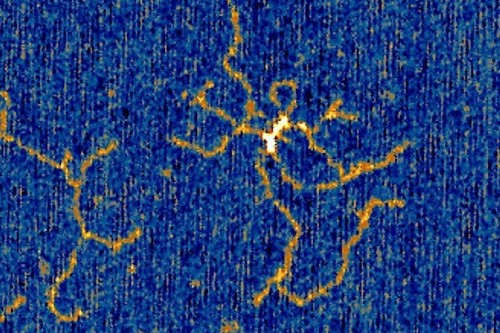
New research has discovered that the molecular machines responsible for copying our DNA have a surprising hidden talent – an ability to create entirely new and highly sophisticated DNA sequences from scratch.
The study, led by the University of Bristol and published in Nature Communicationsanalyses this curious ‘doodling’ activity, showing for the first time that it can be steered and controlled. The findings not only help shed further light on how genetic information emerges, but could also present exciting new ways of writing long DNA sequences.
Every time a cell divides, it needs to copy its DNA. This job falls to proteins called DNA polymerases – tiny biological machines that read an existing DNA strand and build a matching copy, letter by letter, essentially acting as nature’s photocopiers. It has been known, since the 1960s, that some of these machines can also build new DNA without anything to copy from, in a process scientists nicknamed ‘doodling’. Until now, the sequences produced by doodling have been poorly characterised and this study provides the most detailed assessment to date.
Co-lead author Simeon Castle, who conducted the research as part of his PhD in Engineering Biology at the University of Bristol School of Biological Sciences, said: “We used nanopore sequencing to read the full-length sequences of thousands of DNA molecules that polymerases had created entirely on their own. What we found was far more diverse and complex than anyone had appreciated – from simple two-base repeats to elaborate eight-base motifs, all varying depending on which polymerase was used and the reaction conditions.”
Current methods for writing DNA rely on slow chemical processes and struggle to produce sequences longer than a few hundred bases (a base being the single letters from which DNA is built). By contrast, doodling can generate much longer fragments in a single reaction, with some exceeding 85,000 bases.
Co-lead author Thea Irvine, a PhD student in Engineering Biology also at the University’s School of Biological Sciences, added: “One of the most exciting findings was that we could actually steer what the polymerases produced. By changing the temperature or limiting which DNA building blocks were available, we could shift the composition of the sequences generated.
“When we provided only two of the four building blocks present in DNA, the polymerase produced long stretches of highly regular repeating patterns – some over a thousand bases in length.”
The study was supported by Replay Holdings Inc., the Royal Society, the Alan Turing Institute, the Medical Research Council (MRC), the UKRI Engineering and Physical Sciences Research Council (EPSRC) and UKRI Biotechnology and Biological Sciences Research Council (BBSRC). The research united multidisciplinary experts from the University of Bristol, University of St. Andrews, and the Medical Research Council (MRC) Laboratory of Molecular Biology in the UK, and The Centre of Excellence for Engineering Biology in New York and Replay Holdings Inc. in the USA.
Senior author Thomas Gorochowski, Professor of Biological Engineering and a Royal Society University Research Fellow at the University of Bristol, added: “Doodling by DNA polymerases has been known about for decades, but has largely been treated as a curiosity. Our work shows it is a tuneable process with implications for how new genetic material is created and a real potential for biotechnology.
“Combining our findings with advances in AI-powered protein design, we believe harnessing doodling for the guided synthesis of long DNA sequences could be closer than many think.”
Paper
‘Analysis and control of untemplated DNA polymerase activity for guided synthesis of kilobase-scale DNA sequences’ by S.D. Castle et al. in Nature Communications