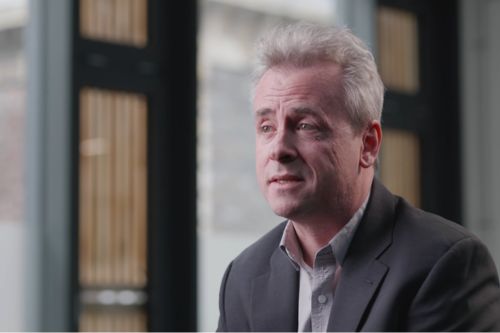






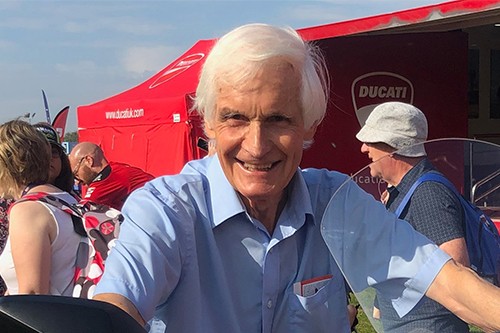
Dr Les Strong, a lecturer and senior lecturer in Insect Biology at the University of Bristol from 1966 to 1999, passed away on 15 January. His former research collaborator, Professor Richard Wall, shares his recollections.
Les Strong was born in South Moor in County Durham on 26 February 1940. He never lost his North East accent or pride in his origins.
After developing an interest in biology at secondary school, at the age of 18 he read Zoology at the University of Sheffield, graduating in 1962. Then, staying on at Sheffield, he undertook a PhD funded by the Department of Scientific and Industrial Research and supervised by Dr Kenneth C Highnam, a leading insect physiologist of the day, known for his research on the neurosecretory system and reproductive development in locusts. Les’s first paper was published after only one year of his PhD and he submitted his thesis ‘The relationships between the brain, corpora allata, and oocyte growth in the Central American locust’ in 1964.
Les then won an SRC research fellowship which kept him at Sheffield for two more years, continuing his work on the development and sexual maturation of locusts. This work was productive and one of his papers, ’Endocrinology of imaginal diapause in the female Red Locust, Nomadacris septemfascata (Serv.)’, was published in Nature (1966). This early success led to his appointment in 1966 to a lectureship in Insect Biology in the Department of Zoology at the University of Bristol. At Bristol Les continued to work on aspects of locust physiology for some years. However, like many people who have worked on Orthoptera, he was eventually obliged to abandon this line of research when repeated exposure led to increasing sensitisation and respiratory issues.
The eminent coleopterist and insect taxonomist at Bristol, Professor Howard Hinton, had been instrumental in setting up the Journal of Insect Physiology in 1957. When, in 1976, he was diagnosed with cancer, he asked Les to take over. Les then edited the Journal for 25 years, initially singlehandedly and then joined in 1993 by David Denlinger as North American co-editor. This was a massive and time-consuming role, particularly in the days when everything was done by hand, with piles of hard-copy manuscripts coming in and out of the journal office every day. Every manuscript was handled, and in many cases read and edited, personally and promptly by Les – with a level of attention to detail that has long since ceased to be the norm.
For several years, Les and I collaborated on studies of the environmental impacts of veterinary parasiticides. Les was in his element when designing and fabricating ingenious ways to extract insects from dung, and with the test cricket on the radio, we spent many happy summer days up to our elbows in manure extracting insect material by flotation. This work resulted in the first demonstration that antiparasitic treatment of cattle with antiparasitic macrocyclic lactones resulted in chemical residues excreted in the dung that were highly toxic to insect colonisers. This work helped to bring attention to this important issue in animal husbandry – one that is still being actively investigated and debated today.
Les was a perfectionist: if he committed to doing something, it was going to be done properly – and promptly. Exam marking, essays and departmental admin were cleared off his desk at lightning speed – an approach to be highly recommended. Les had a particular passion for teaching. He was primarily responsible for teaching entomology at Bristol, particularly after Howard Hinton’s death, but throughout his academic career he was often called upon to fill in on a wide range of other courses as required. He always gave beautifully structured, crystal-clear lectures. He loved teaching and the realisation that he had ignited a spark of interest in the world of insect biology was one of his greatest pleasures. He was Head of Teaching and chair of the teaching committee at Bristol for many years before he was obliged to take early retirement from the University in 1999, due to an ongoing and debilitating inner ear problem.
In his personal life and particularly in retirement, Les, as was his habit, entered into everything he did with gusto: he was a county class squash player and one colleague describes him as a ‘fiend on the squash court’, but wisely he gave this up in his 50s while he was still on top of his game, and took up golf. Another of his hobbies was making stained glass windows, and many houses in Bristol still feature one of his creations. In later years he became passionately involved in organic gardening, composting and even geology – and after some reading up he became the leading light and local organiser of the local geological society, arranging field trips and giving lectures. The watchword for everything Les did was enthusiasm.
Sadly, as a result of deteriorating health he gradually became less active and passed away on 15 January 2026. He will be greatly missed.
He is survived by his wife Ann and daughters Jill and Kerry.