





- Free exhibition celebrates first public library in England
- Library owes “debt of gratitude” to Richard Whittington
- Cookery books, ‘penny dreadfuls’, and one of the world’s finest First Folios held in collections
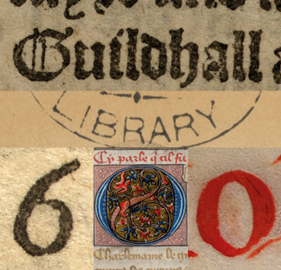
Guildhall Library, which is believed to be the first public library in England, is celebrating its 600th anniversary with a free exhibition about how it was founded, why it was forced to close, and how it reopened 300 years later.
The present-day Guildhall Library focuses on London history and houses the largest collection devoted to a single city in the world, as well as collections on early printed books, English law, Parliamentary records, clocks and clockmakers, business history, and maritime records.
‘Guildhall Library 600’, which opens today, includes displays of some of the library’s most impressive and iconic literary treasures, including:
· The Peter de Riga Bible, an 800-year-old manuscript book, which was part of the original medieval Guildhall Library collection
· The Chronicles of France – a remarkable illuminated manuscript dating from 1399, charting the history of France
· Books by celebrated English historian, John Stow, including the Survey of London (1598), which references the original Guildhall Library and its fate
The exhibition at the self-styled ‘Library of London History’ will explain how the two-storey ‘Common Library’ at Guildhall opened in 1425 with money from Richard Whittington’s will.
It was used by the College of Priests but, after the dissolution of the monasteries, the Crown seized control of the building. The English statesman, William Cecil, borrowed the remaining books – most likely, acting on behalf for the Duke of Somerset, and to furnish his official residence, Somerset House.
The books were never returned and the library was turned into storage, leaving a gap of around 300 years until a small library was opened in 1828 for elected Members of the City Corporation.
As the library grew in size and importance, it became a public library, open to everyone in 1873. In October 1974, Guildhall Library transferred to a new building in Guildhall’s West Wing, housing three sections – Printed Books, Prints and Maps, and Manuscripts.
The Corporation-owned library welcomes visitors from around the world, including academics, students, and City workers, and has forged links with community groups, local universities, and schools.
The library has the unique distinction of holding the largest collection of food and wine books of any public reference library in the UK; a collection of sensational 19th century cheap fiction, known as ‘bloods’ and ‘penny dreadfuls’, and one of the world’s finest and most complete copies of the First Folio.
Chairman of the Corporation’s Culture, Heritage, and Libraries Committee, Brendan Barns, said:
“It is always a joy to see City residents, workers, and students reading and studying in our very popular Guildhall Library.
“Many of them would be surprised and intrigued to hear about its creation and our debt of gratitude to Richard Whittington, its extensive collections, and how the library’s books went on ‘very long-term loan’ and then closed for three centuries.
“In this most important of years, the library’s team has done sterling work to curate this free exhibition, which features some remarkable and rarely seen items, and I commend it to everyone.”
Guildhall Library is an integral part of the City’s rich and vibrant arts and cultural offering, and supports Destination City, the Corporation’s growth strategy for the Square Mile.
The Corporation is one of the largest funders of heritage and cultural activities in the UK and invests over £130m every year. The organisation manages a range of world-class cultural and heritage institutions, including the Barbican Centre, Tower Bridge, Guildhall School of Music & Drama, Guildhall Art Gallery, Guildhall Library, The London Archives, and Keats House. It also supports the London Symphony Orchestra and the new London Museum, which is due to open next year.
ENDS
';