


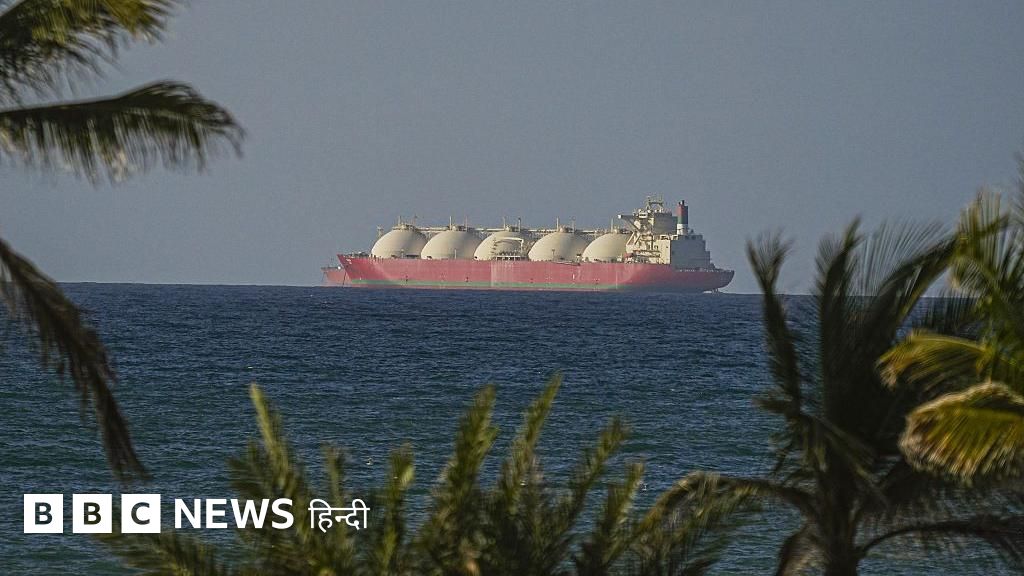





image source, Shady Alassar/Anadolu via Getty Images
Reading Time: 7 minutes
On Friday, Iranian Foreign Minister Abbas Araghchi said in a post on Twitter that the Strait of Hormuz has been fully opened to all commercial shipping for the remainder of the ceasefire period.
“Following the ceasefire in Lebanon, passage through the Strait of Hormuz is declared fully open for all commercial vessels for the remainder of the ceasefire period,” he said in a statement issued on Thursday.
America had announced earlier this week that it would begin a naval blockade of the Strait of Hormuz.
Earlier in February, Iran had effectively closed Hormuz, the world’s busiest oil shipping route, for several weeks in response to the US-Israeli attack.

A two-week ceasefire is in force between Iran and America, which is scheduled to end on April 22.
Iran had set the condition of ceasefire in the entire Middle East including Lebanon before talks with America. However, Israel and America had said that Lebanon is not included in the ceasefire agreement.
At that time, Iran and Pakistan, the mediator in the talks, had also said that Lebanon should also be included in the ceasefire.
What did the IRGC say?
image source, Telewebion/IRINN
According to BBC correspondent Goncheh Habibizad, Iranian state TV has now quoted a “senior military officer” as saying that the movement of these ships will take place only through “determined routes” and with permission from the navy of the Islamic Revolutionary Guard Corps (IRGC).
The official told state TV that the scheduled route had been decided by Iran’s Ports and Maritime Organization.
Iranian state TV quoted a senior military official as saying that the passage of military ships through Hormuz would still be “prohibited”.
what did trump say
image source, Ian Maule/Bloomberg via Getty Images Trump Turns From Iran To Economy As GOP Faces Midterm Stress
US President Donald Trump thanked Iran for opening the Strait of Hormuz in a post on Truth Social.
He wrote, “Iran has just announced that the ‘Strait of Iran’ is completely open and ready for navigation. Thank you!”
However, just a few minutes later he made another post saying that the ‘American blockade’ in Hormuz will continue.
He wrote, “The Strait of Hormuz is fully open and ready for trade and movement, but the naval blockade will continue with force and effect.”
Trump also said that the American blockade will apply only to Iran.
He said, “This will apply only to Iran until our agreement with Iran is 100 percent completed.”
He further said, “This process should be completed very quickly, because most of the points have already been negotiated.”
Earlier, Iran’s Foreign Minister Abbas Araghchi announced to keep the Strait of Hormuz “fully open” for the “remaining period of the ceasefire” with the US.
Fall in oil prices, rise in stock markets
image source, Getty Images
Crude oil prices have fallen sharply after Iran’s Foreign Minister Abbas Araghchi announced that the Strait of Hormuz will be completely open for trade for the “remaining period of the ceasefire”.
At the same time, gains have been registered in the stock markets of America and Europe.
After the announcement, the price of Brent crude fell below $90 per barrel, whereas earlier in the day it was above $98.
A significant decline was also recorded in the American standard NYMEX light sweet crude.
Before the conflict, Brent crude was trading below about $70 a barrel.
It went above $100 in the beginning of March and later in the same month it reached a level of more than $119 per barrel.
Talking about the stock market, both CAC of Paris and DAX of Frankfurt have gone up by more than two percent. The FTSE gain in London was relatively limited and it is up 0.5 percent.
In the first minutes of trading in America, Dow is up 1.3 percent and S&P is up 0.7 percent.
What are the shipping companies saying?
image source, Indranil Aditya/NurPhoto via Getty Images
oliver smith
Senior Business Producer
Shipping companies say that they will not use the Strait of Hormuz until the route is completely safe.
Commercial ships operating around the Gulf region are currently in no hurry to pass through Hormuz. Even after Iran’s announcement of completely opening Hormuz, companies do not want to take risks.
An oil and gas tanker operating company told the BBC on condition of anonymity that Iran’s statement does not make any difference at the moment.
The company said, “We do not want to take unnecessary risks. Our company policy is that we will not be among the first to pass through Hormuz.”
Stena Bulk, another company that operates oil tankers in the region, said it was monitoring the situation closely.
The company said, “The safety of our employees and ships is of utmost importance in every decision. We will not send ships from there until we are completely confident that the route is safe.”
Statement from International Maritime Organization also came
jonathan joseph
business reporter
The head of the International Maritime Organization (IMO) is trying to understand what the full meaning of Iran’s announcement regarding the reopening of Hormuz is.
The fighting has stopped for now, but the military presence of America and Iran is still considerable in this area. Tension remains, so there is still a threat to the safety of ships and their crews.
IMO Secretary General Arsenio Dominguez has attended the UK-France summit in Paris. There he is discussing options to reopen this important sea route safely.
“We are investigating the recent announcement regarding the reopening of Hormuz to see if it is in accordance with the freedom of movement of all merchant ships and the IMO Safe Passage System,” he wrote on Twitter.
Published by Collective Newsroom for the BBC.